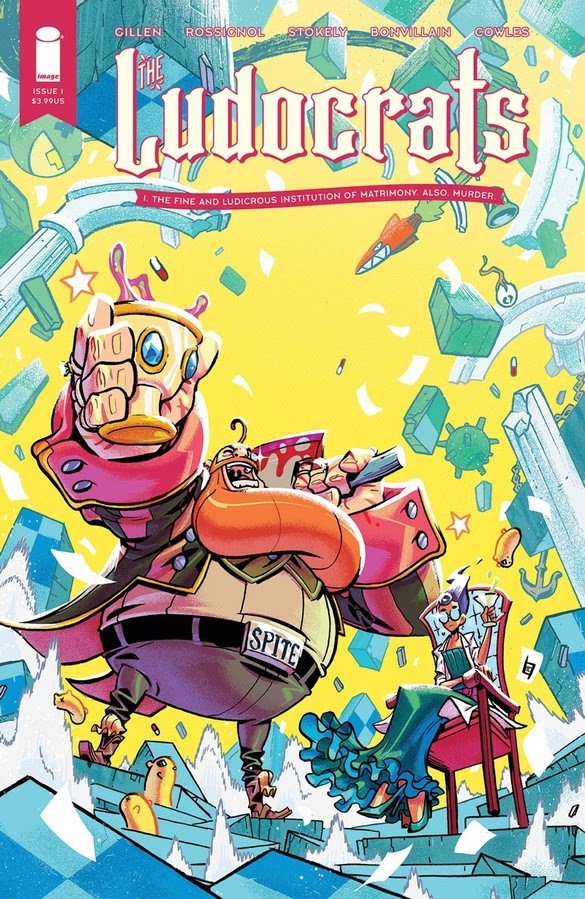
Ludocrats #1 is a wild, decadent comic. Many years in the making, it’s from writers Kieron Gillen and Jim Rossignol, artist Jeff Stokely, colorist Tamra Bonvillain, and letterer Clayton Cowles, who gives the book a definite “Euro” vibe. The story follows the misadventures of Otto and Hades. They’re a part of an aristocratic group dedicated to having a good time. It is an utter paean to the art of hedonism: the comic book equivalent of Dionysus giving Apollo a spanking.
First up, there’s a wedding between Elaina and Lord Pulderwart, a “boring” person. It’s a wondrous occasion for a first issue and turns the classic comedy structure of ending with a wedding on its head reflecting the topsy turvy world order of Ludocrats. Gillen and Rossignol indulge in their most florid and absurd prose. Especially through the character of Otto, who is introduced completely nude, covered in blood, and with his penis out. Otto is pure id and gets the best lines as he is the arbiter of all things “ludicrous”. He is the offspring of Shakespeare’s Falstaff. More so the Merry Wives of Windsor Falstaff than the Henry IV duology Falstaff. Otto is the physical representation of this comic’s themes and attitudes.
Jeff Stokely’s artwork in Ludocrats is Asterix and Obelix by way of Brandon Graham. It features all kinds of fun and hilarious background details that are expanded upon in the issue’s back-matter. Stokely and Tamra Bonvillain’s double-page spread of a wedding set the tone and almost singlehandedly build the world of Ludocrats. It’s like the Mos Eisley cantina on acid. You’re introduced to a world where knights read the newspaper, some folks have goldfish bowls for heads, and a bag of wheat gets a seat all to themselves for some reason or another.
Everything in Stokely’s artwork is exaggerated. It fits the tone of Ludocrats #1 from the aforementioned nude and bloody Otto taking up an entire full-page spread. There’s no room for deadpan (Except for the cool Dr. Hades.), everything is ham in this comic. Even though Ludocrats has the clear structure of a wedding, Kieron Gillen and Jim Rossignol are liberated to write some of the strangest dialogue I’ve seen, especially when Otto tries to flirt with one of the party guests. Who knows that a satire of heteronormativity could be so damn funny, especially when Stokely adds cartoon physics to the mix?
Although its characters behave in unrestrained manners and constantly try to outdo each other in the matters of eccentricity, Ludocrats #1 is a comic that’s fairly easy to follow. Its focus is two main characters and a variety of visual and verbal jokes. Instead of relying on boring exposition (This is actually a plot point), Gillen, Rossignol, Stokely, and Bonvillain throw you straight in the middle of the world without a life vest. This is an admirable storytelling point, and Ludocrats #1 is a true party of a comic that you should safely try to acquire when it’s released.
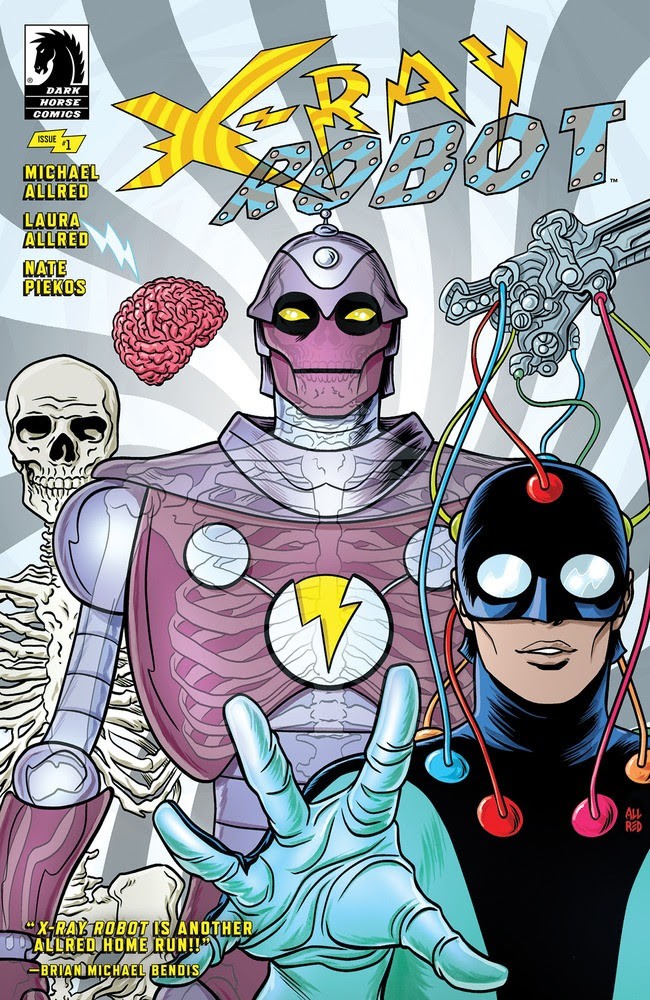
In X-Ray Robot #1, writer/artist Michael Allred and colorist Laura Allred run their usual 1960s space-age aesthetic through a body horror filter. It’s basically that bad trip of a cover of “Lucy in the Sky with Diamonds” that Flaming Lips, Miley Cyrus, and Moby did in 2014 as sequential art. The comic is a tale of a scientist named Dr. Max Wilding discovering interdimensional travel with the help of a nifty robot. However, his journey to the “other side” is not without its effects. It messes up his home and work life while kick-starting this miniseries’ ongoing plot.
X-Ray Robot #1 gets off to kind of a weird start. It looks like the CEO of Wilding’s funding company, Reynolds, makies an unwanted pass at the only female member of their scientific team. Later, she kisses Wilding on the mouth in front of his wife and kids. Honestly, the character’s motivation doesn’t make sense to me. It’s the single, real flaw in a visually stunning, engrossing, and sometimes terrifying comic.
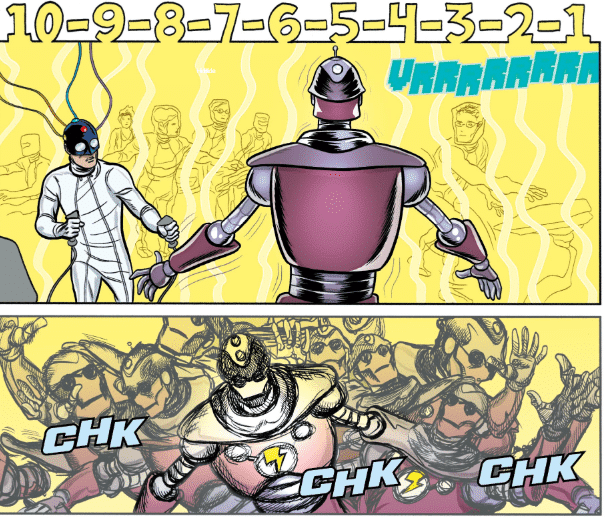
After the initial awkwardness, Mike Allred easily rights the shop by making interdimensional travel look like the process of drawing, but with a robot and a splash of yellow from Laura Allred. Instead of having unnecessary exposition, we get to experience the journey with Wilding and the growing bond between him and his robot. Each trip (Pun definitely intended.) has its own distinct style with consciousness transfer and an incredibly psychedelic double-page spread appearing as the story progresses.
However, a key strength of X-Ray Robot #1 is its juxtaposition of the normal with the otherworldly beginning with Dr. Wilding’s wife and children showing up at his launch and even the banter between scientists as he begins his journey. At first, they seem like scientists, who took design notes from Jack Kirby’s Fantastic Four, Osamu Tezuka’s Astro Boy, and yes, Mike Allred’s earlier work, who have normal lives otherwise. But, then, the unsettling nature of Wilding’s journey creeps up on him while he’s pushing his kid on the swing, in bed with his wife, and finally, hurtling down the passageways of his lab. The man, who had enough wit and grit, to ask his boss for an increase in funding is no longer tethered to reality anymore.
Mike Allred shows this by having a constant sense of movement in his line art and foregoing a boring ol’ grid for fun and new panel shapes. Laura Allred adds the icing on top with intense background colors because X-Ray Robot #1 is really pop art gone loony, or Andy Warhol spending way too much time with Luis Bunuel.
X-Ray Robot has all the pulp science fiction trappings, like intrepid scientists with cool outfits going on a wondrous journey beyond what scientists in our current time can do. Mike Allred combines these elements with the mecha genre, including a cool looking robot that has But he cuts the story together in a way that looks like an avant-garde fever dream at times. Some of the ways he does this is by reality turn on a dime, making Dr. Wilding the ultimate unreliable narrator, and transforming his and Laura Allred’s wonderfully refined artwork into raw pencils.
X-Ray Robot #1 may end up being another scientist and robot team up to save the world from a threat beyond our knowledge, but for now, Mike Allred and Laura Allred subvert these well-trodden tropes and give readers a unique experience of traveling to another dimension and bonding with another consciousness. The way they shift their art style when Dr. Wilding goes to another dimension and the cutting together of tranquil domesticity with violent unreality makes X-Ray Robot #1 a fantastic reading experience and worth pouring over for the Allreds’ dynamic storytelling alone.
Story/Art: Michael Allred Colors: Laura AllredLetters: Nate Piekos Story: 8.0 Art: 9.5 Overall: 8.7 Recommendation: Buy
Dark Horse Comics provided Graphic Policy with a FREE copy for review
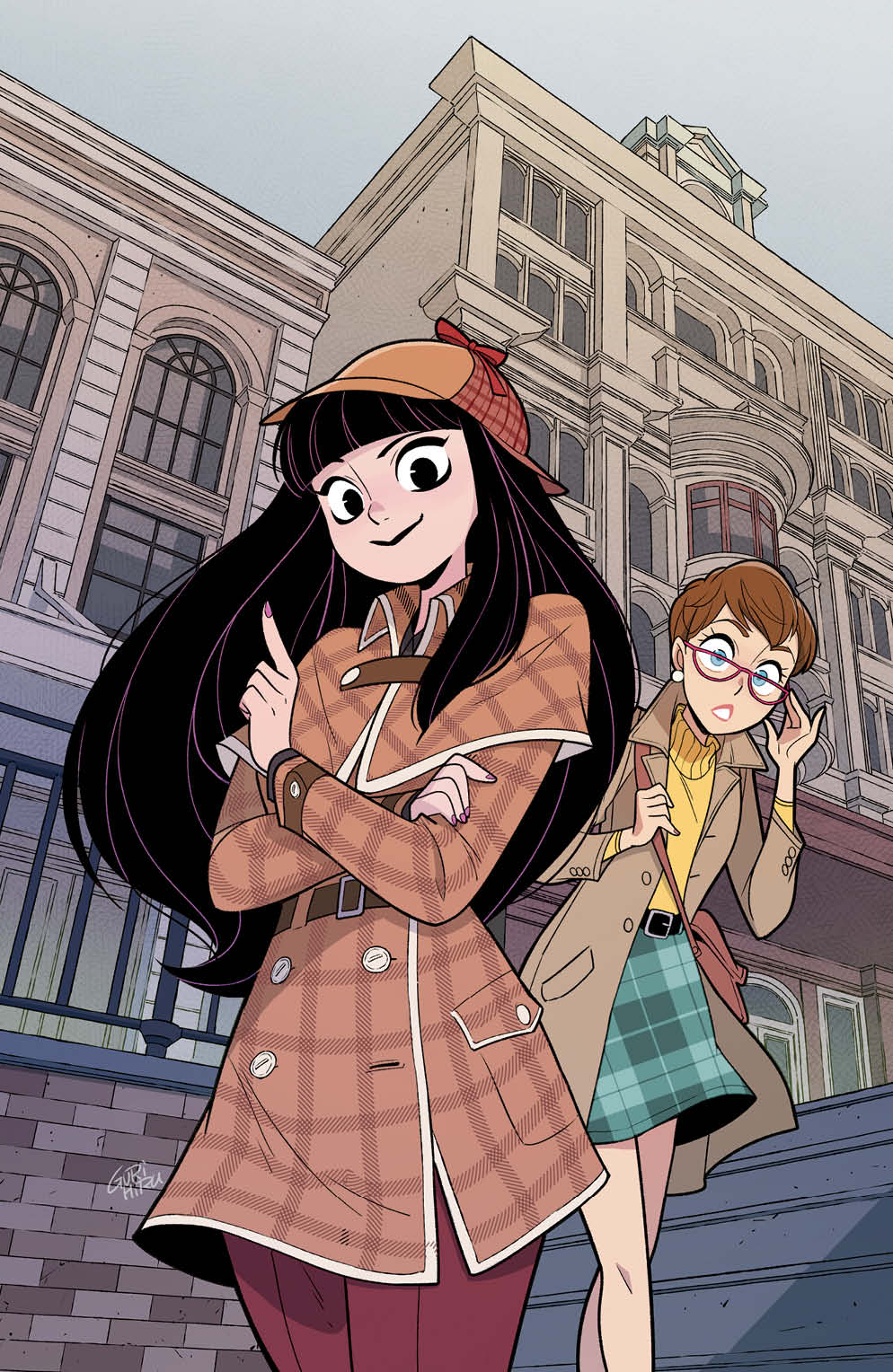
The teen detective, Lottie Grote, is an integral part of John Allison‘s shared universe, Bobbinsverse. She appeared as a main character in Bad Machinery, a few guest appearances in Giant Days, and is now starring in her own comic, Wicked Things. Wicked Things #1 reunites the Giant Days creative team of Allison, Max Sarin, and Whitney Cogar. It’s a more genre-centric story of a teen detectives award show that turns into a whodunit of its own.
However, Allison and Sarin take their time building the friendship between Lottie and Claire and showing her fandom for the famous Japanese detective, Miyamoto, and her not-so-thinly veiled disdain for her fellow detectives. Wicked Things #1 gets into the feeling of not caring, but actually caring, which is Lottie’s opinion towards teen detective awards. She doesn’t care if she’s nominated, then has a great, fun trip to the awards show in London, and isn’t present to get her award… for reasons.
Lottie is an exercise in breathtaking (and hilarious) facial expression from artist Max Sarin. She can go from moody, withdrawn teenager (Think Billie Eilish.) to wildly gesticulating across a row of panels when she think she’s been spurned by her idol, Miyamoto. Sarin and colorist Whitney Cogar make her magnetic presence sauntering from cluttered room at her mom’s house to a sunny train trip and the fancy hotel she got put up in for the teen detective awards.
Claire is a great counterbalance to her as her biggest cheerleader while also indulging in some of the hotel’s finer offerings like 18 types of birds. Her acceptance speech on behalf of the missing Lottie is a true study in sincerity. Sarin also gives her the same wide, wholesome eyes that she gave to Daisy back in Giant Days. Even though Lottie might seem burnt out on the whole detective thing, Claire is there to remind her of her passion for clues and capers. We could also use someone to believe us as much as she believes in Lottie. (The events of the last few pages of Wicked Things shed some doubt on this.)
If you like slow burn, character-driven mystery stories with quirky leads, then Wicked Things is the comic for you. The sheer absurdity of a teen detective awards show and convention makes it a showcase for comedy and fashion choices. (Claire rocks the Fleabag jumpsuit.) But, hey, there’s murder too.
Story: John Allison Art: Max Sarin Colors: Whitney Cogar Letters: Jim Campbell Story: 8.5 Art: 8.5 Overall: 8.5 Recommendation: Buy
BOOM! Studios provided Graphic Policy with a FREE copy for review
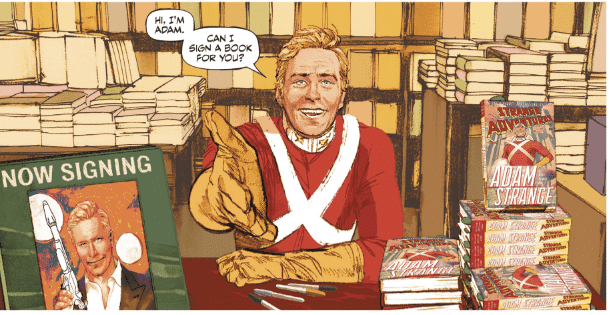
While I was reading Strange Adventures #1, or Tom King, Mitch Gerads, and Evan Shaner’s latest comic on King’s military service and his regrets and feelings about working for the CIA as well as how much he loves his wife starring a DC Comics B-list character, I had the sneaking suspicion I’d read a better version of this comic. That comic was Dare: The Controversial Memoir of Dan Dareby Grant Morrison and Rian Hughes that was serialized in the UK comics magazines Revolverand Crisisin 1990-1991 before being reprinted by both Fantagraphics‘ Monster Comics imprint and Image Comics.
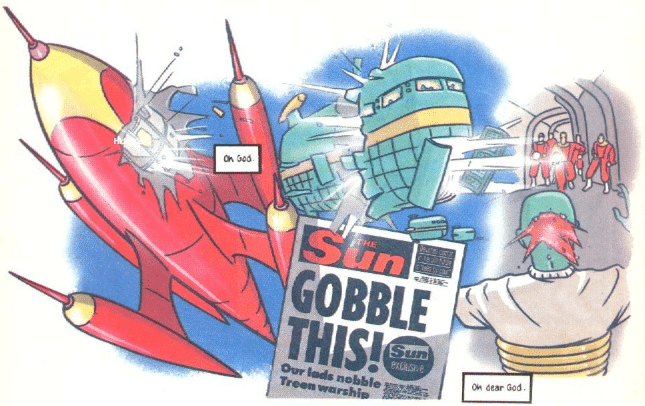
Before going into the whole anything Tom King/Scott Snyder/Geoff Johns has done, a British Invasion writer like Alan Moore or Grant Morrison has done better (And decades before.), I’ll look at the surface similarities between Strange Adventures and Dare. Created in 1958 and 1950 respectively, Adam Strange and Dan Dare have the same Space Age DNA and were influenced by previous sci-fi action heroes, Flash Gordon and Buck Rogers. In his early stories, Adam Strange was accidentally transported from an archaeology dig to the planet Rann where he protected the planet from invaders and fell in love with their princess, Alanna. Dan Dare’s stories were set in the “future” of the 1990s, and he was a pilot in the Interplanet Space Fleet, who explored other planets and protected Earth from the invasions of the villainous Treen.
Strange Adventures and Dare show both Adam Strange and Dan Dare as way past their prime with Dare having a little more satirical bite. The framing narrative of Strange Adventures is Adam Strange going on a book tour where he gets asked questions some friendly, some antagonistic about his actions in Rann, and this ramps up when one of his critics is found with a laser blast in his head. In Dare, Dan Dare is disabled, living off a military pension, and struggling writing his memoirs when Gloria Monday (A stand-in for Margaret Thatcher.) asks him to be the symbol of her re-election campaign even as he begins to find out that her government may have been responsible for the death of his old ally, Dr. Jocelyn Peabody.
Strange Adventures and Dare use the Pykkt Empire (Created for the series) and the Treen respectively as stand-in’s for the “other”. Strange Adventures seems to be using the Pykkt as a commentary on American interventionism in the Middle East (Which is where Tom King served.) with Shaner staging the Adam Strange flashbacks on a desert planet with him fighting a solider with a head and face covering. Dare uses the Treen as a general metaphor for the rebirth of British imperialism, but especially the Falklands War with Hughes’ clever parodies of the Sun‘s violent, xenophobic headlines and the connection between that war and Gloria Monday, er, Margaret Thatcher’s reelection in 1983.
I will throw up a quick disclaimer that Dare is a completed work while Strange Adventures has eleven more issues to tell its story. However, Dare is the stronger work of satire while King seems to be too close to the material he’s writing about to go from his personal experience to something more universal other than a fairly banal “Who is telling the truth?” Grant Morrison and Rian Hughes introducing Dan Dare as a pathetic figure drinking and popping painkillers in front of his fireplace looking more like Morrissey than a “boy’s own comic” hero, who can’t even write his memoirs properly. This desperation and need for money is why he basically sells his soul to the devil and lets Monday use his image for her reelection campaign in the midst of strikes and food shortages that were the reality in the U.K. when Thatcher was prime minister and have not gone away even with fancy things like interplanetary space travel.
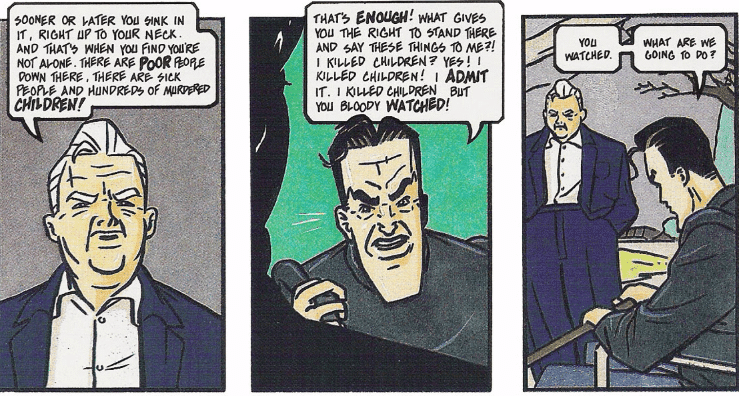
In all aspects, Dare is an excellent work of social commentary that uses the iconic British comic strip character to skewer imperialism, racism, and Tory/Conservative policies that have persisted to 2020 with the government of Boris Johnson in the U.K. and Donald Trump in the United States. Towards the end of the second issue, Morrison and Hughes have Dare’s old batman (A military officer’s personal servant aka hooray for class tension.) , Digby with which he has a strained relationship, confront him for killing Treen children in his last space battle. Instead of making Dare contrite or remorseful, he is portrayed as defensive while still having the good point that Digby watched him gun down the Treen children when they revolted after being treated by both their own leader, Mekon, and Earth as a slave labor force. Dare’s disability, his addictions, and money issues make him a sympathetic figure, but Morrison and Hughes aren’t afraid to call him out on his actions and make a character created to inspire young boys to serve God and the British Empire look weak and morally compromised.
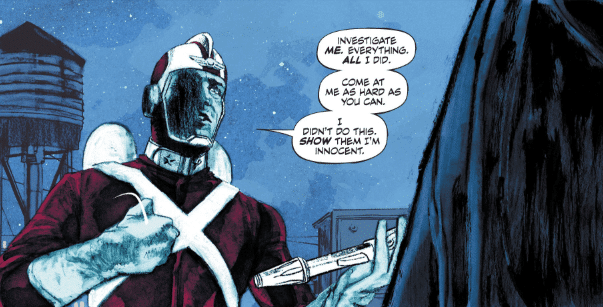
On the other hand, Strange Adventures #1 seems less concerned with broader social commentary and more about Tom King using yet another DC character to deal with how he personally feels about being in the CIA, albeit, with better visuals and less line-wide impact than Heroes in Crisis. The dialogue that Strange uses is telling as he implores Batman to “show them I’m innocent” in a dark-draped panel drawn by Mitch Gerads. Unlike Dare, which casts a skeptical eye on British pop iconography, and by extension, politics and foreign policy, Strange Adventures is about vindication.
Adam Strange has to be the exposition spouting hero drawn in a clean pulp style by Evan Shaner, and this tension between him and Mr. Terrific’s investigation looks like the driving force behind the series. He has to be the hero and have the big redeeming moment while Dare is impotent, can barely walk, and his imagery is used to uphold a government that is okay with turning “undesirable” humans into food called Manna in cahoots with the Treen leader, Mekon, that Dare fought so many years ago. For now, King seems content with self-involvement via superheroes instead of looking at larger systems of control like Grant Morrison and Rian Hughes did in Dare.
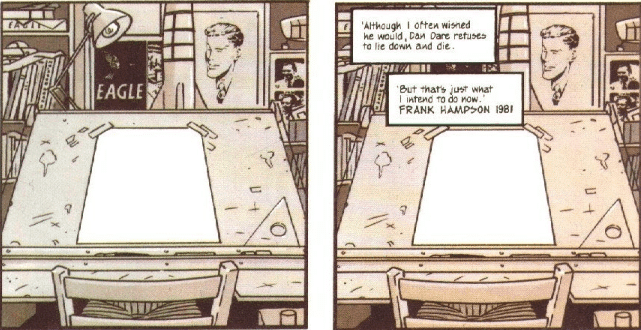
Dare ends with a bomb that Dare set in his old spaceship, Anastasia, going off and wiping out London, including Mekon, who was there celebrating Gloria Monday’s election as well as the protagonist himself before cutting to a blank drawing board in almost a similar manner to the way the ending of Animal Man showed Grant Morrison meeting his creation. It’s a stark, six panel reminder that Dan Dare’s creator, Frank Hampson, signed away the rights to his creation just like Jerry Siegel and Joe Shuster did with Superman under predatory, work for hire contract.
Dare may have been a cheerful, heroic figure, but his creator, Hampson, did not reap a financial reward commensurate with his fame. Morrison and Hughes are using an iconic British character to basically flip off the comics establishment a couple years before the founding of Image Comics in a kind of metafiction and create a revolutionary story. It is highly unlikely that King, Gerads, and Shaner will do that to DC Comics/Warner Bros/A T and T, and at its best, Strange Adventures will be an attempt at pastiche and a dark deconstruction of a Silver Age space hero.
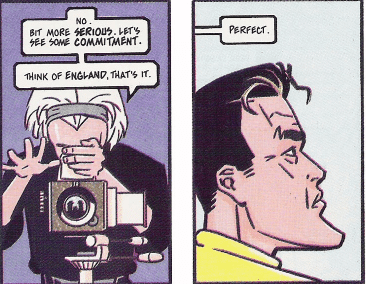
And the fact that Grant Morrison and Rian Hughes use an iconic figure in British pop culture instead of a character that rarely has his own title to tell their story of heroism being used to serve the predatory establishment instead of fighting for truth, justice, and all that stuff makes Dare a stronger story than Strange Adventures. This is despite the comic not being as well-known as Grant Morrison’s other work during that time period, including Zenith, Arkham Asylum, Animal Man, and Doom Patrol. And along with being a compelling work of satire, Dare has some wonderful flourishes like Rian Hughes’ brutalist approach to future architecture and world-building with a character remarking that Art Deco didn’t leave much room for places to live and shop and a cheeky sense of deadpan humor. (See any photoshoot scene featuring Dan Dare.)
If you’re looking for a story where so-called paragons of heroism are powerless to shake the bonds of systems of control, then Grant Morrison and Rian Hughes’ Dare is a comic worth reading. Instead of gazing at its own navel (Albeit in a visually interesting way by Mitch Gerads and Evan Shaner) like Strange Adventures, Dare offers up a portrait of a society crumbling due to conservative social policies and choosing power over decency through the lens of a spaceman’s salad days.
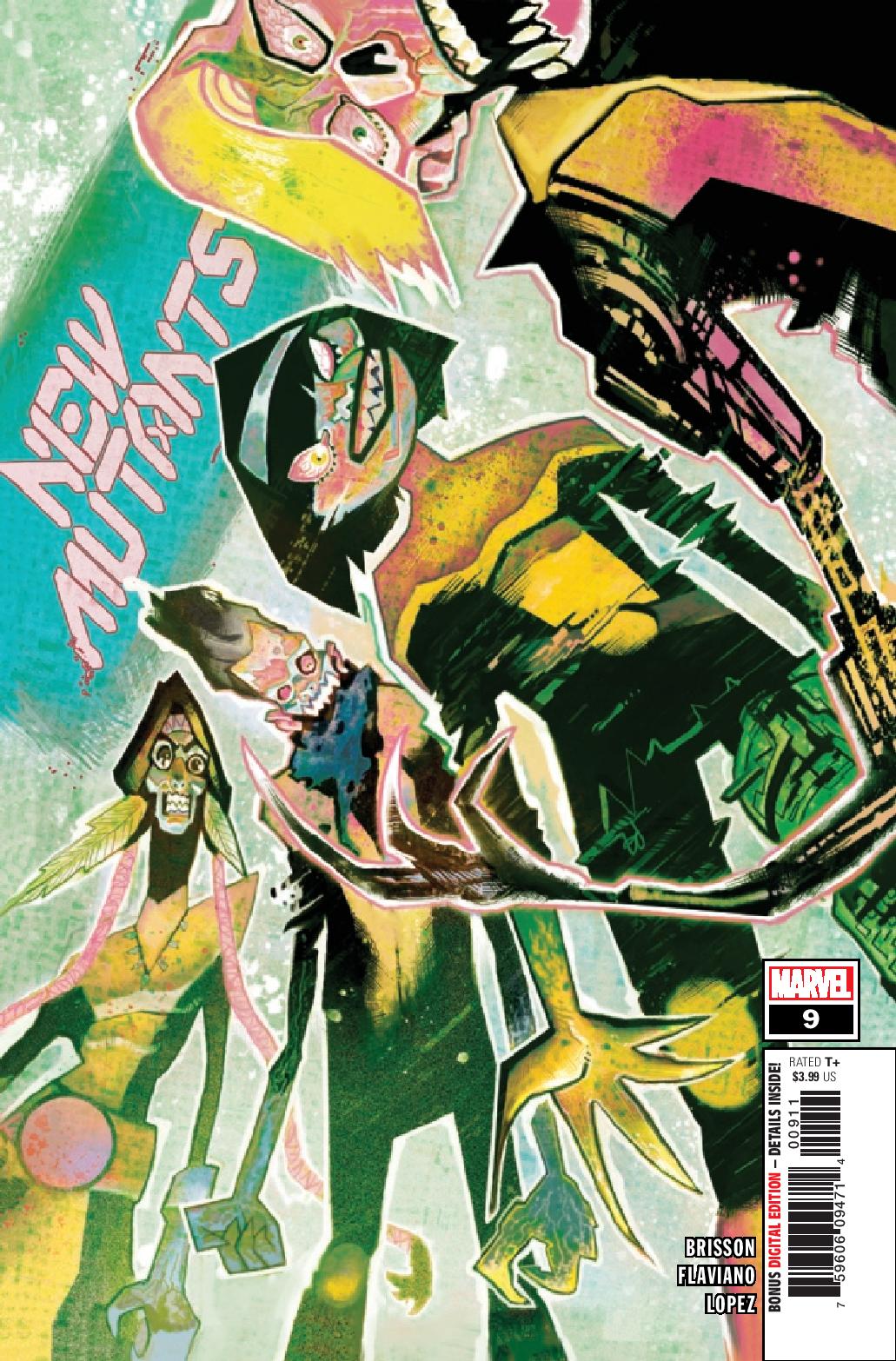
With all the space stuff going on over in X-Men #8, Ed Brisson, Flaviano, and Carlos Lopez reunite the team in New Mutants #9 and send them on a more traditional mission that ends up evoking Bill Sienkiewicz’s work on the title back in the 1980s. Even with a larger cast of characters, Brisson and Flaviano handle the team nicely and give each of the New Mutants’ team members at least a couple of spotlight panels from Magik defending the team’s actions in Nebraska to basically her boss Cyclops to Mondo using his “unusual” powers to help Cypher interface with Krakoa and track a mutant named Tashi, who has some kind of reality warping/alternate universe creating abilities.
New Mutants #9 definitely seems to be an intriguing marriage of two key New Mutants storylines by Chris Claremont and Bill Sienkiewicz, namely, the “Demon Bear Saga” and “Legion”, which form the basis for the upcoming New Mutants film and the now-concluded Legion television show. Basically, Brisson and Flaviano combine the horror elements of the former with the reality warping of the latter for an interesting antagonist that happens to be a teenage girl that lives in the fictional country of Carnelia where mutants are despised and diplomatic relations with Krakoa aren’t a thing. Think Chechnya and LGBTQ rights although Brisson doesn’t delve into the politics beyond the Carnelians not caring if the New Mutants walk into a literal nightmare and giving them no backup or support.
Speaking of Carnelia, the tense interactions between the Carnelian military and the New Mutants is spiced up by Boom Boom knowing broken record thanks to her days as a thief. Coming off the Nebraska arc, Brisson seems to still be enjoying writing Boom Boom and her impetuous attitude as she drags the space-lagged New Mutants into yet another mission. The all action, sometimes drinking definitely betrays a void inside that hopefully he and Flaviano will explore in the future.
Flaviano jumping back on New Mutants gives the comic a real visual pizzazz, especially any time Tashi shows up. The first three pages are quite chilling with minimal dialogue/captions from Brisson and full page splash of how she has changed the landscape with an otherworldly palette from Carlos Lopez. Then, there’s a data and title page, and we’re back to Krakoa with a sunny color palette and more open compositions.
However, Flaviano doesn’t skimp on these important connective scenes choosing poses and facial expressions that are unique the characters like Boom Boom standing with her arms crossed away from the rest of the team to show her independence, and Chamber being frozen and unable to talk to his crush. Also, the aforementioned conversation between Cyclops and Magik is a study in power poses with some interesting backgrounds too that let the theme of precarious utopias and moral ambiguity sink without exposition-heavy dialogue. Cyclops is a supervisor talking to an unruly, yet talented employee; he shouldn’t have to explain everything to the readers.
As well as the tension within the team and the whole potentially causing yet another diplomatic incident after Nebraska, New Mutants #9 has cool and tense action scenes that make creative use of its characters’ powers. Karma and her mental possession abilities were created for sequences like these, and Flaviano and Carlos Lopez go full gonzo when she basically mind-melds with Tashi and is sucked into an alternative universe. And, of course, the sheer firepower of Magma and Chamber don’t work on a mutant with such complex abilities.
Brisson and Flaviano wrap up the story with some special guest stars, and I’m excited to see what these characters from later New Mutants era add to the storyline, especially they’re very much not in the hero camp. Their appearance (And check-in’s with members of Morlocks in Marauders and Cable) shows that Dawn of X is settling in comfortably and starting to show what other groups of mutants think about Krakoa and the roles they play in the new society.
Ed Brisson, Flaviano, and Carlos Lopez spin a typical team rescues a mutant whose powers are out of control from a society that hate and fears her story in New Mutants #9. But Flaviano and Lopez’s art is so breathtaking, and Brisson creates almost effortless chemistry/dysfunction between his large ensemble cast that I didn’t even notice that this is an X-story that has been told dozens of times before. Also, the ending creates even more opportunities for moral complexity and conflict between different mutant factions even though Krakoa is a “paradise”.
Story: Ed Brisson Art: Flaviano Colors: Carlos Lopez Letters: Travis Lanham Story: 8.0 Art: 8.7 Overall: 8.4 Recommendation: Buy
Marvel Comics provided Graphic Policy with a FREE copy for review
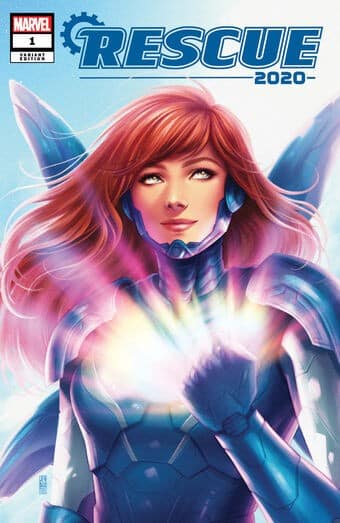
2020 Rescue#1is a rare species of a comic: an event tie-in that is emotionally poignant, entertaining, and you don’t have to be following said event to understand what’s going on. I haven’t read of the “Iron Man 2020” stuff, but I might now. Writer Dana Schwartz, artists Jacen Burrows and Scott Hanna, and colorist Pete Pantazis spin the ballad of Pepper Potts as she reflects on always being the “Girl Friday” in Tony Stark’s life while also finding a way to clone him using his mother, Amanda Armstrong’s (From International Iron Man), DNA so he can help quell the A.I. uprising. So, the plot’s a little wacko, but Schwartz and Burrows make it work thanks to a story that focuses on Pepper’s feelings and has a good dose of the pew, pew armored suit action.
Jacen Burrows is an artist, who has previously worked with comics legends Alan Moore and Warren Ellis on books for Avatar Press, and his more unrestrained approach to comics comes out in a scene where the instruments in Amanda’s music studio have gone wonky and are sorting out how to make pop music. It’s a nice bit of comedy in the midst of all the gloom, and he and Dana Schwartz make the joke pay off in a big way during the mandatory fight scene. But what Burrows is really gifted at is staging conversations between people in an interesting way, and the panel where Pepper looks away and talks about missing her deceased husband, Happy Hogan, really hits hard. He and Schwartz use beat panels really well for emphasis like when Amanda takes a breath to explain her complex relationship to Tony Stark.
Also, as advertised, 2020 Rescue #1 features more visceral thrills of Pepper Potts blasting away HYDRA drones and getting to be badass and superhero in her own right instead of making reservations for Tony Stark and getting talked over. Burrows really amps up the fight scenes with tilting panels disrupting the usual smooth grids and jagged edges bleeding into the gutter. Pete Pantazis’ color palette also intensifies even though it doesn’t really add much to the story. I do like his use of green in the music studio scenes to give everything an eerie, not-quite-right feel, and with the London setting, give the whole sequence an almost Doctor Who special, but trade out sonic screwdrivers for battle suits.
2020 Rescue #1 is a fantastic demonstration of the kind of story potential that can happen in superhero comics when female characters aren’t fridged or sidelined and have agency and complex emotions. As he seems to be the center of this “Iron Man 2020” event, Tony Stark is mentioned quite a bit and is integral to the plot, but Dana Schwartz and Jacen Burrows give about 90% of the spotlight to Pepper Potts and Amanda Armstrong. 2020 Rescue explores mortality (Amanda musing on how her music hasn’t been on the radio.), relationships with problematic men, and has time to kick ass too. It’s worth picking up if you’re any kind of Pepper Potts fan or enjoyed International Iron Man even if you aren’t following Iron Man 2020 as a whole.
Story: Dana Schwartz Art: Jacen Burrows with Scott Hanna Colors: Pete Pantazis Letters: Joe Caramagna Story: 8.8 Art: 8.6 Overall: 8.7 Recommendation: Buy
Marvel Comics provided Graphic Policy with a FREE copy for review
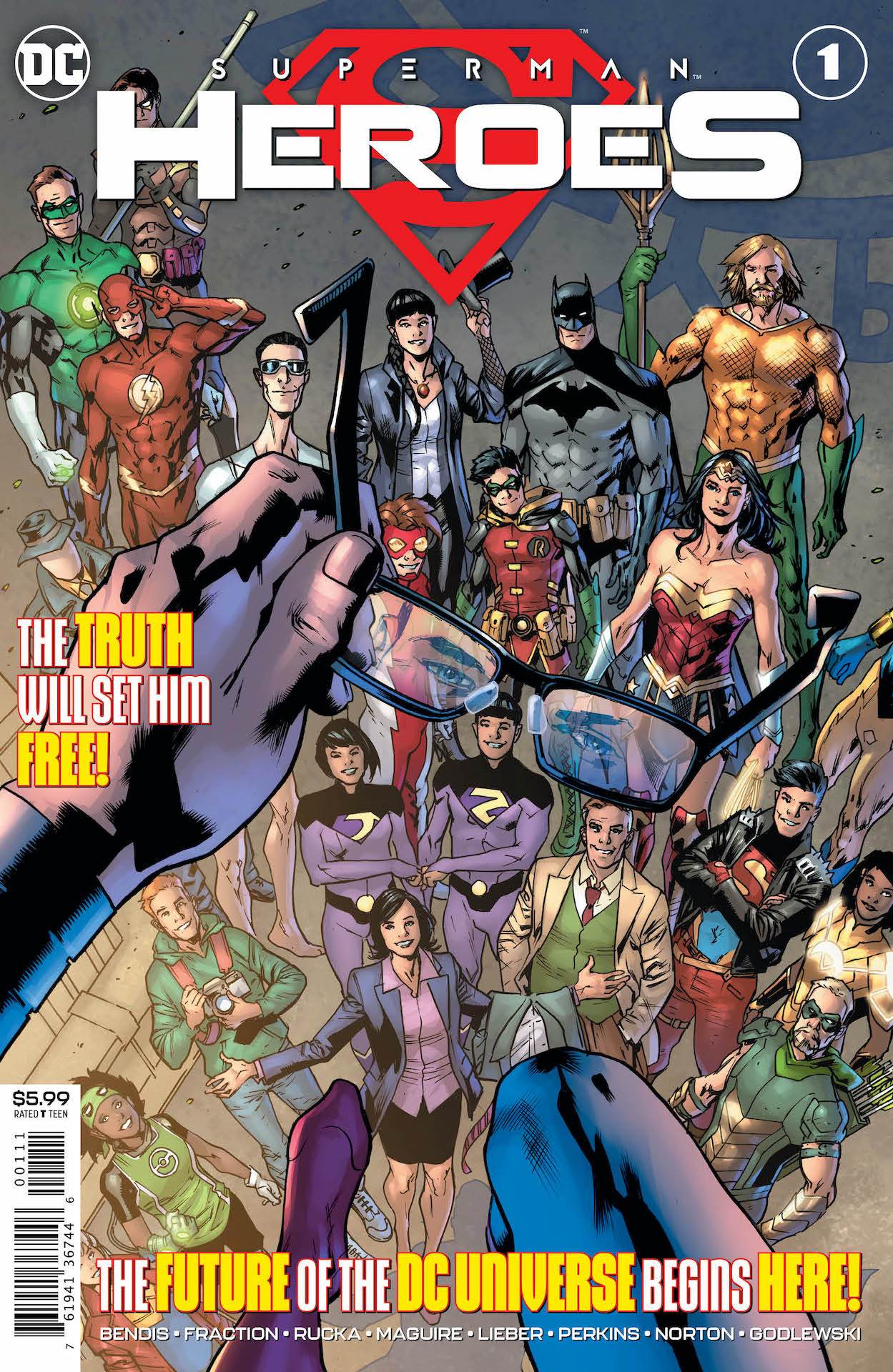
I’m totally okay with Brian Michael Bendis finally allowing Superman to reveal his secret identity as Clark Kent. It seems like a sales gimmick or one that will be walked back in a couple years. It’s remarkably in-character and makes up for the half-assed “mystery” that was Event Leviathan. Superman: Heroes #1 shows the reactions to the big reveal. It does so from a variety of perspectives from Lois Lane to the Justice League. Drawn by the fantastic Kevin Maguire! to Clark Kent’s high school chemistry teacher in a sweet story by Matt Fraction and Scott Godlewski. Fraction also pens Jimmy Olsen’s reaction to his “pal” losing the secret identity. That features slick, emotive art from his Superman’s Pal Jimmy Olsen collaborator Steve Lieber.
And wait, that not’s all. After being terse in the Maguire 12 panel grid sequences, Batman gets to open up to Wonder Woman about his true feelings in regards to Superman’s reveal. It’s a powerful story written by Greg Rucka and drawn in atmospheric shadows by Mike Perkins. However, there’s room for comedy too. Booster Gold finally gets to shout that Superman is Clark Kent after keeping it in for so long because he’s from the future. This comic is a true marriage of different tones. Art and writing styles from Bendis and Maguire set up a running Plastic man gag to Batman coming up with legit, devil’s advocate style arguments for why Superman revealing his secret identity to the world is a terrible idea.
Bendis, Fraction, Rucka, Maguire, Perkins, Lieber, Mike Norton, and Godlewski use Superman: Heroes to show how important Superman is to the both the community of heroes in the DC Universe and the superhero genre as a whole. They also show his roots in Smallville, connections to Lois Lane and Jimmy Olsen, and the consequences of his actions. The best parts of this comic are connected to Smallville. The opening scene features a great conversation between Ma and Pa Kent and young Clark about feeling different or weird and having a greater responsibility to the world because of his abilities.
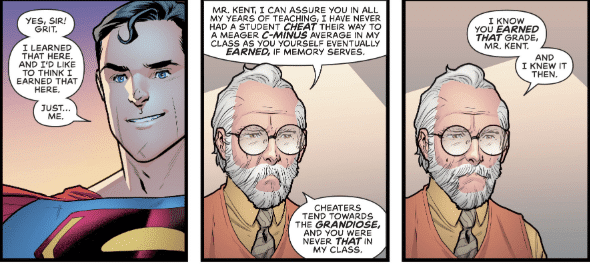
The Fraction/Godlewski Superman and his chemistry teacher scene is really Eisner-worthy. From Godlewski’s clean line and the vivid colors to the underlying theme that it’s been Clark’s work ethic and moral compass that made him a great hero and man and not his superpowers. I also love how he draws Superman’s smile. Even if this means he got a C- in molecular chemistry. Clark Kent is the kid at the end of the bench who hustles for every loose ball, or the student that stays up late and goes to extra tutoring sessions that just happens to have the power of a god. Matt Fraction demonstrates his understanding of Superman’s moral character that pervades the “Truth” storyline as well as his, Rucka, and Bendis’ take on the Metropolis side of the DC Universe.
As evidenced by the “King Superman” plotline brewing over in Superman, Bendis isn’t afraid to look at the negative consequences of Superman revealing his secret identity. That extends to the moral dilemma he’s in as the Daily Planet is owned by Marisol Leone. However, that will be covered in later stories. Maybe Action Comics once the “Year of the Villain” shenanigans are over.
As I’ve mentioned a few times, Rucka and Perkins dig into it immediately in the form of the other 2/3 of the Trinity have a spirited conversation where neither Bruce or Diana is in the right. I really love the panels at the end of scene where Perkins’ heavy shadows lighten, and Diana tells Bruce that maybe he’s jealous that Superman can live his life out in the open and whole. The specters of Tom King’s botched Bat-marriage hang in the shadows of this one. Rucka’s dialogue gets to the core of Batman’s identity issues that have pervaded his best stories. He can’t retire or be a public-facing, but must strike fear into criminals as an archetype of fear.
Superman: Heroes #1 is a high note for Brian Michael Bendis’ current run on the Superman titles. It also features insightful writing from Matt Fraction as well as Greg Rucka reminding readers that he’s one of the greatest Batman and Wonder Woman writers. On the visual side, Mike Perkins shows a conversation can have just as much power as a good fight scene. Kevin Maguire is still the master of the superhero group shot. Steve Lieber’s comedic timing and use of beats works for friends being open and vulnerable together. Even if you aren’t current on Bendis’ Superman comics, Superman: Heroes #1 is worth picking up and dropping $5.99 on. It’s an intelligent and heartwarming take on the first superhero.
Story: Brian Michael Bendis, Matt Fraction, Greg Rucka Art: Kevin Maguire, Mike Perkins, Steve Lieber Art: Mike Norton, Scott GodlewskiColors:Paul Mounts, Gabe Eltaeb Colors: Andy Troy, Nathan Fairbairn Letters: Clayton Cowles, Troy Peteri, Simon Bowland Story: 9.5 Art: 8.0 Overall: 8.8 Recommendation: Buy
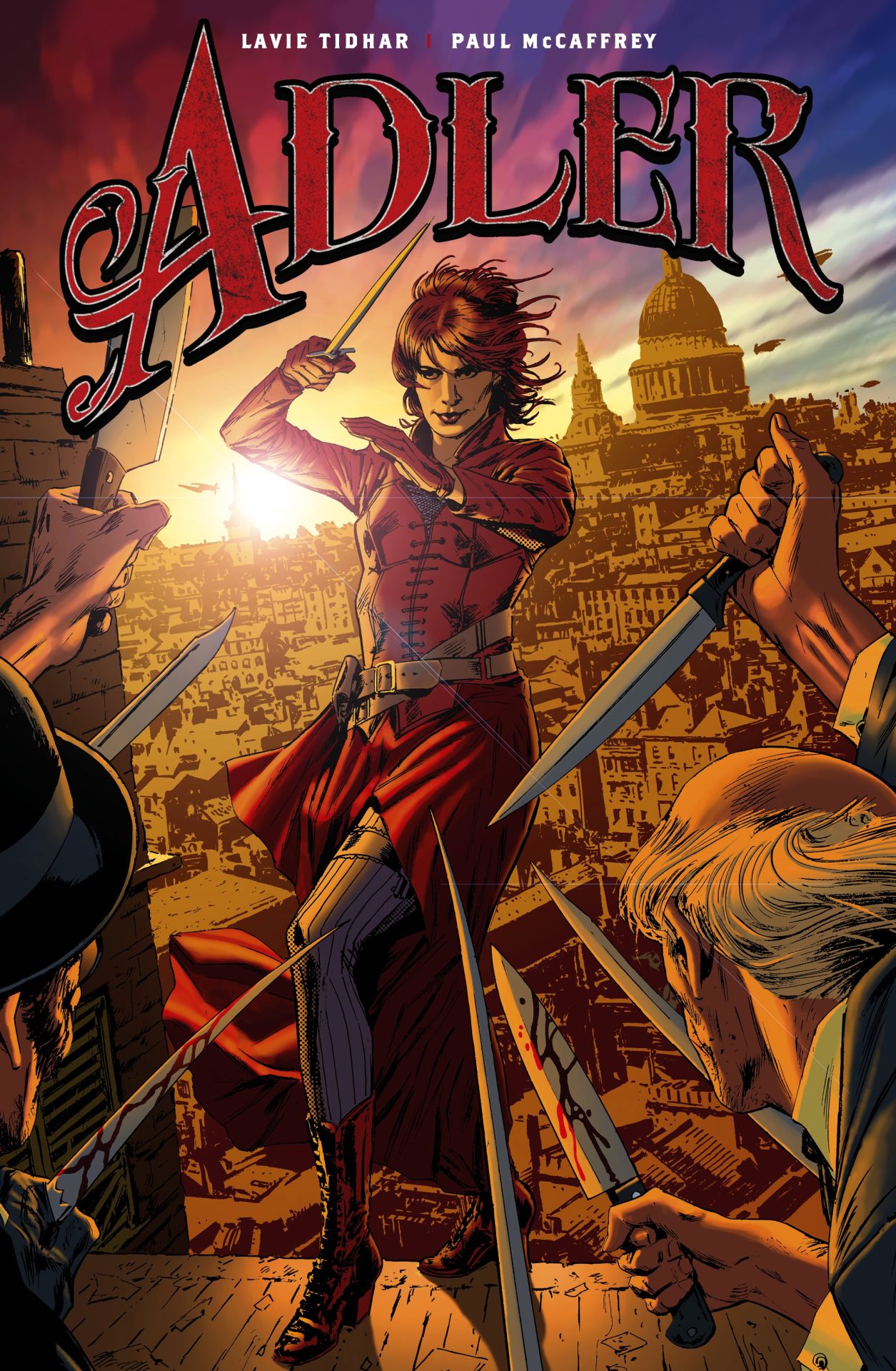
Adler #1 is kind of a nerdfest for anyone who enjoys Victorian literature with such luminaries as Jane Eyre, Estella Havisham, the vampire Carmilla, and even Ayesha from H. Rider Haggard’s She. Writer Lavie Tidhar and artist Paul McCaffrey let the women of these (For better or worse) long enduring late 19th century British novels have just as much fun as the male characters as they engage in shoot outs, witty repartee, and cloak and dagger scheming.
The story begins in the dark, PTSD-inducing imperalist haze of the Second Boer War in South Africa, which establishes Jane as a capable protagonist, who is relegated to the position of nurse even though she does the work of a doctor. While Irene Adler is much more verbose, Jane is a keen observer with McCaffrey giving he quick glances and facial expressions that look like processing or deep thinking. She is a sympathetic POV character and is much more than the sidekick that Adler monologues to as shown by the last several intrigue-filled pages.
Paul McCaffrey has already worked on the comic adaptation of Kim Newman’s fantastic Victorian alternate history novel Anno Dracula (Seriously, it kept me awake on a 10 hour drive from Washington, DC to Louisville, Kentucky.) so cobblestone streets, corsets, cravats, and steampunk blimps come naturally to him. His art is easy to follow and is naturalistic, but a little messed up just like Steve Dillon’s work. McCaffrey’s one weakness is a case of same face with the female characters who aren’t Ayesha, but thankfully, he emphasizes their different hair colors and fashion choices. Carmilla has a Goth thing going for her, Irene Adler is more steampunk, and Estella is an upper class mad scientist. Fashion and costume choice definitely helps establish character in Adler #1.
Another amusing part of Adler #1 is how minimized, and honestly pathetic, the role of the male characters are in the narrative. Irene Adler trolls Moriarty, who comes across as a villain of the week instead of a conniving Big Bad like Andrew Scott’s portrayal in BBC’s Sherlock that had the Internet shrieking every time he was even hinted to appear on the screen. Also, Holmes himself is a non-entity that doesn’t even appear on-panel because he’s too busy chasing rumors of giant hounds on the moors. Instead Adler #1 is about the extreme competence of Irene Adler as well as Jane Eyre trying to find her place in early 20th century England while Ayesha and Carmilla scheme and hint at plots just beginning to unravel.
With more of an emphasis on action, flashy, yet readable visuals, and character personality instead of mystery, Adler #1 is wonderful first course into Lavie Tidhar and Paul McCaffrey’s female-fronted world of Victorian character crossovers. The relationship between Jane and Adler is intrigued, there’s some gunplay, and Tidhar and McCaffrey definitely left me wanting more. Adler is a penny dreadful for the 2020s. I’m looking forward to see the relationship between Jane and Irene Adler develop just as much as the next cool late 19th century/early 20th century female historical figure or literary character cameo.
Story: Lavie Tidhar Art: Paul McCaffrey Letters: Simon Bowland Story: 8.5 Art: 8.0 Overall: 8.3 Recommendation: Buy
Titan Comics provided Graphic Policy with a FREE copy for review
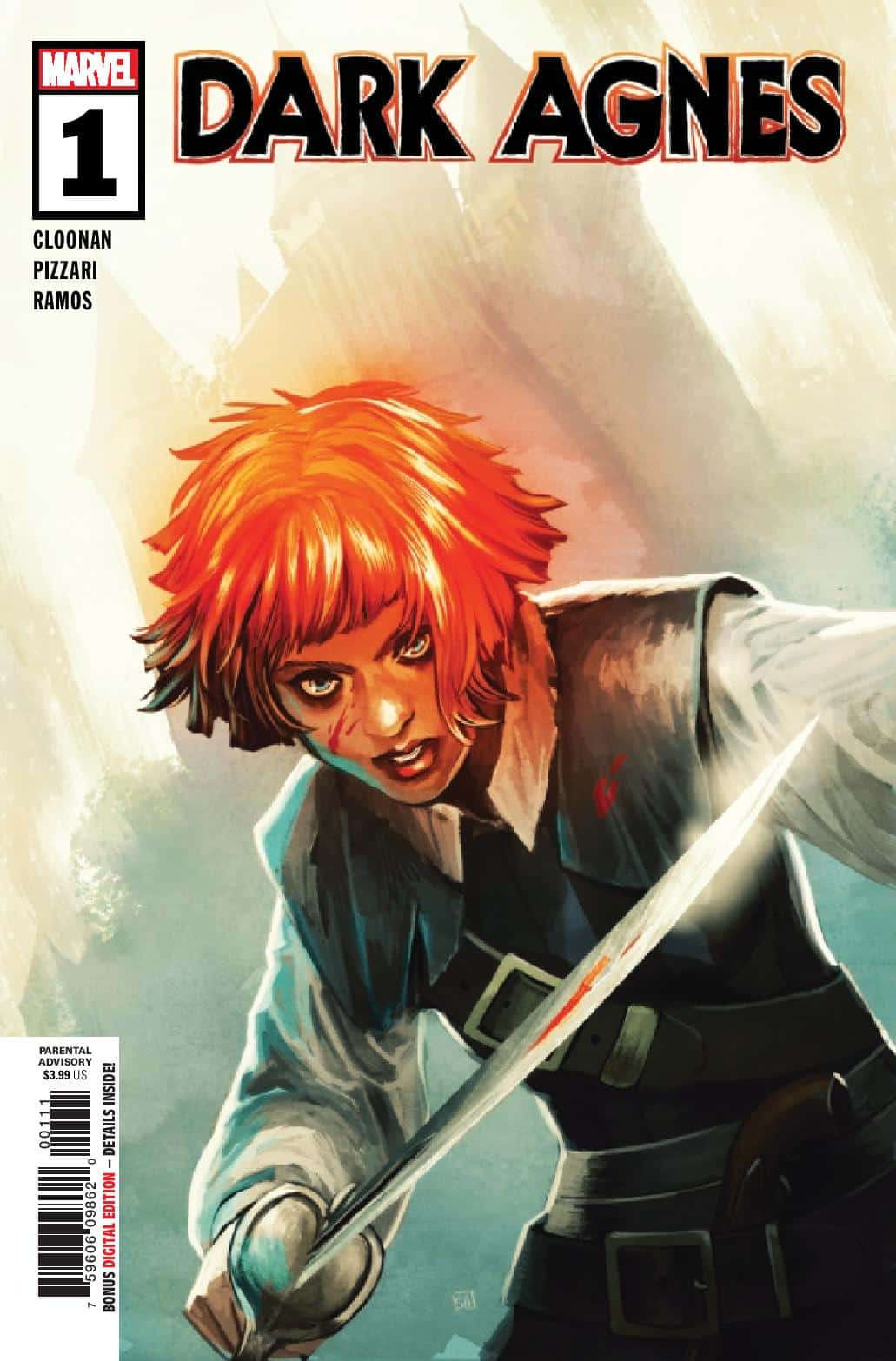
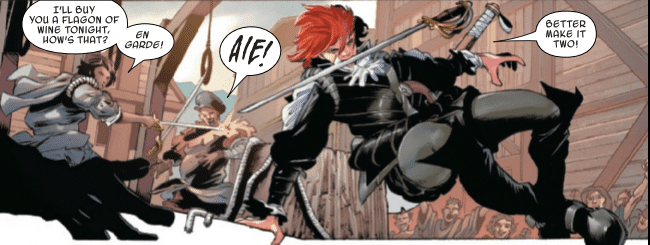
Dark Anges #1 is based on a more obscure Robert E. Howard creation that may have been one of the inspirations for Red Sonja. Agnes de la Ferre aka Dark Agnes is a French woman, who killed the disgusting man she was going to be forced to marry and became a great swordswoman and adventurer. Writer Becky Cloonan, artist Luca Pizzari, and colorist Jay David Ramos definitely understand the swashbuckling, pulpy tone of a Howard story. Even if the execution is lacking in times in the parts of the story that aren’t dialogue. The characters, Dark Agnes and her sidekick Etienne, are more stock than three dimensional. Cloonan writes some witty dialogue and places them in settings that would be out of place in a capital “R” French Romantic novel written in the 19th century, but set centuries before.
However, Dark Agnes #1’s chief weakness isn’t with its prose, but with the visuals. This comic seems to suffer from the “Dynamite problem”, which is having a fantastic, inviting cover and incomprehensible-to-above average (At times) interior art. If it wasn’t for Cloonan’s shout-y dialogue, the initial scene of Dark Agnes rescuing Etienne would have zero suspense. Luca Pizzari handles the big reactions, or flashback dreams, but not the little things that make a set piece great in Dark Agnes #1. There are too many moving parts in his action sequences, and a scene that should be epic (Aka Dark Agnes kicking ass with a sword in her mouth.) falls flat because the focal point on the panel is off center. However, Jay David Ramos does a decent job emphasizing Agnes’ flame red mane as well as using a muddy palette to evoke the stench of stereotypical “Dark Ages” France. He uses brighter colors when Etienne and Dark Agnes take on a rich woman and her nun companion to protect towards the end of the first issue.
One thing that these modern Robert E. Howard adaptations can do is add interiority and shading to pulp archetypes. However, Dark Agnes #1 doesn’t do that, for better or worse. I hate to say it, but Becky Cloonan and Luca Pizzari basically transpose the story of Red Sonja to medieval France. And it’s not intrigued, well-researched medieval France, but just a backdrop for swashbuckling adventures and interspersed French dialogue. The Duke of Alencon seems to be the bad guy, but he could easily be substituted by the Duke of Burgundy or the Sheriff of Nottingham or any such mustache twirler. Hopefully, his real menace is shown down the road.
I do like the basic premise for the character of Dark Agnes, and that she is a woman in an incredibly oppressive time period, who overcomes trauma to be a badass. Even though the storytelling around her is wooden, Cloonan, Pizzari, and Ramos give her true energy to match her flame red hair beginning with the opening of Dark Agnes #1 where she rescues the “damsel in distress” Etienne from execution in a scene that is actually pretty funny. Her sheer swagger coupled with the foreboding images of her dreams sow the seeds of a potentially interesting pulp heroine, and the final pages definitely up the stakes. In video game terms, think “fast travel”.
I definitely wish that Becky Cloonan had the opportunity to both write and draw Dark Agnes because her work on Dark Horse’s Conan shows that she is a natural fit for high energy, bloody adventures. However, that is not the case, and the visuals of Dark Agnes #1 make the book seem more sluggish than exciting. The writing and plotting isn’t pristine either with a generic sense of setting and several cliches even though Cloonan’s dialogue is musical and humorous sometimes. It’s a comic to definitely trade wait for
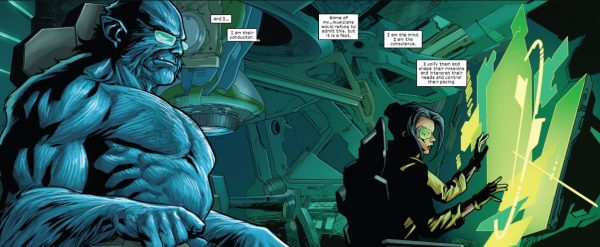
Benjamin Percy and Stephen Segovia transpose cloak and dagger American interventionism to gain a sphere of influence in Latin American countries to the key of mutantdom and Warren Ellis-style high concept-meets-absolutely bonkers. plotting in X-Force #6. The issue starts in a beautiful way with Beast conducting his “symphony” of X-Force operatives with Segovia’s very direct artwork working in tandem with Percy’s descriptive prose for each member’s role on the team. (Wolverine is percussion, and Percy takes a page out of early Claremont X-Men and uses him for action and gruffness instead of the star of the show.)
Beast is the POV character throughout X-Force #6, and what follows is a peek behind the curtain of the mutant CIA. Hank McCoy is his more recently characterized master manipulator self (No timelines were harmed in the making of this issue.) rather than the affable, occasionally flirty fuzzball that was tailor made to be played Kelsey Grammer. Throughout the issue, he doesn’t doubt or waver once immediately giving kill orders for the “telefloronic” organisms created by the country of Terra Verde that could rival Krakoa, its products, and taking away the current mutant leverage on the world. There’s only room for one plant-based tech producing country, and Percy and Segovia craft immediate uncertainty when Black Tom Cassidy, who can manipulate the plant matter of Krakoa, is assaulted by similar plant manner.
And what made X-Force such an interesting read other than its continued use of the body horror aesthetic (Segovia has a much smoother art style than Joshua Cassara though.) is that Beast is sugarcoated to become some kind of heroic or anti-heroic figure. He’s just a powerful mutant, who uses his intellect and occasionally, brute strength and athletic ability to protect Krakoa’s interest. He’s a wetwork operation or a secret war wrapped up in blue fur and glasses.
Beast is as skilled with words and metaphors as he is with positioning operatives and mutant abilities as he compares the telefloronic organisms to Omega sentinels to assuage Jean Grey’s ethical dilemma. There’s a great contrast between the innocence of the classic “Marvel Girl” costume and the dark implications of her action as Stephen Segovia draws her in intense profile with some shading. Also, it’s cathartic when she gets to give Beast a piece of her mind. She’s the most traditionally heroic of the X-Force team, but the dark palette used by Guru e-FX undercuts every “good thing” she seems to do. For example, when she rescues Terra Verde’s president Cocom from the telefloronic organisms, Stephen Segovia and Guru e-FX frame her as an angel of death, not a helping hand.
Since the establishment of Krakoa in House of X/Powers of X, Jonathan Hickman and his fellow X-scribes have couched what would be usual superhero team action into the visual and verbal language of warfare. Marauders is naval conflict, Excalibur is a wild and woolly border dispute with a side of a state-sanctioned puppet ruler, New Mutants is a diplomatic mission gone wrong, X-Men is literally a summit, and X-Force, as I’ve mentioned earlier and keeping with its black ops team roots, is off the books warfare. Throughout the issue, Beast makes sure there are no witnesses to his and his team’s actions so Krakoa keeps its leverage on human nations via the pharmaceutical market and is positioned as the victim, not aggressor. (See the amazing text piece on how he set up Professor X as a martyr figure.)
Benjamin Percy’s choice to filter the story through Beast’s POV and showing behind the hood of his orchestration of the “mutant CIA” gives X-Force #6 incredible narrative focus to go with Stephen Segovia and Guru e-FX’s precise, powerful visuals. It’s a memorable addition to the Dawn of X books’ ongoing saga of a presumably utopian society uses decidedly non-utopian methods to maintain it with X-Force definitely getting to explore the non-utopian part in a creative way with a fantastic ensemble cast.
Story: Benjamin Percy Art: Stephen Segovia Colors: Guru e-FX Letters: Joe Caramagna Story: 9.0 Art: 8.0 Overall: 8.5 Recommendation: Buy
Marvel Comics provided Graphic Policy with a FREE copy for review