
The Department of Truth #24 Questions the Manufactured Nature of Belief
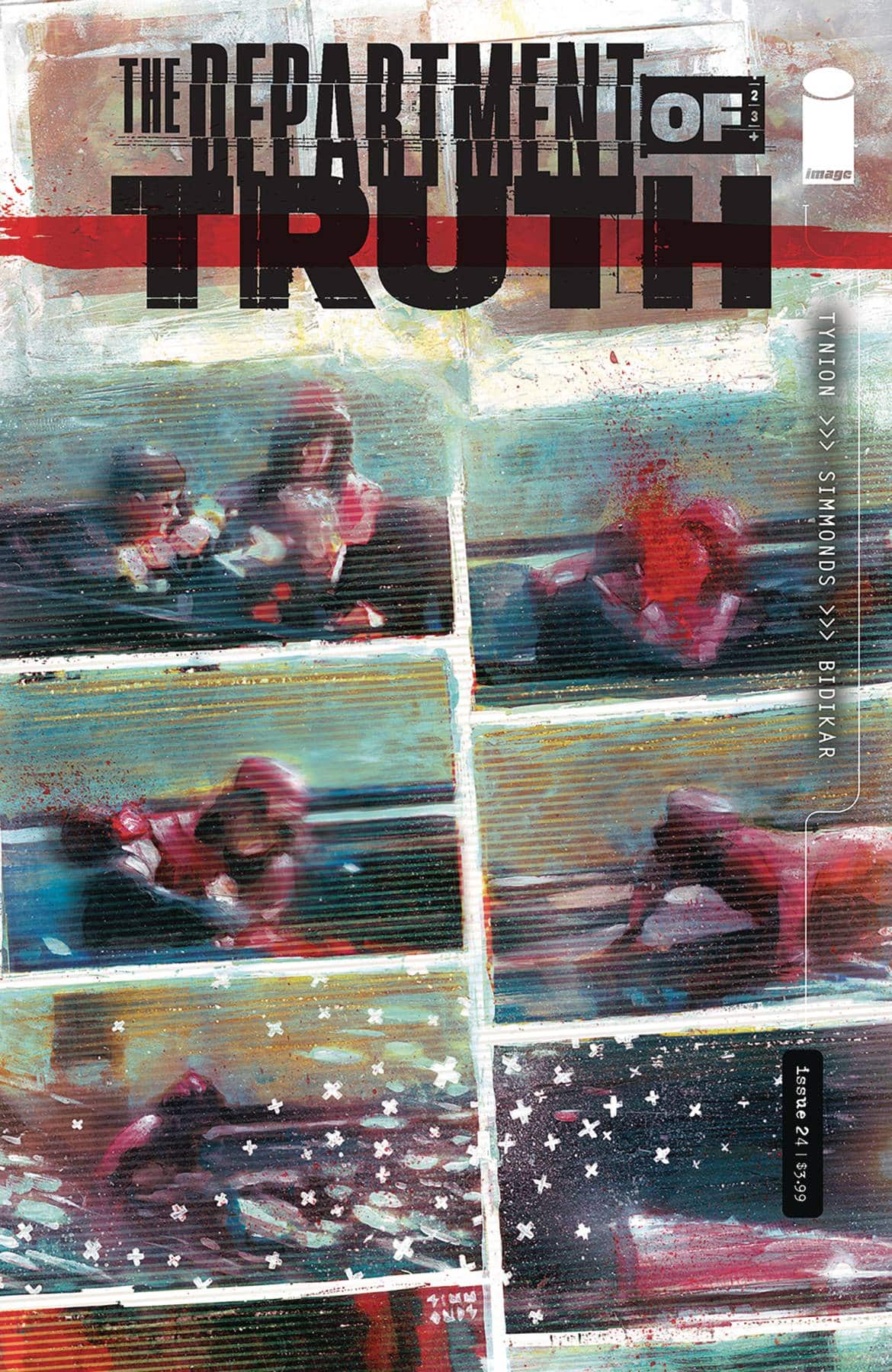
Department of Truth Director Lee Harvey Oswald once traveled to the Soviet Union to join the Department of Lies as a double agent to get more information about them. He did not expect this mission to change his life, the state of America, and the world. The secret history of Oswald before that day in Dallas is revealed as his experiences across the Iron Curtain are exposed. The Department of Truth #24 by James Tynion IV and Martin Simmonds shows what happens to a cracked fantasy and what a man might do to hold it together.
Tynion’s fascination and examination of the mythological American dream and how we view and believe about the country continue to be a strong point of the comic. The issue’s focus on the Cold War and the ideological battle between the United States and the Soviet Union during that era continues to be timely. Tynion understands how the Cold War was not strictly a war of ideals but also one of two different global powers’ differing views on the nature of the world and its future. Yet he highlights how even though the Department of Truth and the Department of Lies hold differing missions, they each share a similar goal of shaping the world in their preferred image. An expertly manufactured image crafted to fit their notion of the truth and how the populations of their respective country should view the world. The Cold War would not be won by firepower, nukes, or raw power but by one country holding a more potent power of belief.
Oswald’s role in the series has taken a greater focus in this arc, where he recounts his time before joining the Department in more detail. Mixing both real history and fiction, Oswald does not exist as either a tragic victim or an opportunistic company man who took that fateful shot at Kennedy in 1963. Considering how much the Kennedy assassination has become a crucial part of the fabric of American mythology, that specific moment in time is a blur for him. Martyrdom creates a robust and infallible power that cannot be challenged, making a more palpable and smooth narrative for people to digest. Instead of contending with the thorniness of humanity, the memory of the ideals of Kennedy allows a person to graft on their ideas and beliefs of his life and what he represented. Humans can be destroyed, but it is much harder to defeat a symbol. The dead do not speak, but those alive talk for them.
Simmond’s hauntingly gorgeous painted art matches the cerebral horror tone of the story. His work exists in its own reality, not our reality. Its expressive and imaginative qualities linger with readers as he shows the malleability of truth and belief. With Aditya Bikar’s artistic and sharp lettering, The Department of Truth Issue #24 exposes the Lynchian nightmare infecting our history and life.
Further twisting the narrative, Tynion and Simmonds provide another exciting installment of the long-running series and ends on an enthralling note. The fight for the nature of the truth continues to the present, but a significant shift occurred in 1963. As we learn more about Oswald, the truth becomes more challenging to define among the lies and beliefs we have been fed. We get a peek at what lies within the man, but The Department of Truth #24 shows that there is still a lot to learn about the man.
Story: James Tynion IV Art and Color: Martin Simmonds Letterer: Aditya Bikar
Story: 9.2 Art: 9.2 Overall: 9.2 Recommendation: Read
Image Comics provided Graphic Policy with a FREE copy for review
Purchase: Kindle
Discover more from Graphic Policy
Subscribe to get the latest posts sent to your email.
