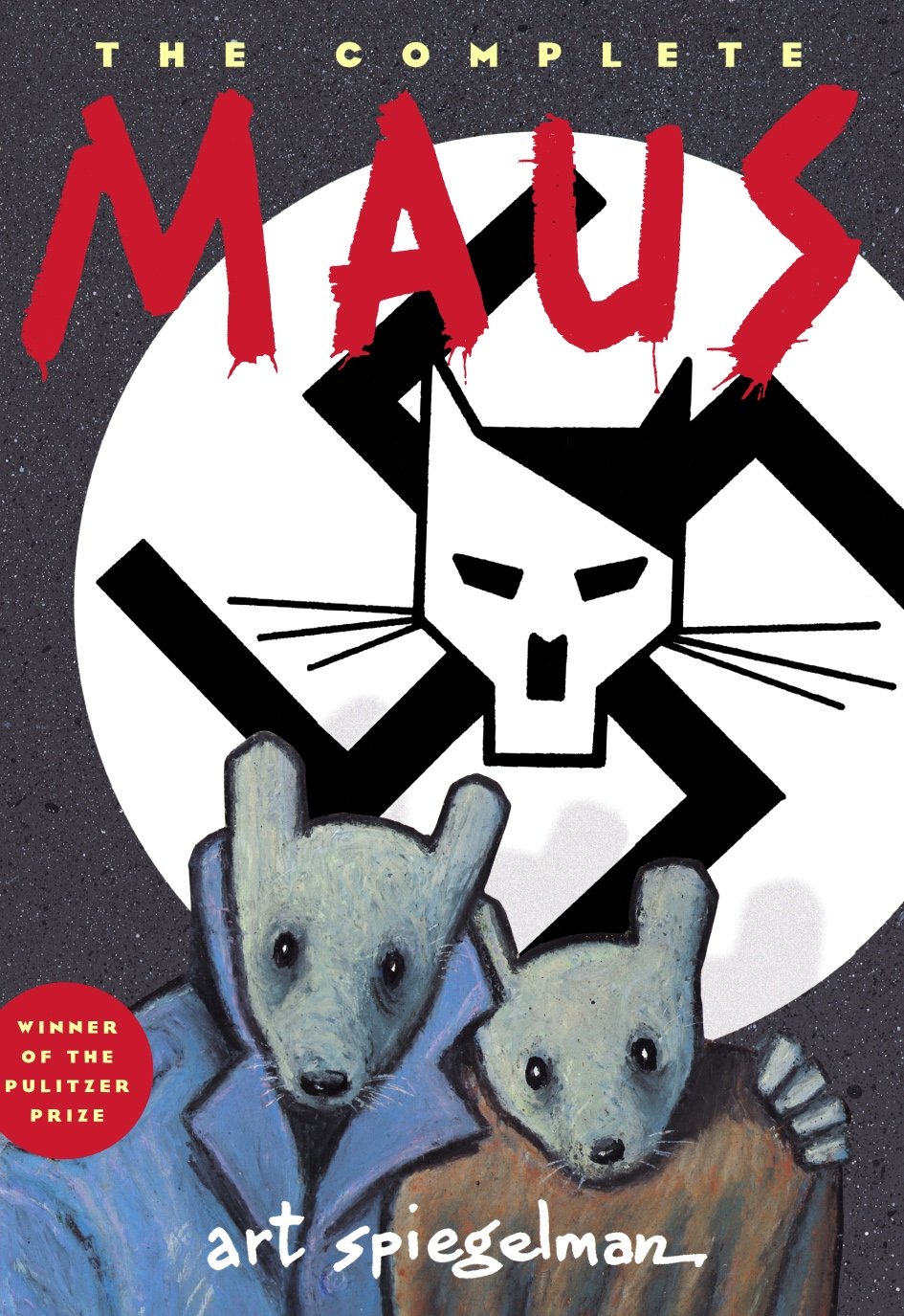
Tennessee bookstore Fairytales Bookstore and More has announced they’re partnering with school librarians to give away free copies of Maus to local students.
The campaign is in response to a local Tennessee school board’s decision to ban Maus from being used to teach the Holocaust due to “objectionable content”.
Nirvana Comics in Knoxville, Tennessee is running a GoFundMe to raise money and purchase copies of Maus. Their plan is to give away the copies to local students as well as those across the US. Students interested in getting one can message the store on Facebook or Instagram.
The weekend is almost here! What geeky things will you all be doing? Sound off in the comments below! While you decide on that, here’s some comic news and reviews from around the web.
Today is International Holocaust Remembrance Day and inappropriately timed is news that a Tennessee school board has removed, aka banned, Maus from the curriculum due to “language and nudity” concerns.
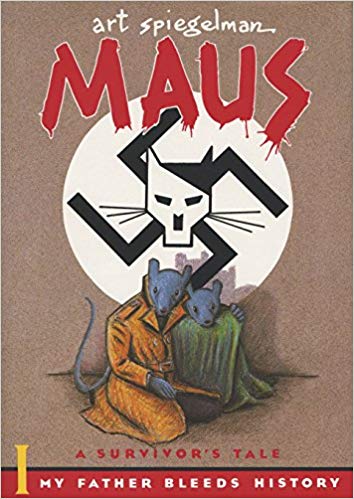
Maus is the Pulitzer Prize-winning graphic novel by Art Spiegelman about the experiences of Holocaust survivors. The Tennessee school board of McMinn County voted 10-0 to remove the book from the curriculum to be replaced by another book that didn’t feature “objectionable” content. Maus is based on Spiegelman’s parents in 1940s Poland, their experiences of anti-Semitism, and their internment in Auschwitz. Jewish people are depicted as mice and Nazis as cats.
McMinn County Director of Schools Lee Parkison stated:
The values of the county are understood. There is some rough, objectionable language in this book and knowing that and hearing from many of you and discussing it, two or three of you came by my office to discuss that.
The word “damn” was brought up as an example of an objectionable word.
I’m trying to, like, wrap my brain around it. …I moved past total bafflement to try to be tolerant of people who may possibly not be Nazis, maybe… They’re totally focused on some bad words that are in the book. I can’t believe the word ‘damn’ would get the book jettisoned out of the school on its own.
I think they’re so myopic in their focus and they’re so afraid of what’s implied and having to defend the decision to teach ‘Maus’ as part of the curriculum that it lead to this kind of daffily myopic response.
English language arts instructional supervisors spoke out at the meeting explainging why the book was used in the curriculum.
Board member Tony Allman showed further ignorance by stating:
We don’t need to enable or somewhat promote this stuff. It shows people hanging, it shows them killing kids, why does the educational system promote this kind of stuff? It is not wise or healthy.
Allman apparently is more offended of reminding people about the six million murdered than the six million murdered. One wonders what Allman thinks about teaching the reality of slavery, and Jim Crow in the United States which also saw hangings and kids being killed.
An instructional surpervisor responded:
I was a history teacher, and there is nothing pretty about the Holocaust, and, for me, this was a great way to depict a horrific time in history.
Mr. Spiegelman did his very best to depict his mother passing away, and we are almost 80 years away. It’s hard for this generation. These kids don’t even know 9/11. They were not even born. For me, this was his way to convey the message.
Board member Mike Cochran stated in the meeting:
I went to school here 13 years. I learned math, English, reading and history. I never had a book with a naked picture in it, never had one with foul language. … So, this idea that we have to have this kind of material in the class in order to teach history, I don’t buy it.
We highly doubt that was reality and sure Cochran has no issue with the violence, rape, and murder that is depicted in the Bible.
The issue isn’t as it stands isn’t about dropping Maus for another text to teach about the Holocaust. It’s calling it “obscenity”, a slippery slope of a claim. Even the preacher of Footloose realized their mistake and what a slope that claim is. It should also be noted that no text has been suggested to replace Maus showing that part of the argument is dubious at best.
This is the latest example of book banning that is being pushed by right-wing provocateurs to make gains politically by stoking “culture wars”.
As has been shown, a dark money network is funding campaigns against “Critical Race Theory”, something not being taught in schools. This book banning is an off-shoot of that showing these pushes are about as natural as an oral bowel movement. The “movement” is being used as a wedge issue to whip up voters and by the right since they have nothing else to run on. It pits parents vs. bureaucrats (and teachers), a match that’s pretty easy to get traction on. The movement has been working for decades and continues the right-wing push to take over at the local level, first at the state and now even lower to get their regressive agenda passed.
The controversy and backwards thinking has just shined a greater spotlight on Maus causing it to sell out and rocket to #1 in numerous lists.
The Rockwell Museum will host an evening with Pulitzer-Prize Winning artist Art Spiegelman. Spiegelman will discuss his groundbreaking Maus graphic novel and its place in current global conversations in this culminating program of The Rockwell’s Year of Questioning Identity.
The event begins at 7 pm on Tuesday, September 10, 2019 and this Rockwell event is located at The Corning Museum of Glass Auditorium, 1 Museum Way, Corning, NY. After an hourlong discussion, Spiegelman will engage with the audience for a question and answer segment. General admission is $20, while student tickets are $10. Rockwell members are admitted free for this event. More details and tickets are available online.
Art Spiegelman’s impressive accomplishments have helped secure
comics’ place as an important part of literature. In 1992, he won the Pulitzer
Prize for his masterful Holocaust narrative, Maus—which portrayed
Jews as mice and Nazis as cats. Maus II continued the
remarkable story of his parents’ survival of the Nazi regime and their lives
later in America. In 1999, he was inducted into the Eisner Award’s Hall of
Fame.
As a pioneer in underground comix, Spiegelman, along with
publisher Francoise Mouly, co-edited RAW, which helped launch the
careers of Chris Ware, Gary Panter and Charles Burns. His boundary-breaking
career stretches from his artwork in The New Yorker to creating The
Garbage Pail Kids for Topps.
His
other books include In the Shadow of No Towers, Jack Cole and Plastic Man: Forms Stretched to Their Limits and MetaMaus. His comics are best
known for their shifting graphic styles, their formal complexity and
controversial content.
Spiegelman currently advocates for greater comics literacy. As an editor, a teacher at the School of Visual Arts in New York City, and a lecturer, Spiegelman has promoted better understanding of comics and has mentored younger cartoonists.
For the past nine years I’ve taught high school English. And–more important to this article and Graphic Policy’s focus in particular–for the last three years I’ve taught a graphic novel class that I created. (See here and here for past writings on that experience).
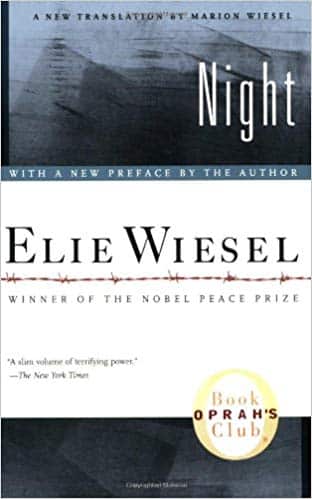
Throughout that time, whenever I’ve seen students read graphic novels in either class, (they read Maus in connection withNight in the non-graphic novel classroom), I saw greater student engagement, greater understanding, and greater confidence from all students. This was true of fictional comics, but I found that it was truer for nonfiction comics, informative comics.
Students don’t like to read textbooks, complex articles, big biographies and the like: but they would gobble up graphic novels about these same topics.
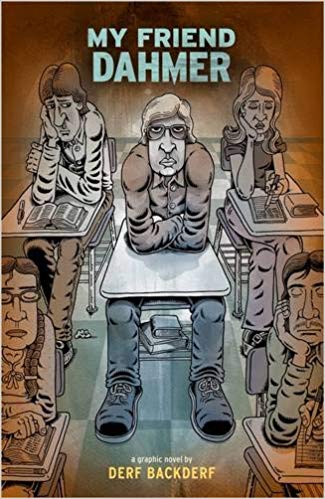
Some preferred the dark My Friend Dahmer.
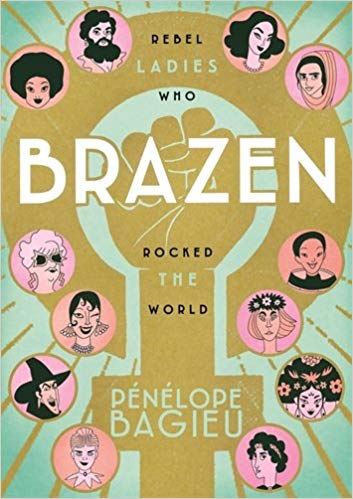
Others steered towards comics that were more positive and empowering, like Brazen: Rebel Ladies Who Rocked the World;
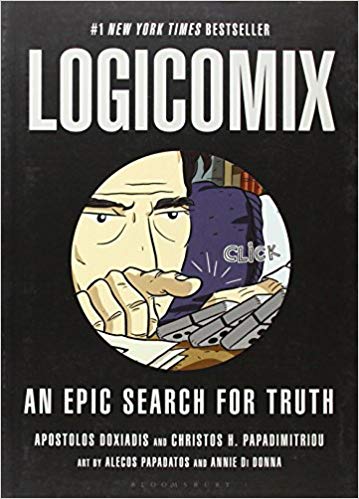
and others chose some more theoretical work that made it easier to understand abstract ideas like Logicomix.
This interest in informational comics, along with my interest in history, led me to create my own informational comic about the Standard of Ur (found here). Here’s a short preview of one page. Yes, it’s not drawn the best–I’m a pro writer and an amateur artist (which shouldn’t be a bad thing, to pursue something for passion, not pay)–but there is some intriguing info here and some innovative designs that make it worth checking out this and the other pages.
The more and more I saw this trend of love for nonfiction comics from my students, and a rising love in myself, the more I wanted to know about this genre within the medium. Sure, I’d read a few bios here, a few memoirs there (something I’m not going to tackle in this series unless there’s a significant amount of information presented). But I hadn’t jumped into informational comics the way I dove and swam through super hero comics, the way I took leaps of faith by following certain creators from project-to-project, from publisher-to-publisher.
I took that plunge, though, and ended up loving informational comics. More importantly, I came to this realization, the subject of this post: Informational comics have existed for most of comics’ history, and their unique evolution has increased their appeal and audience in a way that other genres of comics haven’t.
Before we begin our historical journey, though, there are a few important details to note:
Even though I am a history major (and English teacher–I try not to limit myself into one field, which might be why I don’t like to limit myself to one genre), I don’t know the whole story. Even though I’ve done research for this article and paired that with my own background knowledge and historical academics, I am sure I’m missing part of the story. So–in the comments section–if you note an error, a missing piece that needs to be added, or details that should be downplayed or played up: please let me know. We’re all learning on this planet and respectful interactions like that help all of us, right?
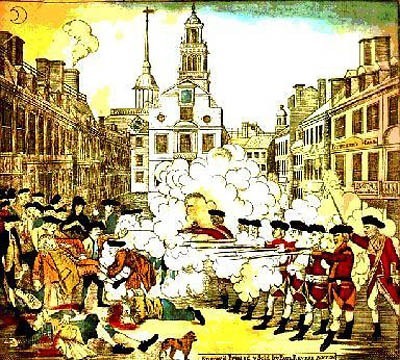
Secondly, while political and propaganda comics were around earlier and more frequently (generally speaking) than informational comics, I’m going to start with the rise of informational comics in the US and only touch on propaganda comics of that time period for proper context. This isn’t too downplay any works focusing on the earlier, political and propaganda pieces: it’s just to have a clear boundary to avoid my tendency to digress. These are some examples of what you’re missing out on given those self-imposed guidelines:
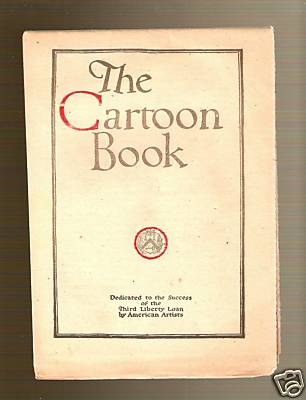
Instead, I am going to focus on the first big surge of informational comics in the US, a surge that coincided with World War II and government-backed comics. Seeing the previous use of comics for propaganda–especially in World War I, comics which were partially collected in the above Cartoon Book by the US government–the US government decided to pursue that path again.
But this time they didn’t just use comics for propaganda: they used them to inform their citizens–at home, in basic training, and abroad. And this time, they brought some of the most popular comics artists of the time to help them create these comics.
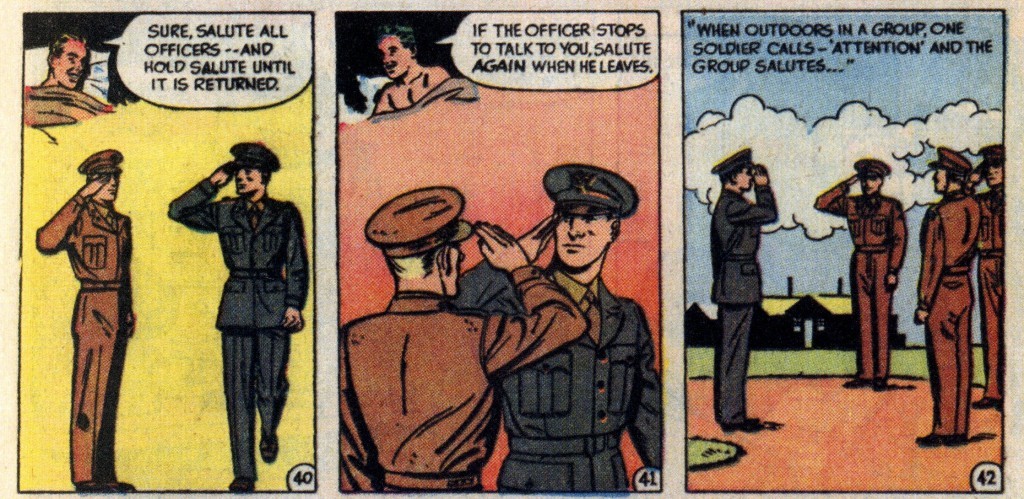
Primarily, they were used to inform military members proper procedure, smart tactics, health prevention, and equipment maintenance. This could cover the simple message–like this comic by Al Avison, co-creator of the Whizzer and noted Captain America artist, from Military Courtesy on how to salute:
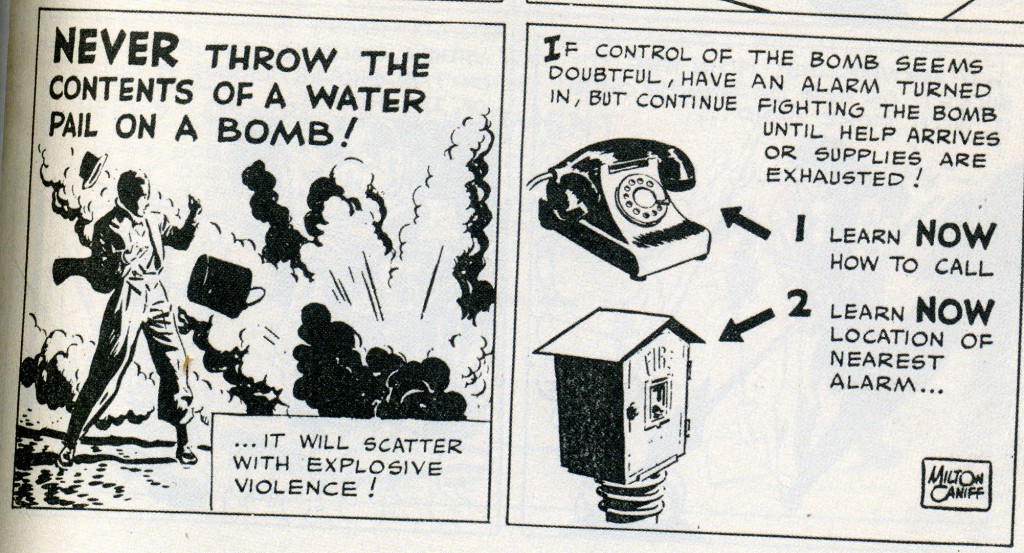
It could cover more complex scenarios of life and death–like this comic about bomb safety procedures fromTerry and the Pirates and Steve Canyon creator Milton Caniff:
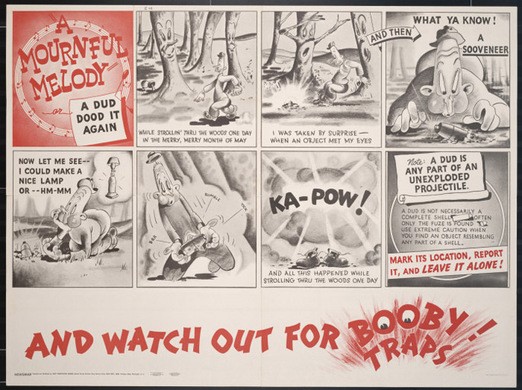
Dealing with explosives was a common thread among military comics, and this next example shows a similar content–
–with a very different artistic style, opting for a more cartoonish and humorous approach (artist credit not found on site I obtained this image):
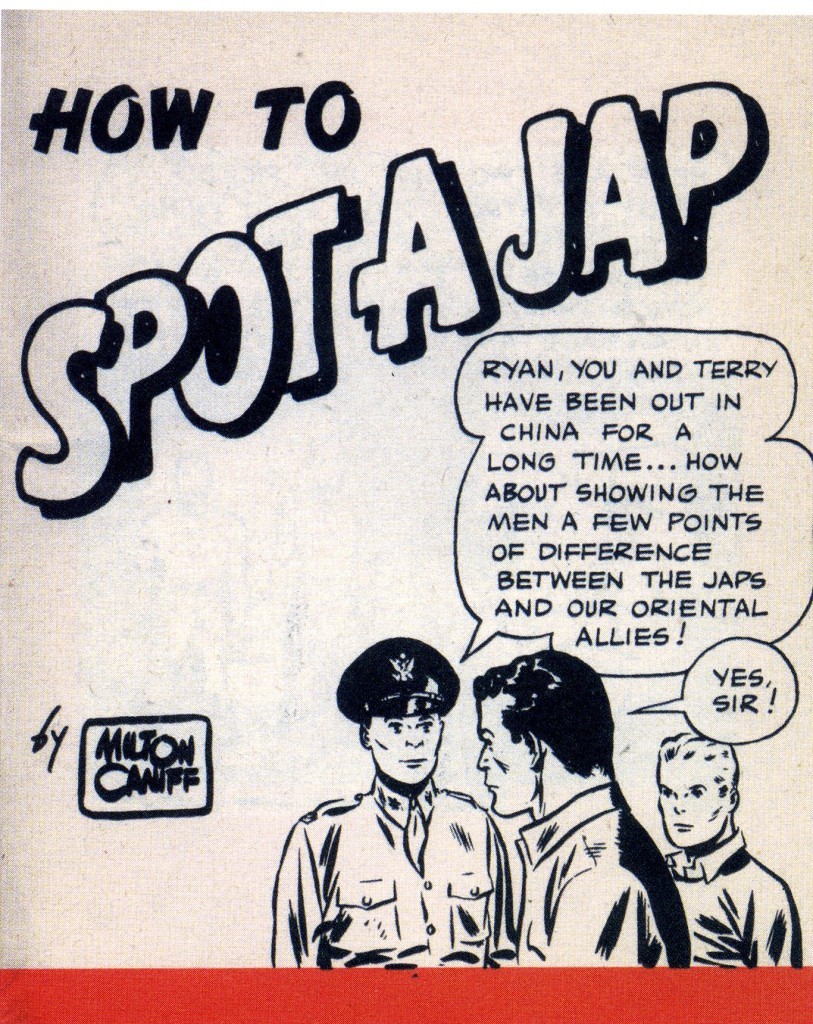
Others could cover strategic insights that would need to be acted on by instinct when in combat–
–like this other piece by Milton Caniff, that has some dated, loaded language. Comics and other media of course were subject to prejudices of the time, reflected in language and stereotypical images. This was true for all comics, not just military and government funded ones: Walt and Skeezix, great in many other ways, had the stereotypical large lips and noses that artists used to portray African Americans.
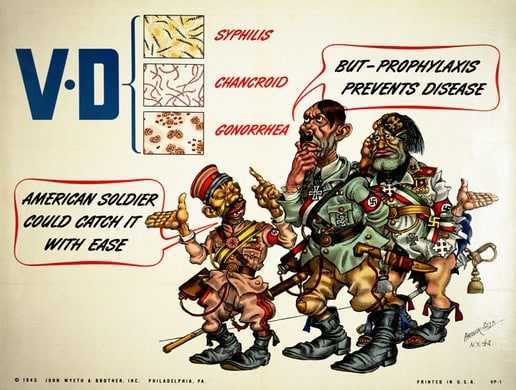
Some supported health education, especially new health concerns inherent in that new environment or inherent in activities soldiers commonly do overseas–
–like this cartoon by Arthur Szyk about the dangers of venereal disease and prevention options:
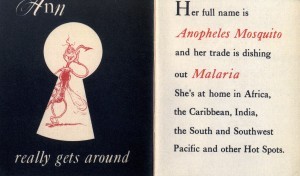
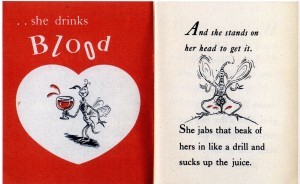
Even Dr. Seuss jumped on this health bandwagon, although the “comics” he created are more similar to the formats of children books made by him and others like him:
Most of these above comics are pretty boring and straightforward, but many comics of the time created salacious narratives out of their informational agendas. Some added sexy images (that have since been limited and removed from contemporary military comics) and some added action and humor to engage the soldiers reading the piece, thinking that more excitement would lead to better education.
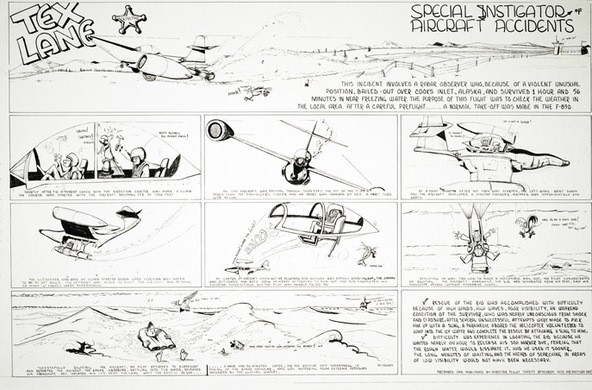
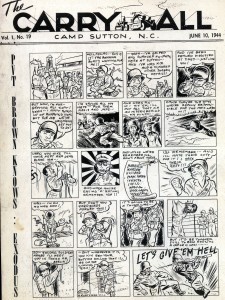
As a teacher, I’ve found this to be generally true, but–honestly–sometimes work ethic matters more. That being said, this approach was successful, as seen by characters like Tex Lane–a comic only circulated on the Elmendorf Air Force Base in Alaska it was created, offering more of a unique and personable approach to its readers:
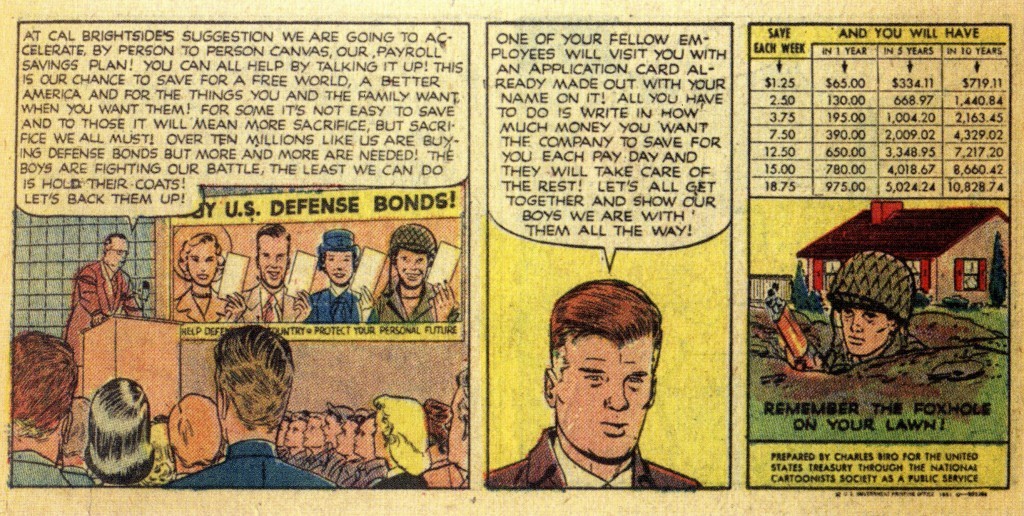
And, yes, sometimes these comics mixed the information with some patriotic propaganda–like Charles Biro, creator of Airboy did with this comic about a payroll savings plan, making citizens save smarter for the long haul of the war. The left two panels push the patriotic agenda heavily and the last panel offers some informational guidance to balance it:
Sometimes, due to the patriotic appeal taken precedence (and a desire for stronger images), comics would inform in a less direct, more implied way, instead of explicitly offering information like the above ones do. One such example of this type of comic is from Robert Osborn, showing (without telling) the proper technique to save a fellow soldier from drowning:
And, of course there were comics that were purely for propaganda, like this one by industry great Harvey Kurtzman:
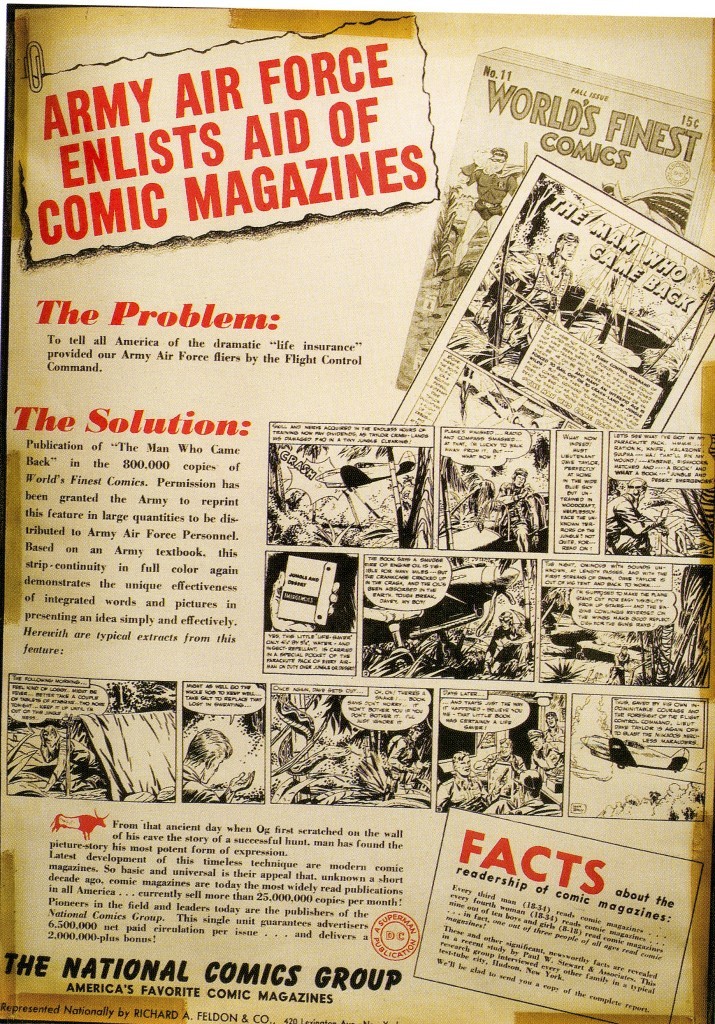
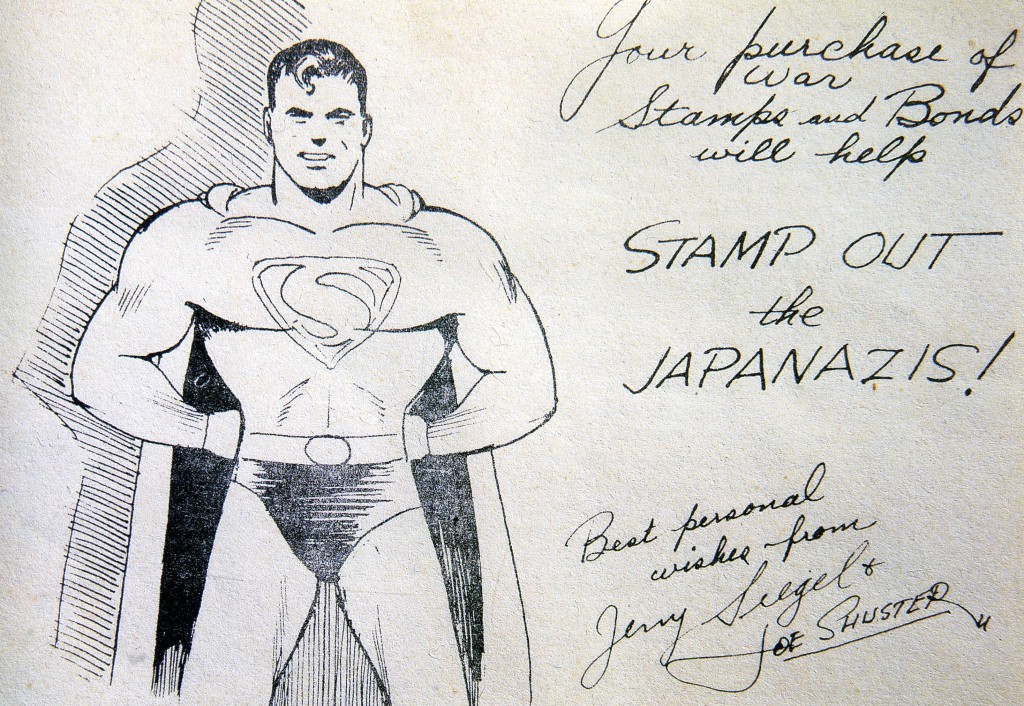
The government even reached out to Marvel and DC comics for help pushing this patriotism, because–after all–who’s more patriotic than Captain America, Wonder Woman, and Superman? And who can so no to that appeal, especially when the creators of these icons were involved, like Siegel and Shuster were in the image below?
I briefly touch on this propaganda for a few reasons:
To remind us that it still existed and was probably the biggest type of government-funded comics during this era. While it’s not my focus for this piece, it would be less than honest to give this proper context.
To show that sometimes propaganda and informational purposes mix.
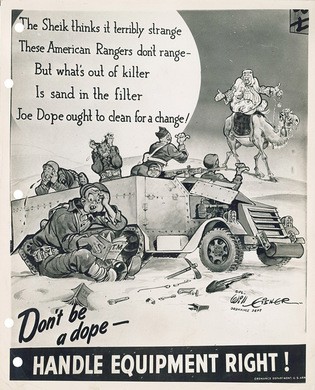
And to transition into this last example, a piece of propaganda by an artist that would go on to have a drastic impact on military informational comics.
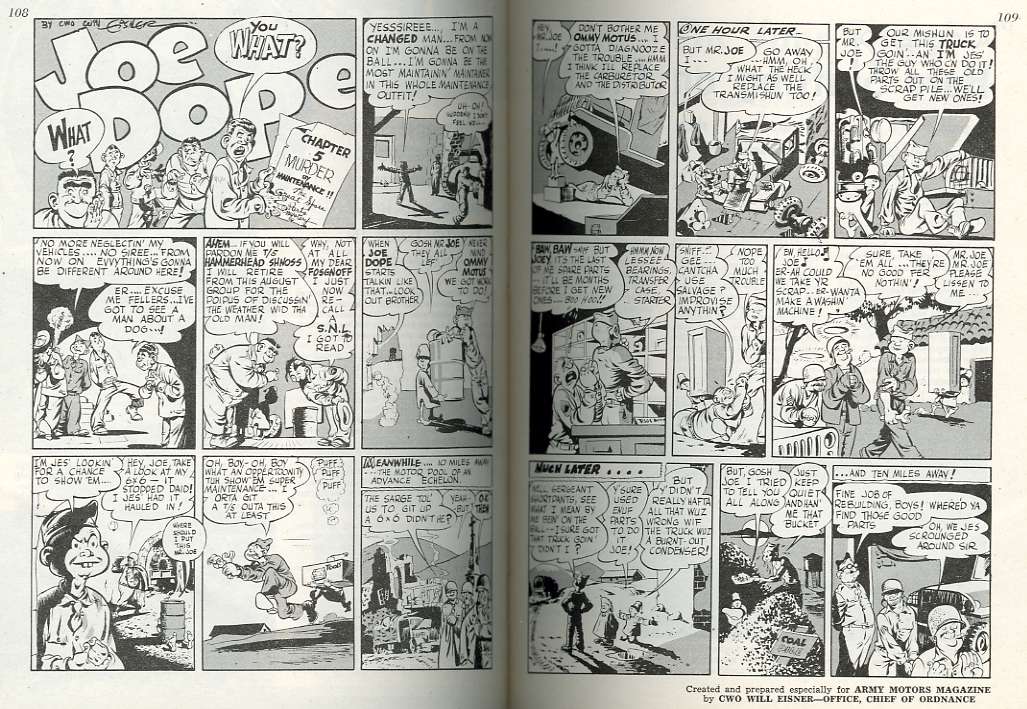
Private Will Eisner, famed creator of The Spirit and, later, A Contract with God arrived at his boot camp in 1942, where he was enlisted to create comics.
Some of his earliest military comics work was for Army Motors—often starring Joe Dope, a soldier who suffers for not following proper procedure (thus showing the procedure that should be followed and the reasons for following it).
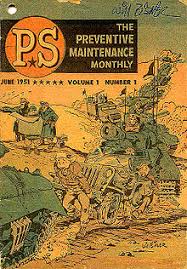
After World War II, Eisner would be responsible for one of the military’s biggest pushes into informational comics. This time he wasn’t enlisted, though, having left the military to start American Visuals Corporation. AVC was soon contacted to produce PS, the Preventative Maintenance Monthly, the comic that rose from Army Motors’ ashes in 1951.
PS–a postscript of sorts for other technical manuals and preventative maintenance guides published by the military–used comics to once again inform the everyman in the military. Comics showed soldiers how to properly take care of equipment and prevent equipment failures that would be costly, both in bucks and bodies. And Joe Dope was back to help instruct as the, well, Dope who did everything wrong.
PS often used infographics (infographics being one of the most widely used ways that comics can deliver information clearly and concisely) like the one above. As many comics and other media of the time period, women were portrayed in a sexualized way to grip the interest of the males reading the comic. Of course that still applies to media today, but PS has moved away from portraying women in this way.
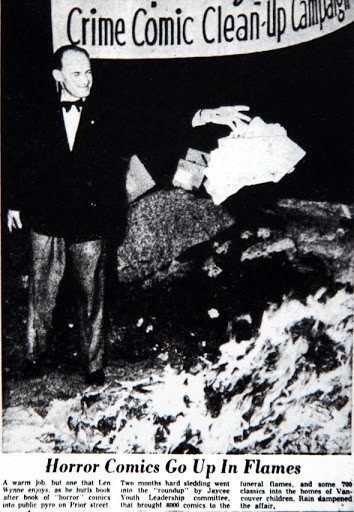
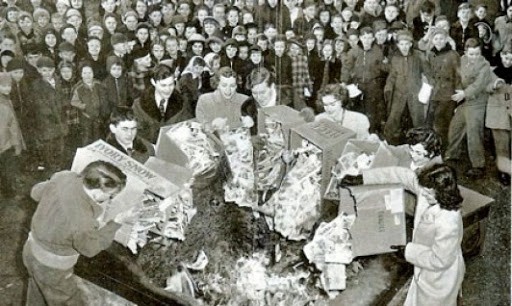
Part of what makes this move so surprising, is that PS was gaining steam just as comics in America were blazing out: Wertham’s Seduction of the Innocent and Congressional Committees were portraying comics as corrupters of youth, leading to laws against comics, comic burnings, and the Comics Code Authority. (All that’s a story for another time, though). Simply put, as many times in the past, the government fought against a media at the same time it was co-opting it for its own purposes.
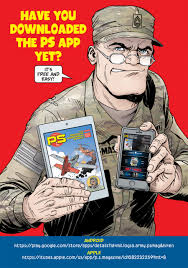
Not only did PS stick around through the Comic Scare, it has stuck around to today. Like many paper periodicals, though, it has gone digital. The 771st issue (November, 2017) was the last print copy. But soldiers can still read comics that inform and entertain them on the PS magazine app, available on smartphones. The evolution of PS is a story for another article, though.
Before we leave our first foray into informational comics, specifically government-backed informational comics, there is one more topic to cover: government comics that were created outside of the military, available and intended for all citizens. Seeing the success of the military comics, the US government decided to distribute comics on a bunch of other issues of national concern: health, education, safety, and more.
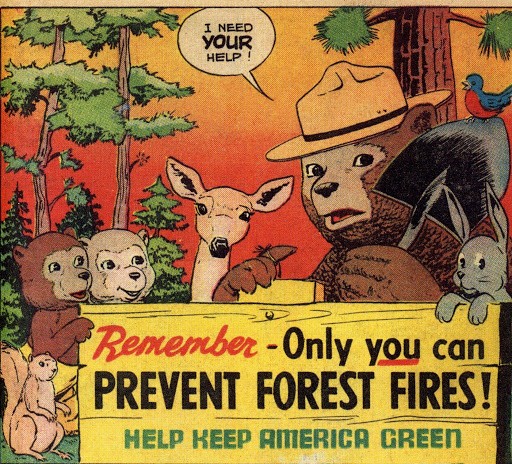
Smokey Bear (not Smokey the Bear, as he is commonly misidentified) was one of the first public-funded comic characters created, helping spread a message against forest fires that still resonates with today’s citizens, albeit in a different way and for different reasons. The above slogan–the most familiar to Americans–was created in 1947, but Smokey Bear was created in 1944 by artist Albert Staehle and writer Harold Rosenberg. He was created for a U.S. Forest Service ad campaign and became the longest running PSA character and campaign.
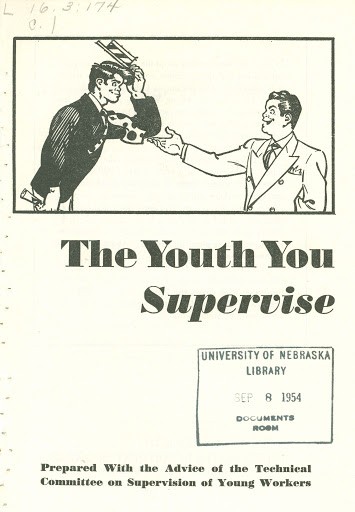
Like military comics, the government continued these educational comics even in the midst of the comic scare amplified by Wertham. Trying to help anyone working with adolescents and children–educators, coaches, and parents for instance–the government created a manual that offered comic advice. “The Youth You Supervise” was released in 1954, and, like many military comics, it drew on established comic creators and figures, featuring Al Capp’s Li’l Abner.
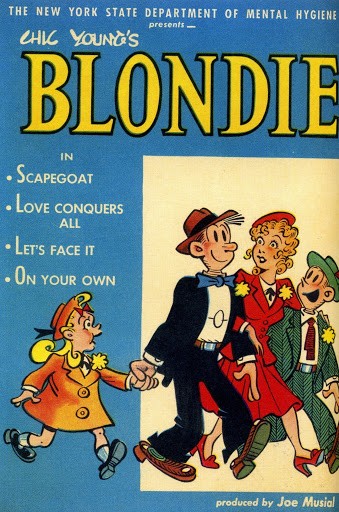
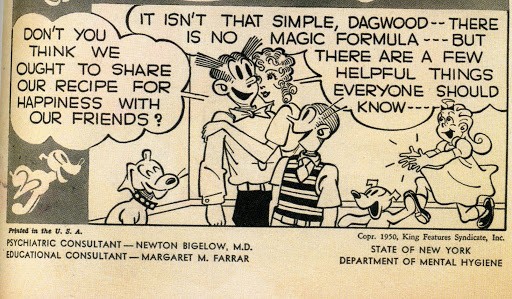
Most of our focus in this article has been on comics from the federal government, but states jumped on this bandwagon too. The New York State Department of Health, under the Department of Mental Hygiene, published a comic that focused on tips to maintain positive mental health. Like with Li’l Abner, they decided to use a popular comic strip character: Blondie and Dagwood.
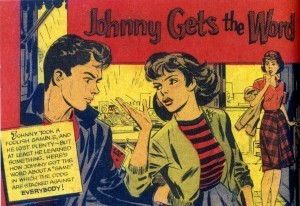
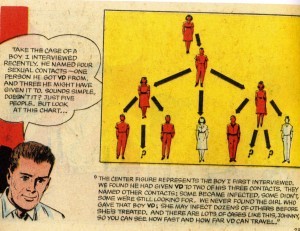
The Health Services Administration in the Department of Health in New York also made comics about sexual health a priority, as seen in the Health Department’s comic “Johnny Gets the Word”, published in 1957. The “word”, in this case, is syphilis. And STDs in general were tackled in infographics like the one below:
The sexual nature of this comic–including discussing that teenagers might have mutliple sexual partners–marks a controversial topic that Wertham might have campaigned against; maybe Wertham was more concerned with superhero comics and EC comics, comics that were marketed towards children and made a profit.
After an onslaught of military comics, the government had decided to use comics for other purposes, a use that would only continue to expand. And it would expand outside of government: Marvel and DC would join the game, using superheroes to educate their readers; traditional book publishers would also get on the board, giving rise to biographies and other traditional nonfiction graphic novels. But those are stories for future installments.
A preview of some of those comics that will be studied in future installments. Note: they don’t represent my views (I was never a fan of “Don’t Ask, Don’t Tell” for instance).
You’d have to have been living under a rock to have avoided the refugee and, to a lesser extent, the immigration discussions occurring this past week due to the executive order signed by President Donald Trump.
As an immigrant myself, it’s a discussion that I’ve been paying some attention too.
First things first, though, is that I should clarify that my situation in no way resembled the plight of those from Syria or other war-torn regions. As a white man immigrating from the United Kingdom it would be offensive to those refugees to say that I know what they’re going through. I don’t.
I genuinely hope that I never will.
Indeed, I have been present in my new country when people start talking about “the immigrants” taking their jobs because they didn’t consider me an immigrant. This was shortly after asking about my accent. I may be a white guy, but my accent sure isn’t from this side of the pond. That’s about as much prejudice as I have ever encountered on my end, directly, and while I found it exasperatingly funny at the time, it does go to show the general sense that a (very) few have toward immigrants (at least in my experience, but as I said, mine is not the same as the Syrian refugees. Not even close). Even comparing a refugee to an immigrant is a slippery slope; while some immigrants such as myself arrive in a new country of their own volition, some undoubtedly feel forced out of their homes, due to escalating conflicts or tensions at home. But either way, the immigrant has a little more freedom to make the decision. A refugee has no choice in the matter; they just want their family to feel safe.
And the type of safety that the Syrian refugees are currently seeking, and the scale of the horror’s they are running from is something that many of us have no personal experience with. Hopefully we never will, but that doesn’t preclude us from having some empathy for them, either.
My family have lived in England for as long as I am aware (my Aunt traced my grandfather’s line back to around the 1700’s, give or take), so I can’t knowingly claim that there is any immigration within my family’s past (myself aside), but that’s not necessarily true of people living on this side of the pond.
There are millions of people in North American who can trace their families back across the years and the oceans to other countries, when their ancestors left their home lands for fear of persecution or simply to hope for a better life.
This is especially true when it comes to some of the early and/or influential members of the comic book community.
Indeed, many of the greatest names in American comics are often the first generation born in the new country, such as Art Speigelman (the author of Maus), Bill Finger (co-creator of Batman, Green Lantern, and many many others), Jerry Siegel and Joe Shuster (the men who created Superman). Even Bob Kane‘s (Batman‘s other co-creator) parents were of Eastern European Jewish descent. The point I am attempting to make here is that the sons of Jewish immigrants created some of our biggest super heroes, and some of our greatest stories.
And what of their creations?
Superman is an alien from another planet who’s family sought refuge for their only child from the end of their world. He is far from native to any country on Earth, yet he has chosen to make the planet his home. Far beyond just simply moving from country to country, Superman is an interplanetary immigrant that kick started the modern superhero comic.
And he’s not the only immigrant in comics, either; Supergirl, the Martian Manhunter are but two of the early inter-planetary examples, X-O Manowar is both a geographical and chronological immigrant (it sounds confusing when typing it like that, but the character is as rich and deep as any other on this list). Howard the Duck has been trapped in a world that he’s slowly become accustomed to, but was never his own; and Thor Odinson has been protecting our world for centuries – and even without his hammer he continues to do so. The idea of a hero from the stars come to save humanity (or in the case of Howard the Duck to simply work amongst us) is an idea that as comic book fans we’re all enamored with , and in many cases these interplanetary immigrants have become some of the most beloved, and powerful, characters in the comic book reading world.
In terms of the more traditional Earthbound type of immigration, the of moving between countries, look at almost the entire second team of X-Men; Banshee, Colossus, Nightcrawler, Sunfire, Storm and Wolverine are all from countries other than the US. You know what that makes them, eh?
If these characters were ignored because they were immigrants, both of the interplanetary and Earthbound nature, would comics, nay, popular culture, even have the same face? The Superman symbol is an internationally recognized symbol of truth, justice, and the American Way, and Wolverine is arguably one of the most popular characters to ever appear in a comic book. What if the parents of the previously mentioned creators, and the numerous others I haven’t named who are also descended from immigrants, were trying to escape their living conditions to provide a better life for their families today? Would we still want to turn them away?
If it wasn’t for the sons and daughters of refugees and immigrants the comic book landscape, and perhaps even our way of life would be drastically different than what we’re used too. Before you add your voice to those who say we should close up our borders, take a long hard look at your family history, at the characters you love, and tell me where you would be if the country you call home had refused to admit any new immigrants at any point in the past two or three hundred years.
Would you still be sat here reading this, if your ancestors hadn’t had the opportunity to live a new life in North America?
You’d have to have been living under a rock to have avoided the refugee and, to a lesser extent, the immigration discussions occurring these past few months.
As an immigrant myself, it’s a discussion that I’ve been paying some attention too.
First things first, though, is that I should clarify that my situation in no way resembled the plight of those from Syria. As a white man immigrating from the United Kingdom it would be offensive to those refugees to say that I know what they’re going through. I don’t.
I genuinely hope that I never will.
Indeed, I have been present in my new country when people start talking about “the immigrants” taking their jobs because they didn’t consider me an immigrant. This was shortly after asking about my accent. I may be a white guy, but my accent sure isn’t from this side of the pond. That’s about as much prejudice as I have ever encountered on my end, directly, and while I found it exasperatingly funny at the time, it does go to show the general sense that a (very) few have toward immigrants (at least in my experience, but as I said, mine is not the same as the Syrian refugees. Not even close). Even comparing a refugee to an immigrant is a slippery slope; while some immigrants such as myself arrive in a new country of their own volition, some undoubtedly feel forced out of their homes, due to escalating conflicts or tensions at home. But either way, the immigrant has a little more freedom to make the decision. A refugee has no choice in the matter; they just want their family to feel safe.
And the type of safety that the Syrian refugees are currently seeking, and the scale of the horror’s they are running from is something that many of us have no personal experience with. Hopefully we never will, but that doesn’t preclude us from having some empathy for them, either.
My family have lived in England for as long as I am aware (my Aunt traced my grandfather’s line back to around the 1700’s, give or take), so I can’t knowingly claim that there is any immigration within my family’s past (myself aside), but that’s not necessarily true of people living on this side of the pond.
There are millions of people in North American who can trace their families back across the years and the oceans to other countries, when their ancestors left their home lands for fear of persecution or simply to hope for a better life.
This is especially true when it comes to some of the early and/or influential members of the comic book community.
Indeed, many of the greatest names in American comics are often the first generation born in the new country, such as Art Speigelman (the author of Maus), Bill Finger (co-creator of Batman, Green Lantern, and many many others), Jerry Siegel and Joe Shuster (the men who created Superman). Even Bob Kane‘s (Batman‘s other co-creator) parents were of Eastern European Jewish descent. The point I am attempting to make here is that the sons of Jewish immigrants created some of our biggest super heroes, and some of our greatest stories.
And what of their creations?
Superman is an alien from another planet who’s family sought refuge for their only child from the end of their world. He is far from native to any country on Earth, yet he has chosen to make the planet his home. Far beyond just simply moving from country to country, Superman is an interplanetary immigrant that kick started the modern superhero comic.
And he’s not the only immigrant in comics, either; Supergirl, the Martian Manhunter are but two of the early inter-planetary examples, X-O Manowar is both a geographical and chronological immigrant (it sounds confusing when typing it like that, but the character is as rich and deep as any other on this list). Howard the Duck has been trapped in a world that he’s slowly become accustomed to, but was never his own; and Thor Odinson has been protecting our world for centuries – and even without his hammer he continues to do so. The idea of a hero from the stars come to save humanity (or in the case of Howard the Duck to simply work amongst us) is an idea that as comic book fans we’re all enamored with , and in many cases these interplanetary immigrants have become some of the most beloved, and powerful, characters in the comic book reading world.
In terms of the more traditional Earthbound type of immigration, the of moving between countries, look at almost the entire second team of X-Men; Banshee, Colossus, Nightcrawler, Sunfire, Storm and Wolverine are all from countries other than the US. You know what that makes them, eh?
If these characters were ignored because they were immigrants, both of the interplanetary and Earthbound nature, would comics, nay, popular culture, even have the same face? The Superman symbol is an internationally recognized symbol of truth, justice, and the American Way, and Wolverine is arguably one of the most popular characters to ever appear in a comic book. What if the parents of the previously mentioned creators, and the numerous others I haven’t named who are also descended from immigrants, were trying to escape their living conditions to provide a better life for their families today? Would we still want to turn them away?
If it wasn’t for the sons and daughters of refugees and immigrants the comic book landscape, and perhaps even our way of life would be drastically different than what we’re used too. Before you add your voice to those who say we should close up our borders, take a long hard look at your family history, at the characters you love, and tell me where you would be if the country you call home had refused to admit any new immigrants at any point in the past two or three hundred years.
Would you still be sat here reading this, if your ancestors hadn’t had the opportunity to live a new life in North America?
A book chronicling Art Spiegelman‘s creation of Maus comes out on October 4. The book includes a DVD, and below is the trailer with more info on the creation of the book.











 A version of this originally ran January 2016.
 Indeed, many of the greatest names in American comics are often the first generation born in the new country, such as Art Speigelman (the author of Maus), Bill Finger (co-creator of Batman, Green Lantern, and many many others), Jerry Siegel and Joe Shuster (the men who created Superman). Even Bob Kane‘s (Batman‘s other co-creator) parents were of Eastern European Jewish descent. The point I am attempting to make here is that the sons of Jewish immigrants created some of our biggest super heroes, and some of our greatest stories.
 In terms of the more traditional Earthbound type of immigration, the of moving between countries, look at almost the entire second team of X-Men; Banshee, Colossus, Nightcrawler, Sunfire, Storm and Wolverine are all from countries other than the US. You know what that makes them, eh?