
Tag Archives: ryan gosling

Movie Review: First Man

firstmanposterFirst Man is a beautiful film celebrating the best in human achievement and brings drama and stakes to a story despite us knowing the ending. It still has some flaws, but its cast shines through and delivers a nostalgia blast of epic proportions as it tries its own moonshot of earning more Oscar gold for its director Damien Chazelle and main cast Ryan Gosling as Neil Armstrong, the eponymous First Man, and Clair Foy as his wife Janet.

The other shining star of this film is it supporting cast. This includes such mainstays as Kyle Chandler, Jason Clarke, Ethan Embry, Ciaran Hinds, Shea Wigham, Patrick Fugit and Lukas Haas. It’s a cavalcade of “Oh, hey, I know that guy!” character actors doing their normal workmanlike best. But the true gem here is Corey Stoll as Buzz Aldrin. He’s everything that Armstrong is not in terms of being outward emotive, and even funny, and Stoll really relishes the part, having fun with every moment that you can.

Director Damien Chazelle here has two major moves. First he relies on the cinematography of the film to really offer some breathtaking emotions and empathy for what things were like for the early astronauts. Rather than the slick space-age feel of a lot of films about the era, Chazelle shows a lot of the dirt, grime, and machinery. We have so many other classic films that depict this era. Philip Kaufman’s The Right Stuff is still an amazing primer and still worthy of anyone’s attention even 35 years after it came out– focusing on the Mercury missions that predated the Gemini and Apollo programs. And Ron Howard’s Apollo 13 is an appropriate denouement for this film, as it shows what happens just less than a year later and everything that could have gone wrong that did not in the Apollo 11 mission. But the approaches could not be more different. Howard makes space feel slick and cool. Kaufman is a little more down and dirty, but less personal. Chazelle, by focusing so closely (literally) on his subject in these tight, confined spaces makes many of the films most intense moments feel claustrophobic and unsafe, even though you know the outcome of the film. Chezelle uses his camera lens to capture that feeling and put us as the audience as close to it as possible. We feel uncomfortable. We feel the tension.

His second trick is to emphasize the Man in First Man. Gosling is a character study as Neil Armstrong, with a sedate, understated tone that gives off a coldness, when we the audience recognize that underneath that placid surface is a turbulent whirlpool of emotion, barely held in check. While Gosling does an amazing job doing so much with so little, it is Claire Foy who really brings us in to the emotion of this piece. At once a master class in acting on her part, and also a commentary on the sacrifices forced on women in the era, and especially of these astronaut wives, she is able to show all of the heartbreak that we the audience feel. We empathize with her as her husband throws himself into his work and mission rather than putting his family first. His emotional compartmentalization takes a toll, and it’s heartbreaking to watch.

As I said in my review of Dunkirk last year, it’s important to note that whenever a filmmaker, especially one with the cache of a Chazelle or Christopher Nolan, at this time of greater cultural awareness decides to make a film with a mainly or even exclusively white and/or male cast, something needs to be investigated about that deliberate choice. Especially when the last film about the space program in this era was Hidden Figures, it’s social malpractice to not even note this. While I won’t go as far as The New Yorker’s claim that First Man is “accidental right wing fetish object,” it is still a story about white male heroism extolling a reserved, square-jawed version of masculinity that isn’t exactly toxic but isn’t exactly woke, either. However, to his credit, Chazelle is able to work with some of this and turn Foy’s and other women’s performances into a commentary on sexism and the gender politics of not only the 1960s, but also (reflectively) today.

On the racial bits, however there’s a bit more of a failure. One of the best bits of the film is as the Apollo missions are preparing, he cuts to some protests outside of Cape Kennedy, where we see people calling for the end of NASA and the moon mission, including a black man singing a song about how he doesn’t have a job or food to eat, but they’re putting white people on the moon. He has a point, and it’s important to note that whenever we tell a story like this that is primarily about white men, there needs to be space made as to why that choice was made. I’m not sure Chazelle really passes that bar here, but he certainly did a better job at it than Christopher Nolan did with Dunkirk. (low bar)

Regardless, the best thing you can say about a film that chronicles historical events, especially ones that are so well documented and remembered in recent history, that you feel a certain tension and anxiousness as events unfold, even though you know what is going to happen. That is the true testament of this film and why it works.

But the film doesn’t really reach its greatest heights until the very end. The scenes on the moon and the way they present it celebrate the majesty and greatness of the moment. It also has some specific personal payoff for Armstrong which will likely demand many audience members bring tissues. But perhaps its best moment is when it saves a key piece of space history into the mix. It is JFK’s “We choose to go to the moon” speech:

It’s hard to listen to this without tearing up a little bit.

“There is no strife, no prejudice, no national conflict in outer space as yet. Its hazards are hostile to us all. Its conquest deserves the best of all mankind, and its opportunity for peaceful cooperation many never come again. But why, some say, the moon? Why choose this as our goal? And they may well ask why climb the highest mountain? Why, 35 years ago, fly the Atlantic? Why does Rice play Texas?” (note: this was the most hilarious inadvertent laugh line in our Austin screening)

“We choose to go to the moon. We choose to go to the moon in this decade and do the other things, not because they are easy, but because they are hard, because that goal will serve to organize and measure the best of our energies and skills, because that challenge is one that we are willing to accept, one we are unwilling to postpone, and one which we intend to win.”

It’s hard to hear that, to understand the risk, the sacrifice that went into our space program, and not think about so many other societal issues that face us. Almost a decade ago I blogged about this same issue and the need to take climate change as seriously as Kennedy took going to the moon. And with the publishing of the new UN report on climate change, we now know we have even less time to avoid disastrous warming.

If you can put aside the gender and racial politics of First Man and take it as a story of everything we can and should be able to accomplish if we put the right resources into it, I hope we can take that hope that might be able to save humanity.

3.75 out of 5 stars
Movie Review: Blade Runner 2049 is a Masterpiece

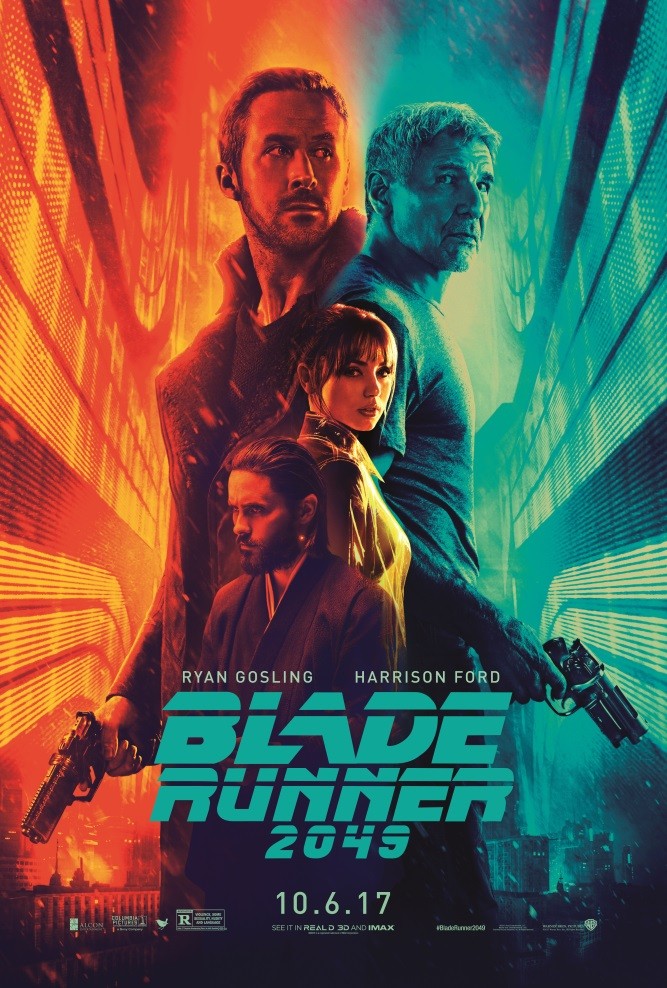
Blade Runner 2049Blade Runner 2049 is a masterpiece and 2017’s best film.

And beyond that I’m not going to tell you anything more about its plot, characters, or anything else you’d expect from a movie review. Don’t let anyone tell you too much about it apart from what you’ve seen in the trailers, as this is a film that deserves to be experienced without much else in the way of explanation.

And, for the love of all that is holy, after you’ve seen it—don’t spoil it for your friends. Just tell them to go see it, too. And go see it with them. And then spend hours afterwards obsessively discussing everything about it.

Suffice it to say it is a continuation of the story from 1982’s Blade Runner set decades in the future in 2049. Ryan Gosling works for the LAPD hunting down and “retiring” rogue replicants, the same job Harrison Ford’s Deckard had in the original. And he uncovers something that threatens to turn their entire world upside down.

Despite his prominent placement in the trailers, don’t expect this to be a Ford / Gosling buddy cop movie. It’s not. Ford doesn’t show up until later, with even less screen time than his turn in 2015’s Star Wars: The Force Awakens. However, his role is vital, and answers lingering questions definitively (though not overtly) that fans have often asked about Deckard.

Director Denis Villeneuve cements himself here as one of, if not the outright, best directors working today. (Public Service Announcement: impress your friends by pronouncing his name correctly. Remember that he is French Canadian, so his first name sounds  more like “Deni”—think like what John Snow calls Daenerys but with an e instead of an a. And his last name is “Vill-neve.” Say it like the beginning of “villain” and “nerve” but without the r.)

Villeneuve pulls incredible performances out of his actors. He understands exactly the world and mythos he’s playing in (arguably better than Ridley Scott?) He understands pacing and tension better than anyone else working today- if you saw Sicario, Prisoners, or Arrival, those were all just the warm up act.

And on top of all of that he has the most incredibly keen eye for visuals. He brings to life the world of this dystopian wasteland in 2049, and does it all in beautiful darkness and light. Again, his play with the darkest darks and hiding things, and his beautiful eye for how different wavelengths of light bring different feelings to the scene shows a master at work.

Just know that there are some amazingly beautiful things here. Giant skyscraper-sized women advertise companionship. A fight in a derelict casino takes place between Ford and Gosling while a glitching hologram Elvis and dancers perform in the background. Ana de Armas and Mackenzie Davis meld/merge into one person.

And then there’s Jared Leto. His turn as the head of the giant corporation producing replicants has an air of a techno-Jesus Zillionaire PsychoDoucheBro. If you hate Leto, you’re going to hate him more—and be glad Villeneuve keeps him shrouded in shadow for much of the movie. If you like his performances, you’re going to hate him, too.

But the real stars of the film are the women. Apparently, the dystopia of Blade Runner is only slightly less misogynistic than the dystopia of The Handmaid’s Tale. Mackenzie Davis (Halt and Catch Fire) is Mariette—and we should likely take that name more literally as marionette—echoing exotic dancer Zhora from the original. As a newer model replicant, she cannot disobey orders and engages in sex work: she is stripped of agency and therefore the ability to consent. So every sexual encounter is therefore rape.

Ana de Armis is even more stunning, for reasons I won’t go into, because spoilers. But her place as Gosling’s girlfriend Joi make you question the nature of love. . .  and then by the end you get the rug ripped out from under you and recognize just how awful this existence is.

Leto’s henchwomen “Luv” (even the name is cringe-y for how women are treated) is also amazing, with a performance from Sylvia Hoeks that rivals any recent femme fatale. She displays a singular focus reminiscent of a Terminator and a glee in carrying out her orders.  But still, all of them are robbed of any real choice in their circumstances.

And then there’s Robin Wright – who is having a spectacular year – as Gosling’s boss and apparently the only woman in all of Los Angeles with any sort of moral agency of her own in this universe. She’s perfect, and this is the kind of role someone gets nominated for Best Supporting Actress for (but really they’re also nominating her for Wonder Woman, but can’t say they’re doing that.)

And it’s within these performances of all of these actors in top form and their various character arcs that we illuminate incredibly deep themes and questions about the nature of existence. Many of these were covered in the original Blade Runner as well, which is why this works so well as a true sequel.

What makes someone human? What purpose do memories and dreams serve? Can artificial intelligences love? Do they feel?

But this film also treads astonishing new ground. It provides a stunning critique of humanity that some might call Marxist—we’ve always depended on forms of slavery, so why not replicants? But, amazingly, we find out that even in a world with robot slaves (let’s be real, that’s what they are), we find there are still sweatshops and child labor. To what extent is everything built on the exploitation of labor? (see? Marxism.) The film reveals, but never answers. And that’s part of what makes it so impressive.

To fully understand what this movie is without revealing too much about it, I have found the best way to discuss it is by saying exactly what it is not. And perhaps the best way to discuss that is to compare it to two other spectacular failures of 2017: Ghost in the Shell and mother!

Ghost in the Shell felt the need to explain everything and dumb things down for the audience. mother!  was too pretentious and ponderous to have any meaning at all, always showing off how smart and deep it was rather than actually getting around to any real point. Blade Runner 2049 splits the difference between these two. It expects a lot from the audience, in much the same way Arrival did last year. But its themes and meanings are clear and reach a logical conclusion, while still leaving room for vigorous discussion and debate. But unlike Arrival and perhaps more like Sicario, it offers a basic narrative that even someone not wanting to watch serious science fiction could enjoy as a basic neo-noir drama with occasional fights and explosions.

Ghost in the Shell and mother! completely missed the mark on their source material (if you include the Christian Bible as source material for Aronofsky’s mess of a film) and seemed almost designed to peeve the target audience who might otherwise like what you would have to say based on their fandom. And at least in the case of mother!, one needed to be familiar with biblical stories and themes to understand what was happening. For Blade Runner 2049, fans of the original film or the Phillip K. Dick story it’s based on will be rewarded. But perhaps even more remarkably, there is zero barrier for entry. You don’t need to know these to understand or enjoy the film. Even better, Blade Runner 2049 nails its biblical allusions, while mother! shows a sophist’s view with all the understanding of the Bible of the most smug atheist subreddit known to man.

And finally, Ghost in the Shell and mother! made questionable choices when it came to whitewashing the main character and treatment of its female main character respectively. While some have tried to play this off as “commentary” (Well, that’s how it is, isn’t it?), their apologism rings hollow. Villeneuve’s previous work on his last two films shows he knows exactly what he’s doing with his female leads. While he can take the hit as the central storyline is still about men and conflict between men while women are robbed of their equality and humanity, I believe the social commentary comes down to Leto and Wright and their performances.

Leto’s Tech Jesus DoucheBro is obsessed with creation of life, and specifically procreation. [Minor spoiler] At one point he even takes a new”born” female replicant and stabs her in the abdomen where her uterus would be, pointing out the “flaws” in his creations—they can’t make babies.  Here he is at the pinnacle of technology, able to create life, of a sort, if you believe “I think, therefore I am,” but he still demeans women and sees them as nothing more than receptacles for procreation. And empty wombs must mean some sort of failure on his part. . . again, you can see why I said this was only slightly better than The Handmaid’s Tale in its misogyny.

And then there’s Wright. She’s the only woman with any agency in the film. She’s also [minor spoiler] one of only two actual women we meet in this world. So if the women in this universe are treated awfully, it’s because they’ve all been commoditized and replaced with replicants.  The other woman character in a late Act 2 speech talks about “the price of freedom,” when her version of freedom is actually complete isolation from all other people.

And in seeing that women are not free in this future, we also see that no one is free. That’s what makes this a dystopian nightmare. Are self-aware replicants actually more human than human? Are the slaves of society really its masters? Is this where we’re going as a species?

And. . . some of those questions might be more fully explored in a future film. Because, oh yeah, there’s definitely an opening for a sequel here.

This is one of the deepest and most satisfying films of the year. It’s also challenging and multi-faceted. It’s beautiful to watch and shows that even the most sacred of cows can be milked for more material.

We didn’t think we needed a Blade Runner sequel. But Villeneuve delivers here something spectacular: a sequel to a classic that perhaps is even better than the original.

5 out of 5 stars.

Ryan Gosling, Ken Kao’s Waypoint and Anonymous Content will produce the The Underwater Welder by Jeff Lemire

the-underwater-welderThe Underwater Welder is the mind–bending graphic novel written by critically acclaimed, award–winning cartoonist, Jeff Lemire, and published by Top Shelf/IDW Publishing.

Ryan Gosling, Ken Kao, and Anonymous Content will produce the film based on the graphic novel.

A New York Times bestselling graphic novel, the story details a man in the dangerous profession of underwater welding, who has a supernatural encounter at the bottom of the sea.

Jeff Lemire, Chris Staros (Editor–in–Chief, Top Shelf), and Ted Adams (CEO and Publisher, IDW Publishing) are attached as executive producers.

The deal was brokered on Jeff Lemire’s behalf by Angela Cheng Caplan of the Cheng Caplan Company, Inc. and Allison Binder, esq. of Stone, Genow, Smelkinson, Binder & Christopher, LLP, and on Top Shelf/IDW’s behalf by Tuvyah Aronoff of Schwell Wimpfheimer & Associates.