
The 5 Best Comics Set in Ancient Rome
With the long-awaited release of Gladiator II this week coupled with the continued decline of a current empire, ancient Rome is back in the cultural conversation. (Plus there was the whole “your Roman empire” TikTok phenomenon in 2023.) There have been many successful films, TV shows (Spartacus is my personal fave.), and video games about an empire that had such an impact on human civilization that I was studying their “dead” language for college credit in the mid-2010s. In addition to this, there are many wonderful comics where the Roman Empire is the main setting, including one of the most popular comics ever. In my research for this article, I discovered that there was a whole manga series called Plinivus about the life of Roman polymath and victim of the Mt. Vesuvius volcanic eruption, Pliny the Elder, but unfortunately, there’s no English translation so it just missed the cut.
However, here are five comic books set in ancient Rome for you to check out while you wait between Gladiator sequels.
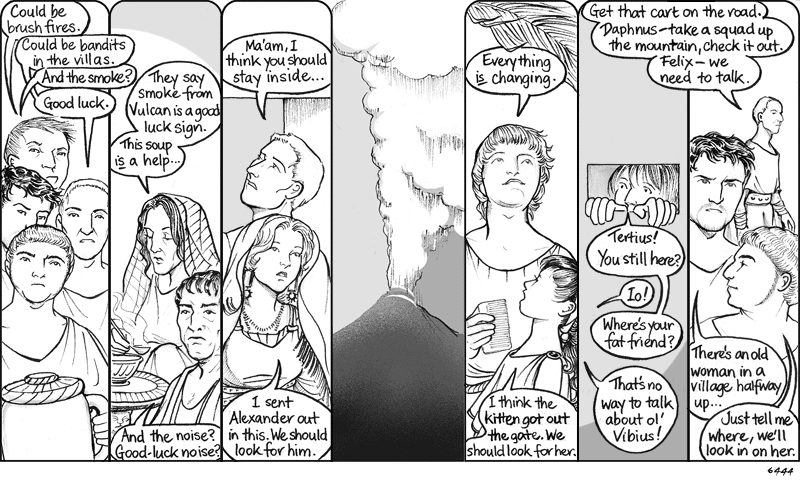
5. SPQR Blues (Webcomic, 2005-present)
Lots of fiction and book about ancient Rome focuses on men with the honorific “Caesar”, the wars and battles of legions, or the political intrigue of a city that makes Washington, DC look like Mayberry. However, Carol Burrell’s SPQR Blues webcomic takes an opposite tack focusing on daily life in Herculaneum before the eruption of Vesuvius during the reign of Emperor Titus. The series follows the ups and downs of the life of former Roman soldier Marcus Felix as he settles down in Herculaneum and runs into his old friend Mus. As the series progresses, there is more intrigue (and murder), and figures from Roman history like future emperor Domitian make appearances. Also, it’s rewarding to see how Burrell’s art style shifts throughout the series going from looser to tighter pencils and more complex backgrounds. Her hand-lettered dialogue is also a continual treat. SPQR Blues is an ancient Roman soap opera with a sprawling cast that really picks up in its second chapter when Carol Burrell elucidates Felix’s backstory.
4. Britannia (Valiant, 2016-2018, 2024)
Written by Peter Milligan with art by Jose Juan Ryp, Robert Gill, and Alvaro Papagiani, Britannia is a supernaturally-tinged detective series set during the reign of Emperor Nero in the first century CE. Its protagonist is Antonius Axia aka the Detectioner, who faced down the monster Orkus in southern Italy and was revived by the Vestal Virgins with special abilities, including the powers of deductive reasoning. Axia’s missions send him all across the Roman Empire beginning in the titular frontier of Britannia to the wilds of Germania and, of course, to Rome itself in a gladiator-centric story called Britannia: We Who Are About To Die. A common thread in the story is the conflict between reason and superstition with Axia representing logic, and his British slave Bran (He’s refused freedom for tax purposes.) representing a belief in the supernatural. Each story has dynamic visuals from artists like Ryp and Gill who have gone on to draw X-Books for Marvel capturing the sex, blood, and rock’n’roll of this period in Roman history. As an added bonus, Britannia came back after a six year hiatus in the one-shot The Great Fire of Rome where Axia must find out the cause of the Great Fire of Rome while, for better or worse, the series becomes part of the greater tapestry of the Valiant Universe.
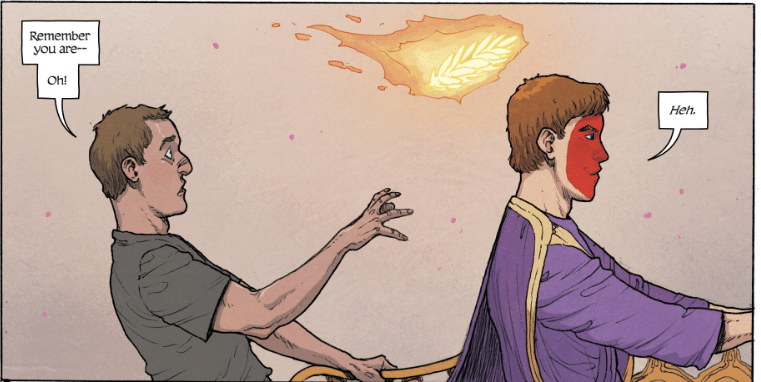
3. The Wicked + the Divine 455 AD (Image, 2017)
In popular culture, the main eras of Roman history that appear are usually the 1st century BCE, the 1st century CE, and the 2nd century CE because it features such heavy hitters as Julius Caesar, Augustus Caesar, and Marcus Aurelius as well as infamous figures like Nero, Caligula, and Commodus. The latter years, or the “decline and fall” of the Roman Empire, don’t get as much love unless figures like Attila the Hun, or by skin of their teeth, King Arthur. However, in this flashback one-shot as part of the modern classic The Wicked + the Divine series, Kieron Gillen, Andre Lima Araujo, and Matthew Wilson nail the decadence and depravity of the final days of Rome as an ancient Roman incarnation of Lucifer takes on the mantle of Julius Caesar, routs the invading Vandals, and refuses to accept his fate as a member of the Pantheon. This comic features one of the most intense and literal portrayals of burnout ever as Lucifer simply can’t accept a world where Rome doesn’t rule the world, but he also wants to be an actor and musician. As the only living member of the Pantheon, he gets to play off Ananke a lot, who wants to keep history traditional, Christian, masculine, and heterosexual instead of queer and rebellious. WicDiv 455 AD is a fun bit of hyperviolent melodrama, especially through the lavish visuals of Araujo Wilson. (Seriously, Lucifer playing one of his senator’s rib cage like a harp has stuck with me for the past seven years.)
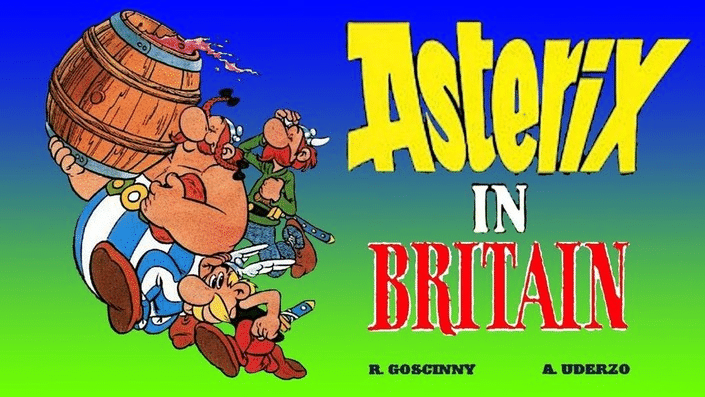
2. Asterix (Various, 1959-present)
Of course, Asterix is on this list and not just to throw a bone to our site’s Francophone readers. Set in and around 50 BCE or thereabouts, Asterix follows the adventures of its titular character, who is a wise warrior and a member of the last Gallic village to resist Julius Caesar’s invasion. He and his not-as-bright, bigger giant monument-carrying friend Obelix defend their village from the Romans while also traveling to a variety of places like Germany, Egypt, Belgium, and even North America on various quests, involving puns, fisticuffs, food, drink, and of course, French stereotypes for other countries during the publication of the book. Although, some of the earlier books are dated at best and racist at worst, creators Rene Goscinny and Albert Uderzo bring a manic, mischievous sense of humor and an anarchic energy to both visuals and wordplay that makes these books highly entertaining reads even in 2024. (My personal favorite volume is Asterix in Britain) Asterix comics could definitely be considered one of France’s finest cultural imports (A close third to Daft Punk and Victor Wembanyama.), and there’s even an Asterix themed amusement park in Picardy with some seriously gnarly coasters. However, the books themselves still hold up (and are still being published) and are definitely worth checking out in 2024 with the caveat that they reflect traditional French stereotypes about the world around them through the lens of ancient Rome.
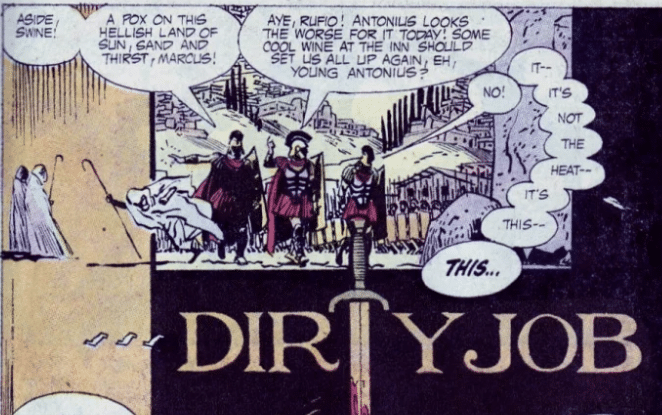
1. “Dirty Job” from Our Army at War #241 (DC Comics, 1972)
My favorite comic story set in ancient Rome is a four page backup story from a long-running DC war comic written by Teen Titans co-creator Bob Haney and drawn by the legendary Alex Toth. It’s about three Roman centurions drinking in a bar after a crucifixion and is one of the most touching anti-war, anti-imperialism, and yes, pro-Christian comic books of all time with Toth’s final page being a silhouette of the crosses on which Jesus of Nazareth and the two thieves hung from the New Testament story. I love the furrows that Toth draws in the face of the conscience-stricken young soldier Antonius, and the way he draws the careless movements of his compatriot, who paws and gropes at the serving women and other workers at the tavern. His layouts also show convey the oppression of the Romans towards the areas that they’ve conquered, and how trapped the centurions feel in following orders and having to do the “dirty work” of executions while their leaders recline in luxury. “Dirty Job” is a masterpiece of the comic book short story form, and its message resonates while empires continue to mistreat innocent people in Palestine on a daily basis.
 Using an even more twisted version of Lucifer from the Pantheon as an object lesson, writer Kieron Gillen, guest artist Andre Araujo (Avengers A.I.), and colorist Matthew Wilson tell the story of Rome in a single narrative that begins with a glorious literal burst of triumph before denigrating into senseless, violence, hubris, and death. The story is set in 455 AD, and the Roman Empire is on its last legs as Geiseric and the Vandals threaten to destroy Rome once and for all. But Lucifer casts aside his name and takes on the mantle of “Julius Caesar” because he thinks he can save the Roman Empire all by himself and not be the 5th century version of Caligula or Nero. He and his boyfriend, Bacchus (The Roman version of Dionysus) get decidedly mixed results from this little escapade.
