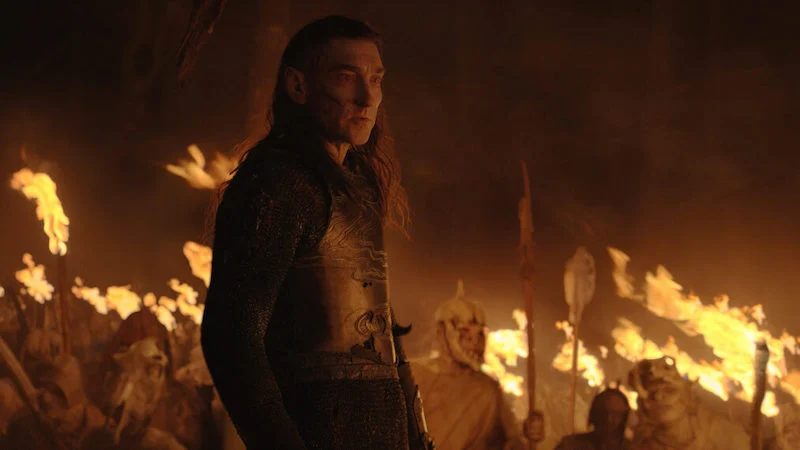
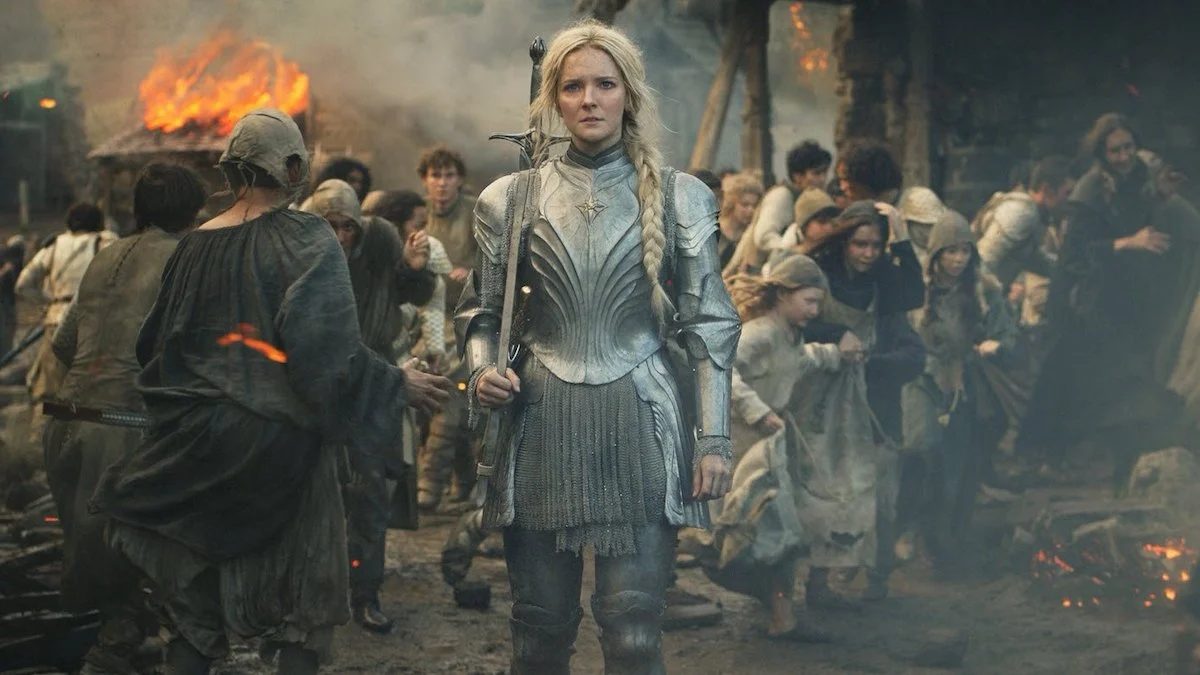
Although it’s not as single-location focused as some of the battle episodes of another certain fantasy show, writers Nicholas Adams, Justin Doble, J.D. Payne, and Patrick McKay center “Udun” around the battle between the humans of the Southlands and Adar (Joseph Mawle) and his Orcs plus a last minute save from the Numenoreans and Galadriel (Morfydd Clark). At times, “Udun” feels like a cover version of Lord of the Rings: The Two Towers, but it distinguishes itself from other Tolkien adaptations by giving psychological depth to one of the Orc characters and its use of the television medium for stronger characterization and long-form mythmaking beyond a feature film. For better or worse, it’s blows Rings of Power‘s storyline wide open and confirms that evil is something that infects the bones of Middle Earth as well as the hearts
Although, at times, he feels like a hybrid of Aragorn and Legolas, Ismael Cruz Cordova continues to nail both the role of action hero and romantic lead with his performance as Arondir throughout the episode. For example, he gets to be part of the big, yet poorly lit opening setpiece where he shoots a flaming arrow and brings down the Elven watchtower. Then, almost immediately he shares a tender moment with the quite badass Bronwyn (Nazanin Boniadi) where they bond over planting a special kind of seed before the battle with the Orcs and save the other seeds for after the battle. This symbolizes them having a future after the war ends. I love that the writers give Brownyn and Arondir a love of growing things in common, and it makes their relationship more organic and believable instead of the usual “crisis bond” in these kinds of movies/TV shows a la Keanu Reeves and Sandra Bullock’s characters in Speed.
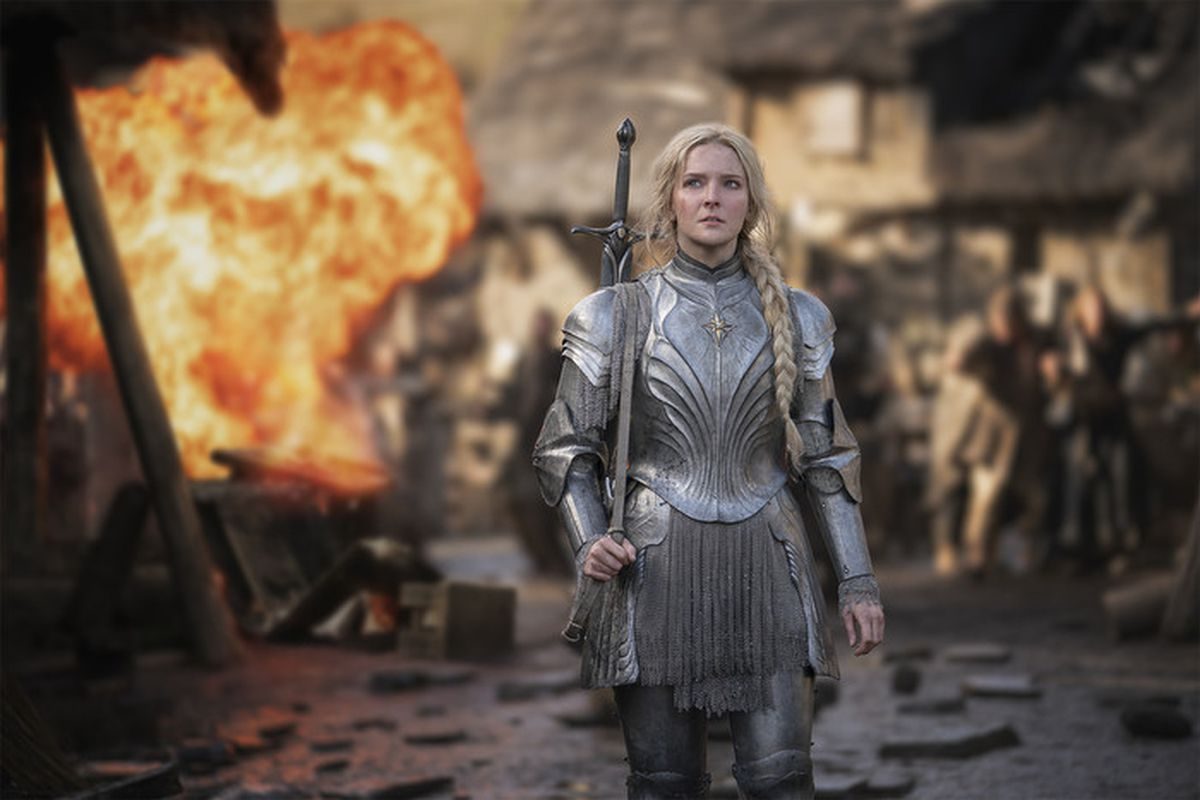
Before they become the literal cavalry saving the day, Adams, Doble, Payne, and McKay use some of “Udun’s” running time to explore the relationship between Galadriel, Elendil (Lloyd Owen), and Isildur (Maxim Baldry). In contrast with the darkness covering the Southlands at the open and close of the episode, the scenes with the Numenorean ships coming to Middle Earth is bathed in the rosy fingers of dawn courtesy of director Charlotte Brandstrom as Galadriel watches Isildur sneak out and look at his first glimpse of land. They have a real general/younger soldier moment with Galadriel reminding him to be humble and the difference between current and idealized Numor. Then, she and Elendil share a terser exchange. The meter of Rings of Power‘s dialogue can be all over the place, but the writers and Owen really nail Elendil’s grief about his wife when asked about her by Galadriel, he mumbles “She drowned”. For now, Elendil is focused on the task at which is liberating the Southlands and installing a quite noble and less roguish Halbrand (Charlie Vickers) as king.
Although, “Udun” excels at the quiet character moments, it falls back on devices and scenarios that appeared in previous Tolkien adaptations. Basically, with the exception of the Orcs dressing up the men of the Southlands as Orcs and using them as cannon fodder and up to the confrontation between Adar and Galadriel, the battle is kind of a Wish.com Battle of Helm’s Deep with a much more TV-budget friendly location and less characters to root for and connect with. For example, Bronwyn telling Theo (Tyro Muhafidin) to protect those who can’t fight is basically verbatim the conversation Theoden has with Eowyn in The Two Towers except Eowyn is a compelling hero, and Theo is a craven brat. And like Gandalf and Eomer, the Numenorean cavalry comes in and saves the day and looks good doing it. The charge isn’t Peter Jackson levels of epic, but Brandstrom does a solid job showing an empire that’s not quite at its peak, yet still pretty glorious. Think the opening battle scene between the Romans and Germans in Gladiator showing the last gasp of imperial power before the decline and fall begins with Marcus Aurelius’ son Commodus.
However, “Udun’s” most powerful scene isn’t a chase scene, cavalry charge, or multi-volcano eruption (Mt. Doom Origins!). It’s an interrogation sequence between Galadriel and Adar where Clark digs into a darker side of her character, and Mawle finds a more sympathetic side of his until it’s undermined by the aforementioned mass murder and environmental destruction. Adar reveals that he was part of the first generation of Elves turned into Orcs by Sauron, but prefers to be called an “Uruk” and still says that he should be treated like humans and Elves instead of something twisted or evil. He just wants a homeland for Uruks while Galadriel wants to exterminate his entire race so maybe she’s the bad guy. The conversation grapples with the problematic aspect of Orcs being “Other” and their one-dimensional characterization throughout the works of Tolkien and its adaptations, but the writers end up back-pedaling once the flames start falling and the episodes wrap up. Still, by the end of “Udun”, Adar is a three-dimensional character who is crafty, yet a father figure to his Uruks and not just a walking fan theory or Sauron Jr. I’d love to see him share a beer with Killmonger, Magneto, and Shylock from Merchant of Venice if he survived the volcanic eruption.
Although not a perfect episode, “Udun” shows that Rings of Power is at its strongest when it digs beneath its surface-level good vs evil conflict and looks at the light and darkness in each major player from revenge-driven Galadriel to unlikely king Halbrand and even Uruk daddy/postcolonial theorist Adar. But, when lit properly (Aka when the Numenoreans arrive), it succeeds on a spectacle/action level as well, especially in its fiery closing moments.
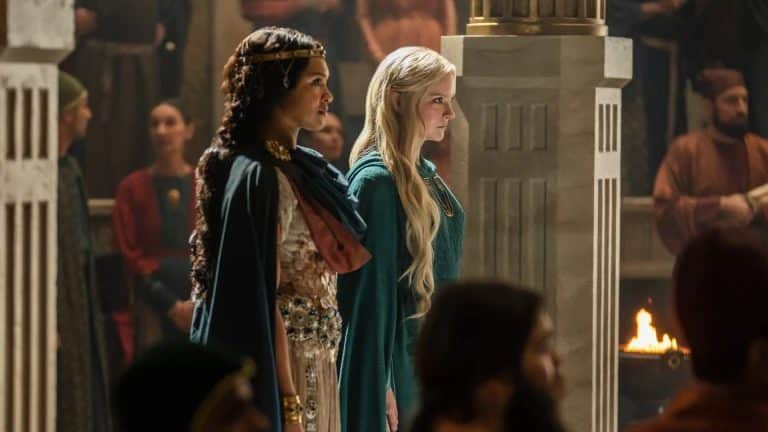
Lord of the Rings: Rings of Power hits the midway point with portents of doom and unexpected alliances in “The Great Wave”. Writers Stephany Folsom, J.D. Payne, and Patrick McKay continue the focus on the kingdom of Numenor beginning with a powerful, opening dream sequence where the queen regent Miriel (Cynthia Addai-Robinson) sees the island destroyed by the titular giant wave while she is blessing babies in the palace. Although she jails Galadriel (Morfydd Clark) for sedition, she is more open to working with the Elves and being faithful to the gods of Middle Earth, the Valar, then she initially let on leading to a surprising conclusion to this episode. As well as spending time in Numenor, “The Great Wave” turns its eye to how the humans of the Southlands are faring and offers a first glimpse at the mysterious Adar (Joseph Mawle) plus a return to Elrond’s (Robert Aramayo) visit to the Dwarves. The episode is chock-full with references that fans of the J.R.R. Tolkien-penned source material will appreciate, but lacks the visual wow factor and emotions of the previous episode as it sets up the back half of the season.
Miriel’s decision to either side with Galadriel and help the humans of the Southlands or continue an isolationist stance is at the center of “The Great Wave”. Galadriel might have great power, but she’s a terrible diplomat and gets a lesson in interpersonal communication from her cellmate Halbrand (Charlie Vickers). The characterization is a little condescending and feels like the writers needed some conflict to spin their wheels until the real reason why Miriel decides to help the Elves comes into play. Clark does get to show off Galadriel’s sheer presence and unyielding presence when she handles a palantir (A magic, seeing stone that can see far-off locations/possible futures) like a champ impressing Miriel, who is revealed to be barely hanging on by a thread because of her sick father Tar-Palantir. As regent, she’s very much an interim head coach, who wants to keep the country/team sailing smoothly and not tear everything down and start a new status quo. It takes an unsettling portent in a moment of visual splendor from director Wayne Che Yip to disrupt this.
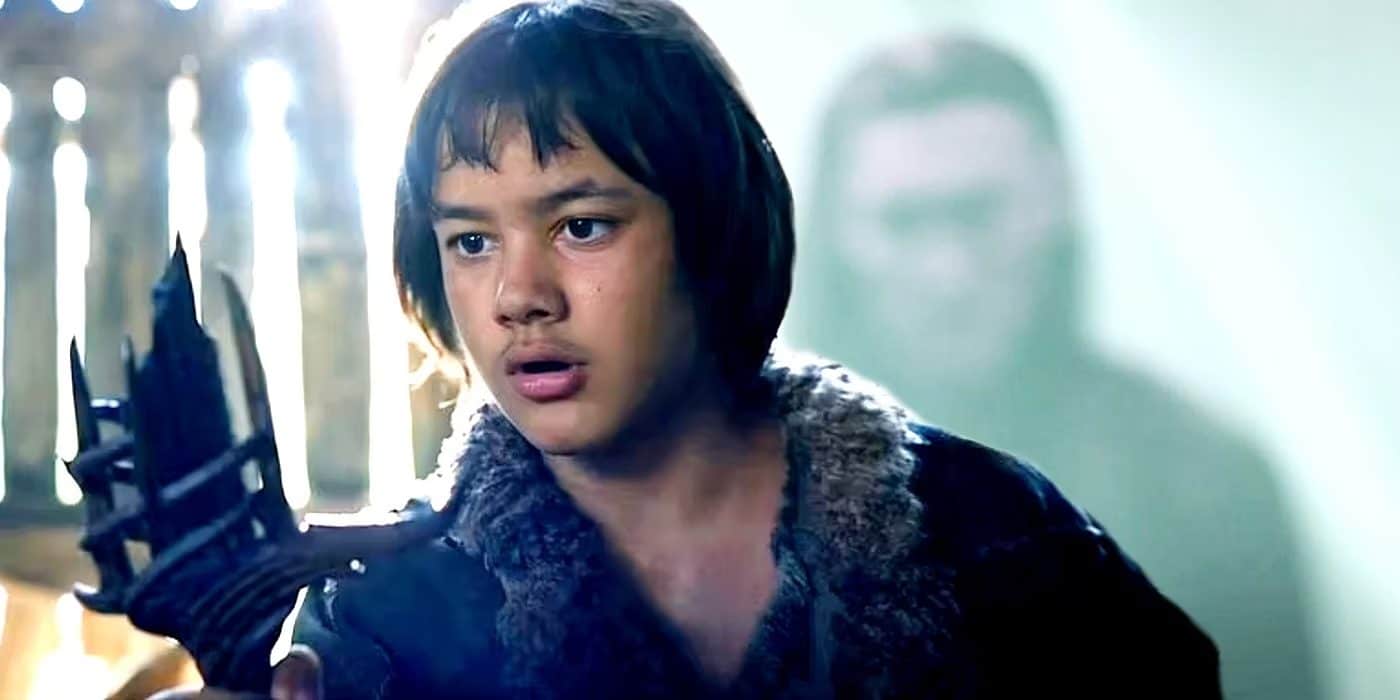
The Southlands’ scenes explore the effects of the supernatural on Middle Earth’s status quo from a different perspective. Building off last week’s fog-obscured character reveal, Folsom, Payne, and McKay stay mystery-shrouded around the character Adar letting makeup and costume design shows that he’s been through some hard time and has an affinity to the Elves, hence, the name. These visual touches cause Arondir to freak out a little bit and have spawned even more fan theories. Mawle plays Adar with unyielding authority offering no terms except surrender to Arondir, who is to run the message to the humans of the Southlands. However, the real supernatural stuff comes from Bronwyn’s (Nazanin Boniadi) son Theo (Tyroe Muhafidin) and his Morgul blade as he and his friend/bad influence Rowan (Ian Blackburn) go to the village to get supplies for the starving Southlanders.
this kid is so fucking annoying for no reason…
However, I have mixed feelings about the Theo storyline. The inclusion of the blade and the namedropping of Sauron from tavern owner Waldreg (Geoff Morrell nails the creepy old man vibes.) add an air of menace and a connection to what’s going on with Galadriel and Numenor. Theo himself doesn’t get much characterization beyond being a scared, annoying brat, who has the plot armor to get around a legion of Orcs and return to the tower of Ostirith where the people of the Southlands are taking shelter. There’s a point about the seductive nature of power in his hunger to hold onto the blade, but mostly, I think the cool, evil sword is wasted on him. The final chase sequence does add to Brownyn’s mom of the year case as she runs through hails of arrows to find Theo with Arondir (A potential future step-dad?) in tow doing cool slow-mo ducks and dodges and tricks worthy of another heartthrob Silvan Elf (Legolas). I like that the writers and Yip keep showing how vulnerable the Orcs are to light, which could come in handy down the road.
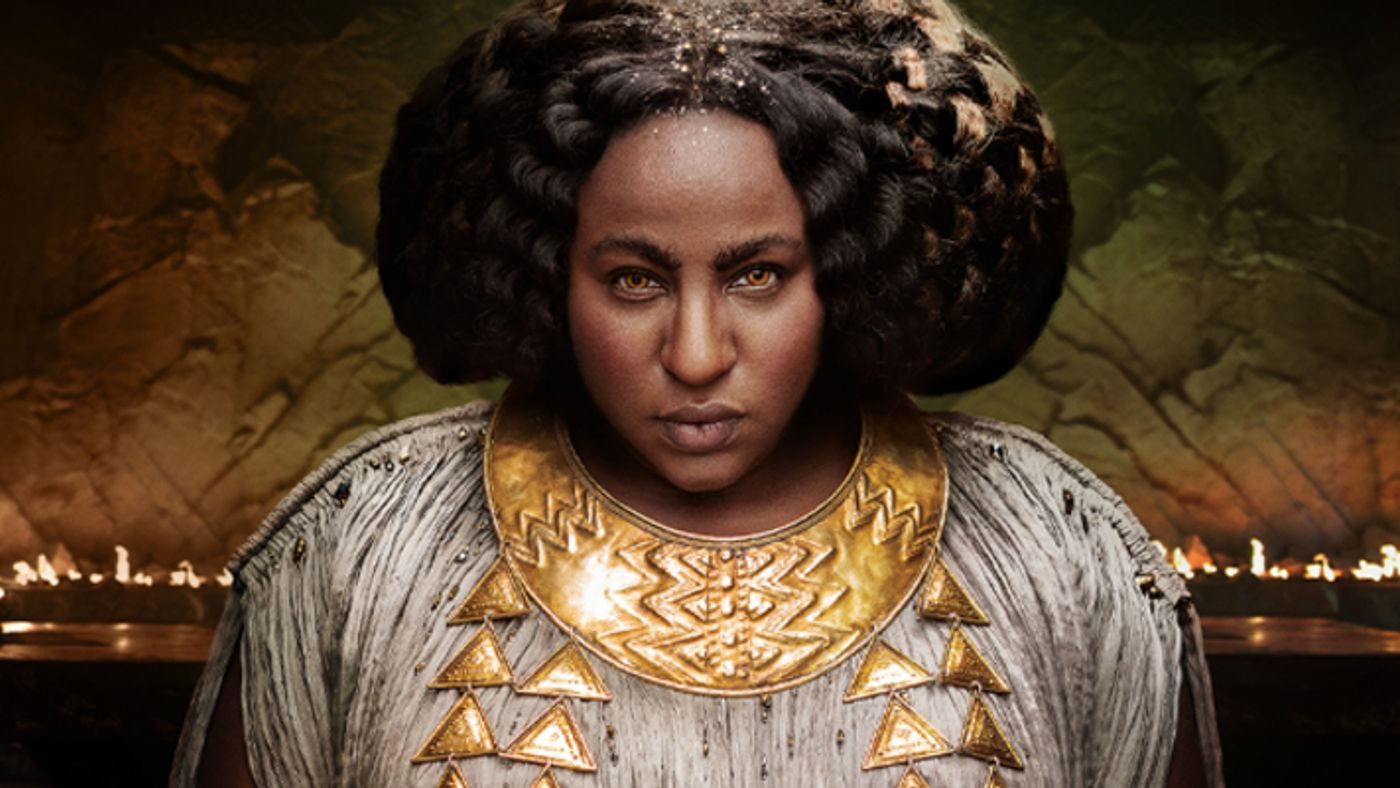
Definitely compared to my reviews of the first three episodes, I’ve been a bit negative of this one, but “The Great Wave” wasn’t in a total wash, and lot of that was thanks to a return to Khazad-Dum. Elrond thinks there’s something secret going on in the mines and doesn’t buy Prince Durin IV’s (Owain Arthur) wife Disa’s (Sophia Omvete) excuses and ends up going on a mini-adventure through Khazad-Dum finally finding out that the dwarves have discovered a new metal named mithril. However, this series of events is more than just an origin story for the metal that corrupted the dwarves and saved Frodo’s life in Fellowship of the Ring, but further develops Prince Durin and Elrond’s friendship that they must balance with duty.
Both Elves and Dwarves think that they’re spying on each other, but Elrond also helps with Prince Durin’s strained relationship with his taciturn, my way or the high way father King Durin III (Peter Mullan) by saying that he wishes that he could have had one last conversation with his father, Earendil. Earendil didn’t actually die, but was placed in the stars by the Valar so Elrond has to basically relive the grief every time he sees the night sky. This anecdote isn’t just fan service for Silmarillion, but adds a dimension of grief to Elrond’s character, especially when he tells Durin IV to just have a conversation with his dad: something he could never have again. However, despite Prince Durin IV giving Elrond mithril as a token of friendship, or Disa’s gorgeous song to save the caved-in miners, there’s a darker edge to wrap up this plot as Durin IV basically comissions Durin III as a spy on the Elves. Duty comes before friendship yet again.
Even though it doesn’t do it in the most entertaining way with time-filling arguments and focuses on one-dimensional characters like Theo, “The Great Wave” gets Rings of Power to its mid-point goal with the Elves and humans of Nuemnor allying to fight evil in the Southlands. Thankfully, it’s not all sunshine and roses with some of the humans of the Southlands being followers of Sauron plus the whole vision of Numenor underwater, its feeble king Tar-Palantir, and Pharazon using the military expedition for political opportunism promising his men that they’ll be giving the Elves orders. However, hopefully, later episodes have more of a personal or emotional connection like the scenes with Durin IV and Elrond aren’t just focused on getting from narrative point A to point B.
After much hype and anticipation, Amazon Studios’ adaptation of J.R.R. Tolkien’s Middle Earth stories dropped with its first two episodes this past week. The Lord of the Rings: Rings of Powerisn’t an adaptation of Lord of the Rings, The Hobbit, or even The Silmarillion, but instead uses the appendices and prologue from The Lord of the Rings novel to weave a story set after the defeat of Middle Earth’s first great foe Morgoth, but before the forging of the Rings of Power and the return of Sauron as seen in the first few minutes of the Fellowship of the Ring film. There are some familiar faces like Galadriel and Elrond, but also new ones like the Brandyfoots and Proudfellow families, Prince Durin IV, and the mysterious Halbrand and the Stranger. The first two episodes have a general through-line of evil rising across Middle Earth affecting all races from the High Elves of the West to the humans of the South and even the nomadic Harfoots. (Someone in the comments will probably say, “Harfeet!”) They generally do a solid job of introducing the characters, conflicts, and location in a visually dazzling way ; honestly, the show has better visuals than dialogue except for the Dwarves and Harfoots.
“Shadows of the Past”
The first episode of Rings of Power opens in a similar manner to the Lord of the Rings: Fellowship of the Ring with a voiceover from the Elf queen Galadriel. However, she’s played by Morfydd Clark in the show, and her voiceover tells the story of her childhood in the deathless land of Valinor where two trees kept everything in perpetual light until they were destroyed by Morgoth, an evil so strong that he’s not even shown on screen and just depicted as a dark rot. This evil leads to an epic war where Amazon Studios has shown that no expense is spared in regards to CGI eagles, dragons, ships, and fireballs and also gives Galadriel her motivation in the series because her brother Finrod was killed by Sauron, who may have survived after the war and is being hunted by Galadriel and her Elves.
However, writers J.D. Payne and Patrick McKay subvert the epic quest narrative of both Lord of the Rings and The Hobbit and instead show a world between two wars from a variety of perspectives in a kind of “People’s History of Middle Earth”. Using a cool visual of the map of Middle Earth to transition between each location, director J.A. Bayona introduces different groups of characters, including the aforementioned High Elves Galadriel, her king Gil-Galad (Benjamin Walker), and his herald/speechwriter Elrond (Robert Aramayo) plus the Harfoots, a kind of proto-Hobbit people, two mysterious Hunters, and a village of humans watched over by the Silvan Elf Arondir (Ismael Cruz Cordova), who is romantically interested in the town healer Bronywn (Nazanin Boniadi).
Even though they’re from disparate locations, they’re connected thematically by the lingering effect of evil on Middle Earth although Sauron is supposedly defeated. This theme is handled directly in Galadriel’s plot lines as she takes her battalion to the farthest Northern wastes of Forodwaith to seek out traces of evil. Elves using their weapons to scale a beyond icy cliff is a powerful image to show the extents that Galadriel will take in her quest for revenge as she repeatedly waves off her compatriots’ requests to take shelter and return to Gil-galad the next day. This leads to danger and a sleekly choreographed battle with an Ice Troll in a cave that is so cold that the Elves’ torches give off no heat and, of course, a mutiny.
Throughout the episode, Galadriel is perceived as a rebellious figure, who still believes in the pervasive nature of evil even as Gil-galad holds a ceremony for her and her soldiers as well as giving them the opportunity to return to Valinor and basically live in Elf heaven forever. Through her tone of voices and the pain in her eyes, Morfydd Clark’s performance nails the fact that Galadriel is older than, say, Elrond and has seen true, primal, light-destroying evil and can tell it’s coming back even though this isn’t convenient politically for the Elves of Middle Earth. It all builds up to a spine-chilling climax where she would rather leap into the cold water of the Sundering Sea than have peace in Valinor. Bayona and cinematographer Oscar Faura flood the frame with life as the other Elves accept their eternal rest while Galadriel flinches, grabs her brother’s sword, and peaces out. Clark brings a lot of conviction to the role of Galadriel. I’m definitely invested in her story moving forward even if some parts of it are weirdly structured like Finrod doing a Bill Murray in Lost in Translation whisper to her at the beginning at the episode and revealing it at the end.
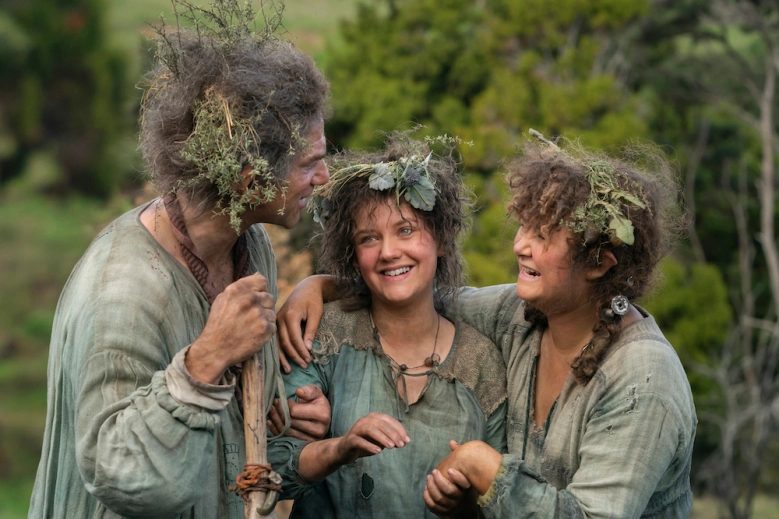
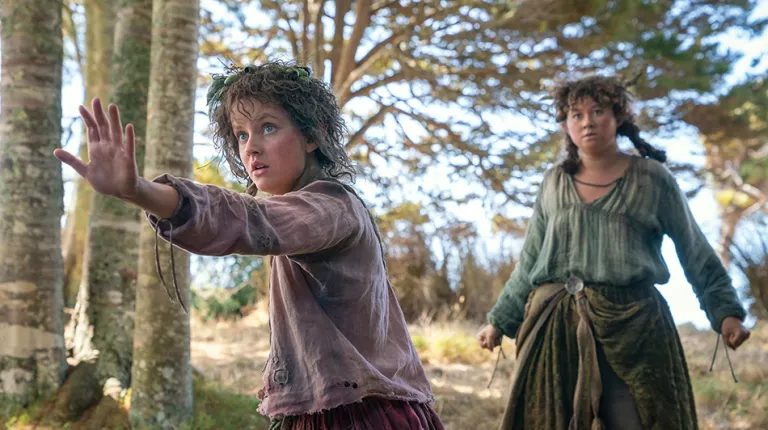
The scenes with the Harfoots and the humans of the South plus Arondir are more atmosphere-setting than jumping head-first into the series’ plot. And that’s totally okay for a first episode because we get to see the effects that the Elves’ war against Morgoth had on ordinary, mortal folks. The Harfoots have chosen the hiding in plain sight route, and a clever little setpiece shows why they weren’t mentioned in the great stories and tales. Nori Brandyfoot (Markella Kavanagh) is the standout in this episode with her firecracker energy and curiosity about the outside world, but Lenny Henry’s Sadoc Burrows brings wisdom and good humor as he pores over a book of symbols to explain the natural, or supernatural phenomena around him. They don’t get as much screen time as the Elves or humans, but a strange visitor is sure to change that.
Arondir, Bronwyn, and the various Silvan Elves and humans of the Southlands lack the charm of the Harfoots or the charisma and wow factor of the High Elves, but provide the most interesting perspective on the nature of evil with a side of colonialism and Elf/human tension. The reason why the Silvan Elves watch Bronwyn’s village is because they supported Morgoth ages ago and are afraid that they’ll turn to evil again. It’s super paternalistic and reminds me a lot of why the United States still has military bases in places like German, Japan, Italy, South Korea, and to a lesser extent now, the Philippines.
Because Elves are immortal, they see centuries as no time at all and still hold a grudge towards these villages for helping Morgoth even though the only thing that happens in them is the occasional bar brawl. The only reason that Arondir lingers in the village is because he is romantically interested in Bronwyn, who is from a village that helped Morgoth even more during the war. He sees evil as something in the past, but his watchwarden still thinks the humans in the villages are evil people and is glad to leave their outposts behind and return west. The interactions between Arondir and all non-Bronwyn humans show the tension between Elves and humans and their long memories versus short. Throw in the presence of actual evil in the village, and it introduces an intriguing element of moral greyness even if the characters in this plotline are about as compelling as Skyrim NPCs.
“Shadows of the Past” features a compelling protagonist in Galadriel and also introduces a variety of POVs during this era of Middle Earth while featuring lavish production values, especially the sequences in Valinor and Forodwaith. It’s a lovely appetizer before hopefully is an intriguing feast about unlikely heroes and an ever-pervasive evil.
“Adrift”
Director J.A. Bayona continues to use imagery to weave together the disparate characters and locations with Galadriel swimming back to Middle Earth under the stars while Nori and the hilarious Poppy Proudfellow (Megan Richards) investigate an amnesiac stranger (Daniel Weyman) who has fallen from the sky and has some kind of power involving flame, darkness, and other scary stuff. Richard and Markella Cavanagh’s chemistry is a highlight of this episode as they try to help out this “Big Person” while also fulfilling their duties as part of the Harfoot community even though the free-wheeling nature of the settlement is a good cover for them bringing snails and checking on their mysterious visitor. They have the same vibe as Saoirse Ronan and Beanie Feldstein’s characters from Lady Bird, but in the wilds of Middle Earth. Weyman’s performance as the Stranger almost has a Frankenstein’s Monster quality to it with him enjoying a meal of snails and then causing every firefly in Poppy and Nori’s lantern to go out. He will definitely be the source of many fan theories.
Another fan theory spawner is Halbrand (Charlie Vickers), a pretty boy from the Southlands, who Galadriel ends up escaping with on a bit of driftwood after a pretty epic monster destroys the raft of a group of not-so-nice sailors that they were with earlier in the episode. Both Galadriel and Halbrand share a common hatred of Orcs because they had killed someone important in their lives, which causes Galadriel to immediately order him to take him to the last place where he saw them. However, she’s just a wandering Elf on the Sundering Sea, and Halbrand waves this off. The only thing they really have in common is survival at this point, and there’s even a parallel in Galadriel leaving her soldiers in the previous episode and Halbrand leaving his crew in this one as they try to accomplish their goals. Galadriel takes more of a backseat in this episode after anchoring the first one, but Halbrand being from the Southlands welds her storyline to the one of Bronwyn, Arondir, and the village.
There’s not a lot of great characterization and Bronwyn’s village continues to feel like a generic fantasy town setting, but Bayona does do a little mini-horror film with Bronwyn, her son Theo, and and one gnarly, bone helmet wearing orc that has been under the house and is scaring all the rats and mice. There’s jump scares, swarming rats, tight spaces, and this bit of the episode feels more Lovecraft than Tolkien. But it’s nice to see Orcs as slasher movie monsters and not just cannon fodder and to see how they would actually affect regular people in a village versus the trained warriors that usually fight them in the Peter Jackson films. The creature design works fits the recurring them of decay and rot with a bloated head spilling black blood. Also, we get to see Bronwyn be a badass and see her son Theo continue to be enthralled with the mysterious part of a blade he found that behaves similarly to one in Fellowship of the Ring. It’s nice to see that Middle Earth can continue to be home to different genres, especially horror.
The final plotline in “Adrift” follows Elrond working with Celebrimbor (Charles Edwards), who wants to build a forge and tower to create something with real “power”. Elrond suggests that they visit his friend Prince Durin IV (Owain Arthur) in the underground Dwarf city of Khazad-Dum aka the Mines of Moria. Writer Gennifer Hutchison uses some wonderful intertextuality with Elrond talking up Dwarven hospitality a la Gimli in the Fellowship of the Ring only to get spurned at the gate and only allowed in if he takes part in a ceremonial rock smashing contest, which he loses to Durin, but still gets to spend time with him thanks to the kindness and his good humor of his wife Disa (A warm, yet humorous performance from Sophia Nomvete aka the first female Dwarf to have a speaking role in any Tolkien property.)
When Durin and Elrond interact, the politics are cast aside, and Elrond gets berated for being a bad friend and not being there for his wedding or the birth of his two children. In another excellent use of how Elves see time differently from other races because of their immortality, Elrond basically treats 20 years like not seeing someone for a couple months or so. However, he still genuinely cares about Durin and spends the dinner asking questions about how he and Disa met (At work, of course!) before broaching the topic of working with the Elves. Of course, Durin III isn’t thrilled with and thinks that the Elves will exploit them although Elrond and Celebrimbor are genuinely curious in learning their methods that include singing to the stone to figure out where to sculpt or carve. This anecdote shared by Disa continues to show how Rings of Power is genuinely interested in showing the day to day life of the folks of Middle Earth along with its slow-burn return of evil/mystery men overarching story.
“Adrift” has good humor, a few scares, and Markella Kavanagh continues to be a delight as Nori Brandyfoot. The appearance of an Orc raises the return of evil stakes, and Bayona and Hutchison wisely show its impact on ordinary people instead of badass heroes like Galadriel.Plus seeing Khazad-Dum at the height of its glory is a genuinely cool use of set design and visual effects and puts Elrond in a different context than the first episode adding depth to his character.
In conclusion, the first two episodes of Rings of Power use the television medium to tell an epic fantasy story of good and evil from a variety of perspectives even if it is only starting to scratch the surface of this era of Middle Earth. The dialogue can be hit or miss, especially when the Elves start speaking in Fran Walsh/Tolkien-esque aphorisms, but this is a gorgeous, immersive fantasy story that reminded me why I fell in love with this world as a kid a little over 20 years ago. It also gives more prominent roles to women and characters of color than the source material, which is refreshing as well.