Tag Archives: Luci

The Wicked + the Divine #1 – 10 Years Later

“And every demon wants his pound of flesh.”–Florence + the Machine

“Forgot that inside the icon, there’s still a young girl from Essex.”–Lorde
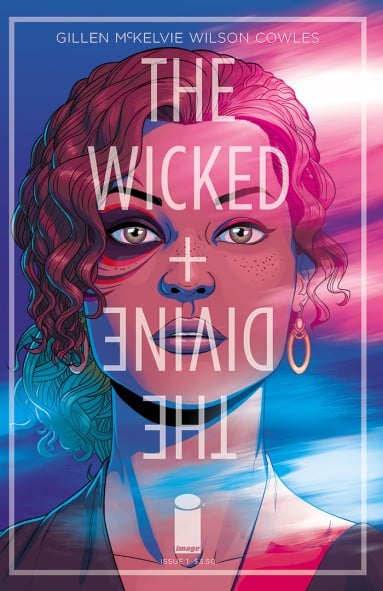
The Wicked + the Divine #1

Until I read Kieron Gillen’s newsletter last week, I couldn’t believe that it had been ten years since The Wicked + the Divine was released and basically changed my life. It, and Gillen and artist Jamie McKelvie’s other collaboration Phonogram, heightened my interest in indie and pop music (Mostly of the British kind because I’m an incorrigible Anglophile.) and transformed me from a Netflix/Marvel comic binging wallflower to a black lipstick wearing, nonbinary Goth degenerate who was closing out bars and dance floors across the South/Midwest/Mid-Atlantic. This might be a bit of an exaggeration because I’m started writing this article at a laidback, very heterosexual brewery while wearing a football top and finished writing it on my bed next to a stack of Amazing Spider-Man comics.

I felt beyond seen in WicDiv‘s cast of characters, especially Laura/Persephone, Inanna, and just a touch of Baphomet. (The whole none more Goth thing.) When the first arcs of the series were released in 2014-2016, I was definitely still a wayward youth working in retail, trying to graduate university (I wrote my undergrad thesis on WicDiv and Paradise Lost when only the single issues were out.), and doing freelance pop culture writing gigs, However, by the time the series wrapped up in 2019, I had found my calling as a librarian and the trade paperback of “Faust Act” was one of the first books I cataloged. Today, I’m legitimately a pop music librarian, and my life has come a little bit full circle so I can write about the series from a new perspective. “Once again we return!”

Because, plot twist, I never actually reviewed The Wicked + the Divine #1. When the book dropped in June 2014, I was busy studying Jane Austen in Bath, England, sinking too many pints while watching Germany dominate in the World Cup (Today, I’m hoping they do the same at the Euros.) , and soliciting old gay men on OK Cupid for help with my paper on British television over the decades. My first review was for WicDiv #2, and it was already my favorite thing helped by my love for Gillen and McKelvie’s Tumblr-era queer pop superhero masterpiece Young Avengers as well as a positive interaction with Kieron Gillen at my first ever comic convention, C2E2 2013. This passion was also fed by the John Milton seminar course I took at university later that year as well as my first read-through of Grant Morrison’s Invisibles because I read somewhere on the Internet that the intro to WicDiv was an homage to The Invisibles #1 sans bald men and John Lennon. With a few gaps, I reviewed the other 50 issues of the series persevering through moves and career changes to actually stay current with the series. But I never wrote about issue one so here are my (Definitely not long awaited) thoughts on The Wicked + the Divine #1 ten years after its release.

Re-reading The Wicked + the Divine #1 in 2024 makes me realize that it was one of the most prescient pieces of pop fiction in the past decade. Influencers, stan culture, aggressive relationships between fans and journalists (E.g. Paste’s review of the latest Taylor Swift album was released sans byline.), it’s all there in this first issue. Hell, even the rise of nostalgia culture is encoded in the character of Luci, who dresses like David Bowie, got her government name from a Beatles song (Eleanor Rigby), and quotes the Fab Four, Rolling Stones, and Philip Larkin like they were born yesterday. She would definitely fit in with the Tik Tok girlies that dress like they’re a character in Almost Famous or standing in for Patricia Morrison from The Sisters of Mercy, circa 1987.

But, with the exception of Cassandra’s utter roasts of the various Pantheon members (“Kids posturing with a Wikipedia summary’s understanding of myth” is an all-time one liner.), Kieron Gillen and Jamie McKelvie treat fandom as a normal part of growing up in WicDiv #1 beginning with our introduction to Laura where she adjusts her look in the mirror trying to look like her new favorite god, Amaterasu. It’s the first in many aesthetic (and later name) changes for Laura and gives off a cosplay vibe, which makes sense because Young Avengers and later WicDiv was famous for its cosplayers thanks to McKelvie’s fashionable, yet functional approach to character design. The Wicked + the Divine is a coming of age comic, and especially this first issue, hones in on Laura trying to figure out who she is through her relationship to the Pantheon between the flashbacks to 1923, court cases, and exploding heads. She wants to be a Pantheon member, but is far from as she stammers her way through the green room and ends up continuing to spend time with Lucifer and Amaterasu because she witnessed a couple murders not because she made some kind of impression on these radiant beings.
The Wicked + the Divine #1

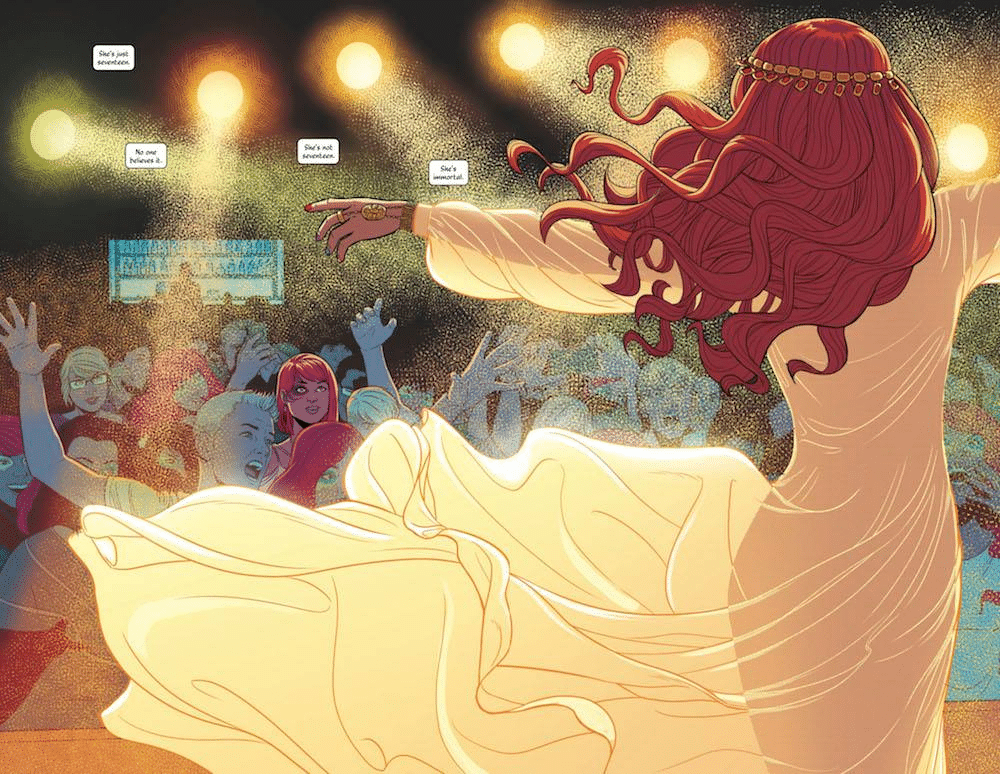
And speaking of radiance, Matthew Wilson’s colors are still as vibrant and awe-inspiring in 2024 as they did in 2014, especially that first splash page of Amaterasu’s gig. Gillen and McKelvie go from the restricted grids of Laura getting ready at her family flat in Brockley before turning the page on a double page spread that nails what it’s like to be wholly enraptured at your favorite artist’s show. The afterglow continues in the following pages as Laura (Through Kieron Gillen’s captions.) processes the performance and tries to connect with Amaterasu before fainting in a white gold flurry. This sequence is a stand-out moment for Wilson in this first issue, but he provides some early bisexual lighting for the Pantheon green room to show that the gender and sexual fluidity of these gods as well as utilizing bright, flat colors accompaniment to Jamie McKelvie’s utter demolition of the human figure when Luci kills the assassins and when the judge mysteriously dies in court.

Moving from the micro to the macro, The Wicked + the Divine follows a pattern that the great comics of the past used, such as The Sandman and Watchmen, which is introduce a rich world with complex characters and universal themes through a simple, accessible plot device. In WicDiv‘s case, it’s the murder mystery. Who killed the judge doesn’t matter in the long run of the series, but it does the job in getting you to pick up WicDiv #2. Gillen and McKelvie introduce the power of the finger click in the opening, absinthe-soaked love child of Sandman and Invisibles flashback and also demonstrate it in present times with inset panels showing Luci kill the fundamentalist Christian gunmen in self-defense. Cassandra’s skepticism aside, the Pantheon members have the ability to kill as well as inspire in an beautiful, abstract way that I’ve witnessed from audience members in the front row at Ethel Cain shows. (I wonder if she’s read WicDiv ; one of her big influences Florence Welch inspired the look for Amaterasu.) The ending of WicDiv #1 and the surprise on Luci’s face creates an air of danger to go with the “necrotically glamorous” (To quote Gerard Way’s blurb on the back of the trade paperback.) tragedy of being a god for two years and then dying, which definitely isn’t a PR line for Amaterasu. I was hooked in 2014 and am still hooked in 2024.

The Wicked + the Divine #1 uses the power of fandom and one’s favorite music and art to explore what it feels like to think that you’re immortal and also about to die, or basically a young adult. Jamie McKelvie and Matthew Wilson’s visuals marry a heightened pop star aesthetic to fundamental, rhythmic storytelling of grids and face and body acting while Kieron Gillen’s caption and dialogues add humor, subtext, and personality to this unforgettable cast of characters. It’s fitting that I’m writing this review while listening to Lorde and Charli XCX’s long-awaited and surprisingly vulnerable collaboration “Girl, so confusing” because I was definitely bumping Pure Heroine, Sucker, and True Romance while writing my first WicDiv reviews in 2014. Sometimes, the things that were great a decade ago are still great plus you have the beauty of hindsight and self-awareness to appreciate them with new eyes and be happy that you’re alive.

Story: Kieron Gillen Art: Jamie McKelvie
Colors: Matthew Wilson Letters: Clayton Cowles
Story: 9.4 Art: 9.8 Overall: 9.6 Recommendation: Buy
Review: The Wicked + the Divine #45

“At every occasion, I’ll be ready for the funeral.”-Band of Horses

The Wicked + the Divine #45

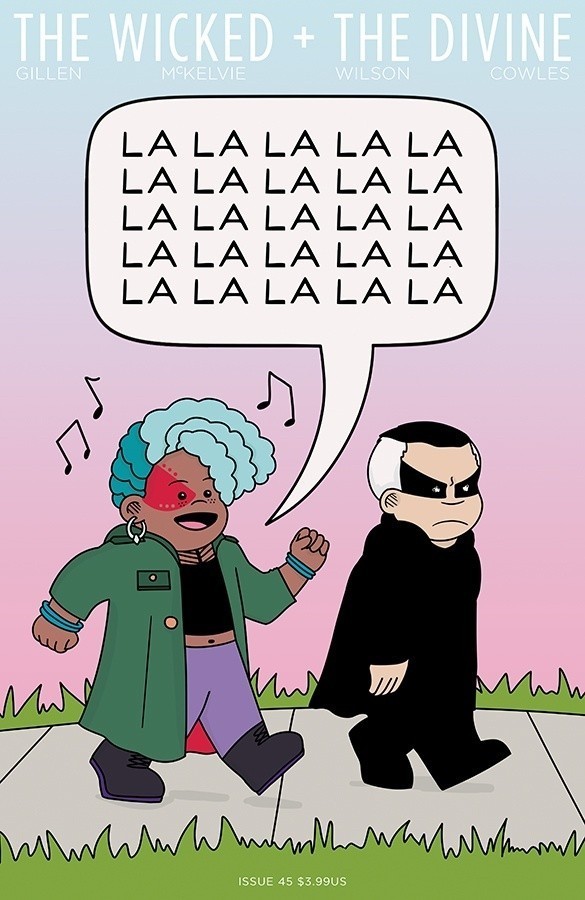
Like the David Bowie song, five years is all we got with The Wicked + the Divine, and writer Kieron Gillen, artist Jamie McKelvie, and colorist Matthew Wilson go out on top in WicDiv #45, which is set 40 years after the events of the previous issue. It’s a thoughtful issue in the vein of The Sandman “The Wake” and is a fantastic character study as Gillen and McKelvie show what happens when the Pantheon grows old beginning with the much guarded secret of the final cover.

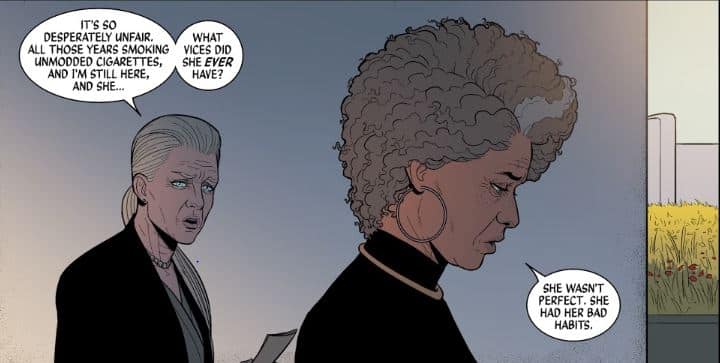
The entire issue happens at Cassandra’s funeral and wake so it’s fitting that the first big reveal is that she and Laura ended up married after a relationship with Eleanor. Speaking of Eleanor, it is so strange to see Lucifer as a senior citizen, and McKelvie does a fantastic job with all the wrinkles, crow’s feet, and other accoutrements of age for a group of characters that I, at least, thought would all flame out in their twenties. But, no, they get to live and reflect on life and relationships beneath the eaves of Valhalla, which has been turned into a National Trust site. There is continuity in the earlier Daft Punk/futuristic elements of Valhalla, but Wilson uses a more muted color palette in keeping with the somber occasion.

One of the most beautiful elements of WicDiv #45 is the interweaving, naturalistic conversations about the characters’ relationships as Gillen and McKelvie do a more graceful version of “Where are they now” with a good mix of grid layouts and wider panels. We get the last word on Zahid and Valentine with the brief return of Baal’s Nathan Fairbairn colored fresco as Zahid wistfully talks about how they have never been or will be with such a force like Baal. It all comes to a climax with Cassandra giving her own eulogy hologram-style, and what, in lesser creative hands, could be a pop-joke about the exploitation of Tupac or Prince turned into a wonderful final analysis of the Pantheon from the sharp, yet loving mind of a journalist turned goddess turned mortal.

The Wicked + the Divine #45

Although there are remarks about Laura being Cassandra’s “vice”, Cass’ final speech shows that she has become a little sweeter in her old age and that the conflict and drama of the two years of the Pantheon didn’t even matter to the end. When she calls Umar, who was feeling pretty down in his dialogue and missing Cameron something fierce, the best person she had known, it resonates emotionally because she isn’t the kind of character to hand out compliments willy nilly. She even gives Eleanor, one of the people she detested the most, the kudos for basically going hard and being the best embodiment she should ever be. Luci was the catalyst for me taking a Milton seminar in undergrad and, by extension, writing about comics academically so that series of panels landed hard.

After remarks on all the remaining Pantheon members, Kieron Gillen flexes his writing muscles and Jamie McKelvie’s flexes his facial expression and gesture ones for a poignant monologue on aging, which is honestly what WicDiv #45 is all about. There was the high energy, passion, action, and fandom of the early arcs supplemented by the greater context of the specials and “Mothering Invention” finally culminating in the Pantheon realizing that they could opt out of the millennia-long cycle of death and rebirth as ordinary humans. (Except Aruna can play the fuck out of a double neck guitar.) This issue shows the product of this mortality and has some awesome group hugs as the death of Cassandra causes surviving, former Pantheon members to come to terms with their mortality.

And because of how much Gillen and McKelvie have fleshed out this cast of characters over five years, The Wicked + the Divine #45 is an easy comic to self-identity with, especially when Laura faces the reader, does a final 1-2-3-4, and there’s a fade to white. Getting old is something that both scares me and is something I’m in denial of, and seeing characters that I felt like I grew up with wrinkles, long happy marriages, and stories of the past makes it a little more palatable. For a series that had a fairly large body count and had some dark relationship dynamics, this happy ending is a delight and an ode to building relationships and craft your own destiny and story to get a little bit meta.

This is a bit obvious to those of you who have been following me on my WicDiv reading/reviewing/interviewing, and yes, living journey the past five years, but The Wicked + the Divine is my favorite comic of all time. Sure, Sandman and The Invisibles are up there, but with WicDiv, I got to go on the journey each single issue, or step, of the way and theorize, weep, celebrate, and even build friendships along the way. It’s a book that’s always been about the big ideas like life, death, the creative act, but always had time for the little things that make life great like puns, pops, literary allusions, and fantastic costume design from Jamie McKelvie.

Even though I’ve been in denial since Monday when I read the final issue, The Wicked + the Divine #45 is the perfect ending to the series with Kieron Gillen, Jamie McKelvie, and Matthew Wilson’s carefully crafted words and visuals on aging, looking back, and looking to the future. This is a comic that has engaged both my head and heart. Like Ananke, and in this issue, Cassandra say, “I love you. I love you all. I’ll miss you.” This comic will always have a beloved place in my heart, and I look forward to rereading, reminiscing, and recommending it into the decades to come even as I begin to look like the characters in this issue.

Story: Kieron Gillen Art: Jamie McKelvie 
Colors: Matthew Wilson Letters: Clayton Cowles
Story: 10 Art: 10 Overall: 10 Recommendation: Buy

Image Comics provided Graphic Policy with a FREE copy for review

Review: The Wicked + The Divine #44

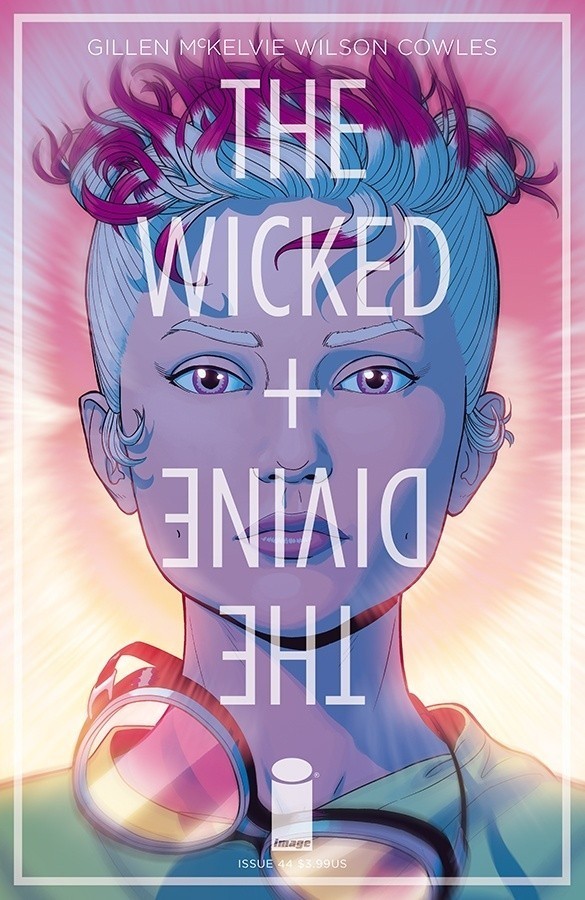
The Wicked + the Divine #44

*This review contains full spoilers for The Wicked + The Divine #44*

With its skull on the first page of issue one, None More Goth visual trappings, and high body count, The Wicked + the Divine sometimes seems to be a book about death. However, it’s really about life and growing up and discovering your true identity, and stuff that sounds like self-help, hippy dippy bullshit. The Wicked + The Divine #44 is executed in a beautiful way by Kieron Gillen, Jamie McKelvie, and Matthew Wilson. Even though there’s one issue left of WicDiv, this The Wicked + The Divine #44 ends the series’ main plot and the tale of godlike teenagers, Ananke and Persephone, and best of all, Luci and Laura, the relationship between mad, bad, and dangerous to know and shy, innocent fangirl that hooked me on the series and evolved well beyond that.

The amazing cliffhanger of WicDiv #43 brought Luci back to the forefront of the narrative and the general limelight just before the end. Gillen has her call herself “the whole world’s dream girlfriend”, and McKelvie and Wilson oblige with some rockstar poses and a side of hellfire. Her new costume is one of my favorite McKelvie designs of the series and gives her the swagger of a person who is only herself when she’s performing in some way. She’s Lord Byron, Bowie, Jagger, and most of all, the Adversary. Luci desires to create chaos and enjoy life with her new lease on it, doesn’t want to relinquish her powers like the other Pantheon members, and would definitely rather reign in Hell.

This is where some writers would have a big punch-up, Miracleman #15 style, with Luci being full of hubris and wrecking London. However, Kieron Gillen and Jamie McKelvie definitely “zag” away from this path and do something a little more life-affirming with Luci and Laura. In a red and black, near farce of the Pantheon transformation sequence and using third-person narration, Gillen, McKelvie, and Wilson sort through the pain that Laura has gone through the past two years, and how much she cared for Luci even when she was on trial for murder back in “Faust Act”.

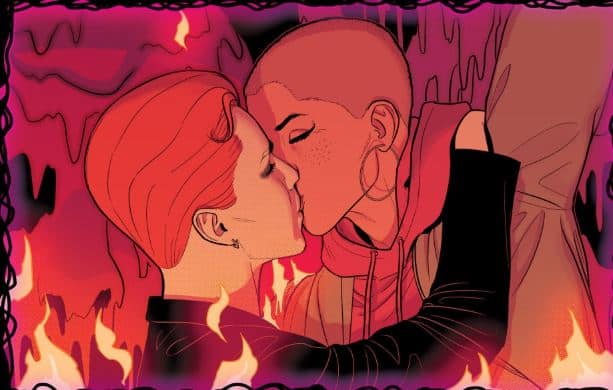
It all culminates in one of the most touching sequences of the series (And we’re only on page 8.) where Luci simply says, “I’m Eleanor”, kisses Laura, and becomes human again. This series of pages is a wonderful inversion of the other Pantheon transformation sequences throughout the series, and the moments after are raw, filled with tears, and the formerly sharp-tongued Lucifer having almost nothing to say. It expertly combines the lofty themes of identity, godhood, and immortality with two estranged friends hugging it out as Laura demonstrates growth by choosing reconciliation over alienation.

The Wicked + the Divine #44

I could probably write this whole review about Luci and Laura, but hey, there are other characters and storylines in The Wicked + The Divine #44 all connected to the throughline of simply living even if it doesn’t mean being a god with worshipers or pop star with fans. With Luci returned to mortality, the situation with Minerva/Ananke is the last big plot thread on the table, and there’s a debate over what to do with her. Laura wants to kill her, but she’s growing as a person and defers to Cassandra’s sensible solution of using Mimir’s plot device engine one last time. (Cass’ reaction is priceless.) But Baal just wants to kill her and be the embodiment of toxic masculinity. His last interactions with Inanna are tragic and are a reminder of how great this series was at exploring queerness and gender performance.

The Wicked + the Divine #44

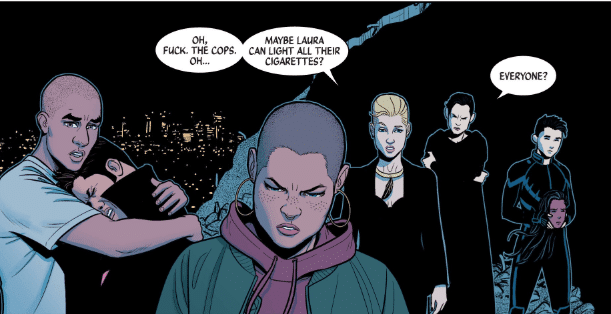
He’s done this throughout the series, but I would like to draw attention to how Jamie McKelvie draws panels with multiple figures in WicDiv #44. He doesn’t just focus on reader eye level, but in the spirit of the old film adage “acting is reacting”, imbues each figure with a small story of their own. A good example of this is the first reaction panel after the deaths of Baal and Minerva. Laura furrowing her brow and figuring what to do with two dead bodies and a SWAT on the way is the focus of the panel.

But McKelvie reminds us of the deep pain that Inanna feels about the death of his former lover and the empathy and friendship Dionysus has for him through his detailed work with them. All of this is with no words; just visuals. Also, Wilson uses a lot of black to give the panel and page a real funereal feel for the literal characters, Baal and Minerva as well as all of Ananke’s machinations and the concept of the Pantheon. There is also a slight glow in the background, which connects to the spotlights used by the cops throughout the issue and symbolizes that the ex-Pantheon members have to deal with the harsh light of reality as mortals from now on. (See the courthouse scene.)

With its opening words and repeated mantra “Once again we return” as well as the revelation of the eternal conflict between Ananke and her sister, WicDiv has been a study of cycles of life and death. This beautiful symmetry pays off big time in WicDiv #43 whose final page is not just an homage to the ending of its predecessor, Grant Morrison’s Invisibles, but the first page of WicDiv #1 with the visual of a living head instead of a skull. It’s also like the ending of John Milton’s Paradise Lost where Adam and Eve lost a chance of immortality in an utopia, but gained the ability to choose “their [own] place of rest”. Laura might not be a goddess any more and is still in hot water for killing Ananke, but she gets to live life as a human being untethered to any rituals or schemes.

I’ve spent the last five years living, regressing, and sometimes growing alongside these characters expertly crafted by Kieron Gillen, Jamie McKelvie, and Matthew Wilson so emotions definitely run high in The Wicked + The Divine #44 especially in regards to Luci and Laura and Baal and Inanna. But it is one of the most life-affirming comics I’ve ever read, and I’m glad that we (hopefully) get to see a peek of the lives of Laura and company in the final issue of the series. (That final cover reveal, y’all!!)

Story: Kieron Gillen Art: Jamie McKelvie 
Colors: Matthew Wilson Letters: Clayton Cowles
Story: 10 Art: 10 Overall: 10 Recommendation: Buy

Image Comics provided Graphic Policy with a FREE copy for review