Tag Archives: Killgrave

Review: Jessica Jones #15

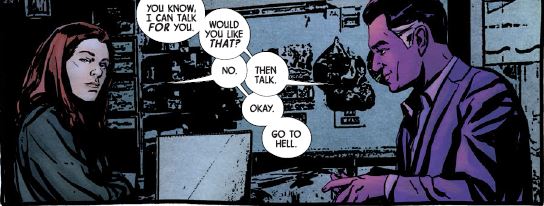
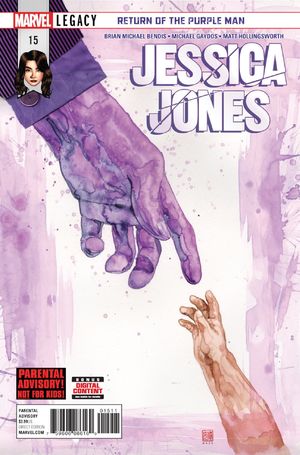
JJ15For the first half of Jessica Jones #15, Killgrave won’t shut the hell up, and Brian Michael Bendis pens some incredibly creepy, gaslighting dialogue as he talks about how interesting Jessica is which is answered by sarcastic glances courtesy of artist Michael Gaydos. Then, Bendis, Gaydos, and colorist Matt Hollingsworth take things in more of a black ops direction as the comic builds to an action horror crescendo. However, the scariest part of this comic is the opening conversation as the Purple Man tries to be civilized and ends up sounding like a wannabe pickup artist/man-baby/psychopath. Bendis and Gaydos lean less on the mind control aspect of his powers and return to the whole abusive relationship part and make him more frightening. So, Jessica Jones #15 ends up being a talk-y comic book, but the extended monologue has the chilling effect of being like a man talking over a woman because he thinks he knows best. Yuck.

Mostly, Hollingsworth has used a drab, yet noir-ish color palette for his work on Alias and Jessica Jones. However, Jessica Jones #15 is filled with pops of purple and yellow for Killgrave that starts small when he is chatting with Jessica and then erupts when he is shot by SHIELD and uses his powers again. The purple in the scene where he possesses everyone around Jessica, Carol Danvers, Nick Fury Jr., and Kraven the Hunter (Of all people.) is like a circuit breaker exploding and setting the house on fire. Michael Gaydos bombards the page with figures and people with intense expression and busts up the grid format that he has utilized for most of the issue. Talking and Killgrave pretending to be a “nice guy” is over, and only action and mind controlling one of the Marvel Universe’s greatest heroes is left on the table.

JJ15Interior

Dialogue is one of Brian Michael Bendis’ strengths, or definitely signatures, which is interesting because comics are primarily a visual, not verbal medium. Killgrave gets a long villainous monologue in Jessica Jones #15 that stretches over almost the entire first half of the comic, but because comics don’t have sound like film/TV, it doesn’t have the same effect as if it was delivered by David Tennant. Plus Gaydos reusing poses and faces hinders the emotional effect of Killgrave’s words on Jessica. His art definitely picks up steam after Killgrave gets hit by a sniper bullet in a double page spread that shows the wound from different POVs from Suicide Squad wannabe Kraven the Hunter to a “dying” Killgrave and a vengeful Jessica, who gets to unleash the anger she’s been holding in all issue.

Bendis’ writing is smart and sobering with Killgrave displaying signs of abusers like telling his former victim that she should be happy that he isn’t doing something worse like “grabbing her by the brain” or making Luke Cage beat all the Avengers to death.  In a similar manner to outed abusers like Harvey Weinstein, Kevin Spacey, and Donald Trump, it’s all a power thing for Killgrave, who feels insecure that Jessica has moved on from him and has a new life as a private eye, Defender, wife, and mother. She treats Killgrave like he’s pathetic with sassy quips, but by the end of the issue, Bendis and Gaydos remind us of how terrifying he is. With his immortality and mind control abilities, the Purple Man is one of the most powerful villains in the Marvel Universe and sending multiple Avengers squads against only enhances his ability because he can turn these good guys bad with a snap of his fingers.

“Purple” is the best arc of Jessica Jones so far because the stakes have been so personal with Killgrave going after Jessica’s family, friends, and mental state instead of trying to kill all the Avengers like in their first meeting in Alias. Jessica Jones #15 is a fairly strong middle chapter of the storyline as Brian Michael Bendis, Michael Gaydos, and Matt Hollingsworth continue to depict Killgrave as a gaslighting abuser with superpowers. They posit the friendship between Jessica and Carol as an equal reaction to him, but this relationship starts to become twisted in the Purple Man’s hands.

Story: Brian Michael Bendis Art: Michael Gaydos Colors: Matt Hollingsworth
Story: 7.8 Art: 7.5 Overall: 7.7 Recommendation: Read

Marvel Comics provided Graphic Policy with a FREE copy for review

Investigating Alias #28

Alias (2001-2003) 028-000Investigating Alias is a weekly issue by issue look at the source material that inspired the popular and critically acclaimed Jessica Jones Netflix show.

In this installment of Investigating Alias, I will be covering Alias #28(2004) written by Brian Michael Bendis, drawn by Michael Gaydos, and colored by Matt Hollingsworth.

In Alias #28, writer Brian Michael Bendis, artist Michael Gaydos, and colorist Matt Hollingsworth wrap up the story of the superhero turned P.I. Jessica Jones as she faces Killgrave one last time and proves without a shadow of a doubt and in front of all the Avengers that she is a hero. She also reveals that she doesn’t like fighting (Even though she is good at it withe her superpowers and everything.), which is in line with her actions throughout the series as she tries to use her words and sleuthing skills to solve cases instead of just bludgeoning people into submission. Bendis also once and for all shows that Scott Lang is a slut shaming jerk (Not on Killgrave’s level though), and that Jessica Jones and Luke Cage were meant to be. Hollingsworth’s colors add some nice atmosphere to their tender romantic chat that closes out the series. And it’s fitting that this book ends on a conversation when some of the greatest battles in Alias weren’t punching brawls, but wars of words.

Alias #28 opens with Killgrave in Scott Lang’s bedroom gloating over him and taunting Jessica while still breaking the fourth wall and playing the critic calling her comic “mainstream with just a touch of indy”. In admittedly what is a cheap twist, Killgrave is actually using his mind control abilities on Jessica to make her see a dead Scott. Then, he manipulates Jessica even more by forcing her to see an image of her friend Carol Danvers snuggled up suggestively between Luke Cage and Scott. This is while he is slut shaming her, and then he walks out and makes her watch as he tells people to beat their neighbor to death. Then, a plot element from Alias #26 comes into play in that it’s revealed that Jean Grey left a psychic trigger for Jessica to overcome Killgrave’s mind control if she makes the choice.

JeanGreyChoice

The Avengers fly into the street to apprehend Killgrave, and Killgrave tells Jessica to break Captain America’s back in a scene very similar to the flashback where he told her to kill all the superheroes to get at Daredevil. However, in what is basically the most epic moment of the series, she beats the crap out of him for entire page as the Avengers watch and admire her. She talks with Scott after the battle about how she feels and says that she is pregnant with someone else’s baby. He runs away. And Alias ends with Luke Cage telling Jessica how much he has begun to care for her after she opened up to him about Killgrave. She tells him that she is pregnant with his baby, and he takes it in stride saying, “Alright then. Next chapter.” Their relationship is further explored in The Pulse where Jessica Jones finally takes a job at the Daily Bugle for J. Jonah Jameson, who is a big fan of hers after she rescued his foster daughter, Mattie Franklin, who used to be Spider-Woman.

PurpleManFourthWall

After seeming a little jarring in Alias #27, the plot device of Killgrave having the ability to break the fourth wall is ingenious at showcasing his evil and powers in a unique way only comics can. His dialogue has a theatrical smarm to it, which means that getting an actor like David Tennant, who is renowned for addressing the audience directly in his soliloquies in Hamlet as well as his monologues in Doctor Who, was a clever bit of casting. Killgrave thinks he plays both author and critic about the world around him giving a short critical assessment of Alias as a comic, predicting future events, and then calling Jessica a “whore” over and over again and shaming her for enjoying sex. Unlike most superhero villains, he has no larger plan to take over the world or gain power just to do what it wants even if that involves rape or murder. Gaydos is the secret weapon here with Killgrave’s casual expression and toothy grin standing at odds with the killing going on around him. And because Jessica isn’t immune to his powers (unlike the TV show), overcoming him is a much tougher challenge.

Killgrave hogs most of the dialogue for the first third of Alias #28, but this comic is all about Jessica Jones’ triumphCapAdmiresJess over him, her PTSD, and making a conscious choice to not be a victim. That’s why the climax of the comic is five, almost silent, vertical panels of her beating Killgrave to a pulp. It is a truly cathartic reversal as she beats up the man, who told her to beat up other superheroes while the aforementioned superheroes watch and are impressed by her. Gaydos cuts away from Killgrave vs. Jessica for a single panel to show Captain America’s reaction as he realizes that his motivational words to her in the first arc where she protected his secret identity weren’t in vain, and that she is truly a great hero even if she hates violence, doesn’t , and isn’t interested in being some kind of a role model. Her beatdown of Killgrave isn’t just a typical end of arc superhero vs. supervillain slugfest, but a personal victory for her as she puts on a mantle of a job she doesn’t want (superhero) to take control of her narrative away from Killgrave, whose metafictional asides are getting a little annoying. And the hug she gets from Carol adds to the catharsis along with her tears as she looks as the incapacitated Killgrave. She has found a kind of peace for now.

After letting Jessica Jones triumph over her demons, Bendis and Gaydos provide the final word on her romantic relationship with Luke Cage and Scott Lang that have been brewing and burning throughout the series. First, Scott Lang is super cold, and his immediate leaving of Jessica after she says she’s pregnant with another man’s child make come across as deeply unkind for fans of Paul Rudd’s charming everyman in the Ant-Man film. But it definitely makes sense in light of his previous comments about her drinking on their first date, his prying into her past and even asking if she got raped, and finally shape changing into Ant-Man when she obviously wanted to be left alone. Even though he is ostensibly nice and heroic, Scott’s relationship with Jessica has been dictated on his terms, and he didn’t like the fact that Jessica slept with another man so he walks out not caring about her feelings in light of her confrontation of Killgrave.

Luke Cage’s relationship with Jessica Jones has been all over the place in Alias. It’s “frustrating” as he tells her in the closing pages of this issue going from passionate sex in Alias #1 to Jessica calling him out for being a “cape chaser” to awkwardness when they both were bodyguards for Matt Murdock and most recently, Jessica opens up to him about her past with Killgrave. This is something she didn’t do for Scott, and Luke listens to her experience and is physically present for her without prying or judging. This simply being there continues in Alias #28.

LukeandJessFinale

Hollingsworth’s colors might be darker alluding to their first night meeting, but Gaydos’ layouts are closer together. There are also plenty of silent, beat panels from Gaydos like when Jessica tells him that she’s pregnant with his child. Instead of running away, Luke sheds a single tear and then smiles. He is ready to make some kind of a life and have some kind of relationship with Jessica Jones. Her face is pretty tensed up through this whole scene, but relaxes just a little bit at the end. And, in 2016, Luke Cage and Jessica Jones are still a couple (Happily married since 2006’s New Avengers Annual) and appearing in Power Man and Iron Fist. The chemistry in this touching moment and the earlier one involving Jessica’s past can be definitely be seen in Krysten Ritter and Mike Colter’s interactions as Jessica Jones and Luke Cage even if he disappears and gets used as Killgrave bait towards the end of the season. Maybe, we’ll get closure in his show or Defenders.

LukeCries

By the time we roll around to Alias #28, we have a real idea of what makes Jessica Jones tick thanks to Brian Michael Bendis, Michael Gaydos, and Matt Hollingsworth. The “Secret Origin of Jessica Jones” and “Purple” arc are especially valuable for providing concrete evidence to why she mistrusts superheroes and their punch first, listen later tactics. There is also her paranoia present from the first arc that is born out of her fear of Killgrave escaping prison and manipulating her to try to kill superheroes or watch him rape young women. Her defeat of Killgrave in Alias #28 is well-earned as she makes a powerful choice to overcome her past, defeat him, and find some kind of closure.

And like all good comics creators, Bendis leaves a couple threads hanging for future developments in the arc of Jessica Jones. First, there is her pregnancy and closer relationship with the father of her baby, Luke Cage, and second, there is her pending job offer from the Daily Bugle, which gave her an honest and worthy headline when she defeated Killgrave. Both of these threads are explored in The Pulse, which places her more in the mainstream Marvel Universe than in the sexy, sleazy, and artistically bold MAX imprint.

Because Jessica Jones is such a compelling character with her unorthodox, yet relatable approach to heroism and has an excellent arc, I will be following her over to the Daily Bugle in The Pulse series in a new series of features of called “Feeling the Pulse”. Fuck yes! (Sadly, that favorite word of Jessica’s isn’t allowed in The Pulse.)

12141681_10153729823723115_8572135856315731668_n

I would also like to thank Kori and Emma at The Rainbow Hub for publishing the first installments of the series, Brett and Elana for helping me find a new home for Investigating Alias at Graphic Policy and letting me guest on their Jessica Jones podcast, and finally to Julia Michels for being the first Jessica Jones fan I met in real life, the best Jewel cosplayer ever, and for rekindling my love for Jess and Alias by taking a night bus to New York Comic Con from Washington DC just to see the Jessica Jones panel. (And snap a selfie with Krysten Ritter!)

Investigating Alias #26-27

Alias27CoverInvestigating Alias is a weekly issue by issue look at the source material that inspired the popular and critically acclaimed Jessica Jones Netflix show.

In this installment of Investigating Alias, I will be covering Alias #26-27 (2003) written by Brian Michael Bendis, drawn by Michael Gaydos, and colored by Matt Hollingsworth with flashback art on Alias #26 by Mark Bagley, Rick Mays, and Art Thibert and flashback colors by Dean White.

In Alias #26-27, writer Brian Michael Bendisartist Michael Gaydos, flashback artists Mark Bagley and Rick Mays, and colorists Matt Hollingsworth and Dean White show how Jessica Jones decided to swear off the superhero profession, and why she hates being pitied. Bendis also give Jessica and Killgrave their non-flashback meeting in The Raft where Killgrave is aware he is in a comic book in a twisted version of Animal Man #26 as he says he can’t escape prison because he’s not “the writer”. There is a theatrical quality to Killgrave’s dialogue that David Tennant channels in the Jessica Jones Netflix show, and Bendis uses the character to get in some cracks about people not buying the comic, slut shaming Jessica Jones because she enjoys sex and sleeps with multiple partners, and worst of all is a “continuity error”. Along with being a rapist, murderer, and manipulative bastard, Bendis makes Killgrave the kind of comic book fan, who sees female characters as sex objects and cares more about continuity and big reveals than an emotionally authentic story. The metafictional twist is a little jarring so late in the series, but it’s evidence of Killgrave’s god complex as he “scripts” the page with his dialogue and also shows how much he gets under people’s skin with his abilities.

Alias #26 continues Jessica’s recounting to Luke Cage of her time under Killgrave’s thrall. There is the final Bagley and White flashback as she dodges Thor’s hammer, but gets decked by Vision as both the Avengers and Defenders try to take her down. Luckily, Carol Danvers swoops up and takes her to a SHIELD hospital before she sustains any more injuries. The art switches again to a manga style from Rick Mays (Kabuki Agents: Scarab) as Jean Grey tries to get Jessica out of her coma by telling her that none of this was her fault, Daredevil took down Purple Man, and making her realize she needs help. Next, Jessica recovers at a SHIELD hospital and strikes up a friendship with Agent Clay Quartermain, who has appeared throughout the series, and she also gets an apology from Iron Man and the (Kurt Busiek/George Perez-era) Avengers along with a job offer as SHIELD liaison to the Avengers. But because she was manipulated by Killgrave, Jessica thinks she failed as a hero, and this is her official retirement as a superhero. The issue ends with Jessica going to The Raft (and getting access with the help of Quartermain) to confront Killgrave and find some kind of closure for herself and the families that have been affected by him.

Killgrave4thWall

As I mentioned earlier, Alias #27 starts strangely with Killgrave being aware that he is in a comic book and breaking the fourth wall in a creepy, opposite of Deadpool and She-Hulk kind of way. Talking with him is too much for Jessica, and she apologizes to the head of the support group that she was supposed to help. Then, there is a major plot twist with Killgrave escaping The Raft after a prison riot, and the support group woman blames it on Jessica because she’s a “mutant fuck”. The next pages are very tense as Jessica is afraid to go to her apartment or office and calls Carol, her mom, and Malcolm as she freaks out about Killgrave’s whereabouts. Quartermain offers to pick her up in a SHIELD helicopter, but she thinks he is being manipulated by Killgrave and runs to Scott Lang’s apartment. She wakes up with the TV blaring and sees Scott covered in his own blood and ants in a mega cliffhanger setting up the final issue of the series.

DontPity

Alias #26 is all about Jessica Jones coming to terms with her trauma and PTSD in her own way from the flashback sequences to her conversation with Luke Cage and finally deciding to confront Killgrave head on towards the end of the issue. The opening page of the issue is intimate and emotional as Gaydos uses a six page grid to show the give and take nature of Jessica and Luke’s chat as she talks about how difficult it is to tell her story out loud, and that she doesn’t want to be pitied. And Luke is there just to support and listen; he admires the fact that she dodged a blow from Thor’s hammer and gives her yet another warm hug. For some reason, she calls Scott instead of him in Alias #27, but that could because of her panic captured by lots of shadows and black from colorist Hollingsworth and pained, intense facial expressions from Gaydos.

ScaryVision

And part of Jessica Jones’ trauma involves superheroes as Bendis and Bagley create a dark juxtaposition between the speed lines and bombastic poses of Thor, Iron Man, and Vision swooping through the sky, and the dialogue about how fast and scary this encounter was. Both Bagley and Gaydos show the physical damage that Vision inflicted on Jessica for hitting Scarlet Witch while under Killgrave’s control , and the mental scars are much worse as she slips into a coma. This flashback scene shows that the Avengers aren’t the best choice for solving problems that involve any kind of psychological nuance. Saving the planet perhaps from the Kree, Skrulls, and Thanos perhaps, but not helping a young woman overcome the mental control of her psyche as well as PTSD from being used as a sex object by a twisted man. And because of their punch first mentality, they don’t listen like Jessica Jones does in her private investigator work and possibly cause more harm than good.

JeanHelpsJess

In contrast with the violent punches and split second decision making of the Avengers (Except for Carol Danvers, who truly cares about Jessica and gets her out of the brawl.), Jean Grey takes a slower, more meditative approach to helping Jessica rebuild her mind after Killgrave’s manipulations. First, she places her at ease with the pretty manga style of Rick Mays’ artwork being attributed to Jessica’s enjoyment of the “kick-ass” film Akira. Mays’ art style is cartoon-y, accessible, and almost therapeutic and works in tandem with Jean telling Jessica that none of this is her fault, and that Killgrave wasn’t in love with her. However, the cut back to reality via Gaydos’ art is super jarring with Jean wearing a green sweater and not a cute green and yellow Phoenix get-up and Jessica still recovering from her physical injuries. But she finds support at the SHIELD rehab along with hugs and smoke breaks from the “cute” Agent Quartermain, and his willingness to be genuine and hear her out creates a nice friendship between them. His taking out the skeevy political kingmaker back in the first arc of Alias no longer reads like a deus ex machina, but helping a friend out.

This real connection between Quartermain and Jessica is the total opposite of the Avengers’ apology to Jessica as Iron Man doesn’t even let Carol greet her and launches into a spiel about how bad he feels that they attacked a fellow superhero. His dialogue reads like a politician’s off a teleprompter. The awkward poses of the various Avengers from the late-1990s/early-2000s iteration of the team written by Kurt Busiek, including Beast, Wonder Man, Jocasta, Scarlet Witch, and Vision, makes them look like they’re going through the motions for a Make-A-Wish kid instead of truly apologizing for physical and mentally hurting a fellow superhero. And, of course, Jessica sees through the facade and calls Nick Fury’s immediate job offer after the “apology”, a “payoff”. Why would she want to work with people, who detached her retina and beat her up? There’s also her own insecurity about being a superhero after Killgrave forced her to use her abilities to beat up police officers and Scarlet Witch. She has a very good reason for turning her back on the superhero profession, and her disdain toward random people asking her why she retired and if she knows The Thing and other random heroes makes complete and utter sense now.

JessFreaked

Alias #27 is also proof positive than Killgrave is more frightening when he is offscreen or panel and in a character’s head rather than smarming around like some Joker wannabe. The pace in the “Purple” arc truly picks up in this issue as Jessica flies, jumps, and runs all over New York to her main haunts of her apartment and office. Gaydos’ panel layouts get thinner, and he uses lots of close-ups on her to show how unsafe and uneasy she feels. Jessica even calls her mom, who she hasn’t talked to the entire the series because that is how dangerous Killgrave is. And there is the continued use of black from Hollingsworth, which is kind of like the purple that the Jessica Jones TV show uses, when she is afraid of him. This visual touch puts an added level of desperation into every conversation that Jessica has until she crashes at Scott Lang’s place. And Bendis and Gaydos go full horror movie on the final page of Alias #27 with a truly revolting image matched with an insane reaction shot from Jessica.

The Jessica Jones TV show captures the tone of the second half of Alias #27 and extends it to a full season of television. Basically, tonal adaptations are much better than straight up adaptations of comic book arc’s plots. (Looking at you, Zack Snyder and Watchmen.) With his ability to get anyone to do what he wants, virtually anyone can be his pawn, and both Bendis and Melissa Rosenberg channel this fear in the comics and TV story of Jessica Jones. In the Jessica Jones TV show, there are cutaway shots of Killgrave whispering to or licking Jessica when she is doing some normal like sitting in her office or on the train home. Likewise, in Alias, Michael Gaydos shows his presence by having a drop of purple in Jessica’s eye when he escapes from The Raft. He is a relentless presence of evil, who thinks he can get away with anything and is a compelling, utterly loathsome villain.

PurpleManEscapes

Killgrave’s terrible comments towards Jessica about her getting naked for comic book readers and multiple references about her being a human retcon show that Bendis and Gaydos are aware of fan criticism of Alias being paced, plotted, and extremely different in tone and attitude to that most Marvel superhero books. Alias isn’t filled with fight scenes, huge plot twists, and there are no easy answers to Jessica Jones’ problems. Michael Gaydos also draws the book in a more naturalistic way with a touch of noir and a muted color palette from Matt Hollingsworth, who will occasionally go bright when a character, like Captain America, Spider-Man, or even Speedball shows up in the comic.

Alias is about a woman, who thinks she isn’t a hero and does heroic things in her own unconventional-for-the-genre ways and focuses on the nuances of her emotions and fucked up relationships instead of punching, hitting, or telling a thrilling crime yarn like Bendis’ work on DaredevilAlias #26-27 shows this by spending an entire issue of Jessica Jones coming to terms with her traumatic relationship to both Killgrave and superheroes, facing her fears and confronting Killgrave, and then unraveling everything because just punching someone, quipping at them, and throwing them in prison doesn’t solve everything. (Sorry, Spider-Man, who definitely has his share of personal issues.)

Investigating Alias #24-25

Alias (2001-2003) 024-000Investigating Alias is a weekly issue by issue look at the source material that inspired the popular and critically acclaimed Jessica Jones Netflix show.

In this installment of Investigating Alias, I will be covering Alias #24-25 (2003) written by Brian Michael Bendis, drawn by Michael Gaydos, and colored by Matt Hollingsworth with flashback art and colors on Alias #25 by Mark Bagley and Dean White.

Alias #24 begins the final arc of the comic, “Purple”, in which Jessica Jones finally talks about how she was mind controlled by Zebediah Killgrave, aka the Purple Man, forced to watch him rape young women, and eventually sent on a “mission” by him to kill any superhero in her path. Writer Brian Michael Bendis and artists Michael Gaydos and Mark Bagley (with the exception of one panel with two naked girls on Killgrave’s bed) don’t show Killgrave’s rapes, but convey his horribleness from quick flashes of him using his power on Jessica Jones, and Jessica’s reactions to him in the present day.

Alias #24 and #25 are powerful and unsettling issues of the series and had a huge influence on the Jessica Jones Netflix show from the close relationship between Jessica and Luke Cage to Killgrave’s ability to instantly make someone do what he wants and even the support group for Killgrave’s victims. And most of all, the show and comic both show the effects of Jessica Jones’ PTSD without exploiting her or participating in victim blaming.

Alias #24 features an out of left field cameo appearance from Kevin Plunder aka Ka-Zar, the ruler of the Savage Land, who wants Jessica Jones to find his pet sabretooth tiger. This case is a little too much for her so she goes home looking for something more local, and then gets a phone call from a woman named Kim Rourke, who needs her help finding information about Zebediah Killgrave. Kim was referred by Avengers Mansion so Jessica flies over there and confronts her friend Carol Danvers for bringing up something terrible for her past, and things get heated with Scott Lang shrinking, growing, and hopping in her cab while Captain America just wants everyone to sit down and have a cup of tea. Scott also found out about her past with Killgrave without her permission so Jessica jumps out of the cab and goes to Kim’s house where dozens of Killgrave’s victims are assembled. She tells them about how his powers come from pheromones, and that he is currently in the supervillain prison, The Raft, after confessing to some mass killings. However, the people in the support group want closure and for him to confess to each of their situations, and Jessica empathizes with the group and takes the case.

JessicaHelp

Alias #25 opens with Jessica Jones lying in her underwear at Luke Cage’s apartment. Working the Killgrave case has heightened her PTSD, and she ended up angrily calling Luke, flying into his apartment, and then puking all over clothes. Luke sent her clothes to the cleaner, let her crash on his couch, and now wants to know what’s wrong with her. Jessica tells him about Killgrave as the art style switches to the style of Mark Bagley’s Amazing Spider-Man comics in the 1990s complete with early digital style colors from Dean White that are different from Matt Hollingsworth’s darker, more naturalistic palette. Jessica (then Jewel) was doing a routine superhero patrol when Killgrave placed her under his mental control, made her attack the police so he could get away, and made her his slave for eight months. He didn’t have sex with her, but even worse, he made her watch as he raped college age women and forced her to bathe and beg him for sex. After a headline shows Daredevil saving the day, Killgrave just snaps and orders Jessica to kill him and any superhero in her path. The issue ends with Jessica flying and then punching Scarlet Witch when she is surrounded by both the Avengers and Defenders. She flies away and is confronted by Thor.

RespectBoundaries

Alias #24 and #25 is a study in what to do and what not to do with someone, who has been through a traumatic event, like being raped or having a family member murdered in front of them in the case of some of the people at the Killgrave support group. Listening is the key, and this is why most of these issues is dialogue driven with Gaydos using the interview layout format for Jessica Jones to answer the support group’s questions about Killgrave. He also uses a 21 panel grid as Jessica opens up to Luke Cage about her past with Killgrave. Luke Cage isn’t perfect and makes an insensitive joke about group sex with the New Warriors, but he’s a better listener than Scott Lang, whose dialogue in the issue is basically him mansplaining to Jessica that he already knows all about her past because he has Avengers clearance. He also doesn’t respect her boundaries and uses his size changing powers in creepy ways like jumping into her taxi cab, hiding on her sunglasses when he’s shrunk down as Ant-Man, and generally making a mess of things.

JessPTSD

Unlike TV shows, like Law and Order: SVU and the recent season of Game of Thrones, and comics like Lobo and Aquaman, which use rape for cheap drama in advancing plotlines, Bendis, Gaydos, and Bagley take Killgrave’s actions very seriously and focus on how his victims’ feelings instead of throwing in cheap plot twists. They show Jessica to be visibly affected by the return of Killgrave to her life with Gaydos drawing a double page spread of Jessica Jones flying on top of a roof, touching her stomach, and taking a moment to process her feelings before she goes to the support group. Bendis, Bagley, and Gaydos also use dialogue, facial expressions, and gestures to depict his actions instead of showing the rapes. Bagley draws his first appearance in Alias #25, which goes from being a happy superhero escapade complete with upbeat dialogue from Bendis and a poster worthy splash page to slow close-ups of Killgrave’s smirking face as he tells Jessica Jones to take off her clothes and then beat up the police so he can finish his steak. This jarring shift in tone from traditional superhero tale to disturbing mental manipulation shows how destructive and evil he is.

JessMeetsKillgrave

Alias #24 and #25 establishes Killgrave as one of the most terrible and pathetic villains in the Marvel Universe. Like in the Jessica Jones TV show, he never takes “No” for answer and is what rape culture apologists, like Roosh V and his Return of Kings cronies, aspire to be. He uses his mental abilities just to sate his own appetites from telling 84 people to stop breathing when a restaurant is too loud to his rapes of college students that he makes Jessica watch for eight months. However, like most men who sexually assault women and manipulating other people for their own pleasure, Killgrave has an inferiority complex and tortures Jessica Jones mentally and sexually because of the many times he had been defeated by Daredevil, the Avengers, or other superheroes. He hates these superheroes because they have the power to ruin his lifestyle of getting anything he wants from anyone.

One of Bendis’ finest moments as a writer in Alias comes in issue 24 when Jessica is talking with Kim Rourke about Killgrave’s abilities and whereabouts. Jessica tells her, “It isn’t the person. The victim cannot be blamed  for– for– for anything they do when they are under this asshole’s control.” This line of dialogue is a sharp right hook at victim blaming and gains meaning later on when Jessica reveals to Luke that she still struggles with realizing that her beating up police officers and Scarlet Witch and watching Killgrave rape women wasn’t her fault because his pheromones felt so “pure”. Killgrave’s abilities could be a metaphor for date rape drugs, like rohypnol, which incapacitates victims and impairs memory. But, in spite of these manipulations and feelings, Bendis makes it completely clear that Killgrave is 100% in the wrong, and that it isn’t Jessica or any of his victims’ faults that they did terrible things for him.

LukeHugsJess

On a slightly happier note, Alias #25 starts to a create an emotional bond between Jessica Jones and Luke Cage and was the first issue of the series that I could see them actually working as a couple. First of all, Luke doesn’t shame Jessica for her drinking or use of profanity like Scott does in their date back in Alias #15 and helps her at her lowest moment without getting angry or defensive. She got angry and flew into his apartment and busted his fridge? So, he makes up a spot for her on the couch while cleaning her vomit stained clothes. However, they really bond once Jessica opens up about her past and feels bad that no one asked about her when she went missing for eight months while she was with Killgrave. Gaydos draws a pained expression on her face, and then Bendis gives Luke some simple dialogue (“Come here.”) and he gives her a hug. Luke Cage doesn’t have the answers to all of Jessica’s problems, but he is just there for her and listens. He is supportive of her just like Jessica is supportive of the other Killgrave victims that want her to investigate him.

By caring about the emotions and feelings of victims of Killgrave’s rapes, sexual assaults, and other mental manipulations, Brian Michael Bendis, Michael Gaydos, and Mark Bagley use Alias #24-25 as an opportunity to create empathy for Jessica Jones the character and show how truly difficult it is for her take on the case involving him. They also lay the foundation for Killgrave as a villain, who is the ultimate embodiment of rape culture, with the inability to be refused anything by anyone that continued to be explored in the Jessica Jones TV show. One difference between the comic and show in regards to him is his hatred for superheroes, which is why he sends Jessica after them.

Alias #24 and #25 are two difficult comics to read and think about with their descriptions of rape and depictions of PTSD, but Bendis, Gaydos, and Bagley make sure that the blame for all these terrible things are laid squarely on  the rapist, Zebediah Killgrave.

Investigating Alias #20-21

Alias_Vol_1_20Investigating Alias is a weekly issue by issue look at the source material that inspired the popular and critically acclaimed Jessica Jones Netflix show.

In this installment of Investigating Alias, I will be covering Alias #20-21(2003) written by Brian Michael Bendis, drawn by Michael Gaydos, and colored by Matt Hollingsworth with dream sequence art from Mark Bagley, Al Vey, and Dean White in Alias #21.

“The Underneath” wraps up in Alias #20-21 as writer Brian Michael Bendis puts the meat of the plot in these issues as well as humanizing J. Jonah Jameson and showing that Jessica Jones can be pretty damn heroic as she has a real connection with Mattie Franklin, the third Spider-Woman, who has been drugged and used as a source of mutant growth hormone (MGH) by her skeezy, wannabe Kingpin boyfriend Denny Haynes. Alias #20 opens up with Jessica Drew going all Emperor Palpatine on Jessica Jones with bio-electric venom blasts, and then our protagonist repays her in kind with a right hook. They bond over the fact that they hate the Avengers and costumes and meet with J. Jonah Jameson and his wife Marla, who formally hire them to find Mattie after an emotional plea. A database search and phone call later, they end up at Denny’s hotel room where another young superhero and former New Warrior Speedball is losing control of his very colorful force field powers. Between this and Civil War where he’s involved in the deaths of hundreds of school children in Stamford, Connecticut, I feel really bad for him.

Alias #21 concludes this arc and starts off with Matt Hollingsworth’s most colorful palette yet with the primary colored energy bursts causing Jessica Jones to lapse in a dream state. This completely silent three page sequence is drawn by Mark Bagley and Al Vey with colors from Dean White and is the first time Killgrave (aka the Purple Man) has appeared in Alias as he is shown kissing and manipulating Jessica before the Defenders led by Doctor Strange show up. It’s a harrowing look at Jessica’s dark past and features many Marvel Universe cameos. After this, Jessica Jones takes out Denny Haynes and with an assist from Jessica Drew and various hotel room furniture dispatches the rude, sexist guy, who was hopped on MGH and beat her up in the club when she was looking for Mattie a couple issues back. They then find out that Speedball has been working with the police to bust Denny’s MGH ring, and Jessica Jones has to fly across New York City with a barely conscious Mattie to avoid Jameson’s enemies using her against him.

The story skips six weeks forward, and a now clean Mattie thanks Jessica Jones for saving her, gives her a newspaper story from J. Jonah Jameson that portrays her as a hero taking down a drug ring, and Marla Jameson says an offer to work as a P.I. for the Daily Bugle is still on the table. Jessica rejects the offer and ends up having an awkward chat/apology with Scott Lang, who hasn’t talked to her in six weeks, but professes his love for her in a manner worthy of a Cameron Crowe film. She reluctantly agrees to another date.

Alias #20 and #21 are pretty big issues in the scope of the series as a whole with the first appearance of Purple Man setting up the series’ final arc featuring his return into Jessica’s life. There is also Jessica having her first kind of “superhero team-up” (in a non-traditional manner) with Jessica Drew, having her longest “flight” yet, and Bendis kind of setting up the sequel series he did to Alias called The Pulse where Jessica worked for a special section of the Daily Bugle focused around superheroes. But beyond these pivotal moments, Bendis and artist Michael Gaydos show the emotional connection that Jessica Jones has created with the Mattie Franklin case because both she and Mattie were young superheroes and orphans, who were manipulated by older, evil men to do things that they didn’t want to.

JessicaJonesEmpathy

This is really captured in the closing of Alias #21 when Jessica is perfectly understanding and empathetic with Mattie. She loves smoking and drinking excessively, being snarky, and punching out her fellow ex-superhero P.I.’s, but also helps Mattie recover from her rape at the hands of Denny Haynes. Visually, Gaydos and Hollingsworth ditch the dark stylized noir of the New York, hotel room, and even earlier office scenes for a neutral palette and a simple nine panel grid as Jessica supports Mattie through the line, “Actually, I know exactly what you mean.” Jessica Jones is truly heroic because she doesn’t just punch out the rapists, but helps the victim recover by listening and just being there for Mattie Franklin

This conversation is followed up by an uncharacteristically positive superhero related story about Jessica Jones and Jessica Drew’s actions from J. Jonah Jameson, who Bendis had given some depth in Alias #20. First off, he has Jameson (through Ben Urich as a go-between) contact Jessica Jones first about helping him find Mattie after threatening her earlier arc, and after she scammed him and used his money to help charities instead of Spider-Man’s secret identity. This is a big step for him, and it’s because he is close to Mattie. Gaydos shows this emotion in his artwork with two close ups of Jameson’s sad face on an uncharacteristically silent page. If you remember, Bendis and Gaydos turned Alias #10 into an illustrated screenplay because Jameson talks so much.

EmotionalJJJ

A quiet J. Jonah Jameson is a big deal, and Bendis and Gaydos show this through the words and facial expressions of Marla Jameson. The scene is framed in the usual little square, big rectangle interview layout that’s been used throughout Alias, but Gaydos continues to zoom into Marla’s face and show how she partially feels responsible for Mattie going missing because of her and Jonah’s busy job. The final close-up shows her fear and the reason why she wants to hire Jessica Jones (and Jessica Drew) because the editor of a newspaper that attacks superheroes having a superhero foster daughter with drug issues could end Jonah’s career and ruin her family’s reputation. But Jonah’s motive isn’t entirely to save his own cigar chomping self, and Marla says that he truly cares for Mattie and wants to be a good father for her to make up for his mistakes with his son, John. Through this conversation and Jonah having to excuse himself earlier, Bendis and Gaydos show a more vulnerable, human side of the tabloid publisher. This is just a man, who wants his daughter to be okay and happens to mistrust masked heroes in an extreme way.

The most fun in Alias #20-21 comes from Jessica Jones and Jessica Drew teaming up. Bendis created Jessica Jones and revived Jessica Drew as a character putting her in the Spider-Woman costume for the first time in over 20 years in New Avengers and giving her own solo book in the Spider-Woman Origin comic in 2005. It’s safe to say he loves both characters and makes them equals in this adventure as they find common ground in their hatred for the Avengers and costumes. Bendis doesn’t have Jessica Drew come up with a huge reason for hanging up the Spider-Woman threads just that it made her “ass look fat”, and this sets up a perfect opportunity for Jessica Jones to quip about the leather The Matrix-inspired costumes that had been proliferating in the Marvel Universe since Ultimate X-Men. They both find a key piece of evidence to the whereabouts of Denny Haynes, and Jessica Drew gives Jessica Jones grief for using the Internet. This is because she doesn’t have an international network like Jessica Drew that pays for month long trips to Istanbul and has to make ends meet any way possible. However, Jessica Drew doesn’t come across as rich and annoying, and her venom blasts are really handy for getting inside locked doors. Hollingsworth uses harsh blue-white coloring for them to make them really jarring against the shadowy backgrounds of the hotels, streets, and apartments that Jessica Drew and Jessica Jones search for Mattie in. She is confident in her abilities, and it seems like Bendis is gunning for Jessica Drew to come back full time as a superhero, which she would two years later in New Avengers. (She was a Skrull though, oops.)

AssFat

Gaydos and Hollingsworth make a rare artistic misstep in the scenes featuring Speedball’s powers towards the end of Alias #20 and at the beginning of Alias #21. The Dippin’ Dots-style colors for his forcefield abilities are really fun, and it’s like he wandered off the set of a kid-friendly Disney Channel show into an HBO drama. However, the yellow, blue, and green balls everywhere obscure the action when Jessica Jones takes out Denny Haynes and his high-on-MGH goon with Jessica Drew and lessens the catharsis of this beatdown. But even if the action is less clear to follow, Gaydos, Hollingsworth, and letterer Cory Petit create an aura of chaos with his powers going everywhere and show that Speedball, who is having problems controlling his powers, is unsuited for this kind of delicate work like secretly infiltrating a drug ring to get MGH of the street. It’s like a darker 21 Jump Street situation, but with superheroes.

EnterKillgrave

Speedball’s colorful abilities do have one visual upside. They create enough of a trippy environment for Jessica Jones to fall into a kind of dream state for three pages, and the brightness of his costume and abilities is kind of a segue between rough hewn noir meets realism of Gaydos and the traditional superhero work of Bagley in the flashback scenes. The first page Bagley draws in a nine panel grid is the most powerful and unsettling as the shrouded, purple form of Killgrave has Jessica (in her Jewel costume) completely under his control. His appearance in the margins of the panel reminds me of early on in the Jessica Jones TV show where he just appeared in Jessica’s head or manipulated people from barely offscreen. His name isn’t mentioned in this issue, and the dream sequence is obscure foreshadowing, like the all-dream episode of Buffy the Vampire Slayer “Restless”. The classic Defenders lineup of Hulk, Silver Surfer, Doctor Strange, Namor, Nighthawk, and Valkyrie showing up casts this dream even more into the realm of the weird. But Bendis and Bagley are wise to not let the cameo overwhelm the sequence and end with a close-up of Jessica Jones in her civilian clothes terrified and wielding some kind of energy weapon. It’s the first real visual taste of Jessica’s past mental manipulation at the hands of Killgrave, and Bendis keeps things extremely mysterious for now.

JessicaFlies

Even though there is an epilogue I mentioned earlier with Jessica Jones comforting Mattie six weeks after her incident and yet enough horrible conversation with Scott Lang, who calls Jessica crazy and then that he loves her, the full page spreads of Jessica flying with Mattie through the air are the true climax of “The Underneath” arc. It’s been mentioned earlier that Jessica can fly, but never figured out landing so it’s an ability she rarely uses. And in keeping with this, Gaydos’ flying pose for Jessica is pretty awkward, and she even crash lands in a random empty room saying the very Jessica Jones one-liner, “The shit I gotta do” before finding a taxi. But the opposite of Superman flying skills aside, this is one of the most heroic things Jessica Jones has done in Alias. She sympathizes with Mattie so much that she uses an ability that she is still uncomfortable with to make sure that Mattie gets home safe without the police and media using her as a tabloid headline. And unlike the beginning of the arc where she hesitates to stop a convenience store robbery, Jessica just jumps out of a window with Mattie. Even though she isn’t particularly inspirational and makes plenty of mistakes, Jessica Jones is a true hero.

Some visual issues with Speedball’s powers aside, Alias #20-21 is a real highlight reel for the series so far. There’s some banter and ass kicking with Jessica Drew and Jessica Jones taking down the men, who have been manipulating, drugging, and raping Mattie Franklin and some character growth as J. Jonah Jameson trusts and writes positively about superheroes who have touched his life personally. Brian Michael Bendis and Mark Bagley also give us our first look at Killgrave and hint at the horrible things in Jessica Jones’ past, which she has used to empathize with Mattie in a powerful way. And finally, we get to see Jessica Jones fly in her own unique way with Michael Gaydos using a full page spread, but rejecting the iconic poses of superheroes in flight for Jessica struggling to carry Mattie. This scene is a real visual climax for the series so far and shows that Jessica Jones is a hero on her own terms and despite her self-doubt and lack of traditional superhero qualities.