It’s an exciting time to be a fan of comic book-based films. New stories are optioned often, and the wait usually isn’t more than a couple of months for the next theatrical release. Part of the fun of following these adaptations is witnessing the choices made in transferring the bold costumes of the printed page to the silver screen. In any adaptation of material from one medium to another, changes are bound to happen, and sometimes for the better. Of course, it can also be disappointing when the choices unnecessarily stray from the established lore. Let’s take a look at a few of the most drastic examples of unfaithful costume choices in comic book films, and whether those changes were appropriate, or way off base.
In writing this article, I made a few rules to help keep things focused: 1) No animation, only live-action projects. 2) Nothing before Superman: The Movie in 1978, just to keep the comparisons relatively similar. 3) Any cases where the alter-ego of a comic character was introduced but not exhibiting powers (such as Dr. Curt Conners in Sam Raimi’s Spider-Man trilogy; he never became The Lizard) was not eligible. 4) Characters created with heavy CGI (like The Hulk) were also in a different category, so they were out.


1) Dolph Lundgren as The Punisher, The Punisher (1989): A cornerstone of most iconic superheroes is a symbol that sums up their mission and their persona. In the case of The Punisher, this is especially true. The skull emblazoned on his costume is a harbinger of death. And yet, in the first feature adaptation of The Punisher starring Dolph Lundgren, his black tactical gear featured no skull at all. There were tiny skulls on the knives that he used as weapons, but that was all. While this film debuted at a time when comic book films (especially those few licensed by Marvel) were not even a shadow of what they have become, it still doesn’t excuse the omission. Beyond the skull, the other parts of the costume are negotiable and variable, but the skull really ties it all together (to paraphrase The Dude). Whatever you may think of the 2004 and 2008 versions of the character, the filmmakers at least had the good sense to include the skull.


2) The Main Cast of X-Men, X-Men (2000): After Blade became a surprise hit in 1998, Marvel upped the stakes by adapting the much-beloved X-Men. Under Bryan Singer’s guidance, the key word was realism, and that extended to the costumes. For the X-Men team, Singer decided on black leather uniforms with hints of color. While the idea of coordinated battle uniforms remained from the earliest comics, otherwise they were quite different from anything seen on the characters before. While at first it seemed that Singer’s choices unnecessarily toned down the bold world of the X-Men, it proved to be a wise choice in the bigger picture. X-Men was a pivotal film in legitimizing the comic book film to worldwide audiences. While Blade may have cracked the door, X-Men pushed it further so that 2002’s Spider-Man could kick it open. Viewing it through that perspective, the care that Bryan Singer and his team took in creating an X-Men film for the masses seems downright prophetic. A film that completely tackled all the outrageousness of the X-Men comics could have alienated some viewers, perhaps causing a much different comic movie landscape.


3) Yancy Butler as Det. Sara Pezzini/Witchblade, Witchblade (2001 – 2002): Of all properties to be adapted to basic cable television, Witchblade must have been far down most people’s list. But it was adapted for TNT, where it aired for two seasons. While the show had a decent share of fans, the realization of the Witchblade itself left a bit to be desired. While in the comics a self-aware organic gauntlet/armor, the Witchblade of the show took on the look of a medieval knight’s armor. Perhaps it was inevitable on a television budget, yet the result was still disappointing. The subsequent anime adaptation presented a truer version of the Witchblade, though it wasn’t Sara Pezzini wearing it in that series. Plans for a feature film reboot have been floated, but nothing has yet landed.


4) Ashley Scott as The Huntress, Birds of Prey (2002 – 2003): Smallville debuted in 2001, and proved to be a decade-long success for the WB network (which became the CW). In response to the success of that show, Birds of Prey came along one season later. While some aspects were very faithful to the comic book series (Dina Meyer as Oracle, formerly Batgirl), others were wildly divergent (Dinah Lance as a psychic teenager rather than martial artist Black Canary). In the latter column was Ashley Scott’s Huntress, a curious mixture of old and new versions of the character. Her costume, however, favored neither version. A strange mix of club wear that included no mask or other source of identity concealment, this Huntress looked like she had just finished crime-fighting and was headed downtown to blow off some steam. While on the show Batman was her biological father, he obviously never instructed her in the importance of anonymity.


5) Dominic Purcell as Dracula/Drake, Blade: Trinity (2004): When the third Blade film rolled around, he had already battled and defeated Deacon Frost and a horde of mutant bloodsuckers. So what could up the stakes? How about Dracula? Yes, I know Dracula isn’t originally a comic book character, but he was published by Marvel in Tomb of Dracula in the 1970s, and that comic was where Blade debuted (he didn’t headline his own book until after the original Blade film became a hit). Marvel’s version of Bram Stoker’s big bad took a page from Bela Lugosi, Christopher Lee and even Jack Palance, whom his facial features were based upon. He also had a jaunty mustache. But in David Goyer’s take on him, Dracula (here using the name “Drake” as an alias) wore no cape, nor evening wear, nor even a mustache. Instead, he settled for a silk shirt and leather pants like he was shooting a 90’s R&B video in the desert. He did have another, more demonic-looking form that was cooler, but it was underused. Couldn’t they at least have kept the mustache?


6) Halle Berry as Catwoman, Catwoman (2004): It felt weird typing “Halle Berry as Catwoman”, because this film is a concrete example of using a familiar name to sell an unfamiliar character. Berry’s character in this film, Patience Price, has no affiliation to Batman or any previous version of Catwoman. And then there’s the costume. A goofy mask that sits too high like a trucker hat, a bikini top with mismatched straps, and ripped leather pants create a look that doesn’t make sense even in the weird pocket universe of the film. At least there is a whip involved; as much a trademark of any Catwoman as of Indiana Jones. A creative misfire added to the list of misfires that comprise this deeply misguided film.


7) Famke Janssen as Dark Phoenix, X-Men: The Last Stand (2006): After the exciting tease for The Dark Phoenix Saga at the end of X2, fans were piqued to see Jean Grey take a walk on the wild side. Unfortunately, the combination of two major plotlines in X-Men: The Last Stand left only half the space for the Phoenix story, and so her debut wasn’t all it could’ve been. That included to her costume as well. The comic story featured a maroon and gold bodysuit complete with a gold sash and a flamebird emblem. For the film, Famke was outfitted with a red dress that alluded to the comic costume, but without the gold, sash or emblem. A choice that paid a bit of service to the look, but minus any of the detail. Would something a bit more bold have worked better to sell her character as a being of incredible power? It couldn’t have hurt.


8) James Franco as New Goblin, Spider-Man 3 (2007): The film costumes of the Green Goblin have always been offbeat choices, from Willem Dafoe’s shiny lime-green armor to Dane DeHaan’s grotesque cyborg combination. But perhaps the most off-the-wall was James Franco as the New Goblin. Harry Osborn’s turn to super-villainy had been progressing for two movies, and by the third film the idea was ripe. If only the execution had been better. The New Goblin opted for a suit based on extreme sports, including a flying snowboard-like glider and a modified paintball mask. While Dafoe’s suit was on the goofy side, it did possess elements of intimidation. But the New Goblin simply came off as the drunken creation of a pissed-off ski patrol douche. Hopefully in the future a more traditional route may be attempted.


9) James McAvoy as Wesley Gibson, Wanted (2008): Now this choice runs perilously close to breaking my rule of “no alter-ego characters”. In the original Wanted comic series, Wesley was outfitted with a very tactical costume that looked like a high-tech cross between Snake Eyes and SWAT team. Because of the change from super-villains to assassins for the film, he never wears anything other than street clothes. However, since he uses and exhibits his skills in those street clothes, he is in full “super” mode. It is definitely the most unfaithful costume choice on this list, since there was no particular attempt made to replicate the comic’s costume. It’s a shame, too, as that costume would’ve looked slick onscreen.


10) Ryan Reynolds as Deadpool, X-Men Origins: Wolverine (2009): I feel much the same way about Deadpool in this film as I do about Halle’s Catwoman – i.e., I just wish they were named something else. In my opinion, the Wade Wilson scenes in this film were good – funny, while also showcasing the character’s powers. But then there’s that troublesome climax, with the eyebeams, the teleportation and the absence of a mouth. It isn’t enough to awkwardly suggest the look of Deadpool’s comic costume. If it’s only half-Deadpool, then it’s not Deadpool. Thankfully, it really does look like Fox is correcting their mistakes with the upcoming solo film. Ryan Reynolds is great casting, but there has to be commitment to the character.
It’s got to be a tricky assignment for costume designers to create the film version of characters with such striking ensembles. You have to pay homage to the source material to please the fans, but you can’t make beloved characters look goofy for their mass-audience debuts. The most successful projects seem to walk the thin line of heightened reality leavened by common sense and real-world input. But make no mistake, it doesn’t take much more than a misstep to lose that line. Still, much of the outside wrappings can be forgiven if the structural integrity of the characters’ personalities are intact. When both are missing, you have Catwoman or the first attempt at Deadpool. When both are present, you have Iron Man or Hellboy. We can only hope that as comic book-based films continue to evolve, more filmmakers will find ways to exhibit both in a satisfying way.
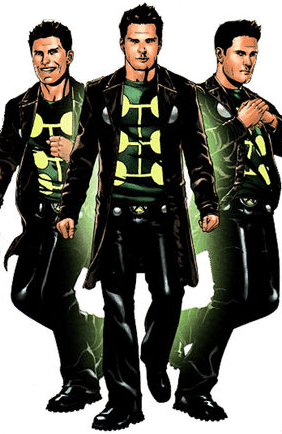 Deadline is reporting that James Franco is looking to play Jamie Maddrox, Multiple Man in a movie from Fox. The script is being written by Allan Heinberg, and Simon Kinberg and Genre Films are producing it along with Franco and Ramona Films.

