Tag Archives: franklin richards

Fantastic Flops: The Fantastic Four: First Steps has a Decent Story and Charming Production Design

Fantastic Four: First Steps

Even though the Fantastic Four comics kickstarted the creation of the Marvel Universe, their film adaptations have been critically maligned. In the “Fantastic Flops” series, I’m going back and re-evaluating the four previous Fantastic Four films and seeing if they’re a “Flop”, “Bop”, or “In-Between”.

To get the obvious out of the way, after 31 years of struggles and not-so-close calls, we finally have a good live action Fantastic Four film in the clunkily named The Fantastic Four: First Steps. (Franklin Richards is incredibly crucial to this film so I get why they did it though.) Veteran television director Matt Shakman (Wandavision, It’s Always Sunny in Philadelphia) and writers Josh Friedman, Eric Pearson, Jeff Kaplan, Ian Springer, and Kat Wood turn in an engaging, retro-futurist standalone yarn that honors the spirit of those early Jack Kirby and Stan Lee comics while adding psychological and ethical dilemmas that come from some of the more contemporary runs like Jonathan Hickman’s work in the early 2010s.

The best thing that Fantastic Four: First Steps has going for it is the production design. Kasra Farahani crafts a world where in the 1960s Marvel Comics only published Fantastic Four comics for the first four years of its existence instead of immediately expanding its universe and bringing back old superheroes like Captain America. Shakman uses breezy news reel montages to establish a utopian world that would make New Deal Democrats, flower children, and sci-fi fanzine readers all smile in perfect harmony. There is a sheen, but also a lived-in feel to the technology used by the Fantastic Four on their various missions as well as the Baxter Building and downtown Manhattan. It’s a shiny, happy world, but there are some rough edges like when Ben Grimm (Ebon Moss-Bachrach) goes to his old neighborhood in Yancy Street to get black and white cookies and perform feats of strength for kids at the local Hebrew school. (The Thing’s Jewish heritage is very much intact in this film.) The attention paid to the brave old/new world helps keeps the stakes real when a regal, yet slightly melancholy Silver Surfer (Julia Garner) heralds the coming of Galactus (Ralph Ineson) and the end of this universe. As a cherry on top, Michael Giacchino’s score perfectly blends soaring heroism and sci-fi exploration.

Let’s continue on to the casting. I didn’t love Joseph Quinn as Human Torch, and he doesn’t have the charisma that Chris Evans and Michael B. Jordan had in previous iterations of the character. Although charming in other roles, Pedro Pascal doesn’t quite pull off the universe’s smartest man, Reed Richards in the science speak sequences. This is really a difficult role to cast. I did find him endearing as a clueless, new dad and trying to override the part of his brain that treats everything like a problem to solve. Vanessa Kirby as Invisible Woman carries the film. She bring heart, humanity, diplomacy, and a mother’s love that turns a moment that could have been a deus ex machina, close the portal, and end the movie type sequence into something emotionally resonant. There’s a big “having it all”, second wave of feminism energy into the way that she’s written as Invisible Woman that fits the period as she is a mother, de facto team leader, and quite the diplomat as well. There’s a sequence where she smooths over a moral dilemma that should be required viewing in public relations courses.

So, if it only got the casting about half-right, then why does Fantastic Four: First Steps succeed where its predecessors failed? It is because Shakman and the writing team understands the Fantastic Four are at the best when they’re solving problems and not just punching bad guys. I love the impossible dilemma that is set for the team: choosing between giving Reed and Sue’s firstborn child to Galactus or giving the Earth to the Devourer. The preparation of Galactus’ invasion is actually one of the most underrated and engaging parts of the film. It’s entertaining watching Reed test all kinds of science and equations while Sue markets them to folks around the world. This is while Johnny Storm becomes a linguistics expert because he has a little crush on the Silver Surfer, and Ben Grimm has a crush of his own on Rachel (An always spectacular Natasha Lyonne) and connects with his neighborhood before the end of days. And when the initial plan fails, it’s fun to watch the team move and adjust on the fly. They’re like a well-oiled machine that’s been doing this for four years, helped usher in a utopian society, and of course, their next challenge is fighting God.

Another element that makes Fantastic Four: First Steps a successful film is the aura that Matt Shakman, the visual effects team, Garner, and Ineson give to the Silver Surfer and Galactus. As revealed in the trailers, the movie uses a comics-accurate design for Galactus, and I love how Ralph Ineson in both voice and motion capture plays the antagonist like a universal constant and force of nature, not a malevolent being. He really wishes he could stop doing this, but someone has to keep the scales balanced in the universe. It’s a similar situation with the tragic Shalla-Bal who acts as Galactus’ herald because she wants to keep her planet and children safe. I love the parallels that Shakman, the writers, Vanessa Kirby, and Julia Garner draw between the Silver Surfer and Invisible Woman, and the flashback scene is pure tragic poetry. It’s nice to see these iconic characters finally get their due in live action, and the writers wisely leave a door open for them to return. Also, hell yeah, the power cosmic!

Despite some less than stellar casting, jokes that unfortunately don’t land, and a return sequence from Galactus’ ship to Earth that drags on and on, The Fantastic Four: First Steps is an entertaining retro sci-fi blockbuster with clever world-building and memorable production design plus a multi-faceted lead performance from Vanessa Kirby as Susan Storm-Richards that makes up for the way the character was poorly written and portrayed in previous films. The battle against Galactus is fittingly epic, and it makes you want to pore over Jack Kirby splash pages or re-read those Jonathan Hickman trade paperbacks. Also, in a similar vein to its movie-mates Superman and Thunderbolts, it’s nice to have superhero films that tell a complete story and have decent character arcs instead of just trying to set up the next installment.

(P.S. I need a Disney Plus animated series in the style of the second post credits scene!)

Overall: 7.0
Verdict: Bop
Messages from Midgard #9 – Mimosas with Loki

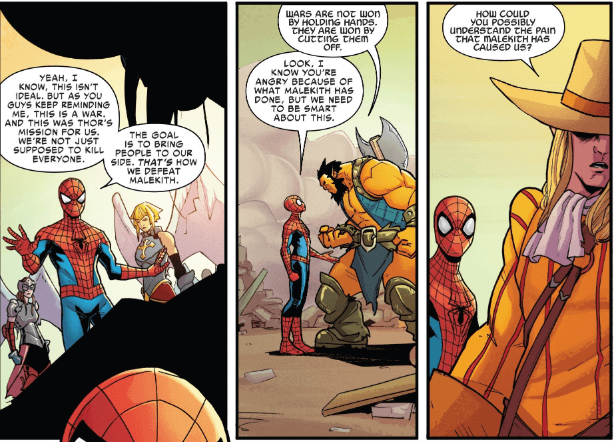
This was a really enjoyable week in “War of the Realms” country with all kinds of heroic happenings going on from Spider-Man choosing to negotiate with and not fight both the Angels of Heven and the Nigerian army in League of the Realms #2 to Cul Borson finding redemption in Thor #13. This week also marks the return of anthology War Scrolls, which features one of Marvel’s best stories of 2019, namely, Wiccan going to drag brunch with Loki. Speaking of drag brunch, “War of the Realms” also got a head start on Pride Month by featuring LGBTQ characters in both League of the Realms #2 and War Scrolls even though the first one is a little more tragic as the angel Fernade mourns over her lost love, Anemone.

War of the Realms: War Scrolls #2

War Scrolls is really one of the “War of the Realms” tie-ins that I wish got more than three issues, especially when we’re blessed with a trio of stories that like we got in issue two. First up is the part two of Jason Aaron, Andrea Sorrentino, and Matthew Wilson’s Daredevil, God of Fear serial, which cosmic sizes a classic battle between Daredevil and the Kingpin. But, before things go from Netflix to Man of Steel, Aaron and Sorrentino do some chilling characterization in a Ben-Day dot flashback where Daredevil prays that he won’t beat a mass murderer to death. Wilson’ color palette switch from flat and old school to majestic fantasy mode helps the story keep its momentum, and although he’s a bad guy, it’s fun to see Wilson Fisk get one up on Malekith and the Dark Elves.

The second serial is a Doctor Strange one from Devin Grayson (Nice to see her getting work again), Paul Davidson, and Andres Mossa. It show the effect of teleporting all the civilians and heroes in New York to the North Pole on Strange and is also cute and charming along the way. The main plot involves Dr. Strange preventing Nightmare from attacking this plane of existence, and Davidson and Mossa channel their inner Ditko with psychedelic art that wouldn’t be out of place in a head shop circa 1968. Grayson writes Dr. Strange as a heroic figure a la the Doctor or even Morpheus from Sandman, who admits his mistake of teleporting the superheroes out of New York and shows Nightmare that fear can be fought and resisted to. And he does this all while taking a nap. (A cute kid even tucks him in and gives him a stuffed animal.)

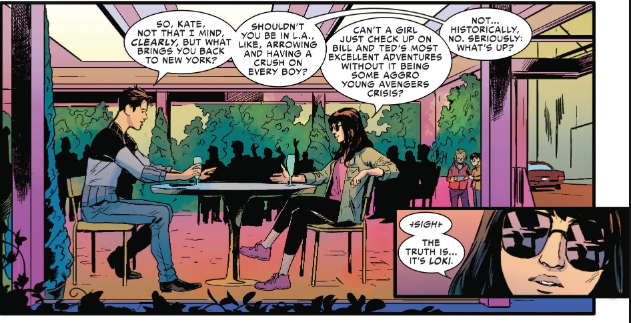
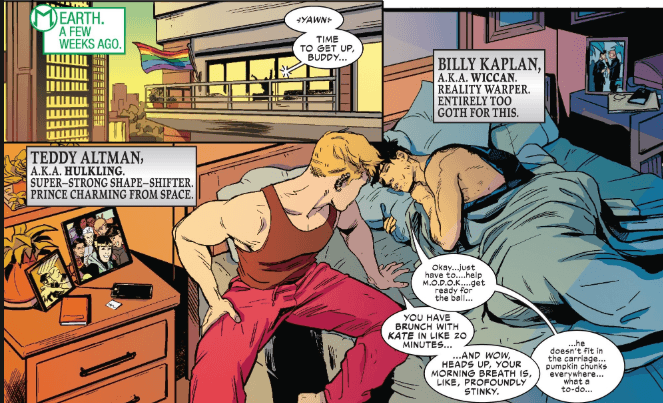
War Scrolls definitely saved the best for last, and that is a drag brunch story by Anthony Oliveira, Nick Robles, and Cris Peter featuring Hulking, Wiccan, and Loki in a mini-Young Avengers reunion. It’s funny, sad, and Kid Loki turns Thor into a bear on the first page. Oliveira and Robles spin the tale of Loki’s relationship with Wiccan and the Young Avengers, and how even though he may have manipulated them and even cast his lot with Malekith the Accursed that they still care about and support him. The story is in direct conversation with Kieron Gillen’s Loki arc in both Journey into Mystery and Young Avengers and clears up loose ends while providing the reason for why Loki wears a horned helmets. Plus Jean Grey and Emma Frost drag queens get into a fight, and Oliveira, Robles, and Peter create a vision of the Marvel universe that is beautifully queer. This story alone (The Daredevil and Dr. Strange ones were great too.) earns War Scrolls #2 an Overall Verdict of Buy.

War of the Realms: Spider-Man & the League of Realms #2

In Spider-Man & the League of Realms #2, Sean Ryan, Nico Leon, and Carlos Lopez basically have Spider-Man herding cats, er, trying to get people like Screwbeard and Ud the Troll, who are hardwired to fight, to avoid unnecessary bloodshed. However, they start with a tragic love story, and Lopez uses beautiful whites and reds to show the story of the Angels Fernande and Anemone, who was killed by Malekith because he just wanted to know what killing an angel felt like. Fernande was the enemy in the previous issue, but now she’s a staunch ally of Spider-Man and decides to help the resistance against the Angels of Heven in Nigeria.

But this issue isn’t all triumphant, and Leon gets the opportunity to show Screwbeard, Ud, and Ivory Honeyshot, whose realm was the first one conquered by Malekith, shooting and fighting their way through Rome. The measured conversation and protective spells of the first half of the issue are replaced with catchphrases, explosions, and a foe that might be beyond any of them. The blows that Malekith’s main lackey Kurse land are powerful reminders of the pointlessness of unceasing violence, and Spider-Man’s probably going to have clean up the mess in the next issue. Because of its mix of fine and cartoon-y art, still quirky ensemble cast, and story that shows the results of both war and diplomacy, League of Realms #2 earns an Overall Verdict of Buy.

Thor #13

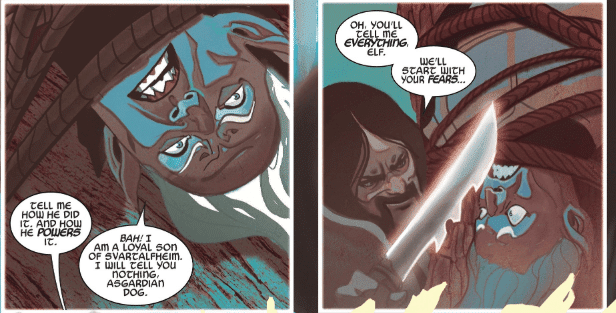
In the Thor tie-in issues of “War of the Realms”, Jason Aaron and artist Mike Del Mundo have been doing a fantastic job of fleshing out the supporting Asgardian characters that have popped up throughout Aaron’s run. Cul Borson, the God of Fear and on a secret suicide mission from Odin, gets the treatment in Thor #13. Beginning in the present day with Cul surrounded by crying Dark Elf children, the comic is structured like a biography of the god with childhood flashbacks of him bullying Odin and eventually being banished to Midgard as the “Serpent”. As he fights through the mushroom mines of Svartalfheim, Cul is in conflict between wanting to be feared and loving and between caring for his little brother and wanting to usurp his throne.

Although the flashbacks include Cul overhearing arguments between Odin and Thor that made him wish he had a son and dark temptations from Malekith, Thor #13 is an action-oriented issue tempered by soul searching narration from Aaron. Del Mundo’s Cul cuts a dark figure in the sickly green of the swamps of Svartalfheim where Dark Elf children, who have been called unworthy, help build Malekith’s empire. He wants to leave them to die, but in a moment of supreme character development hacks off their chains. This leads to a resistance movement even if Cul never sees the fruits of his actions. He was a never a “good guy”, but in a tough moment, he did one heroic thing and can die without wasting his life. Cul’s last stand against the Dark Elves is pretty damn noble as Del Mundo fills his panels with bodies, and combined with Aaron’s insightful writing earns Thor #13 an Overall Verdict of Buy.

Giant-Man #2

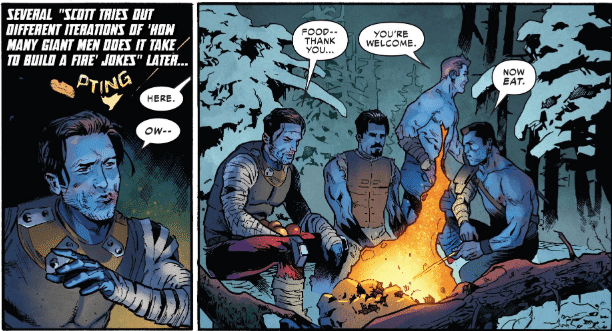
“War of the Realms”‘ most random tie-in continues in Giant-Man #2 where Leah Williams fits Scott Lang, Raz Malhotra, Atlas, and Tom Foster into a fantasy quest narrative, and Marco Castiello’s art is still so shadowy and less than detailed that it is still difficult at times to immediately know who’s talking. (Tom’s shirtlessness, Atlas’ septum ring, Scott’s Ant-Man helmet, and Raz’s Skyrim do help.) In Hero’s Journey and college movie tradition, they end up facing a threshold guardian, who needs them to pay a toll and drink way too much at a party.

Williams’ gift for humor shines through in Giant-Man #2 with Tom’s knack for karaoke coming in handy when faced by Frost Giant locals, and it’s nice to know that there are some Dolly Parton fans in Jotunheim. Castiello also turns the nine panel grid into a grid of debauchery as Atlas keeps downing pints while tired dad Scott Lang passes out early. Also, the drinking songs are cleverly weaved into the plot of the miniseries as the team literally learns how Frost Giants are made and end the penultimate issue with a shot of their final obstacle and a side of how utterly expendable they are. By leaning into fantasy genre trappings and its characters’ dysfunctional personalities, Leah Williams and Marco Castiello create a fun event tie-in that earns an Overall Verdict of Read.

Fantastic Four #10

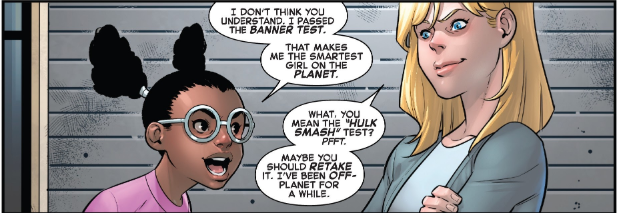
One thing that I loved about Fantastic Four #10 is that write Dan Slott and artists Paco Medina and Kevin Libanda start out by telling the story of the Fantastic Four moving to Yancy Street and Franklin and Valeria Richards trying to fit in with “regular” kids after working with the Future Foundation out in the multiverse and don’t force a tie-in. Franklin is struggling with the dwindling nature of his powers and going through an emo phase, and there’s a block party. Then, Slott introduces all the baddies from “War of the Realms” and connect it to the strength and resolve of the people of Yancy Street as Franklin realizes that growing up in this neighborhood and learning to never give up made Ben Grimm a hero long before the Thing.

I love how Slott writes Franklin and Valeria as ungrateful adolescents and not just cute kids with big brains and godlike powers. Franklin’s almost limitless superpowers have gone to his head, and it’s nice to see some of the kids in the neighborhood cut him down to size when he brags about his abilities instead of helping with art classes at the Grimm Community Center. However, this story nails the awkwardness of moving to a new area when you’re a kid, getting used to new people, and ways of doing things. It also shows that New York didn’t roll over when Malekith invaded, and best of all, introduces a friendship/rivalry between Moon Girl and Valeria that I hope gets fleshed out in future issues. Most of “War of the Realms” has involved street level heroes fighting cosmic threats, but Slott, Medina, and Libanda turn the tables and have the Fantastic Four protecting their neighborhood. This earns Fantastic Four #10 an Overall Verdict of Buy.


Although Marco Castiello’s giant blue Paul Rudd will haunt my dreams, this was probably one of the best weeks for “War of the Realms” with issues that focused on character and story and not making the millionth Dungeons and Dragons/Lord of the Rings reference. Even if Jason Aaron’s War of the Realms mini ends up being a bust, it won’t tarnish his classic Thor run, which has done a great job showing the journey of side characters during this event. Also, Anthony Oliveira needs to write a Young Avengers run ASAP, and Nick Robles has definitely entered the pantheon of sexy Loki artists after his work on War Scrolls #2 and even made the horned helmet cute.


Panel of the Week

If this panel doesn’t make you miss Gillen, McKelvie, and Wilson’s Young Avengers, you have soul. (War of the Realms: War Scrolls #2, Art by Nick Robles and Cris Peter)