
Goblins, Trees And Hope: Talking Farlaine The Goblin With Pug Grumble
Pug Grumble, the pen name for the mysterious creator behind one of the most effortlessly charming series you’ll ever come across, would rather your attention be on his creation rather than himself, which is fine because his creation is wonderful. Farlaine is a book about a goblin shaman desperately searching for a home for his best friend, the tree Ehrenroot. With the sixth book en route very soon, Graphic Policy recently sat down for a quick chat about the on going creator owned book series.
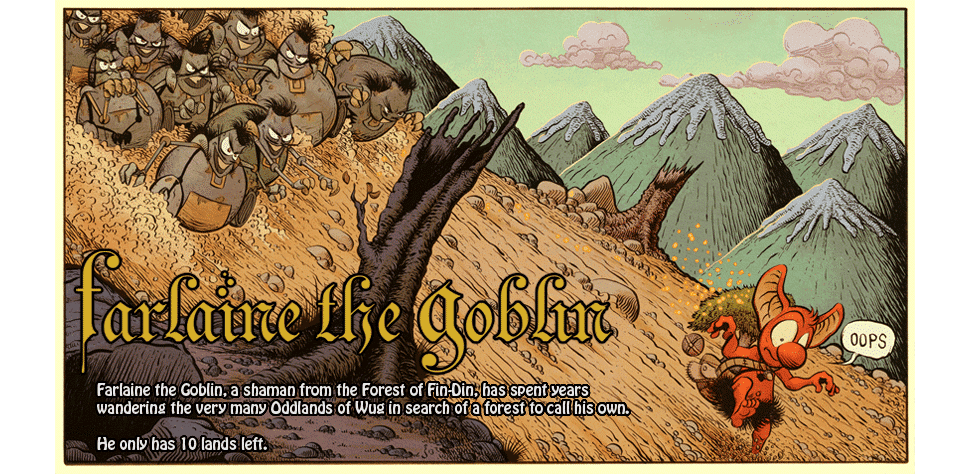 Graphic Policy: For those who haven’t heard of, or read, Farlaine the Goblin before, can you tell us what it’s about?
It seemed perfect. I labeled the drawing “shaman from another land”.From there I started to ponder him and draw him more. He just stuck in there, and over the next year or two he became more polished, his personality emerged, and a story started to take shape. Finally, I got to a point where I really wanted to bring this character to life and read his story myself. So I did :)GP: The story has a very all ages feel to it without being overly kid like, which is wonderful. Do you find it more challenging to write in a style that appeals to both young and old kids?
PG: When I first started writing the series I wrote it entirely for myself. There was no plan to write for any specific audience; I just wrote what I wanted to read.
 GP: Personally, I’d never have considered “helluva” to be a crass word, but then I’m probably less offended by certain words than most. That being said, I think the all ages tag line lends a much purer feeling to the book; I couldn’t imagine the story any other way at this point. How long does it take you to create each issue? Can you talk us through the process?
PG: Yeah, I can’t really fault the original comment too much. If you’re reading the book to a 5 year old it could force a tricky explanation for a parent. And in general, it probably helped send me down a safer path going forward :)
WARNING: Rambling Ahead!
The books have taken me more and more time as I’ve gone, pretty much the opposite of what I was expecting when I began!
When I first started I’d left a job and had some savings and unemployment to last me a year. I had the first book written before I started and had the plot and story well defined for books 2-3, so I had a good sense of where I was going with those first 3. Those 3 books I finished drawing in 9 months, roughly 110 pages of art.
But from there things slowed down dramatically. I had to go back to a desk job and a long commute, so the next year was spent editing the first three books, drawing the covers, pitching to publishers, and finally designing and printing copies of Book 1 in order to submit it to Diamond so I could get in their catalog and into stores.
When Diamond accepted me I then had to do all the publishing work of releasing 3 books, getting reviews, hitting conventions, etc. It was a lot of work to fit around the day job, so by the time I started writing Book 4 it had been a year since I’d finished drawing Book 3.
My goal was always to tell the best stories I could and not focus on a release schedule, so even though I knew it wasn’t great to have huge gaps, I tried to think longterm about the quality of the finished series. In my mind Farlaine had potential as a fairy tale that could appeal to audiences for decades.
Starting with Book 4 the stories weren’t set in stone, which meant a lot more time building the stories out. The process for Books 4-7 has been different from those original 3.
Book 4 I wrote and drew while working a full time job, so it took me more than a year to complete. I realized at that rate it would take me 5 years to finish the series, so I saved up some money and left the job with an eye on finishing Books 5-7 in one run.
Which finally brings me back to your original question – how I work now.
First I collect ideas for months, throwing story ideas, tidbits, lines of dialogue, plot points, world building, and everything else into a bunch of text files in a folder. Once I collect enough ideas and reach critical mass, I start to coalesce them down to a real story. I spend a lot of time on the plotting and writing side of things to try to not do obvious stories or repeat things I’ve already read. My hope is to come up with something a little different that I haven’t read before.
It usually takes me a month or two to write an issue of Farlaine, with my focus mainly on the dialogue and overall plot points and not as much on the visuals.
Once I finish the script I start drawing, but it’s almost like a different part of my brain, so I just print off a page or two at a time and draw what’s on that page. I don’t memorize it or look ahead, letting myself be surprised by things I forgot.
I generally draw one page at a time. For me layouts get boring and lose a lot of their enjoyment and creativity if I plan too far ahead. I prefer surprises and giving ideas the space to grow as I go. I often end up drawing things that weren’t in the script but came to me as I was working. I like that organic aspect a lot.
I also draw really slow. Most guys in comics seem born with a pencil in their hand – I didn’t start drawing until I was 15. So I’m slow and need to figure things out. What I discovered by issue 3 of Farlaine was an approach I stole from David Petersen of Mouse Guard. I started drawing pencil versions of all the characters and angles on separate pieces of paper, then scanning them in and Photoshopping them together with the dialogue onto a template page, which I’d then print out and lightbox. This allowed me to manipulate the sizes I drew characters and move them around to fit the dialogue properly. In that first issue or two you can see a lot of places where the proportions are off, the dialogue is covering art, body parts are randomly arranged or cut off. Most of that was my weak spots showing through:)
So once I started the ‘layout and lightbox’ approach I think the art got a lot better, but also took a lot longer. These days I usually spend one day on all those layout drawings, scanning them in, and printing off that 11×17 rough template. It then takes another day to re-pencil the page, tighten things up, add backgrounds, and finally ink it. I work traditionally with a nib and bottles of ink, so it adds time for ink to dry, pencils to be erased, etc.
From there I scan the finished art back in, do some digital whiteout, and letter the page, before finally printing off the next page of the script and moving on.
In general, I average about 2-3 pages of finished art/week when I’m in a groove. If I get caught up with publishing duties or the rest of life, sometimes that dwindles to a page or less in a week.
Since my stories are now ranging between 40-50 pages each, this means a single volume can take me 6+ months to write and draw, as opposed to those early ones that were cranking along in about 3 months!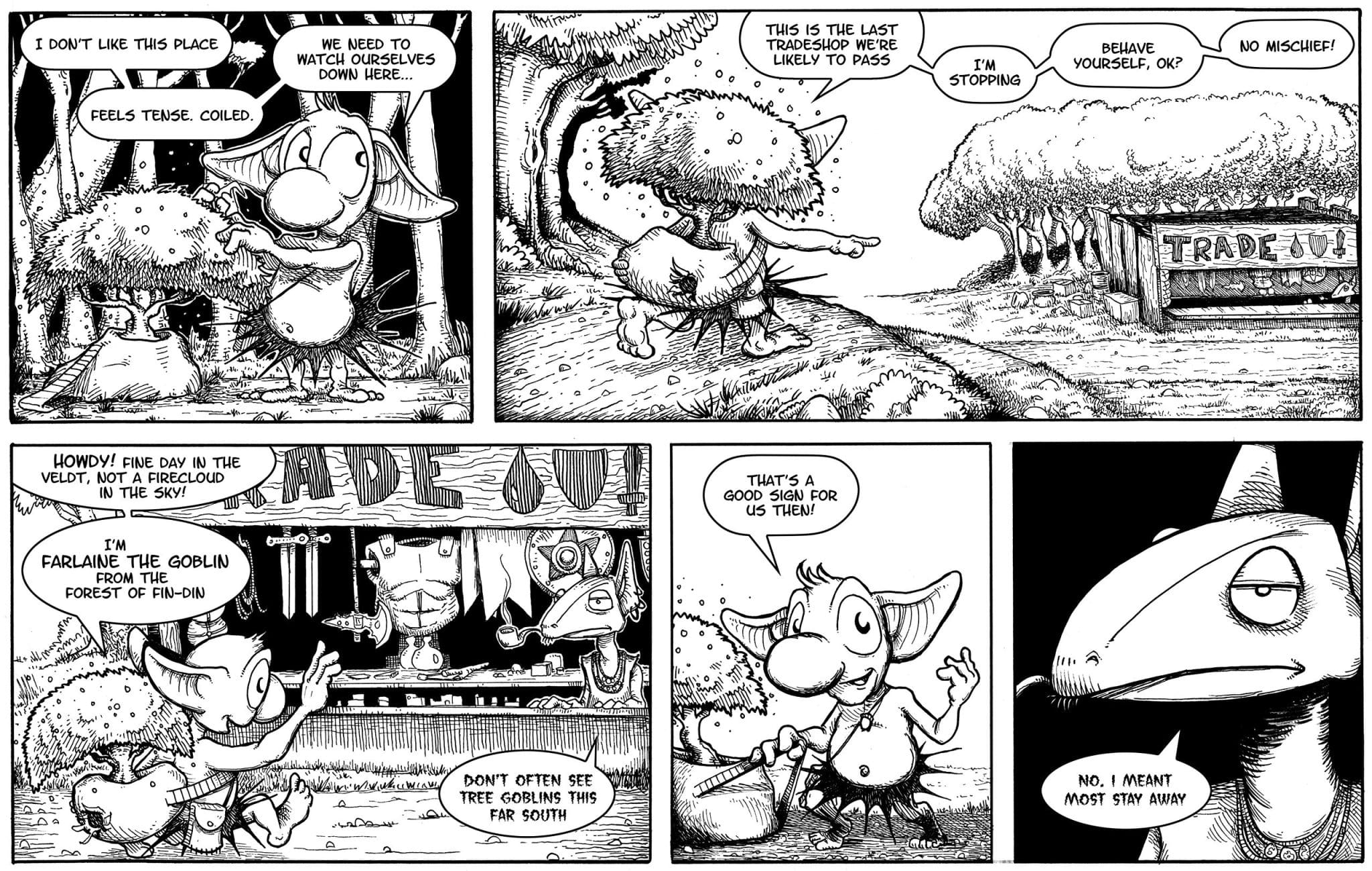
I’m sure there are a lot of parallels between the story and the creation of the book :).
Farlaine is available for purchase here.
 Wednesdays are new comic book day! Each week hundreds of comics are released, and that can be pretty daunting to go over and choose what to buy. That’s where we come in!
