
Tag Archives: David Kohl

My 7 Favorite Phonogram B-Sides

In advance of Kieron Gillen and Caspar Wjingaard’s upcoming comic The Power Fantasy, we’re revisiting some of Gillen’s previous creator-owned work.

As I’ve written before in features and monthly reviews, Phonogram will always be one of my favorite comics and is responsible for roughly 60% of my music taste. For folks who weren’t reading the book 8-18 years ago, Phonogram is a fantasy comic where music is literally magic. The first miniseries Rue Britannia is about protagonist David Kohl trying to find the missing goddess Britannia aka the personification of Britpop music. The follow up The Singles Club is probably still my favorite Kieron Gillen, Jamie McKelvie, and Matthew Wilson collaboration and tells the story of one evening at a Bristol night club from seven different perspectives. Finally, The Immaterial Girl wraps up the series with its focus on it-girl Emily Aster from the previous two volumes of Phonogram dealing with having two identities in a love letter to MTV-era music and videos. The comic does a wonderful job exploring people’s connection to music, and how it affects their identities using a touch of fantasy. It also functions as an engaging piece of pop music criticism. Seriously, I think “retromancer” every time I get an email from a local music venue about an 80s or emo night.

One underrated thing about the Phonogram comics were its B-sides. These were short comics usually by an artist other than McKelvie that fleshed out supporting characters, commented on a music genre, or told a story about David Kohl’s past or future. Initially, you could only find them in the single issues along with a quite-snarky-at-times glossary of terms and bands that I treated as gospel back in college plus other backmatter like record reviews and a letters page. However, they were collected in the Complete Phonogram hardcover, and you can binge them all at once in all their glory, read them after the issue they first appeared in, or even do a fully chronological read of Phonogram. In addition to fleshing out the themes and characters of the series, the B-sides also act as a showcase of some of the best UK indie comics talent of the 2000s/2010s.

Here are 7 of my favorite B-sides from Phonogram: The Singles Club and The Immaterial Girl in the order of the release date of the comic they originally appeared in.
1. “She Who Bleeds for Your Entertainment”

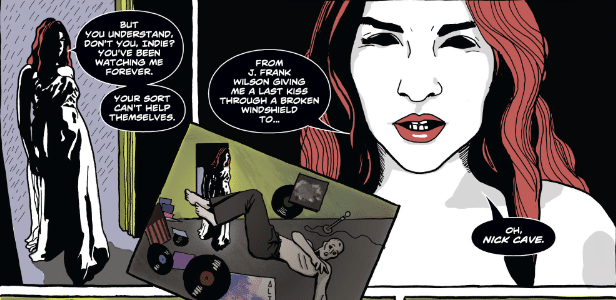
It’s kind of messed up, but Indie Dave is one of the characters I relate to in Phonogram. He’s balding, not great at housekeeping, loves isolation, and is a fan of Joy Division and other artists of early punk/post punk explosion. (You can see Patti Smith, Gang of Four, and Wire posters in his flat in the background of panels in this story.) Gillen could have used him as a cautionary tale in Phonogram, but instead he gets his own arc throughout the B-sides of The Singles Club. This first one, “She Who Bleeds for Your Entertainment”, is an ode to all the women who died in songs from the teenage tragedy tracks of the 1960s to the at-the-time contemporary sad boy tunes of Death Cab for Cutie and Sufjan Stevens. Laurenn McCubbin’s art and colors screams aggressive a la The Morrigan in The Wicked + the Divine as the personification of dead women in songs hurls invectives at him culminating in “emosogynist”. “She Who Bleeds for Your Entertainment” isn’t some kind of moralizing, pop feminist sermon, but a call to consume dark music and its lyrics more mindfully and maybe give some of those female characters agency like Nick Cave did in his tracks with and about PJ Harvey. (They’re my most missed celebrity couple.) There’s room for both Murder Ballads and Boatman’s Call in the world. It’s also a wake up call for Indie Dave to leave his pathetic vinyl-strewn hut and experience real life for once.
2. “Wuthering Heights”

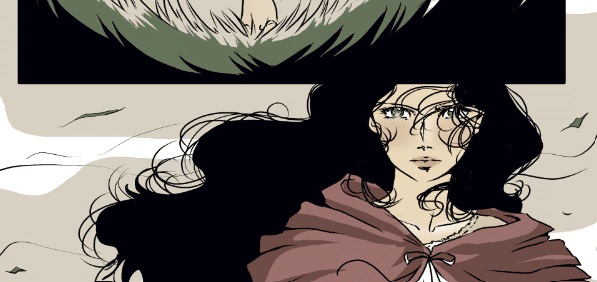
And Indie Dave gets to experience real life almost immediately in the next B-side, “Wuthering Heights”, a beautiful silent comic that is an homage to the Kate Bush song of the same name. Emma Vieceli handles art duties in a style that’s manga meets fantasy landscapes. Unlike the woman in “She Who Bleeds for Your Entertainment”, the female lead of this comic runs, frolics, and dances providing the magical energy for Indie Dave’s journey of self-discovery in the form of a Kate Bush compilation tape. Instead of being cloistered in his room, Indie Dave sets off for the great outdoors with Bush’s ethereal music in his ears and The Dreaming and The Kick Inside in his bag. Indie, artsy music is still his passion and maybe a security blanket, but at least, he’s touching gorgeous Vieceli-colored greensward.
Phonogram

3. “David Kohl: Phonomancer”

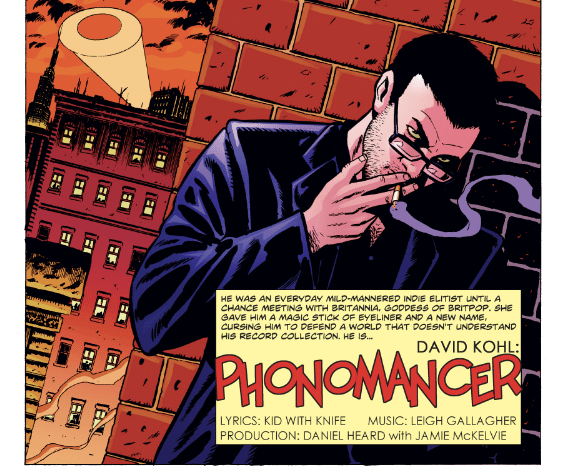
This was one of the first Phonogram B-sides that immediately popped into my mind when I thought about working on this project. “David Kohl: Phonomancer” is a four page parody of Phonogram: Rue Britannia via the Jamie Delano era of Hellblazer. Leigh Gallagher‘s art feels like it should be on newsprint (It’s the wide margin gutters!), and Daniel Heard‘s colors are a dead ringer for Daniel Vozzo’s work on basically every Vertigo/DC Mature Readers title. Kieron Gillen does an amazing job poking fun at the wordiness of old comics/Rue Britannia by having a panel that lays out the main themes of the miniseries with one talking head and blank background. However, the final page is all action and flags, and I definitely detected a little Authority-era Bryan Hitch-meets-Rob Liefeld in the big biceps and guns and Union Jack in the penultimate panel because, of course, action man Kid-with-Knife is the narrator of this yarn. “David Kohl: Phonomancer” is a monument to how clever you have to be to make something seem so dumb.
Phonogram

4. “Your Song”

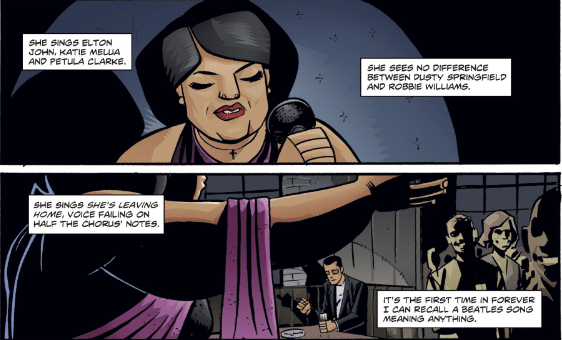
In “Your Song”, Gillen and PJ Holden craft an ode to enjoying your favorite songs while out and about as David Kohl has some drinks at a rural pub while watching a pub singer who’s not very good. However, he ends up being immersed in her performance and realizes that she cares about music as much as him in her own way. Kohl even thinks about cursing a heckler by having her have the same song stuck in her for eternity (A common Phonogram spell.), but realizes that she doesn’t actually care about music so it wouldn’t be a punishment at all. Holden nails the poorly lit interiors and exteriors of the pub while progressively adding lines to Kohl’s face as he warms up to the pub singer, looks at her daughters’ encouragement, and simply finds pleasure in a dance with a stranger. “Your Song” is the perfect sweet and sour B-side beginning with snarky criticism and ending with blissful acceptance as Kohl boogies the night away.
Phonogram

5. “Blurred”

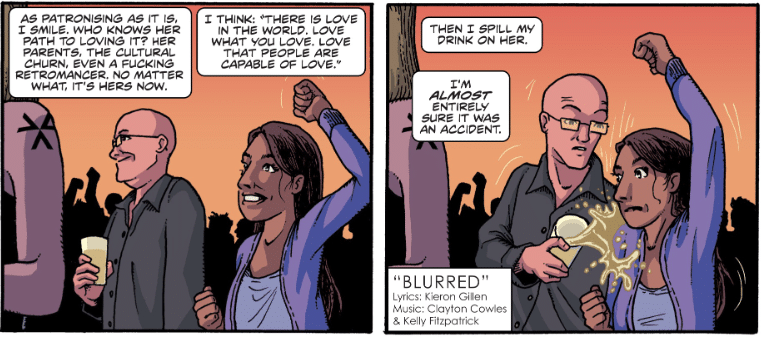
I picked this B-side drawn by Clayton Cowles and colored by Kelly Fitzpatrick as a favorite because I’m totally the girl that David Kohl spills a drink on while comparing a Blur show in 2015 to a Sex Pistols one in 1996. It’s a five panel comic about handing the fandom of a band to another generation. I was a toddler when Parklife came out, and Blur and Oasis battled for the supremacy of Britpop, but you can bet your ass I was on the plane to LA to see them play a warm-up show before Coachella. On the flipside, it’s me at the 7-Eleven chatting with some teenagers/college students/young people (Kohl was right about people under 30 all looking at the same.) about my Paramore shirt when they were toddlers when Riot! came out. It’s cool seeing artists have generations-spanning impact, and gatekeeping that is uncool. I don’t care if they got into Paramore because they opened for Taylor Swift on the Eras tour. I got into them because they said “whore” uncensored on the radio, and Hayley Williams was a ginger from Middle Tennessee like me. Teenagers will probably be listening to The Smiths and “Teenagers” by My Chemical Romance in 2050, mark my words. Gillen and Cowles nail that sentiment while paying homage to the best Brit pop band with a little cheeky Kohl humor on the side.
Phonogram

6. “I Hate Myself”

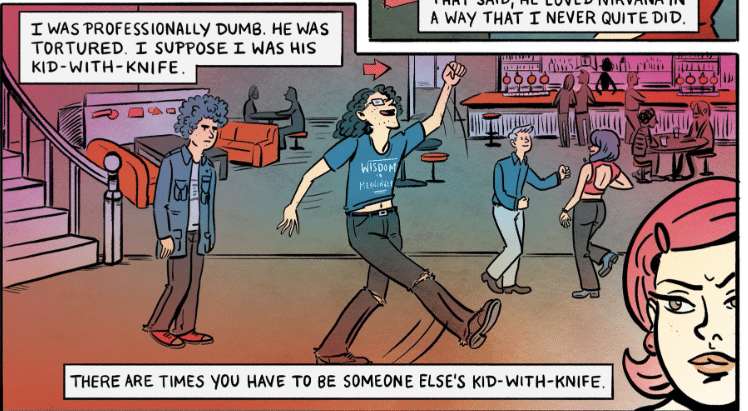
“There are times you have to someone else’s Kid-with-Knife” is a piece of wisdom I think about when I get a little too big for my britches, or the main character syndrome starts to creep up. And I got it from “I Hate Myself”, which was illustrated by Jules Scheele in a lovely, throwback 90s indie comic style combined with a more contemporary approach to color palette. It’s a flashback story of David Kohl in Catholic school with his friend Johnny Panic, who is a huge Nirvana fan, and later confides in Kohl that the band saved his life. In the space of two pages, Gillen and Scheele go through the triumphs, angst (Ecclesiastes quotes on t-shirts!), and dick jokes of adolescence before giving a glimpse of Panic in the future as he dances with shirtless Slovakian men to “Smells like Teen Spirit”. It’s really amusing and cathartic to see a pre-Britannia Kohl fumbling with his identity and following the lead of a more confident, high-energy, and yes, depressed friend illustrating the simple truth that sometimes we’re not always the protagonist.
Phonogram

7. “Modern Love”

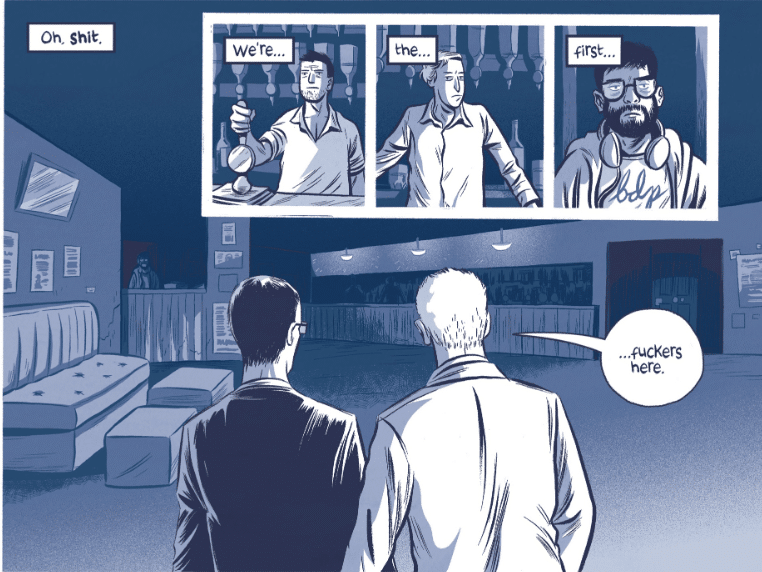
And of course, I had to wrap up this article with the final canonical Phonogram B-side and in-universe story in general, “Modern Love”, which is drawn by Tom Humberstone and is the reason I never turn up early for club nights. (Being “the first fuckers there” is so embarrassing for no discernible reason.) This comic chronicles David Kohl’s bachelor party, which is just him and Kid-with-Knife going to a club, discussing assault weapons, and dancing to The Smiths, Kenickie, and David Bowie aka the songs on Kieron Gillen’s writing playlist. this is funny because the final page of the comic blurs the lines between fiction and autobiography with Gillen pulling a Grant Morrison, facing the audience, and wiping a tear away as he puts this universe to bed. “Modern Love” is a lovely coda to David Kohl’s journey as Humberstone’s pink and blues make memories of club nights rush through his mind, and we get his entire career as a phonomancer in the rush of a page. It’s a beautiful ending to the series and an ode to building friendships, meaning, and creating with the aid of pop bangers like the Bowie track that gives the B-side its name. (I also feel like I lived this comic because I briefly danced with Kieron Gillen to “Modern Love” once upon a time.)

C2E2 2017: Kieron Gillen Talks High Fantasy, “Self-Hatred,” and Music Spoiling Comics

Through his creator owned comics Phonogram and The Wicked + the Divine with artist Jamie McKelvie and colorist Matthew Wilson, Kieron Gillen has masterfully melded the fantastic worlds of music and urban fantasy into an exciting read experience. He has also conquered the worlds of Marvel with the delightful Young Avengers and way too sad Loki solo series Journey into Mystery among others as well as comics set in a galaxy far far away, like Doctor Aphra and Darth Vader. He’s also one hell of a DJ and has quite the Twitter pun game.

At C2E2, I got the opportunity to chat with Kieron about being a fantasy writer, and how the characters of WicDiv have all become terrible people. We also preview the upcoming WicDiv 455 special set in ancient Rome and ponder the fate of Phonogram‘s David Kohl (and his fiction suit wearer Kieron Gillen) in 2017 as well as strain out some of that book’s autobiographical bits.

Graphic Policy: I guess you could classify WicDiv and Phonogram as urban fantasy. (And Journey into Mystery, now that I think of it.) What has drawn you to the fantasy genre over and over again, and do you have any particular books or fantasy films that have influenced you?

Kieron Gillen: Back when I was starting to write comics, I used to call myself a speculative fiction writer. The person I was seeing told me, “No, you’re not, Kieron.” She said, “You’re a fantasy writer. Making a world where music is magic isn’t speculative fiction.” Being a speculative fiction writer is much cooler because science fiction writers are genuinely cooler than fantasy writers in my opinion. It’s real work as opposed to fantasy, which is just making shit up.

It took me a long time to accept [being a fantasy writer]. I burnt out on a lot of fantasy as a teenager. I had a kind of “come to Jesus” moment where I was like “What on Earth is this shit?” A lot of fantasy is just shit like the travelogue school of fantasy where there’s a map, the heroes will go around the map, and the big mountain. At least, Tolkien had a degree of originality.

So, the idea of me identifying as a fantasy writer is anathema. But then there’s the whole idea of urban fantasy. I used to write essays about this when I was a music writer before I realized [urban fantasy] was what I wanted to write. It was the idea of the transformation of an environment. The magic in Phonogram is that we have a world, and then you add something over the world. Like augmented reality.

People tell me that Phonogram gives them permission to view listening to music and going to clubs as a magical space. It always makes me think about parkour. My favorite thing about parkour, at least when it started, was the idea that buildings are designed as prisons for people. But, in your imagination, it can turn into a playground. They’ve chosen to see the world differently, and there’s always things to traverse.

This is kind of what urban fantasy does. You have a world and overlay it. There’s magic here. It’s like when I was a kid and loved Transformers. That car [Outside the convention center] could be a fucking robot. It’s like the Kurt Busiek core idea about superheroes. We have this magical thing in the world, and the world doesn’t change. The point of Superman is that you can see him fly past you in the skyline. If you take superheroes too seriously, you become something alternate history like Uber or science fiction. Add a superhero, and the world changes enormously.

I’ve actually been digging into primary world fantasy, like Middle Earth, as opposed to Narnia, which is a secondary world. It’s something I want to do in the future.

GP: You doing high fantasy would be awesome.

KG: I’ve said in a few interviews that I’m working on my next big, spangly thing. It’s a very literary high fantasy. It’s very grown up. I say grown up as a very loaded term because high fantasy is trashy in many ways. But I want to dig into some bigger themes and see what I can do with the genre. That hate fuck, that passion I have for fantasy means something.

GP: One thing I really enjoyed about “Imperial Phase” was that you and Jamie [McKelvie] gave Minerva and Baal a lot of character development. Why did you leave them out of the last issue of the arc?

KG: I get asked questions like “You’re very efficient with your storytelling. You hit stuff very cleanly and elegantly.” A lot of that is necessity, which is a word that is very fucking loaded in the context of WicDiv.

GP: Oh yeah, good ol’ Ananke.

KG: I’ve got 14 primary characters across the series and quite a few smaller, supporting ones. I ask what we can fit in an issue. The previous issue where we did the “phased” bit was me responding to the fact that I had so much shit to do. How can I do it in an artful way that speaks to the theme of the book.

Baal and Minerva just weren’t in this issue. The thing about “Imperial Phase” is that there’s parts one and two. When I originally planned “Imperial Phase”, I was thinking that we don’t have a cliffhanger. What’s the most unexpected thing for a WicDiv end of arc to be? It just stops, and we continue it. But when I ended up plotting it, it had a climax, but just a different kind of climax.

There was no room for Baal. If you remove Baal, you remove Minerva as well. The reason that Baal wasn’t there was a soft story beat. “Oh poop, Baal isn’t coming” leads to Persephone’s “Why do we hurt people?” The reason that Baal wasn’t there was because Persephone was there. It’s that moment when you realize that someone’s not coming to a party because they don’t want to see you. Baal not being at the party is kind of the point.

Baal is a sensitive man, and I love the dichotomy between him and Minerva. In other words, there’s more from Baal and Minerva in “Imperial Phase Part Two”. At the end of the story, Baal will be one of people’s favorite characters. He and Minerva are some of the most interesting characters, and knowing the whole story means I put him low in the mix early and then bring him up later.

GP: Good metaphor!

KG: I’m always a DJ. And since I know the whole thing, I want to build him up at different times. Dionysus is stepping forward and is one of the key players in the next arc. He’s got a scene in issue 30 with the Morrigan, which is one of my favorite things to do with the character

GP: I am really looking forward to the WicDiv 455 Special. Why did you decide to set it at the end of the Roman Empire instead of the Augustan Age with Ovid and Virgil, or during the time of Nero?

KG: If you set it at the end, you can include anything earlier. Everyone at the end knows what happens to Nero, Sulla, and Caligula, and you can reference all those people. If you’re doing something about Rome, set it at the end, make it about the end of Rome. Of course, WicDiv is about endings and the death of an empire.

This is minor spoilers, but the basic plot of 455 is that 455’s Lucifer has decided to not be involved in the Ananke pact and says, ” We don’t need Lucifer, we need Julius Caesar (Who was a god.), I’m going to save the empire.” You imagine that goes well.

The way I researched this special as opposed to the Romantics’ one [WicDiv 1831 Special] was different because the Romantics were a small cast of people, I could go relatively deep. Rome is so big that I had to do a very broad sweep and look at the entire history of Rome, which interests me. There’s some stuff I wished I gotten into, like Tiberius, who did Goth parties where everyone was in black. The slaves are painted black, he’s wearing full black, and they spend the entire party talking about death. And he’s killed people so everyone expects to die. It’s the most Gothic thing I’ve ever heard. But we had to cut it from the story.

GP: Why was Andre Araujo the perfect artist for this story?

KG: The way to phrase it is that I had a core image based on a Roman triumph, and I needed an artist willing to draw a Roman triumph. A triumph is a blaze of color and shape. Andre and I were talking when his comic Man Plus was out, and he said that he was working on a creator owned Rome pitch. In my head, I thought he was a [Katsuhiro] Otomo-esque cyberpunk guy because of Avengers A.I. and Man Plus, which is basically Akira reimagined in Portugal.

He had fantasy, sci-fi, and medieval pitches. And I said, “You like historical stuff and like drawing enormous landscapes. We can use this.” I asked him, and he was working on Ales [Kot’s] new book Generation Gone. So, we’ve derailed the work on another Image book in WicDiv’s favor and are very grateful to Ales. Also, Matt Wilson is doing the colors, and it works very well in the issue.

GP: The first 12 issues of WicDiv seemed to be about the relationship between being a fan and a creator, especially through our main character, Laura. How does her turn to the “dark side” in the past arc fit in with that fan/creator dynamic?

KG: “Imperial Phase” has been solipsistic. It’s about the gods being quite navel gaze-y. You get bits of fan stuff, like Persephone having her own fans. And that’s fun. I love how creepy everyone wearing a Persephone skull is. That transition from being a fan to having fans, and the responsibilities and duties that lie on that access and how well you navigate it.

WicDiv is based on a format of four years. The first year is a fan trying to become great, the second is this weird thing and ends with you getting your big hit. The third is you’ve got your success, and now what the hell is it for? The third year is about many things, but mostly my ambivalent feelings about WicDiv‘s success. When you get to the end of WicDiv, you’ll get that. There’s spoilery stuff I don’t really want to talk about yet.

GP: It’s like your “Ashes to Ashes”.

KG: A little bit, yeah. To go with the Bowie, we start out with Ziggy Stardust with some Black Parade, then you’ve got the Berlin period for “Commercial Suicide”. Then, it’s Let’s Dance, and “Oh yeah, we’ve got an enormous hit.” We’ve done the “Bad Blood” Taylor Swift everything explodes thing, what now? The idea that you can remain successful and use your craft to do a trashy pop thing, and everyone will love it.

But how can you look in the mirror? It’s basically the stuff that killed Cobain. That’s kind of what “Imperial Phase” has been about. There’s lots of self-hatred. That’s what we do.

GP: I don’t really get a Nirvana vibe from WicDiv, but it makes sense now.

KG: Everything’s in there. I don’t want to do too much because the gods are disappearing down their own holes in their own different ways, which is kind of the point. They have their own hamartia. This collapse is how we delineate whether people are wrestling with their demons or not.

GP: Right now, Amaterasu is basically evil. When in the past issues of WicDiv did you start to seed in her heel turn and realize she would turn out this way?

KG: It’s like one of those questions, “How do you define evil?” Amaterasu is somebody who has been easy to forgive her foibles because she’s nice. She’s Cassandra’s opposite. Cassandra is easy to dislike, but is mainly right. She is very abrasive, and it’s the irony of “the Cassandra”. People aren’t listening to her because she’s annoying, but she’s mostly right.

As opposed to Amaterasu, who’s very sweet, very kind, and a coward. And she looks great. She’s a pretty white girl, and people let them get away with things. If you look back at the first speech she gives [in WicDiv #1], it’s creepy as hell. Amaterasu is someone who knows stuff, but isn’t great at putting the them together. She’s got her practiced lines, but her interview [in the first issue] falls apart when she panics.

I’m always worried that I make her IQ drop too much. But she just doesn’t get it. One thing I love about Amaterasu is that apart from the loss of her parents, she’s had a nice life. She’s 17 and the second youngest of the Pantheon. She’s slightly younger than Persephone.

GP: I always forget she’s so young.

KG: It doesn’t make her behavior forgivable, but you understand it. If you reread WicDiv, you’ll go, “Oh yeah, that was kind of coming.” But I think might be easy to miss what we’re trying to do with Amaterasu until you got to her solo issue and that image of her immediate rage when someone tried to take a toy from her. That’s Amaterasu in two pages. This is mine, and fuck you if you try to take it.

The darker side of the characters has started to come out. And, in the last issue, she’s a fucking monster. There’s some stuff that she does that is amazing as in “Wow, you actually did that.”

GP: Like the whole “ShinTwo” thing.

KG: I always knew she was going to lean into that, but only got the pun while writing her first scenes. ShinTwo, oh no! That’s so bad, and it’s completely the right thing to do [for the character].

The thing about WicDiv is that it’s all very planned. I know the characters’ arcs. But the specific execution is what I keep free; otherwise it’s just typing for four years. It’s got to surprise and delight me, or it gets boring. And if gets boring for me, it’s even more boring for the readers. A bored writer is generally a shit writer.

GP: Moving onto the recently released Complete Phonogram, what is David Kohl up to in 2017?

KG: I imagine he’s being interviewed about his glorious career as a phonomancer. He’s settled into being a complete has-been, which is kind of the weird joy of it, I think. That final story I did with Tom Humberstone when we pull away the mask a bit and let Kohl become Kieron, and he’s like “Yeah, you got me”.

And the weird thing is you’ve got this push and pull between Kieron Gillen the writer and David Kohl the character. There are bits, like when Michael Jackson dies, and that segue between time and space. Those panels are very clearly about me, Kieron Gillen, as opposed to the panels that are about this fictional character, David Kohl, who is a critique of my own writing of a certain period. I think David Kohl is about me.


GP: Phonogram: Rue Britannia especially has that autobio comic vibe to it.

KG: I’ve learned to hide it better. When I was writing Rue Britannia, I was influenced by Joe Matt’s The Poor Bastard, Eddie Campbell, and of course, Grant Morrison with this quasi-fiction suit sort of thing. That’s what I wanted to do with Kohl.With Rue Britannia, I hid [the autobiographical elements] less expertly than I did later. Like I gave Britannia some of the same outfits as someone I dated. It’s kind of funny when people come up cosplaying as one of my ex-girlfriends.

I realized that in Singles Club, which is more autobiographical in a real way.There’s more facts in Rue Britannia and more emotional truth in Singles Club. By splitting the stories into the seven characters of Singles Club, I could hide it better, which is what WicDiv is doing as well.

GP: I have one last musical-based question. I’m a big fan of the WicDiv playlist, and it keeps me sane during work. I was wondering what albums or artists you were listening to while scripting “Imperial Phase Part 2”.

KG: The easiest way is to look at the playlist, but there are songs I want to add that aren’t on Spotify, like “Shocked” by Kylie Minogue. And then there’s others I can’t add because of spoilers. You need to be an obsessive WicDiv fan to see what I’m adding, but sometimes I have to wait until various [story] beats hit to drop it in. Like if there was a song called “Sakhmet’s Eating Some People,” I would add it to the playlist.

If you look at the more recent stuff on the playlist, there’s ANOHNI and her track “4 Degrees” that’s amazing apocalyptic awfulness. Blood Orange’s album Freetown Sound is on there and very Persephone in its sadness. Then, there’s Downtown Boys and their cover of “Dancing in the Dark” [by Bruce Springsteen]. I was obsessed with that track for a week and kept breaking into tears about why this record meant so much to me.

[Downtown Boys] are an X-Ray Spex-like bisexual punk band from New York, and their cover of “Dancing in the Dark” reframes the sheer anger of the lyric as a song about depression with dancing in it. You’ve got the beat and the line, “I wanna change my clothes, my hair, my faces”, and it’s like someone carving their face off. It feels very political.

And you can scan the playlist for more great stuff.


Kieron Gillen is currently writing “Modded” and Uber: Invasion for Avatar, Doctor Aphra for Marvel Comics, and of course, The Wicked + the Divine at Image Comics.

You can find him on Twitter and Tumblr.