Author Archives: Andy Wilson

Movie Review: First Man

firstmanposterFirst Man is a beautiful film celebrating the best in human achievement and brings drama and stakes to a story despite us knowing the ending. It still has some flaws, but its cast shines through and delivers a nostalgia blast of epic proportions as it tries its own moonshot of earning more Oscar gold for its director Damien Chazelle and main cast Ryan Gosling as Neil Armstrong, the eponymous First Man, and Clair Foy as his wife Janet.

The other shining star of this film is it supporting cast. This includes such mainstays as Kyle Chandler, Jason Clarke, Ethan Embry, Ciaran Hinds, Shea Wigham, Patrick Fugit and Lukas Haas. It’s a cavalcade of “Oh, hey, I know that guy!” character actors doing their normal workmanlike best. But the true gem here is Corey Stoll as Buzz Aldrin. He’s everything that Armstrong is not in terms of being outward emotive, and even funny, and Stoll really relishes the part, having fun with every moment that you can.

Director Damien Chazelle here has two major moves. First he relies on the cinematography of the film to really offer some breathtaking emotions and empathy for what things were like for the early astronauts. Rather than the slick space-age feel of a lot of films about the era, Chazelle shows a lot of the dirt, grime, and machinery. We have so many other classic films that depict this era. Philip Kaufman’s The Right Stuff is still an amazing primer and still worthy of anyone’s attention even 35 years after it came out– focusing on the Mercury missions that predated the Gemini and Apollo programs. And Ron Howard’s Apollo 13 is an appropriate denouement for this film, as it shows what happens just less than a year later and everything that could have gone wrong that did not in the Apollo 11 mission. But the approaches could not be more different. Howard makes space feel slick and cool. Kaufman is a little more down and dirty, but less personal. Chazelle, by focusing so closely (literally) on his subject in these tight, confined spaces makes many of the films most intense moments feel claustrophobic and unsafe, even though you know the outcome of the film. Chezelle uses his camera lens to capture that feeling and put us as the audience as close to it as possible. We feel uncomfortable. We feel the tension.

His second trick is to emphasize the Man in First Man. Gosling is a character study as Neil Armstrong, with a sedate, understated tone that gives off a coldness, when we the audience recognize that underneath that placid surface is a turbulent whirlpool of emotion, barely held in check. While Gosling does an amazing job doing so much with so little, it is Claire Foy who really brings us in to the emotion of this piece. At once a master class in acting on her part, and also a commentary on the sacrifices forced on women in the era, and especially of these astronaut wives, she is able to show all of the heartbreak that we the audience feel. We empathize with her as her husband throws himself into his work and mission rather than putting his family first. His emotional compartmentalization takes a toll, and it’s heartbreaking to watch.

As I said in my review of Dunkirk last year, it’s important to note that whenever a filmmaker, especially one with the cache of a Chazelle or Christopher Nolan, at this time of greater cultural awareness decides to make a film with a mainly or even exclusively white and/or male cast, something needs to be investigated about that deliberate choice. Especially when the last film about the space program in this era was Hidden Figures, it’s social malpractice to not even note this. While I won’t go as far as The New Yorker’s claim that First Man is “accidental right wing fetish object,” it is still a story about white male heroism extolling a reserved, square-jawed version of masculinity that isn’t exactly toxic but isn’t exactly woke, either. However, to his credit, Chazelle is able to work with some of this and turn Foy’s and other women’s performances into a commentary on sexism and the gender politics of not only the 1960s, but also (reflectively) today.

On the racial bits, however there’s a bit more of a failure. One of the best bits of the film is as the Apollo missions are preparing, he cuts to some protests outside of Cape Kennedy, where we see people calling for the end of NASA and the moon mission, including a black man singing a song about how he doesn’t have a job or food to eat, but they’re putting white people on the moon. He has a point, and it’s important to note that whenever we tell a story like this that is primarily about white men, there needs to be space made as to why that choice was made. I’m not sure Chazelle really passes that bar here, but he certainly did a better job at it than Christopher Nolan did with Dunkirk. (low bar)

Regardless, the best thing you can say about a film that chronicles historical events, especially ones that are so well documented and remembered in recent history, that you feel a certain tension and anxiousness as events unfold, even though you know what is going to happen. That is the true testament of this film and why it works.

But the film doesn’t really reach its greatest heights until the very end. The scenes on the moon and the way they present it celebrate the majesty and greatness of the moment. It also has some specific personal payoff for Armstrong which will likely demand many audience members bring tissues. But perhaps its best moment is when it saves a key piece of space history into the mix. It is JFK’s “We choose to go to the moon” speech:

It’s hard to listen to this without tearing up a little bit.

“There is no strife, no prejudice, no national conflict in outer space as yet. Its hazards are hostile to us all. Its conquest deserves the best of all mankind, and its opportunity for peaceful cooperation many never come again. But why, some say, the moon? Why choose this as our goal? And they may well ask why climb the highest mountain? Why, 35 years ago, fly the Atlantic? Why does Rice play Texas?” (note: this was the most hilarious inadvertent laugh line in our Austin screening)

“We choose to go to the moon. We choose to go to the moon in this decade and do the other things, not because they are easy, but because they are hard, because that goal will serve to organize and measure the best of our energies and skills, because that challenge is one that we are willing to accept, one we are unwilling to postpone, and one which we intend to win.”

It’s hard to hear that, to understand the risk, the sacrifice that went into our space program, and not think about so many other societal issues that face us. Almost a decade ago I blogged about this same issue and the need to take climate change as seriously as Kennedy took going to the moon. And with the publishing of the new UN report on climate change, we now know we have even less time to avoid disastrous warming.

If you can put aside the gender and racial politics of First Man and take it as a story of everything we can and should be able to accomplish if we put the right resources into it, I hope we can take that hope that might be able to save humanity.

3.75 out of 5 stars

Movie Review: Night School

night school posterWe’ve all seen Night School before, but that doesn’t mean it’s bad. While the new Kevin Hart film feels a little bit paint by numbers, it still delivers laughs and highlights the comedic talents of it’s amazing cast, chief among whom is Tiffany Haddish who owns every scene she is in.
Our story centers around Teddy Walker (who should just be named Kevin Hart), an extremely successful BBQ salesman in Atlanta. He’s about to propose to his girlfriend, Lisa (Megalyn Echikunwoke who you may recognize from the CW’s Arrowverse shows as Vixen) but he has a major secret — he is a high school dropout who is living paycheck-to-paycheck in order to impress her with money that he doesn’t have. When hijinks eventually ensue, he finds himself in need of a new job and his best option is to go back to school pursue his GED at night school at his previous high school to get a job in finance with his best friend Marvin (Ben Schwartz — yes! Jean Ralphio!).

However in a bit of irony, the school’s principal is now the kid who he bullied in high school (Taran Killam), who looks to return the favor with some humiliation of his own. Luckily for him the night Schools teacher is the unorthodox but strict Carrie (Tiffany Haddish), who won’t give up on either him or any of the other misfits in his night school class. Oh, and those miscreants? Rob Riggle, Mary Lynn Rajskub, Al Madrigal, Romany Malco, and Fat Joe— who joins class via Skype from prison.

This movie has a lot of jokes, and most of them are funny. The the script seems to take a shotgun approach of trying to pack as many little jokes in as possible and hope that some of them hit. Luckily a number of them do, mostly because of grade A comedic talent, especially Haddish, who may be one of the most underrated comedic talents in Hollywood right now.

Unfortunately, the film just doesn’t know exactly where it’s trying to go. There’s an extended dance break where they go to the school’s prom, because I guess why not? There’s also a side plot involving Hart working at a Christian themed chicken joint which, while funny, doesn’t really fit anywhere else into the film. But oh well. It’s mostly funny.

Hart also does something really smart here which is allow himself to be the fast-talking flim-flam artist, but he still mostly a straight man. This allows Haddish to take the lead and his supporting actors to do most of the heavy lifting.

The film almost takes a turn as a sort of  heist film in a strange Act II break when they decide to rob the principal’s office to get the answers to their midterm test. Even though this mostly works, it’s still just a very strange turn for the movie which doesn’t really seem to know what it wants to do.

Speaking of not knowing what it wants to do, the opening of the film very clearly sets up a sibling rivalry with a twin sister for Hart to deal with, and then drops her the entire rest of the film.

The plot is fairly thin, the character arcs are fairly thin, and you can see where everything is going from miles away. But at least the jokes are mostly funny along the way.

However, it sometimes devolves into more shocking or simple gross-out gags and humor, which just doesn’t work. Like at all. In their attempts to justify their R-rating, they really don’t do anything good with it.

What is truly unfortunate is that films like this will unfortunately be marketed as “Urban” (read: black only) films. It’s incredibly troubling that more and more often films are only marketed to a certain segment of the population, even though there’s nothing inherently racial about the film.

There are a few incredibly funny jokes about being “woke” that somehow involve robots. There’s also a very funny call out of Principal Stewart using “black voice” which makes an excellent counterpoint to this summer’s breakout hit Sorry to Bother You and their use of “white voice.” Though nowhere near as brilliant, they’re talking about some of the same things, but drawing attention to the fact that when white people “code switch” they do it to pretend to be “cool” rather than it being a matter of survival and identity for others. It’s an issue much better dealt with in the upcoming The Hate U Give, but it’s nice to see a comedy trying at broader social comedy.

The biggest problem is we’ve seen this movie dozens of times before. However if you are a fan of Kevin Hart and this cast, you will get some laughs out of this. But if there’s one reason to see this, it’s Haddish. Hopefully this will be another crossover success for her like Girls Trip and we will get to see more of her– at least as much as we do of Kevin Hart.

2.5 out of 5 stars 

Review: Doctor Who The Thirteenth Doctor #0

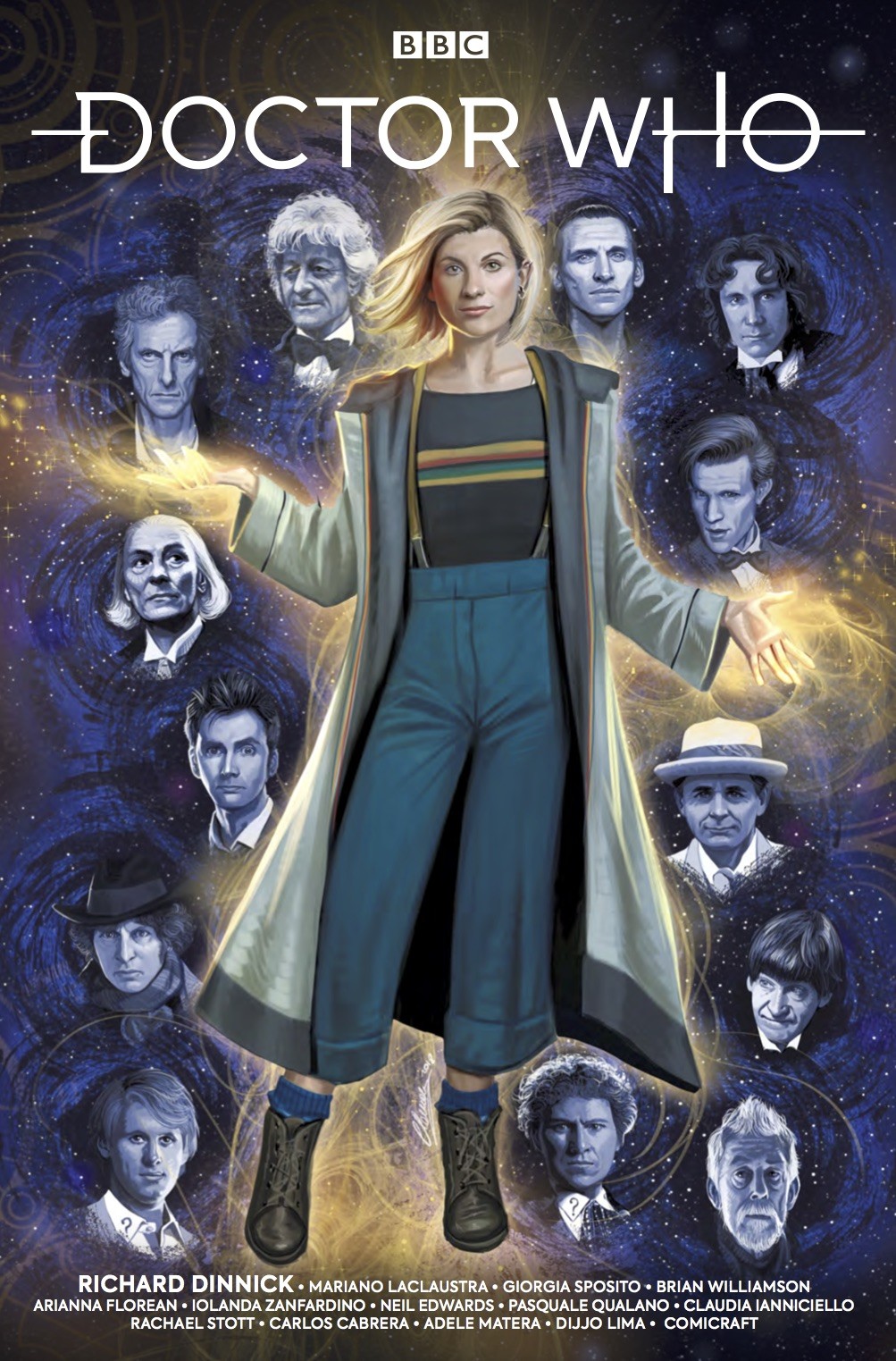
Doctor Who: The Thirteenth Doctor #0 is a true beauty and a wonderful collector’s item for anyone who has enjoyed any part of the last 50 plus years of Doctor Who history. For starters, just look at this cover:

Doctor_Who_The_Thiteenth_Doctor_0_Cover A

Surrounded by portraits of all thirteen previous incarnations, the book very obviously centers around our Thirteenth Doctor, played by Jodie Whittaker who makes her worldwide debut on October 7th on the BBC and BBC America in the US. Issue #0 takes us lifetime by lifetime of the Doctor’s many transformations and their adventures through the galaxy giving each one his due and tying back thematically to what we can expect from this new Doctor.

However, those looking to glean clues into the future of the Doctor will not find too many, but what they will find is beautiful artwork especially some breathtakingly beautiful and meticulous art of the 13th Doctor herself.

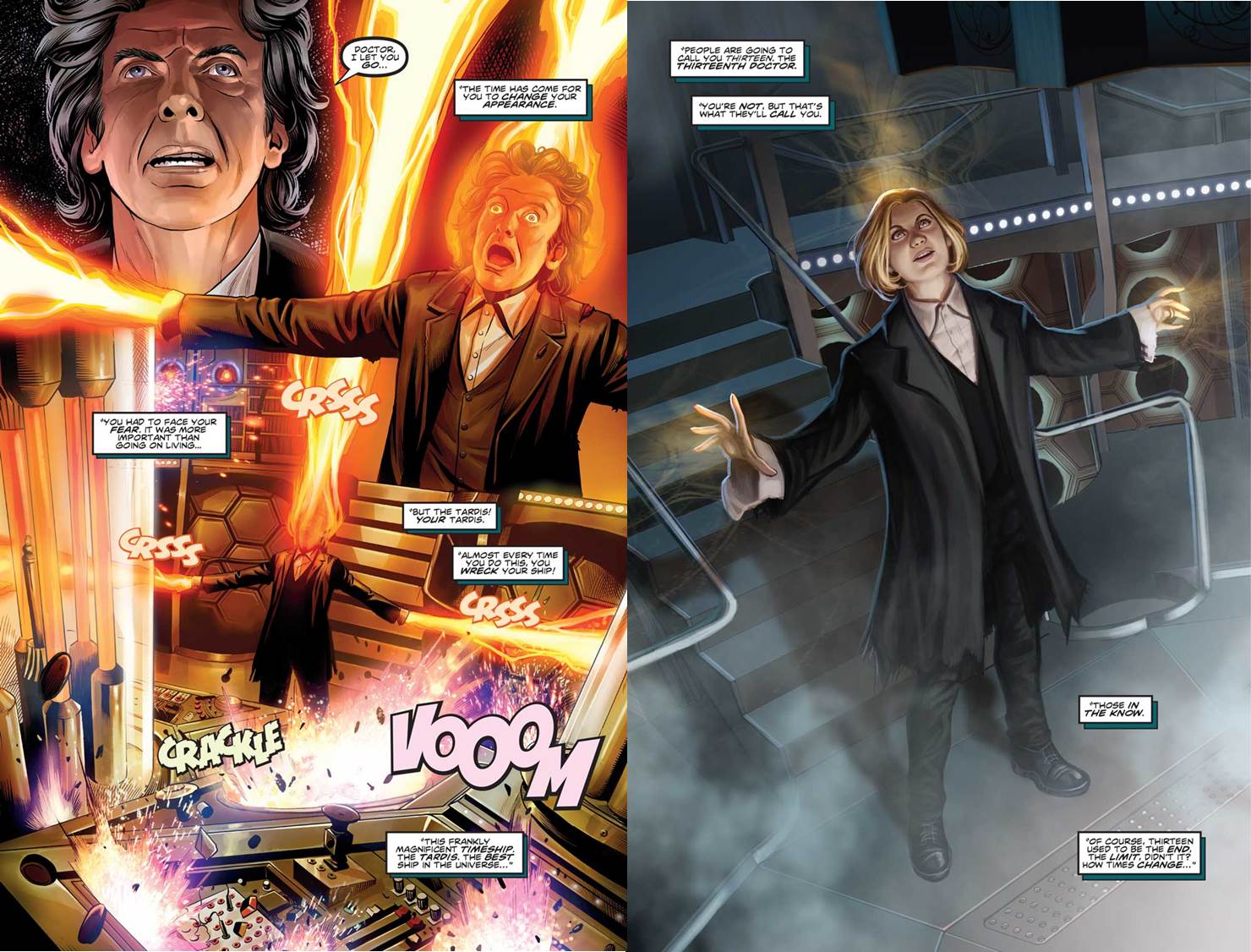
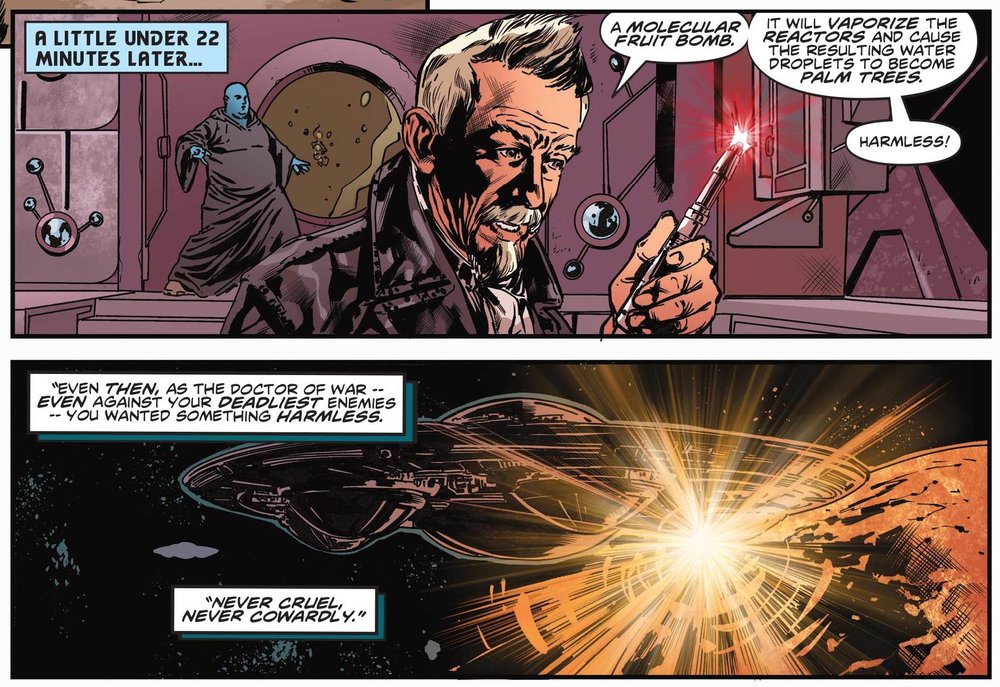
You’ll also find a story that brings out so many themes of the Doctor’s existence throughout history. And this is not your typical book 0 either. It’s very long, with a short story arc given to each of the doctor’s previous incarnations as they travel through space, time, and history. One of the best parts about this are the varied art styles, with each artist giving each doctor their own unique look and feel. For instance Tom Baker’s Fourth Doctor feels very cartoonish and bright, while John Hurt’s War Doctor is appropriately austere and serious with strong elements of Jack Kirby space fantasy.

rsz_dw_13d_vol_0_003-064-comic-strip5

Just as Peter Capaldi’s final episode as the Twelfth Doctor — the Christmas special “Twice Upon a Time” — where he crosses paths with the First Doctor, this too feels very spot-on in terms of what the creators are trying to say about the legacy of the Doctor as a character.

So too do we see similar seeds planted in each of the Doctors’ paths. They weave in and out of each other, and there are plenty of Easter eggs that fans will enjoy greatly. But they finally and completely come together in a complete character arc that leads to this moment. There’s even some poking fun at the Doctor Who fandom’s hardest gender essentialists who claim The Doctor can’t be female and Timelords don’t regenerate into other genders. Speaking of gender bending, you also get a nice cameo from Captain Jack Harkness tagging along with the Tenth Doctor and Rose.

But most of all this book simply feels like a major work of art. It is a compendium of everything you might want to briefly know about the Doctor coming into this 13th transformation.

Doctor Who 0 regeneration

Any Doctor Who fan should consider picking this up, especially for the beautiful art of the 13th Doctor and her transformation. It feels so fresh and vibrant and is the perfect appetizer for what we hope will be served up to us in just a week and a half’s time. Even if, or perhaps especially if, you’re like me and have only passing knowledge of classic Doctor Who and are more of a fan of the more recent seasons since the reboot, this is a great primer of everything you may have missed.

Story: Richard Dinnick Art: Giorgia Sposito, Mariano Laclaustra and various
Story: 7.0 Art: 8.0 Overall: 8.0 Recommendation Buy

Titan Comics provided Graphic Policy with a FREE copy for review

Movie Review: Fahrenheit 11/9

Fahrenheit 11-9Michael Moore‘s latest documentary agitprop Fahrenheit 11/9 feels like a Frankenmovie. Moore, master of the genre and previous nailer of the zeitgeist in films like Bowling for Columbine, Sicko, and the classic Roger and Me seems to not have his finger on the pulse of what’s really going on in America. Or, perhaps he’s responding to a frenetic schizophrenic political landscape.
Moore’s schtick, while perfect for the Clinton/Gingrich and Bush years, really seems to be wearing thin as well. As a friend who works in liberal causes put it to me, “If a white man in his 60’s is going to tell us what’s wrong with America today, he better bring it.” And, yeah, he sorta doesn’t. While there are attempts at being intersectional and lifting up the voices of the oppressed who are not white and male, the film still takes a primarily class-and-economics based approach and doesn’t really plumb the depths of racism or sexism that also got us where we are. It’s a reductive take from the most sophomoric of your Bernie Bro friends, which is sad. Because this is Michael Moore we’re talking about, and we should expect better.

Rather than focus on one theme and do it well, it’s as if he’s tried to make three different movies with vastly different tones and purposes and then mash them together. The result is jarring and unpleasant. It doesn’t work, and I’ve never felt so much personally in agreement with the politics of a film and yet disliked it so much. Say what you will about agitators like Dinesh D’Souza, but his Death of a Nation was at least cogent even if it was insane and false.

The three movies Moore tries to make here are:
Act I: The rise of Donald Trump,
Act II: The longstanding issues that birthed Trumpism in the first place — and The Resistance and how we’re fighting back
Act III: These people are literally Nazis. . . and we’ve already lost. And it’s mostly this third act that is so jarring and doesn’t work.

But when more is on, he is on. During Act II he delves into the water crisis in his home city of Flint, Michigan, and the politics that allowed this to happen. Moore is in his element here and this is both beautiful and inspiring as he lifts up the local voices and highlights exactly what’s going wrong and how terrible it is. It’s only here he breaks out of his mold and calls out what happened for what it was: the attempted genocidal poisoning of a majority black and poor city. He does similar work in traveling to West Virginia and talking to teachers who are striking, and traveling to Florida to speak with the students from Marjory Stoneman Douglas High School. He also highlights a new breed of political activism and candidates including spending time with Alexandria Ocasio-Cortez before she won her primary. It’s a beautiful history-in-the-making and A-Star-is-Born moment.

If he’d only just made this film, and stuck with it, it would be among his best. It is focused and cogent the way that Sicko was and laid out a very serious case of the failings of our government that have nothing to do with Trump.

But of course he has to address the elephant in the room, and that means a less-than-stellar First Act which is a stunningly uneffective hit job on Donald Trump. At times funny when it should be serious, and at times overly serious when it should be satirical, there’s also an especially cringey several minute turn where he deconstructs Donald’s gross sexual feelings towards his daughter Ivanka. We get it, Michael. It’s gross. Most of us coming to see this have already seen these clips, this isn’t new, and it’s just plain uncomfortable. There’s no deeper truth or way forward. And when you’re going to take on someone like Trump, it’s sad to see such a failure of imagination to really make something stick.

The best parts of Act I are the skewering he does of several other sacred cows who were complicit in the rise of Trump. This includes both the Democratic National Committee, Nancy Pelosi, and the mainstream “liberal” news media. He goes after their cravenness for ratings and how they propped up Trump as a sideshow. But most interestingly he goes after the culture of sex predation that’s seems to infect far too many corners of the media landscape. He certainly makes a case that the media was always going to be unable to deal with a serial groper and sexually predatory candidate when they themselves are far too much the same way. Again, when Moore is on, he is on. But it’s sad because it never quite gels into a cohesive critique or explanation of what happened.

In Moore’s attempt to cover everything, he ends up truly covering nothing and adding no new heat nor light to the conversation. Perhaps those who aren’t generally tuned in to the news may learn something, but Moore has to understand that he’s preaching to the choir here and he’s generally not giving them anything new to sing about or any particularly good take. He also tries ham-fistedly to re-prosecute some of the elements of the 2016 election and his feelings that somehow Bernie Sanders ran in a rigged primary. At this point it’s just gross, it accomplishes nothing, and Moore should learn to move on.

Which leads to the Third Act, where Moore details the rise of the Nazis and how similar this is to what is going on now. However, one of the things Moore fails to mention in his take on this is the inability of the center-left and the far left to effectively combat the rise of fascism because they were too busy fighting each other. And here Moore is pouring more gasoline on the fire and opening up old wounds between Bernie folks and Hillary folks rather than giving a clear sense of vision to move forward.

The ending is completely frustrating because he basically makes the case that we are screwed, and nothing can fix what’s wrong. That sort of nihilism doesn’t sit well, and it also is so completely different from the realism and hope that Moore is able to tell during his second act.

I miss the optimistic Michael Moore from his previous films. While I dismissed as clever hokum the cheery optimism of Where to Invade Next, what was brilliant about that film in hindsight was its beautiful denouement where Moore and a childhood friend walked along the crumbling remains of the Berlin Wall and talked about how magical it was that that wall came down. After decades of it being the symbol of oppression and separation, finally it was all too much and within days the barriers were broken down, and people were literally coming, hammers in hand, to break down this wall to be reunited with friends and family from the other side. We could use a little bit of that optimism here, because especially in context of an election happening in only a few weeks, Moore has to understand that is ending is more likely to depress the troops that would fight the midterm battle.

This is why for the first time in several decades I have to recommend to people to please do not go see Michael Moore’s new movie, at least not yet. Know that it is out there, and know that he’s trying to go back to the well of his greatest hits. He’s critical of Trump, he shows how organized people working hard can stand up to political bullies and make real headway. . . and then he burns it all down in a little literal Reichstag fire with memories of 9/11 and fascism on the move.

In one sense, maybe he’s trying to steel audiences for if something truly terrible does happen in the next few weeks or months or years — which would be an actual moment where democracy could slip away from us long-term. But the actual effects of this are to mostly just be hella depressing. So if you insist on seeing Fahrenheit 11/9 in theaters in the next few weeks, don’t let it stop your resolve, or maybe leave about 2/3 of the way through as soon as Moore starts showing Triumph of the Will footage with Trump’s voice dubbed over Hitler. Because it’s all downhill after that.

2 out of 5 stars

Movie Review: Peppermint

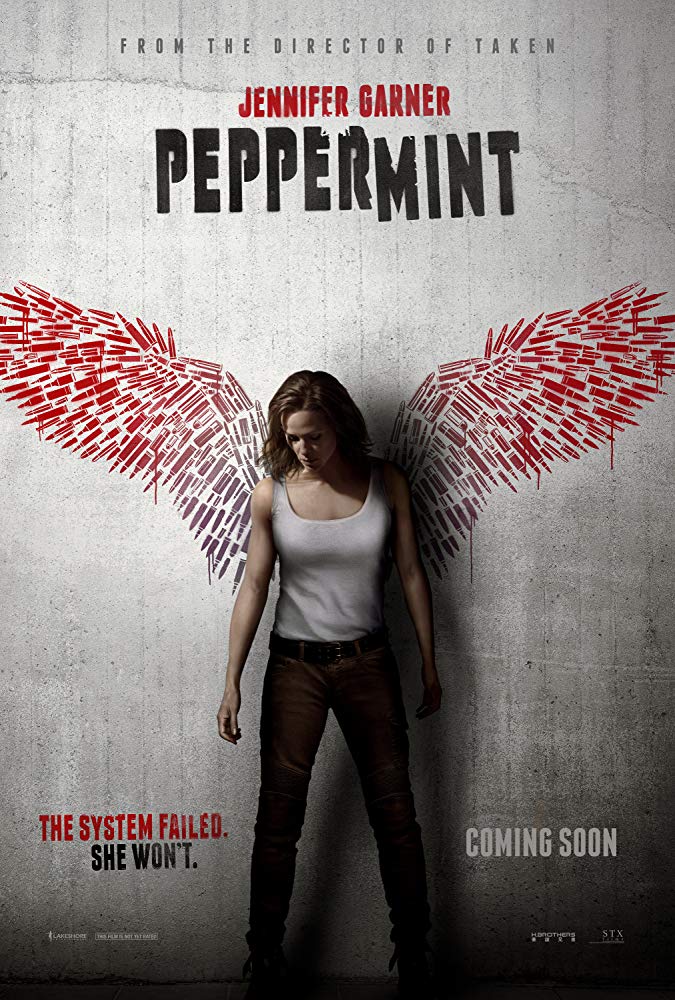
Peppermint is the same movie we’ve seen dozens of times before, but with a singular twist: this time it’s a woman.
Jennifer Garner plays Riley North, our vigilante heroine, who takes on a Los Angeles drug cartel after her family was murdered. This revenge thriller subgenre has been recently elevated by Keanu Reeves and David Leitch in John Wick, and even by Denzel Washington in The Equalizer,  but this just simply does not live up to that same level.

Instead, it plays out much like a middling revenge thriller with all of its tropes generally intact. Except for one– because in this instance it’s the husband who gets “fridged” instead of the wife. We also get John Gallagher Jr sporting the most 70’s cop mustache seen on film in forty years playing your incredibly typical cop. It’s not bad, just predictable.

Many years ago Jennifer Garner starred in what is likely the worst film based on a mainstream comic book character in recent memory: Elektra. That was a mess, but this film shows what might have been done with Garner in a lead role taking on a bunch of baddies as a badass assassin. She fills that role perfectly, and her recent off screen super heroic actions also help build cache and audience buy-in as we root for her to take down the bad guys. This is a return to form for Garner who first broke out in this type of role in Alias and a reminder of her formidable presence and action star skills that Hollywood recently seems to be ignoring in favor of putting her in more typical “mom” roles.

Back to Elektra– the comparison to comic book movies is not far afield, as the film this most fully resembles is The Punisher starring Thomas Jane and John Travolta. It is not a surprise that our screenwriter, Chad St. John, wrote the Punisher short film Dirty Laundry. . . as well as London Has Fallen. This film’s pedigree also includes director Pierre Morel, who made the first Taken film. Strip away any of that film’s uniqueness and you have that same sort of by the numbers over the top action violence, but that doesn’t make it altogether unenjoyable to watch.

Indeed, many of the action scenes have a glimmer that makes you wish this film was just ever so slightly better. The film also tries to tease out a few subplots around social media use and the epidemic of homelessness currently facing many cities in America but especially Los Angeles, but fails to really land any of them.

What we’re left with is a lot of unmet potential — and in an era where we have John Wick (or Atomic Blonde), this just doesn’t quite measure up. However, it’s certainly better than most of the films that Garner has recently been in, and it would be great to see more of her in these action roles — and generally more women out in front of action films playing the roles that are normally reserved for our Bruce Willises, Liam Neesons and Charles Bronsons.

This is a proof of concept that women can play these roles just as well as men, and a showcase for Garner’s skills as an action star which should be taken more advantage of, but the film never breaks out of its tropes.

2.5 out of 5 stars

Movie Review: The Meg

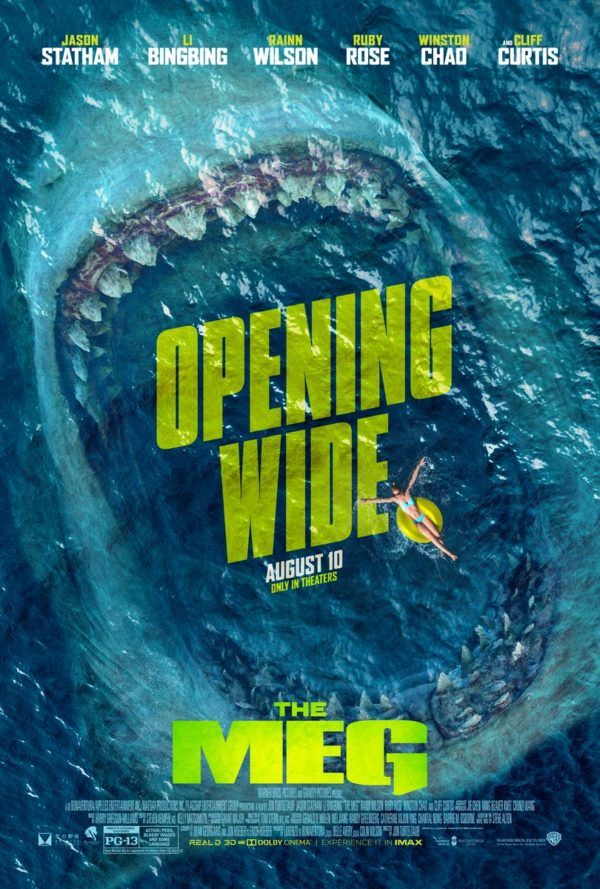
themegposterIt doesn’t get more quintessentially end of summer than a scary shark movie, and The Meg hopes that by upping the size of the shark, the size of the audience thrills will increase proportionately.
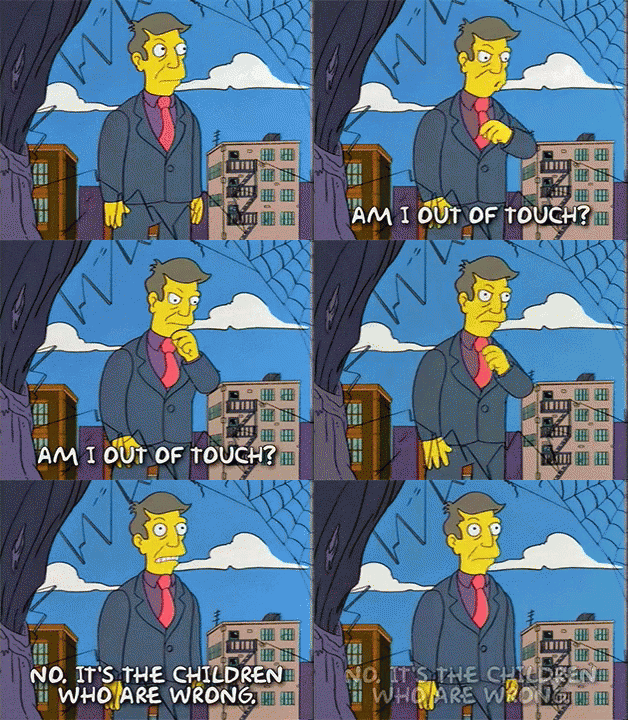
Welp . . . we’re gonna need a bigger shark.

While the film delivers on some basic scares, its ridiculous premise (ancient megalodon escapes from previously unexplored area of the ocean and wreaks havoc) and over the top action don’t make for nearly as thrilling an experience as the filmmakers would like. But, it’s slightly smarter than a Sharknado, and its effects budget are equal to at least a half dozen Sharknados, so it’s not unwatchable. But it’s as big as it is stupid. That doesn’t mean it isn’t at least a little fun.

A lot of that fun comes from the main cast, with Jason Statham as the action hero and asian cinema mainstay Li Bingbing as a marine biologist. Funding her research is a rebel billionaire played by Rainn Wilson, who brings some comic relief to the story.  And supporting cast like Ruby Rose and Masi Oka do a good job of being story/character chum in the water. While not used to their full potential, they do their job.

Let me take a moment and address the news that Ruby Rose will be playing Batwoman on the CW crossover event later this fall. She is great in this film — as she is in most things — and this is an opportunity to check out what you’re likely to see. She’s not in the film much, but enough to enjoy, and possibly is even the best performance in the entire thing, or at least in a close contest with Li Bingbing.

This movie is best when it embraces being a big, dumb shark movie. It is at its worst when it veers from that. Yes, there’s a romantic subplot. Yes, there’s an adorable child. There’s even a scene late in the movie with an adorable dog in peril! It has plot holes as big as its prehistoric antagonist. But the worst is when it takes a few moments to give us a very special public service announcement:

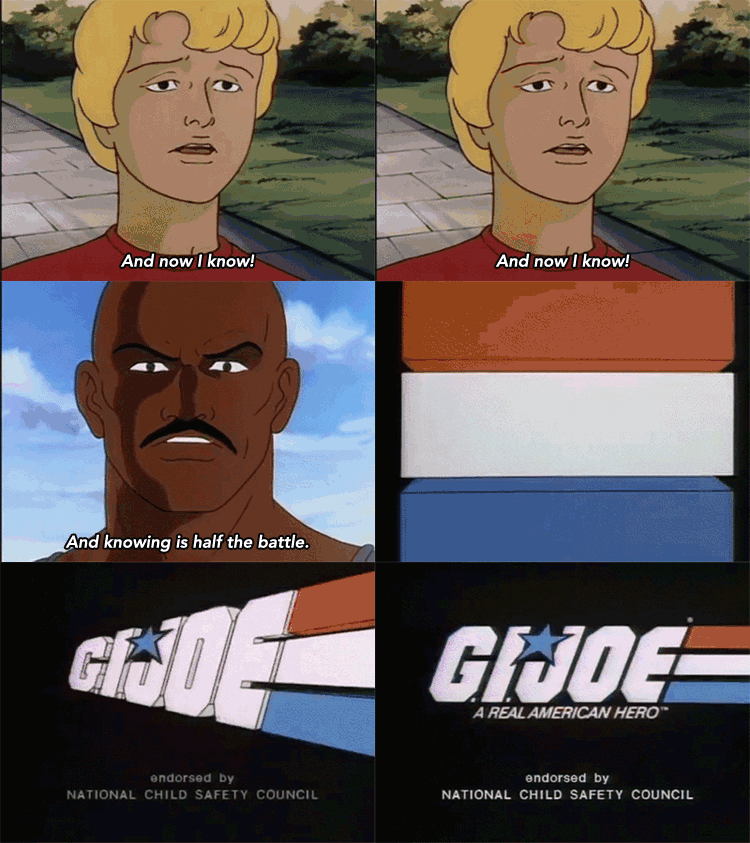
While tracking our eponymous Meg, they come upon wreckage from a fishing boat, and are surprised to find dead sharks floating in the water. One of them notes the sharks have had their fins removed — The Meg didn’t do this, evil fishermen did. “All this for a bowl of soup,” one of them laments. All we need is the rainbow flying across the sky to tell us “The More You Know!”

I understand that this message was not meant for me, per se, but for the audiences in China that this film was, evidently, largely made. That’s fine. They’re the world’s largest movie market, and not everything has to be made for US consumption. But it specifically takes us out of the film and out of the moment to remind us that what we’re seeing is fake. For those who complain about “SJWs” “ruining movies/tv shows/comics” with “social justice messages,” here’s a reminder of what that actually looks like when it’s done badly.

There’s a certain type of person who needs to see every shark movie, and for those people this will likely check off a number of boxes of what they want to see. It isn’t Jaws, and it isn’t even Deep Blue Sea, but it has its share of fun. If you’re looking to escape the summer heat in an air-conditioned theater and munch through a giant bucket of buttered corn like a feeding frenzy, you could do worse. (I mean, convicted felon Dinesh D’Souza has a new piece of propaganda out there deifying his man Trump, possibly in return for issuing him that crooked pardon, so that goes without saying) But in order to even attempt to enjoy this movie, you will have to de-evolve your brain to prehistoric shark levels.

2.5 out of 5

Bad News for Geeks: The Oscar for Achievement in Popular Film

And the Award for the Worst Idea for Awards Shows 2018 goes to. . .  The Academy of Motion Picture Arts and Sciences announcing an award for “outstanding achievement in popular film.”

It’s stupid, it’s pandering, it’s condescending, and also potentially racist.

On first glance, geeks might rejoice! “Finally, a category that will reward the movies I love — Star Wars, Marvel, DC, Harry Potter, Jurassic Park!”

Well yes. And no.

The Academy is correct in identifying that fewer and fewer people are watching The Oscars every year. But this won’t help with that– at all. Yes, please, add more categories and ones that will represent the best in pop geek cinema. In fact, I identified five such ideas earlier this year. I quote myself:

“Most of the Best Picture nominations have made less than $100 million. NONE of the top 10 grossing movies of 2017 are nominated for Best Picture or Best Director. While we should in no way conflate box office with artistic merit, … it’s no wonder the public tunes out– because the Oscars celebrate what Hollywood likes in its movies, but not necessarily the rest of the country. In fact, of the top twenty best performing films of 2017, you only have two that received Best Picture / Best Director nominations — Dunkirk (16th) and Get Out (18th).”

My personal favorites of 2017 included blockbusters and artsy movies. While I would never expect to see Atomic Blonde nominated for Best Picture (it was also only a minor box office success), I am surprised that amazing films like Coco and Your Name are not. (Note: I am talking about the time-travel-starcrossed lovers anime Your Name and not Call Me By Your Name). But why are they not nominated as Best Picture?

Because they are animated films, and animation has its own separate category. Films like Zootopia, Inside Out, and The Incredibles deserve Oscar buzz. But they will never get it because they are stuck in the same situation we are about to put “popular” films in. This is the same problem documentaries have– films like Man on Wire, The Act of Killing, Cave of Forgotten Dreams, or 13th should all be considered amongst the best films of their respective years. Ditto for foreign language films.

The Academy should be asking, “Is how we choose Best Picture, Director, Writer and Actor nominees maybe not considering a whole slew of great films because our voting population is mainly old, white men who are susceptible to lobbying/bribery/marketing from the major studios and bullies/abusers like the Weinsteins?” Instead they’re saying, “Maybe if we nominate one of these superhero movies it will get these rubes off their tractors and turnip trucks.”

In the wake of controversies like #OscarsSoWhite, they are trying to increase the diversity of what films they consider, but this will ultimately backfire. Let’s be 100% real — if this category had existed last year, Get Out would’ve been in it. How do we know this? Because at the Golden Globes, it was nominated in the “Musicals and Comedy” slate.

It’s not hard to posit that the following conversation took place:

A: “They’re going to call us racist if Black Panther isn’t nominated for Best Picture.”
B: “Well, what if we designed a new category it can be sure to win, so we don’t have to worry about it?”
C: “Yes! A separate, but equal, award for. . . best popular movie or something.”

Or maybe the answer is just make sure the people voting are given the option to, you know, vote for Black Panther. And maybe extend your voting to enough people to make sure it can happen. And you don’t have to pander. You don’t have to condescend. But that, of course, would require you to make Hollywood less of an old-boys-club run by suits looking at spreadsheets. The key is having a younger, more racially diverse, more equal in terms of gender ratios group of voters, which means having more of those people making the films we love. But nah, let’s just make a popularity award.

This is not at all to poo-poo “popular” movies. I will fight you why Captain America: Civil War was the best movie of 2016 (and Captain America: Winter Soldier the best of 2014). Of the 100+ films I’ve seen and reviewed this year here on Graphic Policy and elsewhere, Black Panther has so far received my highest score. It shouldn’t be nominated for an award because it’s “popular”– it should be nominated because it’s a damn fine movie. Again, I will fight anyone who says differently. I love nothing more than sit down and obsessively talk about the minutae of Ryan Coogler or Rian Johnson’s work.

Do I want The Last Jedi to be nominated for Best Picture? Sure! The original Star Wars was nominated for Best Picture and should’ve won against Annie Hall, and Rian Johnson’s masterpiece is in that same echelon of great Star Wars movies. (Yes, @ me if you must, because I will die on this hill and am happy to block tons of trolls on Twitter)

But what I don’t want is every year or so for a Star Wars film to get a participation trophy because it made so much money. It doesn’t need a popularity award– it just made a billion dollars! It’s @#$%ing Star Wars — one of the most culturally ubiquitous things on the planet. That’s enough. If you’re going to reward it for its cinematic achievement, then do so. But don’t do it because you think it will get more eyes on a tv broadcast. (SPOILER ALERT: It won’t.) That path leads to the Dark Side. . . and the Star Wars Holiday Special.

What it will do is ghettoize great films just because they are popular.

Let’s play this out. This year’s nominees will likely include Black Panther, Avengers: Infinity War, Incredibles 2, Mary Poppins Returns. . . yes, those are all Disney films. Add in Deadpool 2 as a soon-to-be-Disney property. Anyone see a problem with this? First, if you’re literally any other film, why even bother? Second, remember that the Oscars telecast is on ABC. If this category — even just for this year — is just an extended commercial for Disney’s corporate holdings, then, again, why even bother?

The biggest tragedy will be if groundbreaking genre films like Sorry to Bother You, Hereditary, or A Quiet Place get relegated to this category.  Again — 100%– Get Out would have been in this category last year. So would Logan and likely Wonder Woman. We shouldn’t be content with this, but instead demand that real artistic work be taken seriously and not dismissed out of hand as though “Best” and “Popular” are largely mutually exclusive categories. Both James Mangold and Patty Jenkins deserved to be nominated as Best Director and their films nominated for Best Picture. Instead, we get Three Billboards Outside Ebbing, Missouri and Darkest Hour. 

It’s precisely that kind of bullshit that makes people not tune in. Another movie about Dunkirk? (and the absolute worst of the three released in 2017!) And a misguided discussion about forgiveness that completely misses the mark, especially when it comes to issues of race? Yeah, no. Ain’t nobody got time for that. Ghettoizing Get Out, Logan, The Last Jedi, and Wonder Woman into a “popular movies” category wouldn’t fix that.

Apologies for using the word ghettoize. I do not do so lightly. I do so in the literal sense of segregating people based on outward characteristics in order to provide them with substandard services.

While The Academy would like to be more diverse, this category will serve as a “runner up” category to keep films like Black Panther, Sorry to Bother You, A Wrinkle in Time, Crazy Rich Asians AND their filmmakers away from the podium.

That’s not fair, and it’s not ok. I made a joke earlier about a “separate, but equal, category.” That’s what this is. As long as it exists as a consolation prize while “real” art gets nominated for Best Picture, it will serve to “other” deserving filmmakers.

While this will be good news that early next year we can stop remembering that the only recent movie based on a comic book to win an Oscar is Suicide Squad (executive produced by supervillain Treasury Secretary and therefore fifth in line for the presidency Steve Mnuchin!) that is likely the only good thing about this situation. Sure, Ryan Coogler might get to accept an Oscar, but he deserves to be in the same category as Spielberg and Scorcese.

Movie Review: The Darkest Minds

The_Darkest_Minds_posterKids with superpowers. A dystopian future where everyone under 18 is rounded up into camps or dead. Government conspiracy. This seems like it should be ample fodder to create a new movie franchise, but this film falls flat because of a weak script and some poor lead acting choices.
Our main lead, however, Amandla Stenberg as Ruby, is not one of them. No stranger to the world of dystopian YA fiction (she played Rue in The Hunger Games and was excellent in last year’s Everything Everything) she holds this film together. The central conceit is a plague that kills most children but that leaves survivors with superpowers. The government rounds them up and puts them in camps (an idea that might not be so distasteful if it were merely fiction and had been released, say, last summer) and segregates them by “color.” Most common and least dangerous are “Greens” who are super smart, then “Blues” who have telekinesis, then “Yellows” who have electrical powers. Least common and ordered to be shot on sight are “Reds” and “Oranges.” Ruby is an Orange with psychic abilities to control other peoples’ minds, which she first uses to convince them “I’m a Green” and is able too hide among the other prisoners.

However, she is eventually found out and then rescued from the prison camp by a doctor played by Mandy Moore. Fearing all is not what it seems with her rescuer, she instead escapes with a small group of kids searching for a supposed safe place led by another Orange. Zu, a mute Yellow, and Chubs, the most precocious Green ever, are great. But Liam, a Blue and romantic interest for Ruby, seems like his actual super power is to be a black hole of charisma. Unfortunately, a lot of the film is dependent on him and it just falls apart.

The other major flaw is this is very clearly based on a YA novel — not that this is a bad thing, as we’ve had a good run with The Hunger Games films and even with lesser franchises Divergent and The Maze Runner. But this film is paced and structured like a book. Which is perfectly fine if you are a book. But it just doesn’t translate as well and so most of the tension and twists and turns are telegraphed miles away.

It’s really too bad, because there are great elements in here. Again, Amandla Stenberg is a superstar and deserves for this to be better. The key group of kids is compelling, and it’s great to see diversity (2 black kids, an Asian kid, a white kid) portrayed as normalcy. The supporting adult cast also includes such reliable presences as Bradley Whitford as the President and Gwendoline Christie as a badass bounty hunter on the trail of our heroes.

The film ends, somewhat predictably, with an opening for a sequel. There are two other books in this series that possibly deserve to be adapted as well. But it’s just too bad as this is unlikely to attract the attention (or money) needed to secure a sequel.

The Darkest Minds is the coolest idea but the most mediocre movie.

2 out of 5 stars


Movie Review: Christopher Robin

christopher robin poster“Oh Pooh. You’re not a bear of very little brain. You’re a bear of humongous heart.”
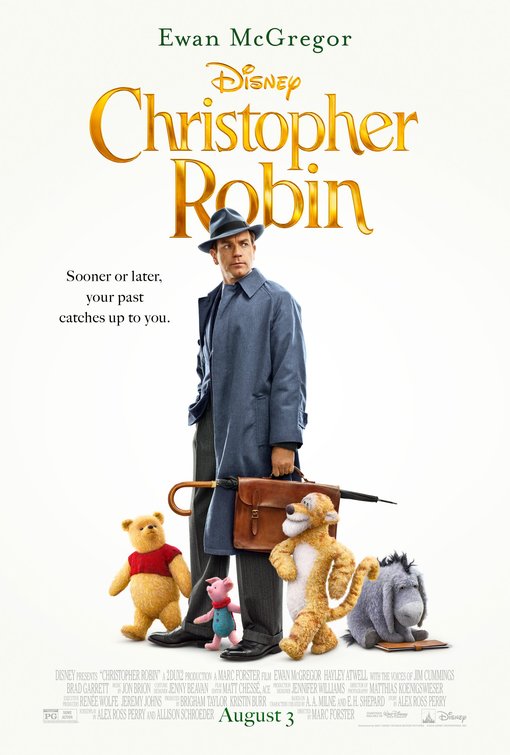
Ewan McGregor as a middle-aged, overworked Christopher Robin says this to his former childhood toy, but he may as well have been describing this movie.  Heavy on sentiment and nonsense, light on plot or fresh character takes this isn’t a bad movie. It’s quite literally the cinematic equivalent of hugging your childhood stuffed animal or security blanket, remembering when times were simpler and having a twinge of midlife crisis.

The original Disney The Many Adventures of Winnie the Pooh begins with a narrator telling us “This could be the room of any small boy. But it just so happens to belong to a boy named Christopher Robin.” This movie — a live action sequel to the previous Pooh catalog — could be about the lost childhood of any middle aged man, but it just so happens to belong to a man named Christopher Robin. In post-war England, he finds himself under the thumb of a lazy and unscrupulous boss (Mark Gatiss) who forces him to work long hours and weekends — forgoing a planned holiday with his wife (the always lovely Hayley Atwell) and precocious daughter. This is familiar Disney material– father loses his way, and needs some magical element to help him reclaim his childhood wonder and imagination.

Meanwhile, deep in the Hundred Acre Wood of Christopher Robin’s childhood imagination, Pooh awakens after a long rest and can’t find his friends. Instead, he travels to London to fetch Christopher Robin from the tedium of planning an important meeting and off they go to find ‘Tigger, Kanga, Roo, Piglet, Eeyore, Owl, and Rabbit. And of course, wackiness ensues, and they have t fight nasty heffalumps and woozles and learn to have childlike wonder again.

A lot of praise needs to go to Ewan McGregor for his work here, as the entire film rests on his shoulders. In much of the movie, it’s just him acting against an imaginary stuffed animal. He’s really charming and delightful, and the supporting cast are almost equally as god. The voice cast here playing the stuffed animals are also great. Legendary voice artist Jim Cummings basically is Pooh and Tigger, having inhabited these roles for decades now.  There’s also some brilliant casting of Brad Garrett as Eeyore and Peter Capaldi as Rabbit, but they are sadly underused as most of the film concentrates only on Christopher Robin and Pooh.

As stated previously, this is a script of very little brain, and very much predictability. But it’s pure, uncut Disney nostalgia straight from the source. For those who grew up with Pooh and are bringing their children or grandchildren to see this, you will enjoy this in direct relation to how much nostalgia you have for this particular property or classic Disney in general. It will generally feel like this movie was almost made more for adults than children– the message almost certainly is. And for true Disney superfans, stay through the credits to see and hear Richard Sherman (who co-write the original Pooh songs and half of the classic Disney songbook) perform a new song he wrote specifically for this film. He’ still got it.

Someone needed to remind these folks they were making a children’s movie, as the moral center seems more focused on shaming workaholic middle aged people. And the tone of the film for its first act is extremely dour. It finally picks up in predictable fashion and ends strong with a lot of heart. But with Paddington 2 having hit earlier this year, it’s unfortunate that Disney’s return to this familiar territory didn’t land better as it can’t stack up to the more charming sequel. There are also several Disney movies with this same basic idea, and this compares even less favorably against those.

3.5 out of 5 stars

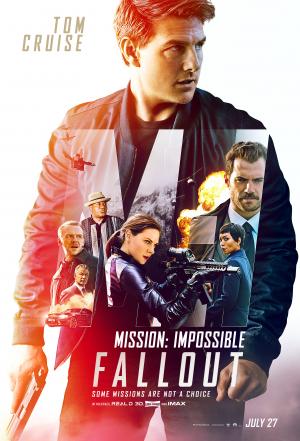
Movie Review: Mission Impossible: Fallout

IMI Fallout postert’s rare for a franchise to almost completely reinvent itself in almost every outing. It’s even more rare for it to deliver, arguably, its best film twenty years in. Writer and director Christoher McQuarrie delivers his best film ever, as though he’s taken everything he’s learned from his past two and a half decades of experience, writing such classics as The Usual Suspects and being frequent Tom Cruise collaborator, to craft a great movie about the stakes of failure.

Failure is one of the great recurring themes in the film, as Cruise’s Ethan Hunt just wins by sheer luck. Several times in the film you think the good guys lose — because they do, repeatedly — and wonder if maybe this film will end with them losing, or with a noble self-sacrifice.

Our story begins with some stolen plutonium, and a failed recovery plan where Ethan chooses to save the lives of his longtime teammates Luther (Ving Rhames) and Benji (Simon Pegg) rather than recover the nuclear materials. So the CIA Director (Angela Bassett) does her best Amanda Waller impersonation and assigns one of their most deadly agents, August Walker (Henry Cavill), to provide “oversight” on the IMF team. Translation: he will kill anyone who gets in their way, including Hunt and his team if they go rogue.

Their clashing styles and the chemistry between Cruise and Cavill provide some of the best material of the film. Cavill is an imposing presence and director McQuarrie somehow makes it look like he hits harder here than as Superman. Cavill is also just really good as a spy and an action movie star, but somehow in a completely opposite way from his turn in The Man From U.N.C.L.E.

But the emotional core here is with Pegg and returning actors Rebecca Ferguson and Michelle Monaghan. First, all three of them give great performances. Pegg has perhaps the most interesting character arc of any person in the franchise, going from computer geek in MI:III to hero-in-his-own-right in this outing. But it’s each of the characters’ connections to Hunt and his need to protect them that make the stakes of this so much higher and more personal than in previous outings. PS- If you need more reason to love Simon Pegg, you should see his recent apology for mocking Jar Jar Binks here. Really insightful stuff.

The last Mission Impossible film was full of bombastic stunts and plot, but two years later I couldn’t tell you a thing about it or what happened. Its villain, Solomon Lane, was supposedly so much smarter and always a step ahead of Hunt, but you never really felt that. In Fallout, you feel very much like the good guys are constantly being outsmarted and the stakes for failure — nuclear annihilation for a huge portion of the world’s population — are possible.

McQuarrie writes this in the same way as his tour de force The Usual Suspects, with layers upon layers of misdirection and snappy dialogue. He builds tension and releases it, hiding important exposition n moments of humor to help the explaining go down. Like Usual Suspects, there’s real humor in here. And if you’re familiar with the principle of Chekov’s Gun, he loads and cocks so many guns and leaves you waiting for the payoff. Even when you see something coming — especially when you see it coming — you just are left waiting in anticipation for sweet release of the payoff.

He’s also willing to take some risks. There is a point about two hours into the movie when I was convinced it was over, and this would be The Empire Strikes Back of a trilogy about Ethan Hunt and Solomon Lane. Indeed, in a world where Hobbits, Hunger Games, and Harry Potters are split into multiple movies for financial reasons, you can imagine wanting to extend this franchise in that way. But it doesn’t, and gives you this brilliant denouement of a final thirty minutes that gives specific payoff to everything not only from the previous two hours but the last twenty years. Yes, this is two and half hours long. It doesn’t feel like it. Bravo, Chris McQuarrie, bravo.

And then there’s his visual style. Wow, just wow. The cinematography here is brilliant. The pacing is unbelievable. There’s an extended chase scene through Paris that goes on for what seems like twenty minutes, and there’s never a dull moment. Eat your heart out, French Connection. 

This may be the best Mission: Impossible movie. And it is certainly the best spy thriller we’ve had in a long time. This is a cure for what ails the late summertime blues and the rare summer blockbuster that doesn’t require you to turn off your brain to have fun with it.

4.25 out of 5 stars

« Older Entries Recent Entries »