Author Archives: Andy Wilson

Movie Review: The Snowman

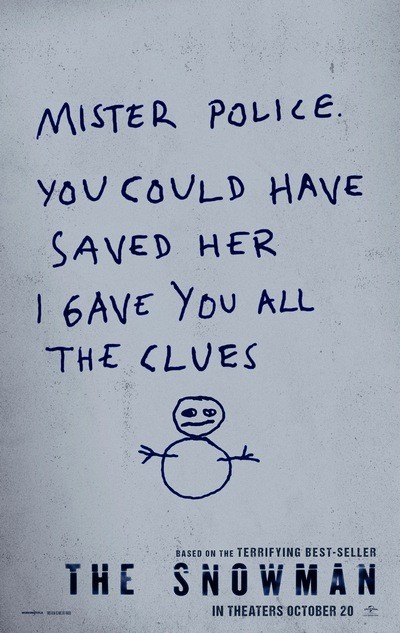
Snowman-Poster

Mister Police. You could have saved this movie. It gave you all the parts.

Even a stellar cast led by Michael Fassbender and featuring Oscar winner JK Simmons couldn’t save this movie. Director Tomas Alfredson (Let the Right One In, Tinker Tailor Soldier Spy) used his keen eye to capture the stark beauty of its setting of Norway, but even that couldn’t make up for some pretty glaring problems.

Fassbender plays Oslo detective Harry Hole on the trail of a serial murderer whose signature is always leaving behind a snowman. Given the pedigree of the film — based on the novel by Jo Nesbø, directed by Alfredson — one would hope the end product would be better.

Instead, it is cliched and predictable. Any mystery where you can correctly guess who the culprit is so early in the film is just not worth it. Our audience even laughed at several key moments that were meant to induce dread or show menace — always a bad sign that your film may be sliding into Tommy Wiseau’s The Room territory.

According to director Alfredson, they ended up not being able to shoot 10-15% of the script, leaving it “like when you’re making a big jigsaw puzzle and a few pieces are missing so you don’t see the whole picture.” When a director as skilled as Alfredson feels robbed of the tools to make their vision a reality, that’s a bad sign. Or perhaps it’s a sign of a director making excuses for a film they know not to be up to snuff.

Either way, it’s troubling. And it would be hard to conceive of this film being 10-15% longer. Clocking in at just under two hours, it feels interminably longer.

And while most of the actors here are fairly solid, an almost unrecognizable Val Kilmer pulls us out of the movie with a jarring performance that seems just off. Given the actor’s battles with throat cancer, it’s obvious his lines were dubbed in post production. But the vocal performances don’t always quite line up, making it seem more like an old kung fu movie. You hope Kilmer is able to fully recover from his health problems, because this would be a shame to be his final on-screen performance.

It’s sad that a film that should have been The Girl With the Dragon Tattoo meets Zodiac meets Let the Right One In is more Manos! Hands of Fate. Like that film, this should be enjoyable to hear the Rifftrax commentary, but not for much else. At a time when your options at the theaters includes Blade Runner 2049 and the surprisingly fun and campy Happy Death Day, don’t choose The Snowman. 

Overall Rating: 2 out of 5

Movie Review: Blade Runner 2049 is a Masterpiece

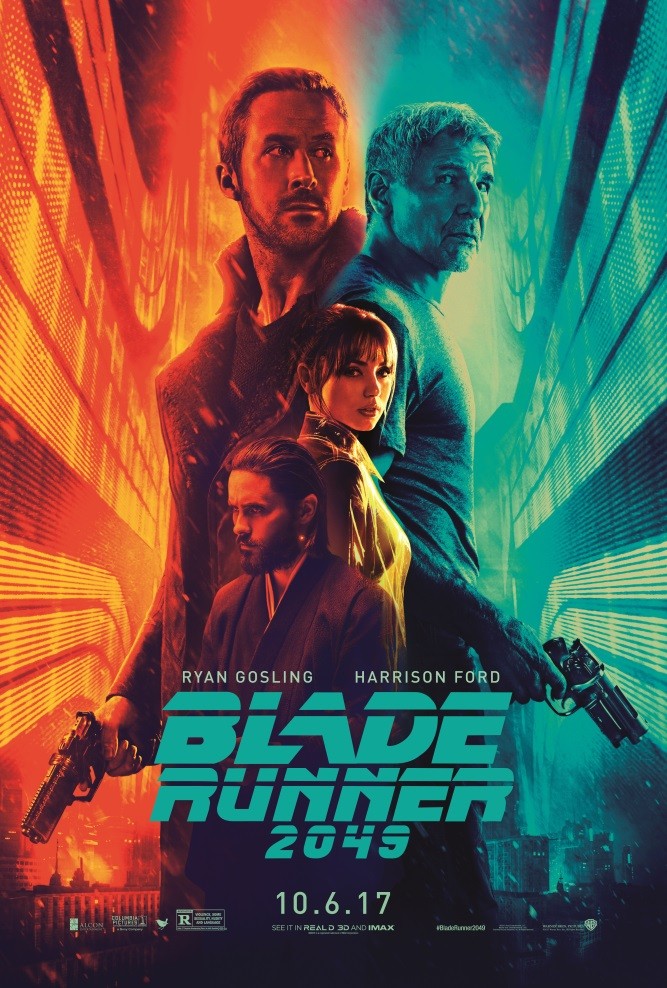
Blade Runner 2049Blade Runner 2049 is a masterpiece and 2017’s best film.

And beyond that I’m not going to tell you anything more about its plot, characters, or anything else you’d expect from a movie review. Don’t let anyone tell you too much about it apart from what you’ve seen in the trailers, as this is a film that deserves to be experienced without much else in the way of explanation.

And, for the love of all that is holy, after you’ve seen it—don’t spoil it for your friends. Just tell them to go see it, too. And go see it with them. And then spend hours afterwards obsessively discussing everything about it.

Suffice it to say it is a continuation of the story from 1982’s Blade Runner set decades in the future in 2049. Ryan Gosling works for the LAPD hunting down and “retiring” rogue replicants, the same job Harrison Ford’s Deckard had in the original. And he uncovers something that threatens to turn their entire world upside down.

Despite his prominent placement in the trailers, don’t expect this to be a Ford / Gosling buddy cop movie. It’s not. Ford doesn’t show up until later, with even less screen time than his turn in 2015’s Star Wars: The Force Awakens. However, his role is vital, and answers lingering questions definitively (though not overtly) that fans have often asked about Deckard.

Director Denis Villeneuve cements himself here as one of, if not the outright, best directors working today. (Public Service Announcement: impress your friends by pronouncing his name correctly. Remember that he is French Canadian, so his first name sounds  more like “Deni”—think like what John Snow calls Daenerys but with an e instead of an a. And his last name is “Vill-neve.” Say it like the beginning of “villain” and “nerve” but without the r.)

Villeneuve pulls incredible performances out of his actors. He understands exactly the world and mythos he’s playing in (arguably better than Ridley Scott?) He understands pacing and tension better than anyone else working today- if you saw Sicario, Prisoners, or Arrival, those were all just the warm up act.

And on top of all of that he has the most incredibly keen eye for visuals. He brings to life the world of this dystopian wasteland in 2049, and does it all in beautiful darkness and light. Again, his play with the darkest darks and hiding things, and his beautiful eye for how different wavelengths of light bring different feelings to the scene shows a master at work.

Just know that there are some amazingly beautiful things here. Giant skyscraper-sized women advertise companionship. A fight in a derelict casino takes place between Ford and Gosling while a glitching hologram Elvis and dancers perform in the background. Ana de Armas and Mackenzie Davis meld/merge into one person.

And then there’s Jared Leto. His turn as the head of the giant corporation producing replicants has an air of a techno-Jesus Zillionaire PsychoDoucheBro. If you hate Leto, you’re going to hate him more—and be glad Villeneuve keeps him shrouded in shadow for much of the movie. If you like his performances, you’re going to hate him, too.

But the real stars of the film are the women. Apparently, the dystopia of Blade Runner is only slightly less misogynistic than the dystopia of The Handmaid’s Tale. Mackenzie Davis (Halt and Catch Fire) is Mariette—and we should likely take that name more literally as marionette—echoing exotic dancer Zhora from the original. As a newer model replicant, she cannot disobey orders and engages in sex work: she is stripped of agency and therefore the ability to consent. So every sexual encounter is therefore rape.

Ana de Armis is even more stunning, for reasons I won’t go into, because spoilers. But her place as Gosling’s girlfriend Joi make you question the nature of love. . .  and then by the end you get the rug ripped out from under you and recognize just how awful this existence is.

Leto’s henchwomen “Luv” (even the name is cringe-y for how women are treated) is also amazing, with a performance from Sylvia Hoeks that rivals any recent femme fatale. She displays a singular focus reminiscent of a Terminator and a glee in carrying out her orders.  But still, all of them are robbed of any real choice in their circumstances.

And then there’s Robin Wright – who is having a spectacular year – as Gosling’s boss and apparently the only woman in all of Los Angeles with any sort of moral agency of her own in this universe. She’s perfect, and this is the kind of role someone gets nominated for Best Supporting Actress for (but really they’re also nominating her for Wonder Woman, but can’t say they’re doing that.)

And it’s within these performances of all of these actors in top form and their various character arcs that we illuminate incredibly deep themes and questions about the nature of existence. Many of these were covered in the original Blade Runner as well, which is why this works so well as a true sequel.

What makes someone human? What purpose do memories and dreams serve? Can artificial intelligences love? Do they feel?

But this film also treads astonishing new ground. It provides a stunning critique of humanity that some might call Marxist—we’ve always depended on forms of slavery, so why not replicants? But, amazingly, we find out that even in a world with robot slaves (let’s be real, that’s what they are), we find there are still sweatshops and child labor. To what extent is everything built on the exploitation of labor? (see? Marxism.) The film reveals, but never answers. And that’s part of what makes it so impressive.

To fully understand what this movie is without revealing too much about it, I have found the best way to discuss it is by saying exactly what it is not. And perhaps the best way to discuss that is to compare it to two other spectacular failures of 2017: Ghost in the Shell and mother!

Ghost in the Shell felt the need to explain everything and dumb things down for the audience. mother!  was too pretentious and ponderous to have any meaning at all, always showing off how smart and deep it was rather than actually getting around to any real point. Blade Runner 2049 splits the difference between these two. It expects a lot from the audience, in much the same way Arrival did last year. But its themes and meanings are clear and reach a logical conclusion, while still leaving room for vigorous discussion and debate. But unlike Arrival and perhaps more like Sicario, it offers a basic narrative that even someone not wanting to watch serious science fiction could enjoy as a basic neo-noir drama with occasional fights and explosions.

Ghost in the Shell and mother! completely missed the mark on their source material (if you include the Christian Bible as source material for Aronofsky’s mess of a film) and seemed almost designed to peeve the target audience who might otherwise like what you would have to say based on their fandom. And at least in the case of mother!, one needed to be familiar with biblical stories and themes to understand what was happening. For Blade Runner 2049, fans of the original film or the Phillip K. Dick story it’s based on will be rewarded. But perhaps even more remarkably, there is zero barrier for entry. You don’t need to know these to understand or enjoy the film. Even better, Blade Runner 2049 nails its biblical allusions, while mother! shows a sophist’s view with all the understanding of the Bible of the most smug atheist subreddit known to man.

And finally, Ghost in the Shell and mother! made questionable choices when it came to whitewashing the main character and treatment of its female main character respectively. While some have tried to play this off as “commentary” (Well, that’s how it is, isn’t it?), their apologism rings hollow. Villeneuve’s previous work on his last two films shows he knows exactly what he’s doing with his female leads. While he can take the hit as the central storyline is still about men and conflict between men while women are robbed of their equality and humanity, I believe the social commentary comes down to Leto and Wright and their performances.

Leto’s Tech Jesus DoucheBro is obsessed with creation of life, and specifically procreation. [Minor spoiler] At one point he even takes a new”born” female replicant and stabs her in the abdomen where her uterus would be, pointing out the “flaws” in his creations—they can’t make babies.  Here he is at the pinnacle of technology, able to create life, of a sort, if you believe “I think, therefore I am,” but he still demeans women and sees them as nothing more than receptacles for procreation. And empty wombs must mean some sort of failure on his part. . . again, you can see why I said this was only slightly better than The Handmaid’s Tale in its misogyny.

And then there’s Wright. She’s the only woman with any agency in the film. She’s also [minor spoiler] one of only two actual women we meet in this world. So if the women in this universe are treated awfully, it’s because they’ve all been commoditized and replaced with replicants.  The other woman character in a late Act 2 speech talks about “the price of freedom,” when her version of freedom is actually complete isolation from all other people.

And in seeing that women are not free in this future, we also see that no one is free. That’s what makes this a dystopian nightmare. Are self-aware replicants actually more human than human? Are the slaves of society really its masters? Is this where we’re going as a species?

And. . . some of those questions might be more fully explored in a future film. Because, oh yeah, there’s definitely an opening for a sequel here.

This is one of the deepest and most satisfying films of the year. It’s also challenging and multi-faceted. It’s beautiful to watch and shows that even the most sacred of cows can be milked for more material.

We didn’t think we needed a Blade Runner sequel. But Villeneuve delivers here something spectacular: a sequel to a classic that perhaps is even better than the original.

5 out of 5 stars.

Movie Review: mother!

mother posterI have another name for this movie.

Yes, it starts with mother! But it ends with a word you can’t say on television that Samuel L. Jackson likes. A lot.

This is one of the most astoundingly ponderous and pretentious films I’ve seen in years. Director Darren Aronofsky can be hit or miss, and this is perhaps his biggest miss ever. It’s like he took the reactions to Noah, in which critics and audiences did not like his retelling of the story of the biblical flood, and said, “Oh, you hated that? Great, well now I’m going to do it to THE ENTIRE BIBLE.”

This is incredibly unfortunate, for a movie that is spectacularly acted and meticulously filmed. The film follows Jennifer Lawrencemarried to Javier Bardem, a poet suffering from writers’ block. When unexpected houseguests Ed Harris and Michelle Pfeiffer arrive, they begin to cause problems, as do their children, played by siblings Domhnall  and Brian Gleeson. But Bardem’s poet can’t get enough of the attention they lavish on him for his talent, and despite his wife’s protestations to send the guests away and the damage they do to their house, more and more guests arrive. There is supposedly a metaphor in here for the biblical Genesis story, which eventually muddles through the arrival of a Messianic child and an eventual apocalypse, but it’s too ponderous and clumsily told that the metaphor collapses under its own weight.

Even the title mother! is pretentious and offputting. It literally shouts at us with its exclamation mark. And then emphasizes its lower-case m so we know this is a Very Serious Important Move about Very Serious Things, like a college sophomore who decides their name shouldn’t be capitalized so they can stand out in the crowd and show off how self-effacing they are.

This film is the textbook definition of laying it on too thick, with a steaming side of heavy hands. And, astoundingly, at the same time, it is hella confusing for the first two-thirds of the film! As an audience member coming in, you’re left wondering exactly what is going on or what you’re supposed to be taking away from this.

The themes are all over the place. Is this movie about the erasure of the divine feminine from Christianity? Is it about the lack of respect for women and the creative, nurturing force? Is this about the environment and Mother Earth / Gaia? Is this about the creative process and the relationship between artist and audience? Is it a horror movie? Are the events depicted on screen actually happening, metaphor, or some sort of surrealistic nightmare?

Apparently the answer to all of these is yes. And no. To quote Janeane Garofalo in the cult classic Mystery Men, You’re not well-liked. You’re abrasive and off-putting. You try and say pithy things, but your wit is a hindrance and so, therefore nothing is provocative.It’s just mixed metaphors.”

When you take a classic, beautifully woven epic with multiple themes like Les Miserables or Anna Karenina or The Godfather, whether the medium is the page, the stage, or the screen, the skilled autuer will fully develop those themes and make them accessible at multiple levels.

With mother!, Aronofsky doesn’t fully develop any of them, and so the film in trying to say everything, in fact, says nothing. This leaves even the most ardent lover of film confused is not a sign of brilliance. It is a sign of failure.   

And where the film really strikes out is in its attempts to have a message of feminism, it mostly just ends up glorifying violence towards and erasure of women. I’m sorry, but you can’t be a feminist movie if you can’t even pass the Bechdel Test. It’s a fairly low bar, and they didn’t even manage to get over that.

Even more creepy is the way the camera follows Jennifer Lawrence throughout the movie. Wearing an incredibly sheer nightgown and no underwear for much of the film, she is intentionally lit to repeatedly show off her nipples. The camera follows her from behind with more shots of her butt than a Michael Bay movie. (And can we point out that the movie would be 40 minutes shorter if it didn’t incessantly follow her movement throughout the house, padding an already ponderous picture?)

And then in the final climax of the film, she is brutally attacked, her clothing ripped, exposing her bare breasts. . .  in a rape scene. No. No. No. No. NO.

Aronofsky has publicly stated that we have been destroying our mother earth with our presence– message received. But to take it a step further to depict it on screen as an actual rape contributes to rape culture by not only seemingly glorifying/fetishizing the moment but also by lessening the impact of the epidemic of sexual assault in our country. I even bristle at the too-easy-to-make metaphor of pollution, climate change, etc “raping Mother Earth.” It doesn’t elevate a call to action, but it does lessen the impact of actual sexual assault. That being said, mother!’s final fiery apocalypse fueled by combusting oil and coal is a metaphor worth exploring– it’s just unfortunate that it is too glibly conflated with violence towards women that its impact is lessened.

It’s arguable that mother! wants to teach us something about the important place for women, but all we’re left with is a glorification of her erasure, abuse, and ultimate place as an adjunct to the man. And [spoiler alert, but IDGAF] at the end of the film, we also find out that her special, sacred role is ultimately replaceable, and she can be consumed in apocalyptic destruction and the ultimate in self-effacement and annihilation, and just as easily replaced by another woman.

Nice job, Darren Aronofsky. You took a movie about women, put your girlfriend in it, and made it all about you– the ultimate in white male “feminism.” And you bet those quotation marks are ironic.

And if you were trying to make a message about the environment, you absolutely failed– showing that our earth is completely replaceable. It isn’t. As an environmentalist myself, that implication goes beyond being problematic to dangerous.

What’s most infuriating is I really really really wanted to like this movie. It has some amazing elements in it that, if properly developed, could have made something cool. The environmental message is absolutely necessary and poignant, especially given the events of the last few weeks. A message about art and audience would have been cool. Something that was actually feminist would have been amazing. And Aronofsky’s visual sense is right on point here. He masterfully uses his setting to create an emotional response. I can name only a handful of other films that came out this year as competently shot/composed as this. (Detroit, Your Name, Get Out, Dunkirk) But someone needed to sit him down and tell him he was being self-indulgent and an idiot.

This is that Jerry Seinfeld joke that the original title for Tolstoy’s novel was War: What is it Good For? If Tolstoy had published that joke draft instead of War and Peace, we would laugh about how terrible that book is. mother! is that underdeveloped potential with an epic that deserves to be told in a more cogent fashion.

1 out of 5 stars

Movie Review: IT

IT posterContent Warning / Trigger Warning: Sewer Clowns.

The new adaptation of Stephen King‘s It starring Bill Skarsgård as Pennywise the Clown is one of the best scary movies in a long time and even puts itself in the running for one of the best adaptations of King’s work. It’s scary. It’s funny. It’s nostalgic. But most of all, it keeps the focus where it should be — on the kids who call themselves “The Losers Club” — to deliver a poignant, touching story about growing up, loss, fear, and grief. And on top of that, it’s just a great scary movie.

But it’s not just a scary movie. Most surprising is just how funny it is at times. The Losers Club talk more like the kids from South Park (and therefore like your average 13 year old) and the humor helps cut the tension in important ways.

And yes, the film is scary. And not just in the easy-jump-scare-loud-noise scare we’ve become accustomed to. Since the monster feeds on fears, we see supremely disturbing and scary images brought to life. This is layered on top of super-creepy atmosphere that lurks under the idyllic charms of small town pastiche.

Director Andy Muschietti understands his craft and understands how to layer on the fright. Like any good magic trick, there’s the set up, suspense building, and the big reveal.

And the big reveal here is the film’s Pennywise the Clown. While they certainly show plenty of Pennywise in the film, they definitely take a less-is-more approach with him. Bill Skarsgård is fantastic. He’s taking as much of a page from Heath Ledger’s Joker (and Mark Hamill’s Joker) as he is from Tim Curry’s portrayal, and the results are creepy and intense.

The less-is-more approach with Pennywise means the focus ends up back where it belongs: the kids. And these kids are fantastic. Jaeden Lieberher (St. Vincent, Midnight Special) gets top billing as Bill, whose brother George is the first victim in the film. Finn Wolfhard (Stranger Things) is another familiar face who is no stranger to the nostalgia-laden horror story. But here he really gets to break loose as the kid with the dirtiest mouth and dirtiest mind, giving breath to the unfettered id that it is to be a 13 year old boy.

But the best performance among them is from Sophia Lillis, the lone female in the Losers Club. She is both independent and strong, while also vulnerable and scared. With her home life as much of a hellscape as anything involving evil sewer clowns, she brings an extra layer of emotion beyond anything any of the boys do.

Gone are so many of the affectations and deep worldbuilding of King’s original story– and it’s for the better. There is no jumping back and forth between times and adult and child versions of the main characters. There is no greater mysticism, giant turtles or spiders, or mumbo-jumbo. There is (thankfully) no child orgy. By jettisoning so much of this and focusing on a simple monster vs. kids story, we get the distilled essence of what makes King’s story work in the first place.

Purists will definitely have a problem with this adaptation, but one way to approach this is that the film seems more inspired by other great Stephen King adaptations, like Stand By Me, and other classic 80’s kid-centric adventure movies like The Goonies, Space Camp, Flight of the Navigator, D.A.R.Y.L., Big, War Games, Weird Science, The Neverending Story, or Explorers than by the original source material. But, fear not– the film leaves itself wide open for the inevitable sequel, ostensibly the story of the adult versions of our characters. . . which would be set today.

The movie makes possibly the smartest choice of all in making this a period piece set in the 80’s. Not only does that allow for maximum nostalgia, but it also keeps the story simple. Without things like cell phones, social media, helicopter parenting, etc, it makes it normal for kids to be outside riding their bikes, exploring sewers, and swimming in quarries. Yes, it even has a “cleaning up” montage with a jaunty soundtrack (in this case The Cure’s “Six Different Ways” — a deep cut from one of their best and most under-recognized albums). There are also dozens of Easter Eggs throughout the movie, from the movies on the marquee of the local theater to posters the kids have on their walls. It’s enough to make any 80’s or 90’s kid’s heart flutter.

And this is, again, where the film draws smartly from things like Stand By Me. The same sort of childhood nostalgia for the 1950’s audiences had in the 80’s (see also Back to the Future) is what many audiences feel now. So of course it makes sense to update this and set the film in the 80’s.

It is not a perfect film. It suffers from a few convenient plot holes and contrivances, but no worse than your average Marvel movie. And despite wearing its heart on its sleeve when confronting fears and grief, it doesn’t feel like we’re treading any really new ground here. That could be because we’re talking about the adaptation of a thirty year old novel. Or it could be that any film that comes out in 2017, especially of the horror genre, is going to have to stack up against the social commentary and innovation of Get Out. 

So it’s not the rebirth of cool– so what? It’s still an incredibly fun flick that will make you spill your popcorn bucket in fright and make you nostalgic for 1989 and that awesome, scary, fun time of being 13. You’ll float, too.

4 out of 5 stars

Movie Review: The Trip to Spain

The Trip To Spain PosterThe end of summer always brings a sort of ennui.

Unless you’ve pulled a total Phineas and Ferb, managing to suck the marrow out of every single day, you’re faced with the regret of things left undone as the days get shorter and shorter into Fall.

The Trip to Spain is the perfect movie for this perfect time of year, as we join Steve Coogan and Rob Bryden for their third semi-autobiographical romp through food and the countryside. And yes, you get your first Michael Caine impression less than fifteen minutes into the runtime.

For fans of the first two films, this is very much the same, with even a wink at the audience at the beginning that sequels, and especially trilogies, never hold up to their original.

And yet, this brings a fresh and original message as our stars play Don Quixote and Sancho Panza, gallivanting through the countryside trying to pretend they’re not getting older– and how being 50 is a strange concept. While the second trip film largely dealt with Bryden, this third one spends more focus on Coogan, especially his (unspoken) fears that he may have peaked– and also that he is not recognized for his work.

It’s this honesty and rawness that makes this film more than just a string of silly impressions and riffing — although the new territory of Sean Connery, Roger Moore, David Bowie, Mick Jagger, and Marlon Brando impressions are especially fun.

And then there’s the food. Once again, this takes on a special air of high class food porn. Although, some of it is reduced to the most ridiculous levels, as Coogan proclaims his butter is “life-affirming.” You can’t help that these amazing meals are being consumed by the most idiotic, egotistical middle-aged man-children ever to walk the earth. And that’s ultimately why these films work.

However, this chapter ends very strangely and ambiguously. Indeed, it’s almost a cliffhanger. Without an obligatory sequel, it seems strange that this is where they’d end it.

Other than that, the trip is good, even if the final destination isn’t. And perhaps that’s the point of the film, is that reaching a milestone of middle age like 50 is ambiguous and strange. But there’s certainly no better way to do it than surrounded by good friends, good food, and ridiculous impressions.

¡Buen provecho!

3 out of 5 stars


Movie Review: Detroit

Kathryn Bigelow‘s newest shows off her impressive talent as a director capable of creating relentless tension, but her cast and the social message are the real stars here.  This is, unfortunately, one of those great movies that all the people who really need to see it and understand it never will. (See also: Fruitvale Station)

Set against the backdrop of the 1967 Detroit riots, this tells the true story of the police raid on the Algiers Hotel where several people were shot and police accused of misconduct and brutality. This has been described as a horror movie where the unkillable monster is racism, and that is about the perfect description.

But even better, it depicts racism not as just a character flaw of a few bad apples, but as a systemic oppression that disadvantages people of color at every turn. So, the monster is not just specifically the bad cops– it’s the whole system. And so even though this is a movie about what happened 50 years ago, it’s a movie about what’s happening yesterday, today, and tomorrow as systemic racism continues to plague us. It’s also a morality lesson about what happens when a director like Bigelow, who is white, uses the privilege she has to elevate the stories of others and speak out against these injustices.

A director at the top of her craft

Kathryn Bigelow is amazing here. All of her ability to craft tension and human drama that we’ve seen in previous outings like The Hurt Locker and Zero Dark Thirty are on full display here.  Most of this centers around the major focal point of the movie: a situation at the Algiers where the police line up everyone against the wall and interrogate them about who has a gun and who was shooting at the police.

She also expertly draws out amazing performances from her cast. John Boyega plays Melvin Dismukes, a security guard who gets caught up in the raid on the Algiers and is stuck between worlds as he tries to de-escalate the situation. Algee Smith is Larry Reed, lead singer of soul group The Dramatics, who was at the hotel along with his friend and the band’s manager, Fred. Smith also lends his singing voice to the film, which provides some amazing color to an otherwise stark, bleak depiction of those days. He also appears on the soundtrack with Reed himself to provide a sort of musical denouement for the film. Some final scenes showing his life in shambles after the incident also show the after-effects of this brutality, and his performance is on point.

Anthony Mackie (Captain America:Winter Soldier, Civil War; The Hurt Locker) also delivers a stellar performance, but both he and Jason Mitchell (Straight Outta Compton, Keanu) are drastically underutilized. In fact, neither of them shows up until halfway through the movie. But given how the film was marketed and Mackie receiving top billing, you might expect more screen time. But that expectation will be unfulfilled. But what it lacks in quantity, it amps up in quality. Playing a recently discharged Army vet, you can see the wheels in his head turning: “I risked my life in ‘Nam for this?!?”

What you can say, though, is that each actor gets their due, gets their moment to shine, and it all plays in to making the main story a cohesive whole. Bigelow knows not only how to extract every ounce of tension out of these scenes, but also Oscar-worthy performances from several of her actors.

The movie’s major flaw that is also its biggest strength

But, this movie has some problems. I mentioned Mackie not showing up until halfway through. That’s part of it. But the more I’ve thought about it, the more I’ve come to the following conclusion:

My wife and I recently celebrated our 16th wedding anniversary. (WHAT?!) It made me think back of the time of ring shopping and what a process that was. But we ended up getting a great deal on the main diamond in her ring because it had this giant inclusion, or flaw, in the middle of it. But somehow that little hollow space made the gem sparkle even more brightly.

Detroit has a problem like this. We don’t meet any of our main characters until almost 20 minutes into the movie. Our opening scene is the incident that sparks the Detroit riots, as police raid a club operating without a liquor license, and we’re introduced to Officer Frank (Chris ChalkGotham, Homeland), the only black officer in this all-white police squad.

His story is then abruptly dropped and we don’t see him again.

As the riots begin, we see a young Congressman John Conyers speaking to an angry crowd and calling for peace.

And then we never see him again.

And Mackie and Mitchell don’t show up until halfway through the movie.

The audience gets a sense of violent whiplash as we’re thrown new characters and left wondering exactly whose story we’re supposed to be following.

This is a problem, but when you look at it again, it is brilliant.

One of the things Bigelow does best is she inherently sides with the rioters. A riot is a grim, irrational and desperate act. But the opening of the film serves to put us in that mindset and gets the audience to take part of the mob mentality where it truly does seem like the only solution is to start smashing and burning things.

It hurts the cohesiveness of the story, but I think the payoff in tone and theme is a good trade-off. But, it’s still a flaw in what is otherwise a really good film.

The race issue and using your privilege in a positive way

So, a lot has been said about Bigelow, a white woman, making this movie so specifically about racism and police brutality.  In a post film Q&A livestreamed to Alamo Drafthouse locations nationwide, Chris Chalk mentioned that this was the way it was supposed to be: Kathryn Bigelow could choose to make any movie she wanted to, and she chose to tell this story. That’s how you use your privilege — to lift up others’ stories and others’ voices.

She’s not appropriating the story, nor making it about white characters, nor telling it from their point of view, as is often the case with so many movies about race (Mississippi Burning, for example).

And perhaps most importantly, she isn’t telling a story just about racism and racism as a personal flaw. She paints it as systemic and woven into all of the various ways a black person may interact with the system.

This centers specifically on her depiction of the police and the other law enforcement involved. On the micro-level, we have our three main cops who are eventually charged with the murders and assaults at the Algiers. And we see three very different types of people– I will call them the Three Little Piggies.

WARNING: The rest of this section contains plot elements/historical elements that some would consider SPOILERS. If you don’t want to know more, skip to the next section until after you’ve seen the film.

The first pig built his house out of straight-up racism. But even he doesn’t think he’s a bad guy– he sees people burning down their community and asks “How is this America?” He sees this as a failure of the government to smack down bad behavior– that the police need to come in with a strong hand and take out the bad guys. (Sound like anyone we know?)

The Second Little Pig isn’t necessarily racist, but he’s working the system pretty hard. When The First Little Pig says he shot someone because he was reaching for his gun and had a knife, he corroborates the story, “Yeah, I heard him say ‘Drop the knife.'” Good cop covering for bad, and is indifferent about race, or at least not inherently anti-black.

Our Third Little Pig is really nervous and probably isn’t malicious at all. But because he isn’t playing the same game the other two are, ends up using their same tactics to even more brutal effect.

Pigs 2 and 3 eventually squeal, because they know their actions were bad, but then their confession is thrown out because they were deprived of their union lawyer before they were questioned. The system worked to protect all three cops under a code of silence where they all cover for one another.

And so it doesn’t take every cop being a racist to cause a problem. The system is the problem.

One of the other problems was the lack of accountability or oversight by other law enforcement. The raid on the Algiers took place because National Guard troops thought they were under fire from that vicinity, and fired back. National Guard and State Police personnel were on the scene, but eventually left when they saw what a shit show it was becoming. A Michigan State Police officer saw how bad it was, and walked out, telling the three white Detroit PD members, “this is a local police issue.”

And there were other failures– ones all too common today, yesterday, and most likely tomorrow. There was the all white jury. There was the slick lawyering that made the case that we couldn’t be sure who shot whom at the Algiers. And then there was the sea of faces in the courtroom– the front rows filled with white faces in blue police uniforms, and the back rows filled with black faces. Again, Bigelow’s eye for detail here helps show how even these more subtle nuances create a tone for the system and set it up to fail to deliver justice.

Again, in this whole narrative, there only had to be one guy who really hated black people. But the system literally allowed him to get away with murder.

I’m not so naive to think we can ever get rid of racial prejudice, (nor should we try to legislate this), but I do hope that we can take a hard look at our systems and ask how they might perpetuate inequalities and oppression.

Detroit vs. Dunkirk

It’s hard to talk about Detroit without referencing its peer, Christopher Nolan’s Dunkirk.  Spoiler alert: (not really) I’m giving both films the same rating– a solid 4 out of 5 stars. But when I wrote my review, I noted how white and male-centric Nolan’s choices were and why that rubbed me the wrong way.  Others have weighed in on whether telling the story this way whitewashes history, eliminating the contribution of non-white soldiers.

No matter where you come down on this argument, I want to make one thing extremely clear: these are artistic choices, and especially when you have directors like Nolan and Bigelow who have a large amount of creative control over the film (in the case of Nolan, he was acting as writer, director, and producer), these choices are worth pointing out and asking why.

Whenever a director makes a film that is completely white and completely male, that erases from the historical record the contribution of non-whites and non-males and contributes to a culture that says that white and male is standard, and everything else is an aberration.

That is not to say that Dunkirk is racist, or Christopher Nolan is racist. But they are films designed to do well at the box office by portraying white male heroism at its best, just as in hundreds of previous movies about white male heroism in World War II. And they are designed to be awarded by the Academy and other groups who judge films. It’s not that individual Oscar voters are racist– but there’s a reason #OscarsSoWhite was a thing, and it’s that a film like Dunkirk is designed to please that section of the audience. It is a movie that is everything we are told makes a movie great.

Let’s also be clear– Detroit is also designed to be that same sort of Oscar-bait, but for a completely different reason. When people talk about Hidden Figures, 12 Years a Slave, Fences, or Selma, they don’t bring up the same things a person brings up first when praising Dunkirk. They immediately go for talking about the racial aspect of the film and how heartbreaking it is, etc, etc.  It’s simply not the same sort of meritocracy we expect, or want, out of our prestige pictures. Even in judging the relative merits of movies, we hold movies with a racial element to a different standard. And that’s the difference between personal racism (let’s be clear– no one who needs to see this movie to understand what’s happening in terms of race in this country is going to see it or have their minds changed by it) and systemic bias. Oscar voters didn’t need to be personally racist to snub Ava DuVernay for best director for Selma and instead nominate Bennet Miller for Foxcatcher. (Yes, I’m still mad about that. Probably always will be.) But systemic biases can be in place that cause these outcomes.

As for directors’ choices, Nolan chose to make a war movie about World War II– a story that anyone who paid attention in history class knows about. He chose for his heroes archetypal British stiff-upper-lip types, especially the people he loves to work with, and did great with them!  Bigelow chose to make a movie about an incident largely forgotten, and also largely prescient in terms of the current state of affairs in 2017 with the Black Lives Matter movement responding to the murder and assault by police of hundreds of  African Americans across the country. She chose a story with a diverse cast and diverse characters. And even though there were two white women who were brutalized by the police as well, she never makes the story about them.  (As an aside, there are still not enough female roles in this film, especially not enough for women of color. Despite history being history. . .  well, I’m just tired of Samira Wiley showing up in a walk-on supporting role and not getting to do more– you know what I’m saying?) And she told her story in a gripping way that never lets the audience go. And despite the film’s dropping characters in a jarring and unsettling way, it serves the tone and theme of the film.

Nolan took an easy story to tell– one that has been told before in dozens of different ways– and made it intentionally hard with a chopped up timeline and continuity. Bigelow took a hard to tell story and delivers it seared and sizzling to the plate, but still raw and bloody in its center– “black and blue” as you would order it at a steak joint. Nolan chopped up the story and timeline to show off how smart and skilled he is. Bigelow chose to drop characters and make the audience uncomfortable for the sake of making them uncomfortable and in the mindset of what it must have been like to be in Detroit in 1967. They’re both ultimate craftsmen at the top of their game. But the reason they’re making unconventional choices is a world of difference.

So both of them are excellent films with a few flaws, but the context of why they are the way they are is all the difference.

Final thoughts

It’s pretty clear how much I liked this movie. I am still not perfectly comfortable with its problems, but I think it was a good way for Bigelow to get what she wanted. Again, this is one of those unfortunate films that everyone who needs to see it never will. And those who will probably already know– but hopefully this will fuel their passion to maybe make real changes in how we do things in our country. Bigelow might be preaching to choir, but someone needs to be passing out hymnals. And this is as good of a song as we’re going to get.

4 out of 5 stars

Movie Review: The Emoji Movie

emoji_movie_posterJust how bad is it? It’s really, really, really bad.

💩 💩 💩 💩 💩 out of 5 🌟

But were we really expecting anything less from this? The very idea of it sounded terrible from the outset. No one in 1975 decided to make a kids film about the pet rock. There’s no 90’s-tastic The Slap Bracelet Movie or Pogs! The Movie! (We do have Space Jam, but that’s not all that terrible.) The biggest problem is that huge amount of legitimate talent they must have had kompromat Russian dossiers on in order to blackmail them to make this.

TJ Miller is a “Meh” emoji 😒 living inside high school freshman Alex’s phone, where every app is its own city. And on his first day on the job he messes up the face he’s supposed to pull– and emoji aren’t supposed to be able to have more than one emotion. So he goes on a quest with Hi5 ✋ (James Corden) to find a hacker (Anna Faris) who can upload them onto the cloud where he can fix his code. Sound dumb? It is. And so much worse.

Literally the only moment of joy in this entire film is when they wander through YouTube and are momentarily mesmerized by a cat video.

There. You’ve now experienced 100% of what is good and entertaining in The Emoji Movie.

Mentioning YouTube, this film is chock-full of internet product placement. Twitter, Facebook, Dropbox, Crackle — they all make cameos. And the worst is a sequence in the Just Dance app introducing The Emoji Dance, which is one of the most cringeworthy moments in a movie chock full of them.

SmilerAnd then there’s the film’s purported antagonist– Maya Rudolph as a smiley emoji whose presence is nails on a chalkboard  in a movie that is a swimming pool full of glass shards, razorblades, and lemon juice.

When a movie like The Lego Movie works, it’s partially because its villain Lord Business delivers a greater meaning about the dangers of conformity. But Smiler is just an awful generic discount store brand version.  So while a positive message about being yourself and it being ok to have other emotions might have been intended, it’s so lost in an incredibly uninspired and dumb script.

It’s a shame because Rudolph is incredibly talented. So are Miller, Faris, Corden and the rest of the cast. To a person — up to and especially including Sir Patrick Stewart who has a brief cameo as the poo emoji — the entire cast are talented people who deserve better material. Indeed, the first trailer and the cast led me to believe this might not be awful. But it wastes their talents like gold-plating a toilet does. Just because it’s covered in gold doesn’t make what’s in the bowl stink any less. This movie is a gold-plated commode filled with a mountain of filth like you’d find on one of those episodes of Hoarders.

For another perspective, this is how my 11 year old daughter — the target demographic for this “film” — responded: halfway through, she got up to leave the theater to text her friends how bad it was:

texts emoji movie

1- Imminently proud that my daughter knows NOT to text in the theater.

2- Even more proud that she can recognize how terrible this abomination is.

It’s sometimes the case where a critic sees a movie and it doesn’t resonate, because, well, it just wasn’t made for them. I get that. This is not one of those cases. This is a case of where the movie doesn’t understand itself.

One needn’t be 13 to understand the appeal of emoji. But the people who made this movie obviously don’t. And they also don’t understand how smartphones and apps work, either.

giphy

It’s also not clear any of them know or regularly interact with any teen or tween of any sort. As much of a creative wasteland as Hollywood movie studios can be, this is the absolute most uninspired and creative nadir of not only the year, but perhaps the decade.

This was made by the same out of touch corporate groupthink that gave us Poochie, the Edsel, and New Coke.

So, yes. The Emoji Movie is truly that bad. And, unfortunately, according to box office figures and how it beat the vastly superior Atomic Blondethis is a sign of why in America we can’t have nice things.

ZERO stars out of 5

Movie Review: Atomic Blonde

atomic_blonde_posterMix source material graphic novel The Coldest City with classic thrillers like The French Connection, add in some modern Hong Kong-inspired action sequences and killer-thrillers like John Wick, and set it to the soundtrack of a 1989 Berlin discotheque, and you have Atomic Blonde.

It’s a perfect cocktail of fun, sexy, cool, and brutal as MI-6 agent Lorraine Broughton (Charlize Theron) combs through Berlin on assignment to find a secret dossier that details all the identities and dirty laundry of secret agents around the world on all sides of the Cold War. It’s literally the weeks before the Berlin Wall is about to fall, making it even more dangerous as both sides are playing as though they have nothing left to lose.

Complicating matters is Britain’s station chief David Percival (James McAvoy) who has gone native, engaging in smuggling and information brokering beyond his normal job duties. Lorraine is also tasked with using the hunt for the list to uncover a mole within the agency who has been passing information to the Soviets. Further complicating things is French agent Delphine LaSalle (Sofia Boutella), with whom things get too close, and too personal, for Lorraine.

The film is absolutely gorgeous to look at. Scenes are framed like comic book panels, and the cold blue and grey color palate — punctuated by the occasional stark neon — help evoke  the specific time and place of the film’s setting.

What helps set this even more in late 80’s Cold War Berlin is the film’s soundtrack. A heavy industrial synth backbone of Depeche Mode, Ministry, and New Order are offset by the tenderness of Til Tuesday’s “Voices Carry,” which takes on an added emotional resonance as a sort of love theme in the film. Depeche Mode reminds us “Sweet little girl/I’d prefer/ you behind the wheel/ and me the passenger” which becomes a sort of feminist anthem as we recognize that songs is now about Lorraine and Percival– and also gets us amped for a cool action sequence. Flock of Seagulls’ “I Ran” is used perfectly in an eye-popping, jaw-dropping chase scene, and David Bowie makes not one, but two appearances on the soundtrack, giving the film its sort of ethos of “putting out fires with gasoline.”

As amazing and perfect as the soundtracks to Baby Driver and Guardians of the Galaxy Vol. 2 were, this is the soundtrack of the year.

One of the other most fun elements in the film is how it’s told– completely in flashback, with a beat-up, post-mission Lorraine being debriefed by her MI-6 handler (a perpetually uncomfortable-looking Toby Jones) and a senior official from the CIA (an incredibly annoyed John Goodman). The interplay between Theron, Jones, and Goodman is masterful and is the apotheosis of the beautiful character work that prevents this film from being simply a bloody spy thriller. We also see Lorraine holding back key details, letting us know she isn’t exactly the most reliable of narrators. This draws heavily from other great thrillers that use this device like The Usual Suspects, but also manages to be its own film.

One of the things that makes this so unique is its portrayal of a completely bisexual protagonist. And unlike James Bond who seems to hold little sentiment for his various romantic conquests who end up dead, Lorraine is motivated by her feelings for those she has fallen for. But, she’s still a kickass spy who puts her business first– we just also see a very human emotional toll this takes.

So much of the credit for this film need to go to director David Leitch. Best known as a stunt and second unit director who also cut his teeth on John Wick, Leitch is able to bring a dazzling and unique visual style sorely lacking in so many blockbusters. He also puts together a hell of a fight scene, one where we as the audience feel the weight of every blow and crunch of every bone and sinew. It helps that he’s drawing from The Coldest City graphic novel, whose authors get a script credit, to bring such a great story to life. But he does it with such great visual and auditory panache that this becomes one of the best movies of 2017, and a super cool way to chill out during the dog days of summer.

Go see this, then spend hours with your friends coming up with slash/fiction where Lorraine, John Wick, and the characters from Kingsman all meet up and fight each other.

4 out of 5 stars

Movie Review: Dunkirk

Dunkirk-IMAX-posterThe battle and evacuation at Dunkirk set the tone and narrative for much of the Allied response to the Nazi advances. Christopher Nolan‘s new ensemble war drama distills that heroism into a set of interweaving narratives, telling a powerful story with all of the technical prowess he is known for. While not the masterpiece some are claiming it is, Dunkirk is a great war film– and emphasis on film.

For those who missed that day in history class, (spoiler alert?) Dunkirk was the time the French and English armies found themselves surrounded and trying to evacuate from the Northern coast of France. Only 50 or so miles across the English Channel, almost half a million soldiers waited to be rescued– and British citizens took to their small boats to help bring everyone back.

Nolan tells us three main stories, focusing on a single person on the beach, a fighter pilot (Tom Hardy), and a British man help with the rescue (Mark Rylance). With typical Nolan panache, he mixes up the timelines and weaves them together thematically rather than by time, so Hardy’s heroic sky antics (in reality stretching across several hours) seems to stretch for the days that the soldiers waited on the beaches.

Beautifully filmed in wide-screen format, if you are going to see this in theaters, it deserves to be seen in a theater with the biggest, best screen and best sound system possible. While this highlights Nolan’s skills as a filmmaker, this timeline is also something that was incredibly distracting. When a scene changes from night to day to night again and then to day, it’s jarring, and not in a good way. This seems almost like Nolan trying to show us how clever he is rather than just focusing on telling a story. While this sort of temporal tomfoolery works in a story like Memento or Inception, it just seems out of place in a grounded war movie like this about actual events that transpired. I’d like to see a cut of the film with the story simply told in linear fashion– it would be better sans Nolan trying to show us how clever he is.

Speaking of jarring, (but this time in a good way)there’s also Nolan’s sound design. Every bullet, every bomb hits with an intensity that you feel. As they cross the channel on his boat, Rylance’s Mr. Dawson teaches his son and his friend George to tell the differences in engine sounds between the Luftwaffe and RAF fighters, and soon we as the audience can listen for the differences as well– and feel the dread that comes with the sound of an incoming German plane diving towards stranded soldiers on a pier or on the beach. A line of bombs explode on the sand in spectacular fashion, the final one hitting mere meters from one of our protagonists. It’s raw, it’s visceral, and shows just how good Nolan can be in delivering cinematic greatness– when he’s not busy trying to show off.

Nolan also chooses an intentionally bleak color palatte, helping to reinforce the dire situation. In fact, the only brief bright colors we get are some brief sunsets at the end of the film, as if to imply that their darkest hours were over. He also manages to use all of the real estate available to him on screen. Again, see this on the largest screen possible with the best sound system possible.

On top of its technical achievements, you also have some excellent performances. Mark Rylance delivers a perfect self-effacing Englishman charm, complete with stiff upper lip. On his way to Dunkirk, he picks up a stranded, shell-shocked sailor played by Cillian Murphy, whose performance is also one of the highlights of the film. But the best part here is Hardy– a major complaint with this is that his story is so strong and the stories of the people on the beach are far less compelling. It almost would have been better to just do a Tom Hardy RAF movie. (Although, there is always the possibility for a sequel. . . )

Nolan makes some interesting choices here, not the least of which is to ever mention “Germans,” “Nazis,” “Fritz,” “Jerry,” or any other name. They were simply “the enemy.” This is an interesting choice, as it begs the question why it’s necessary? When you have literally the most universally hated and recognizable modern manifestation of pure evil, why shy away from it? If there was a point, it was lost in the film, but it has the air of apologism.

In isolation, this wouldn’t be so disconcerting. But then you recognize that there is not a single woman or non-white male given any sort of speaking role in this film. It’s a historical fact, yes, that most of the soldiers on the beach at Dunkirk would have been white men. But when Michael Bay manages to make Pearl Harbor,  one of the most universally reviled war films of all time, more diverse and inclusive than your film. . .  well, that’s strike two. For an example of other types of stories that could be told about the heroism at Dunkirk, you can check out Their Finest from earlier this year.

Luckily Nolan never gets to strike three, but given his comments earlier this week about Netflix, and responses from directors like Ava DuVernay and Bong Joon-ho (who have released films through Netflix that otherwise wouldn’t get distribution) it’s clear Nolan is perhaps the least “woke” major director working today.

That is all incredibly sad, as the film on its own is quite good. But, with great filmmaking power comes great filmmaking responsibility. Doing another white man’s heroism war film seems really superfluous in 2017.

But if you do go see this (repeated for the third time because, yes, it’s the most important thing to know) go see it on the biggest screen with the best sound system you have access to.

4 out of 5 stars

Movie Review: Valerian and the City of a Thousand Planets

valerian french posterDon’t discount Luc Besson‘s newest film because it seems derivative: it’s based on classic French comics that inspired everyone from George Lucas to Besson himself. But, you should discount it because its characters are flimsy, script is weak and the film, while interesting to look at, is terminally boring.

Our story centers around Valerian (Dane DeHaan) and Laureline (Cara Delevingne), federal agents from the space station Alpha, a giant city of millions of inhabitants from thousands of worlds. When sent on a mission to retrieve a valuable item from an inter-dimensional crime lord, they find themselves at the heart of a conspiracy to cover up something rotten at the heart of Alpha.

It’s gorgeous to look at. The inter-dimensional crime boss? He’s played by John Goodman, and literally is in an alternate dimension. Tourists show up to this barren wasteland and by putting on goggles and going through a special scanner, can see and interact with a giant open bazaar dozens of stories tall and miles across that exists in an alternate reality. It’s like Space Mall of America times 1000. It is the most amazing concept and pulled off brilliantly, as is a gag involving Valerian literally having one hand (and his gun) in one universe and the rest of him in ours.

And then there’s Alpha itself, which you can directly see as an inspiration on Besson’s vision of future New York in The Fifth Element as well as George Lucas’s visions of Coruscant as a giant city-planet in the Star Wars prequels. It’s breathtaking, and a chase through multiple levels is one of the best realized action sequences in the film.

But that’s where the good parts of the film end. If you turned the sound down and made up your own script, it might be more enjoyable. If Besson had spent anywhere near as much attention to writing good dialogue that illuminated his characters as he did to his visual design and effects, this would have been a stellar movie.

Instead, characters are left spouting drivel that sounds more like a middle schooler trying to ape pithy, pulpy verbal patter reminiscent of 1940s classics or noir. Unfortunately, Dane Dehaan is not Humphrey Bogart or Cary Grant. And Cara Delevingne is not Ingrid Bergman or either Hepburn.

Their characterizations are strained as well. The film starts with a proposal on a beach, but Dehane and Delevigne don’t act like longtime work partners or seem to have romantic interest in one another. They try to create a sort of Sam and Dianne bickering sexual tension, but it just never works. You don’t get that either of them actually cares for one another except that they’re expected to because. . .  movie trope.

There are other dubious character choices. Remember the inter-dimensional crime lord? Sounds like a cool character to have throughout the movie, right? Yeah, no. He’s inexplicably gone after the first act. Rihanna and Ethan Hawke show up as a shape-shifting alien named Bubble making her way as an exotic dancer(/hooker? it never gets that far) and her pimp, but they come and go far too soon. We’re also expected to feel for the death of a character who had only been introduced fifteen minutes earlier. Spoiler alert: we don’t.

However, the film ends with a nice rumination on colonialism and how we treat civilizations who we feel are inferior. It’s too bad this wasn’t a stronger theme throughout, or it might have made the wooden acting and hollow script more palatable.

No, this is not as good as The Fifth Element. Somehow just because Bruce Willis and Milla Jovovich make it look effortless to make their way through their film, we think it is. But that script looks like Shakespeare compared to this. And missing is Gary Oldman and his Mangalore cohorts– this film has no discernible villain and the absence is noticeable. Both Fifth Element and the Star Wars prequels, despite their flaws, look so much more impressive when compared to this.

There’s certainly an audience for this film, but your tolerance for style over substance will have to be incredibly high. That said, it’s visually stunning and should be lauded for bringing the fantastic vision of the future from these classic comics.

2 out of 5 stars

« Older Entries Recent Entries »