Author Archives: Ricardo Denis

I Saw The TV Glow turns adolescence into a horror TV show
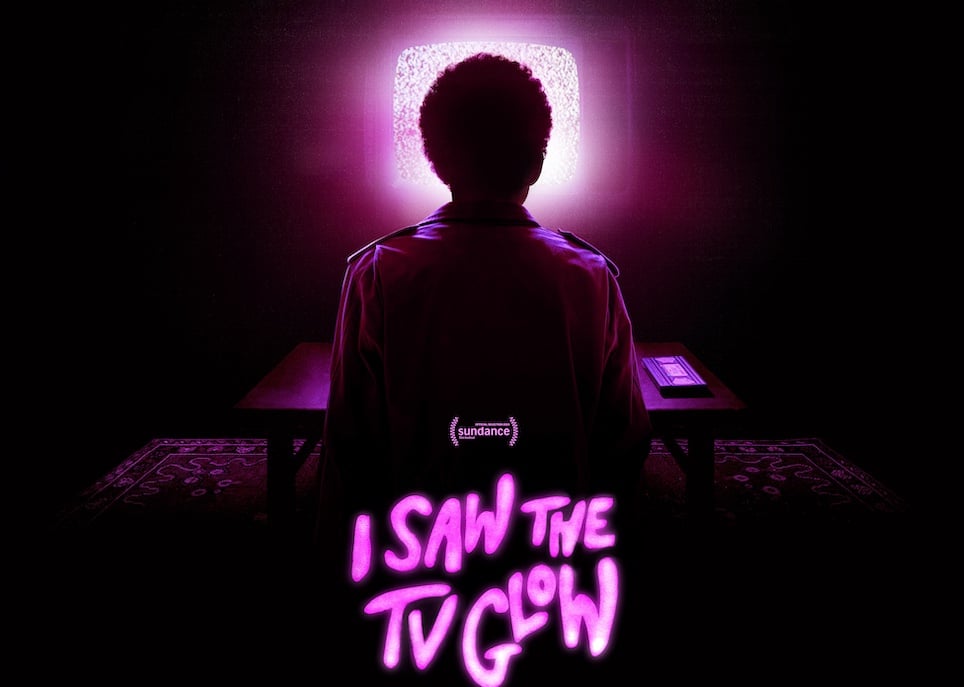
I Saw The TV Glow

It’s safe to assume a lot of us grew up watching a tv show that not only helped inform our identities but also our fears. For me it was Nickelodeon’s Are You Afraid of the Dark, a show that made me appreciate horror storytelling and how scary monsters could be when they had great backstories pushing them forward. For others it was Goosebumps or Eerie, Indiana or Buffy the Vampire Slayer. Older generations had their own shows, The Twilight Zone and The Outer Limits among them. Regardless, these shows possessed the power to confront viewers with metaphors and creepy situations that could force them to reckon with their own sense of self at a young age. In the process, it was hard not to put ourselves in the shoes of the kids that faced the supernatural. We wanted to be as brave as they were.

Jane Schoenbrun’s I Saw the TV Glow taps into this world of identities and the tv shows that would shape them for a story that looks at adolescence as if it were a tv show of its own, one that could get rewritten for the worse at any moment.

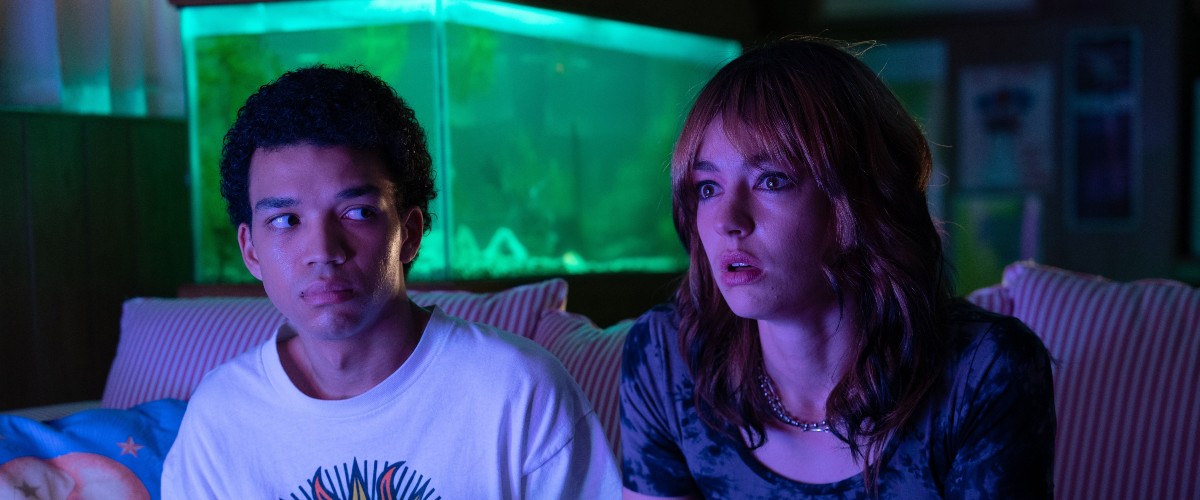
I Saw The TV Glow follows Owen (played by Justice Smith when the character’s older and by Ian Foreman when he’s younger) and Maddy (played by Brigette Lundy-Paine both as the young and older version of the character), two friends who bond over a show called The Pink Opaque, a mix of Goosebumps and Charmed (with some Supernatural) that also follows two friends who face off against the demonic forces of main villain Mr. Melancholy.

As Maddy and Owen’s friendship grows, finding itself reflected somewhat by that of the kids in The Pink Opaque, their personal development turns episodic. Its progression isn’t all encompassing, though. It’s more akin to how we remember our younger years in terms of special or traumatic moments that mark us. It’s a path paved with its fair share of tragedies.

This idea is furthered by Schoenbrun’s decision to have Owen break the fourth wall for quick bits of narration to offer insight into both his feelings and the things that happen to Maddy. They act as points of no return, of memories that will haunt the character. In fact, the screen glows with neon-infused words marking the beginning of new chapters in the story, further cementing that sense of life masquerading as a tv show.

You’d think this focus on tv and how influential it is as a source of identity would keep I Saw the TV Glow in nostalgia territory to the point of it being only decipherable to Nineties kids, but it’s actually the opposite. Schoenbrun’s neon-tinged visuals (beautifully composed by cinematographer Eric Yue) allude to the ephemeral quality of memories, to how we construct and unconsciously manipulate them down to the way they’re lighted. It opens up the movie to anyone who’s ever obsessed over a tv show and survived middle school and high school in large part because of it.

I Saw The TV Glow

That’s not to say there aren’t any references and influences strewn throughout. There’s a scene in a dark bar with a whole musical number that echoes a similar scene found in the original Twin Peaks series, and there’s flashes of Tobe Hooper’s Poltergeist and David Cronenberg’s Videodrome that are potent enough to come across as intentional winks to them.

That Schoenbrun also shot the scenes from The Pink Opaque in the fuzzy analogue style that characterized Nineties TV strengthens the idea that nostalgia is how we reconnect with the bits and pieces we used to put our identities together.

And then comes the gut punch. I Saw the TV Glow slowly pulls back the veil on nostalgia to reveal its most frightening realization: growing up means deciding what things will and will not accompany you into adulthood, knowing the choice can backfire. It’s a tough consideration as Schoenbrun essentially argues that building one’s identity is as much about breathing life into the self as it is about the willful death of certain parts of the self. What you kill to become your true self is crucial and it determines a lot, but not letting certain things die can prevent the full blossoming of identity. Nostalgia can either be a reminder of what we became or a reminder of what we didn’t become, and that’s hard to come to terms with.
I Saw The TV Glow

I Saw the TV Glow takes nostalgia and turns it into a source of terror that finds scary things in the memories of our youth. Like a tv show, there’s certain episodes that we love to watch and rewatch. But then there are also episodes we dread catching up to, that we wish weren’t a part of the whole. We can skip them, but they don’t stop belonging to the story. And they’ll haunt the characters involved in one way or another.
ZOM 100 is a zombie anime for the working-class

Typically, the start of the zombie apocalypse is a harrowing affair. In Night of the Living Dead it leads to racism and stubbornness, in Train to Busan it props up a hellish commute, and in Return of the Living Dead it turns a party in a graveyard into a blood feast for the undead. Zombies are under no obligation to offer the living a good time. That is, unless you’re at work and being belittled by your superiors every day for not putting in overtime for the good of a company that underpays but expects absolute dedication to their visions. For those people, the zombie apocalypse is cause for celebration. A chance to go out and enjoy life. This is the zombie apocalypse of ZOM 100: Bucket List of the Dead.

 ZOM 100: Bucket List of the Dead

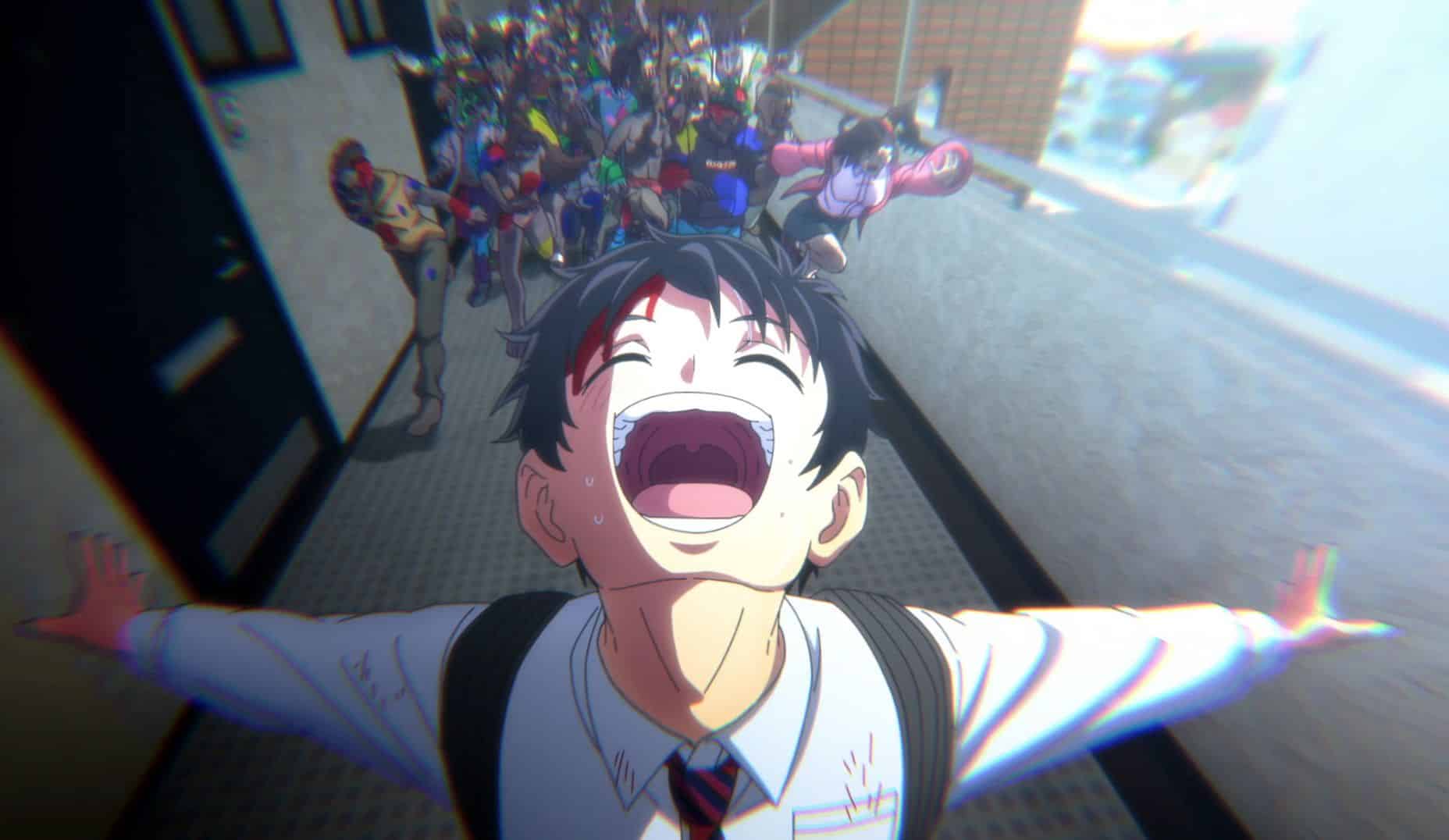
Adapted by Bug Films from the manga of the same name by writer Haro Aso and illustrator Kotaro Takata, ZOM 100 follows Akira Tendo, an exhausted 24-year-old office worker who works for an exploitative marketing agency. The grind has left him an empty shell, a drone that merely exists on automatic. Routine has zapped any chance for excitement to make an appearance every now and then, and existence has been confined to small cubicles and even smaller apartments. He’s essentially become a zombie without having to go through the whole dying process. And then the end of the world starts, freeing Akira from his tortured existence.

In light of this newly acquired free time, Akira makes a bucket list. He intends to do all the things he said he wanted to do but couldn’t because of his job. And then it’s one mad dash to live life after the other.

The story thrives on relatability, and rooting for Akira is infectious. It’s very easy to see his side of things and to validate his decision to take the apocalypse as an opportunity to decompress. For example, one of the first things he tries to scratch off his list is giving himself a day to just lounge at his apartment, drinking beer and enjoying the silence. Of course, he’s running low on beer because he’s never home long enough to restock. Intent on enjoying his time how he wants to, he ventures outside and in the process meets Shizuka, another survivor who has a history with abuse.

The concept works because it captures the simplicity of our human needs so well. Working all day and getting back home just to wash up, sleep, work, and repeat the process means leading a very insular life. Veer from the script and you’ll open yourself up to meeting new people and enjoying life. For example, one of the benefits of freedom from work results in Akira reconnecting with his old college pal Kencho, a hilarious companion that always wanted to be a stand-up comedian and so decides to shed his clothes every chance he gets to further that dream. This reunion wouldn’t have happened had the zombies decided not to disrupt the status quo. Horror has a hell of a way of telling people how scary things can help us reevaluate life.

 ZOM 100: Bucket List of the Dead

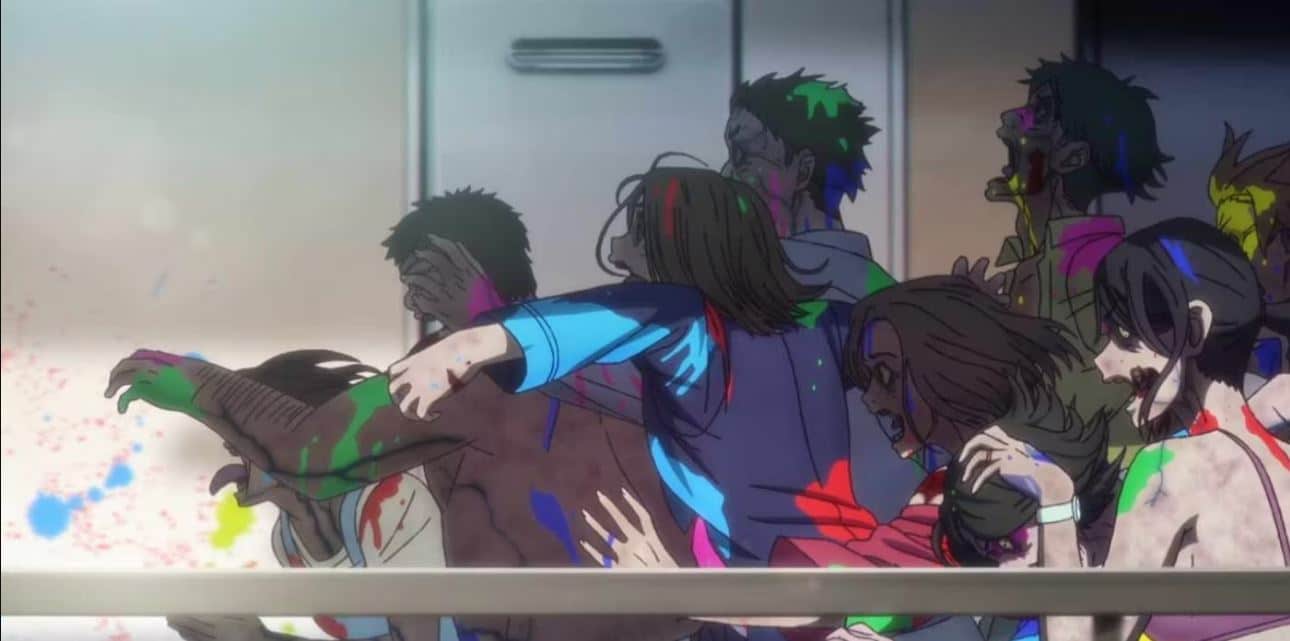
Of course, ZOM 100 is still a zombie anime, so you’ll get a lot of undead action each episode. Just don’t expect a gorefest the likes of a Lucio Fulci zombie flick or cannibal carnage done a la Tom Savini. That said, the series adds an interesting twist to the violence by drenching zombies in a mess of bright neon-like colors as a substitute for the usual red when showing blood. It helps keep the zombies kinetic, playful, and very stylish overall. They’re still a threat and there are some intense zombie chases that ramp up the intensity, but fun outweighs outright horror here.

It’s not often one can say this about a zombie apocalypse story, but ZOM 100 is a great comfort watch. It’s not out to wallow in trauma or to comment on the destructive nature of humanity. It’s about enjoying life. This sets it apart from tradition in ways very few other stories of its kind do (with the film One Cut of the Dead and the manga I Am Hero among top exceptions). It can get emotional, but there’s always a joke around the corner that can bring you back to relative peace. The message? Don’t be a work zombie. Make your own bucket list and see it through, even if it means dodging the undead to cross out each item.

Joseph Koch’s Comic Book Warehouse is invaluable and it’s a damn shame it’s closing

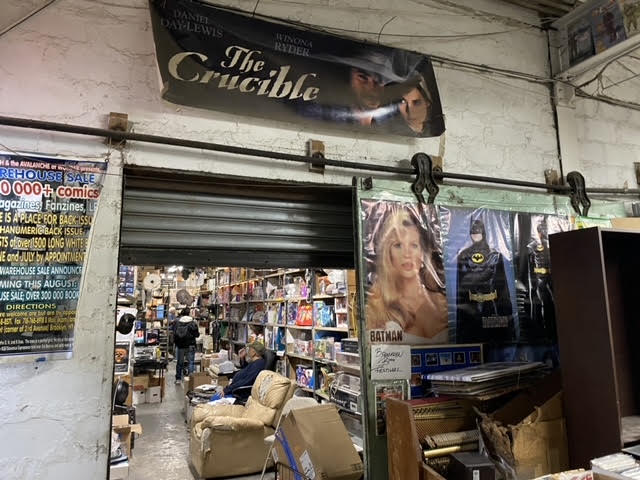
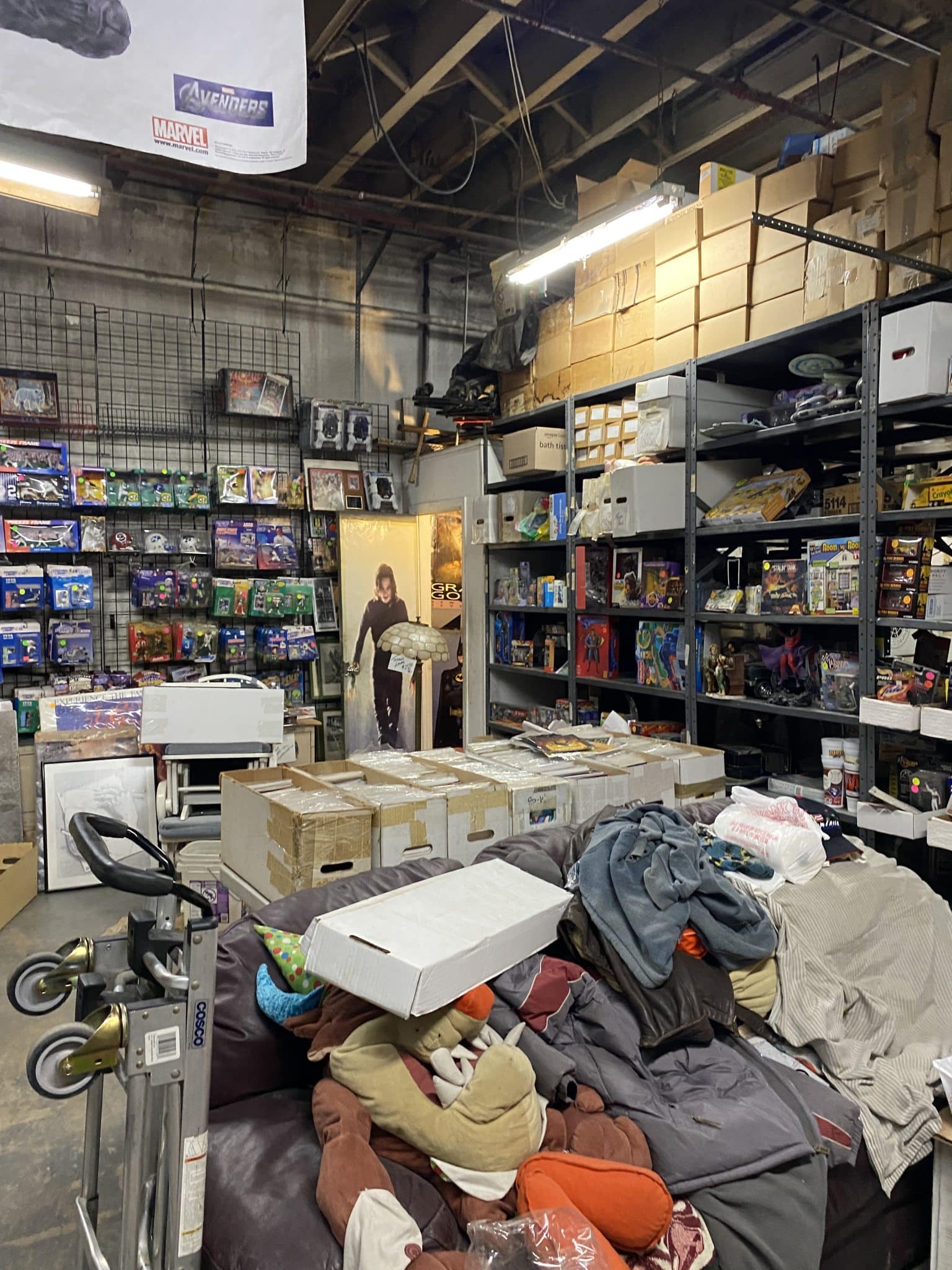
It takes standing in a warehouse full of comics to gain somewhat of an understanding of how vast the entire history of the medium truly is. There’s just not that many chances to do this, to take in the enormity of it all in a place filled to the brim with boxes upon boxes of single issues and adjacent merch. Joseph Koch’s Comic Book Warehouse is one such place, and the cruel march of rising rent costs, inflation, and outright greed has forced the location to announce it is closing its doors.

Located in the Sunset Park area of Brooklyn, the warehouse is the stuff of legend. Mention of its name in conventions and other comic book shops built up a location that was, in essence, a memory palace.

It carried an irregular operation schedule, opening either on weekends or by appointment. Given its elusive state of being, it took me a while to finally make the trip over. In fact, it was news of its closing that finally got me to right that wrong. Turns out the threat of losing something important to history is a strong motivator, but one that has the potential to kick in too late.

Upon first entering the warehouse, you’re met with a sense of potential discovery. No specific issue or book or action figure will be readily available upon request. You have to work for your find. The reward, on the other hand, can come in multiple unexpected forms. Dedicated single issue hunters have a great chance at landing that hard-to-find item, but what they’d discover in the process would probably eclipse the actual reason they went to Koch’s in the first place.

I didn’t go with a specific comic in mind to find. No mission other than the experience. Not five minutes in, though, I stumbled upon stacks of Humanoid/DC books that only ever tend to crop up either in smaller conventions or older comic book stores that overstocked in them thinking they’d yield a small fortune. Jordorowsky and Bess’s Son of the Gun, Baranko’s The Horde, Carlos Portela and Das Pastoras’s Deicide, and Mark Malés’s Different Ugliness, Different Madness were all there and in plentiful amounts. It felt like getting a look into the comics market of the past to appreciate what was trying to hit it off with readers (and maybe didn’t, to the extent that was expected at least).

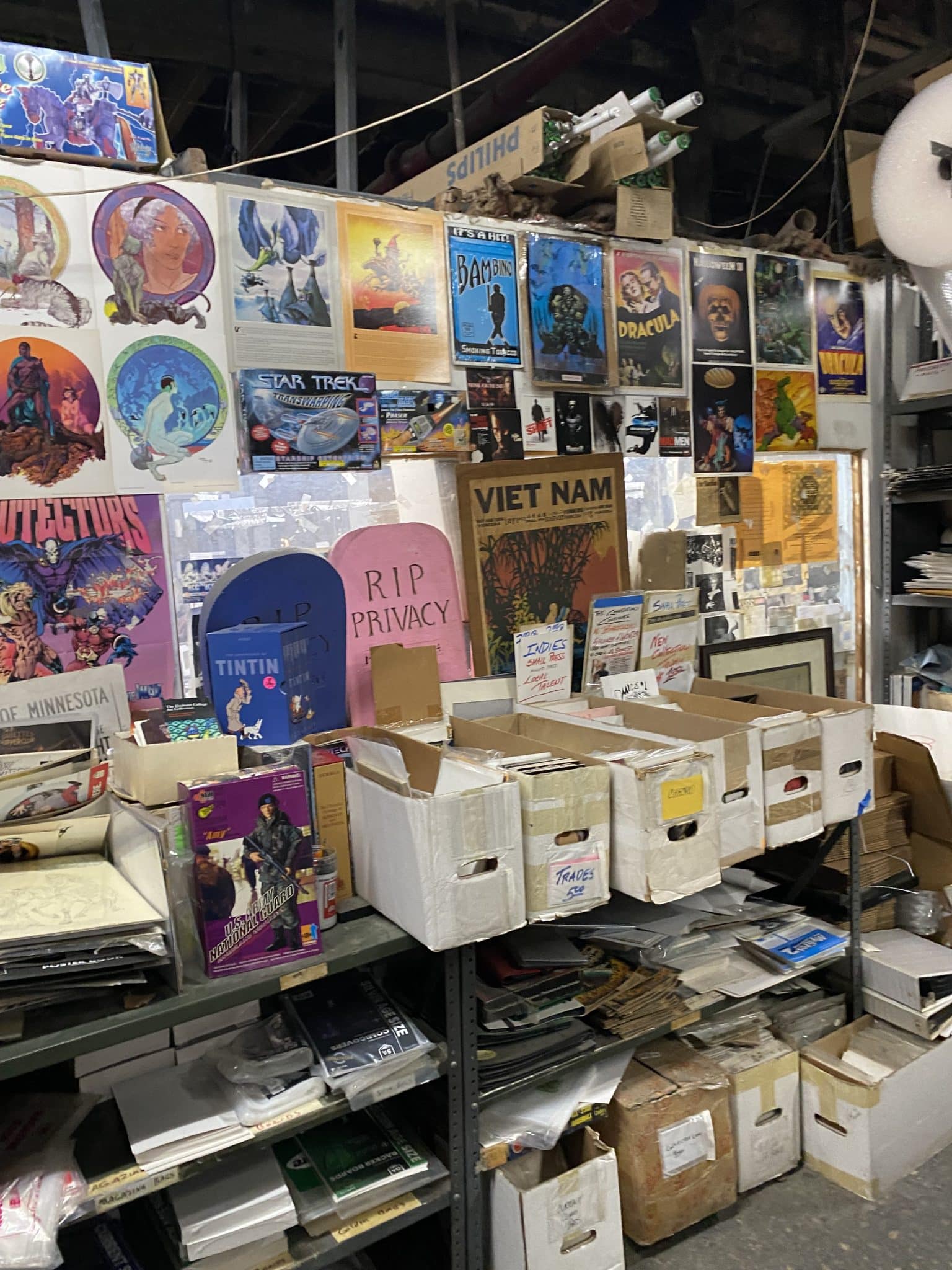
One find in particular was a stark reminder of how comics are always trying to make what’s old new again. In one of the shelves furthest from the entrance was a section that had more adult comics mixed in with oversized editions of masterworks and classics. Among them were the first ten to twelve issues of the 1994 Penthouse Comix magazine, which ran up to 1998. Of special note was issue #7, which featured an erotic take on (not) Batman by comics legend Moebius. In it, Batman goes to the shrink and is confronted by his dress-up fetishes.

It was hard not to think of the current Penthouse Comix reboot and reflect on whether it’ll meet the same fate as it did in the Nineties. Seeing a past attempt at something preserved in a warehouse would bring up questions on whether it would find a more willing audience today to become a more constant presence in the comics landscape. Hell, if it will even become a part of the conversation.

A few shelves over led to old Vertigo books that I had never even heard of before, found next to a box filled with House of Hammer horror magazines that featured comics adaptations of some of the studio’s most popular movies. In a sense, the warehouse also speaks to the cruelty of time and how it elevates as much stuff as it forgets.

These are the types of things that a single visit can bring to the fore. You can’t help but think how much or how little comics have changed throughout the years. By merely existing, Koch’s Comic Book Warehouse became a statement on the nature of comics as an industry. It only has a bit more time left in that role.

Comics history isn’t the only thing getting lost when it closes its doors for the last time. Koch’s also housed old newspapers, a hefty collection of Playboys and other adult periodicals, comics-adjacent toys and merch, sci-fi books, VHS cassettes, posters, trading cards, and random objects that look like they were acquired in a yard sale or from the Warrens’ occult artefact room from The Conjuring films.

All of it would fit in well in a museum, and it would be quite sad if it ends up boxed and taken to the dump. Some local comic stores have been taking stock off them, but not all of it will make it to someone else’s hands. The volume of what can potentially be lost equates to losing the finer details of a complicated narrative that thrives in minutiae.

If you have the opportunity and haven’t done so yet, give Koch’s Comic Book Warehouse a visit. If you’ve been before, go again. Surround yourself in the history of a medium, of an industry, and acknowledge the expansiveness of human creativity that lives in the things that still inhabit that space for a little while longer. You won’t get many more opportunities to do so.

Interview: Zack Quaintance finds the life of comics in DEATH OF COMICS BOOKCASE

comics bookcase

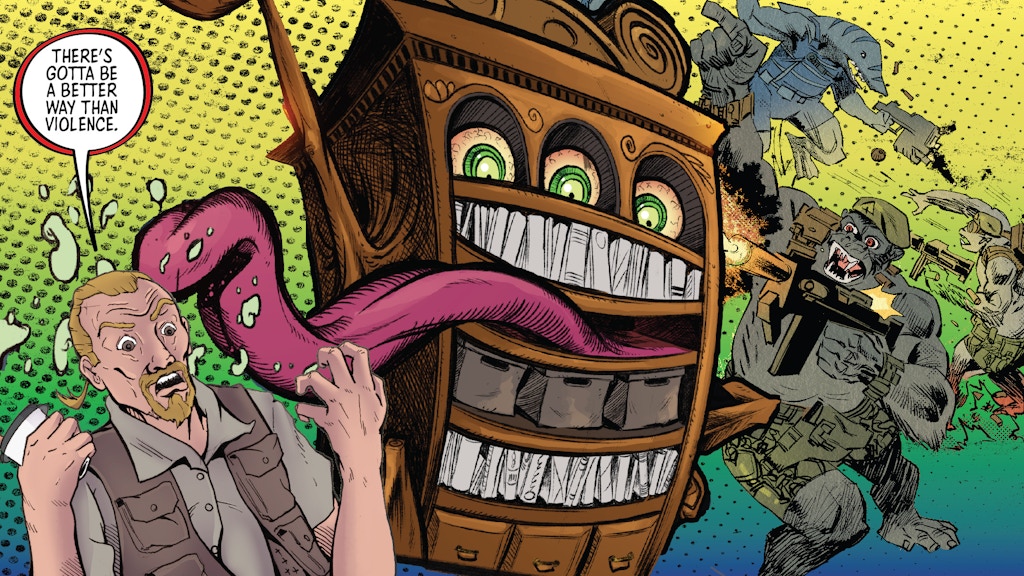
Including the word ‘death’ in the title of a comic book could suggest that a funereal tone will be taking charge of the proceedings. But that’s not the case with Zack Quaintance’s Death of Comics Bookcase, Vol. 1, an anthology comic that takes a magnifying glass to the medium and finds it can celebrate, mourn, and offer necessary warnings on the future of comics by way of werewolf priests, living comics bookcases, and morally haphazard wizards.

The project, which hopes to get funded via Kickstarter, tackles a different genre in each of its stories, from fantasy and horror to superheroes, but they’re all woven into a wrap-around story that centers on the titular Comics Bookcase. The variety on display makes the book feel like a roadmap for all the things comics can do, highlighting the richness of the medium. It’s a book that accounts for a life in comics, which Quaintance has certainly led and is still living (he is currently the Reviews Editor for Comics Beat).

There is one thing that brings all these stories together: Quaintance’s sharp approach to satire. No instance of humor is there for the sake of a punchline. There’s thought put into each joke, of the kind that will inspire staring into distance to reflect upon the meaning behind some of them (like when you’re watching a movie and you realize the sword is actually a phallic symbol, or that the main villain is a stand-in for the author’s mother).

One story stands out for how personal it feels while still managing to be a solid horror story. The Werewolf Priest, illustrated by Anna Readman with colors by Brad Simpson, follows a journalist on the heels of a story about a priest that’s rumored to be a werewolf. It has the satire locked down, but it also succeeds in becoming a gleefully gruesome monster-of-the-week yarn that looks at immigration and the loneliness that comes with being a journalist in the process (pulling from Quaintance’s previous experience in the field). It’s strong enough to be its own comics series and it is a definite highlight.

Quaintance scripts all the stories but is accompanied by a different artist in each one. PJ Holden, Nick Cagnetti, Luke Horsman, Ryan Lee, and Pat Skott all lend their talents here.

I corresponded with Quaintance to get at just how Death of Comics Bookcase came to be, what goes into Kickstarting a book, and why that Werewolf story is so damn good.

RICARDO SERRANO: Anthology comics can be strange creatures as they let you flex different storytelling styles while still feeling part of a unifying vision. You go for a different genre per story here. What did you hope would come through in each segment to keep it all together?

ZACK QUAINTANCE: I didn’t initially plan to connect them at all, outside of the Death of Comics Bookcase framing device story that runs in between each. But in the process of working on them, a shared sensibility started to emerge. I really like comics that take absurd concepts seriously, and that’s absolutely what ended up unifying the book. The high concepts are very pulpy — whether it’s a werewolf priest or a war between sharks and apes — but there’s depth beneath that pulp, too.

SERRANO: One thing that’s present in each story is humor. Each one has its own tone though. What do you find in humor that helps you tell these kinds of stories?

QUAINTANCE: The humor just kind of showed up. At no point did I think to myself, ‘Okay, time to make this funny.’ I spent quite a bit of time thinking about each story before and during scripting. I had the concepts for each early, but it took a long time to figure out how to first introduce readers to each world and then later how to wrap things up in ways that felt satisfying. At a certain point, I think I started trying to entertain myself. The longer I tinkered, the more jokes started to creep in.

SERRANO: One of my favorite stories from the book is the Werewolf story, which actually says a lot about journalism in the process. It feels personal. How did you come about this story?

QUAINTANCE: That story is based on my life. Well, sort of. I’ve never seen a werewolf, but after college, I did get a job at The Monitor in McAllen, Texas, on the U.S.-Mexico Border. My first beat was night cops. It was a really rough time. I was 23 and didn’t know a single person for hundreds of miles. I’d drive around at night from car crashes to murder scenes to incidents with Border Patrol. I had really idealistic notions about reporting, but the paper there was on hard times. Nobody was reading it, nor did anyone respect it as a community institution. It was an intense mix of loneliness, violence, and professional futility. So, the comic has monsters, but for me the real horror is the young journalist reconciling his expectations with the reality of his job. 

SERRANO: This isn’t your first time around Kickstarting a book. How have these experiences differed and what’s surprised you the most on this one?

QUAINTANCE: The last time I did a Kickstarter campaign, it was August 2020. Comics Twitter was alive and well, which made promo easier, or at least more centralized. Now when I have something new to unveil, I have five platforms to put it out on, and each one of those platforms works a little differently in how you have to court engagement. It’s more time consuming. The way I think about it is promo has gone from taking a highway, to taking a muddy road. You can still get where you’re going, but it’s going to take more pushing and patience.

SERRANO: Already thinking of book 2? More Death of Comics Bookcase on the horizon? 

QUAINTANCE: Absolutely! The plan as of now is to do at least three volumes. I’ve already got an idea of what will be in the second book, some of which will look familiar to readers of this volume. In fact, the only way there won’t be more Death of Comics Bookcase is if we don’t fund this one. I should also point out that two of these stories — The Werewolf Priest and Goldmask! — were designed as backdoor pitches. And while it wasn’t initially going to be, Nick Cagnetti and I changed the ending of Responsibili-Teen ever so slightly to make it so that character could also return. That’s a long way of saying, yes, absolutely. And the second volume would obviously be Reign of the Comics Bookcases.

You can find the Kickstarter page for Death of Comics Bookcase, Vol. 1 here.

Quiet on the Set puts Nickelodeon in very dark waters

nickelodeon

There’s a scene in the movie Steve Jobs (2015) between the titular Apple giant and his friend Steve Wozniak in which they fight over giving certain development teams their due for helping build some of the most successful products in the company’s history. Jobs hunkers down on his position to not recognize those people. Wozniak offers stern rebuttals. When Wozniak realizes Jobs won’t budge, he offers this as a parting shot before walking out on his friend: “It’s not binary. You can be gifted and decent at the same time.”

The sentiment behind this scene echoes throughout ID’s new 4-part docuseries Quiet on the Set: The Dark Side of Kids TV, on Nickelodeon’s toxic work environment during the Nineties and the early 2000s in shows led by Dan Schneider. It’s essentially an exploration of what happens when a company’s biggest moneymaker is an abusive, sexist, and unethical presence that can make or break careers and leave deep scars on those caught in his path.

In addition, the show dives into the discovery of at least three sexual predators that worked on different sets and prayed on talent from programs such All That and iCarly. From this comes the bombshell revelation that one of Nickelodeon’s biggest stars, Drake Bell, was a victim of one such predator. He tells his story publicly for the first time in this series and it is both heartbreaking and deeply harrowing.

There are a lot of things Quiet on the Set does right, but a few specific ones are truly striking. First up is the quality of the interviews and the time afforded to them so that the voices of the affected lead the narrative. Featuring some of the now-adult stars of Schneider’s shows and other staff—All That cast members Bryan Hearne and Katrina Johnson, director Virgil Fabian, and The Amanda Show writers Jenny Kilgen and Christy Stratton among them—series directors Mary Robertson and Emma Schwartz give each interviewee a chance to get as much of their story out to the public as possible.

One thing that elevates these interviews is the set design for their scenes. Each person is seated either behind a table with office supplies on it or on an actor’s chair that highlights what their roles were and how important they’re work was to the success of each show. It gives them a sense of respectability that recognizes their experience without forcing upon them the victim label as if that’s all they came to be after they left or were removed from their positions.

The setup makes it seem like we’re stepping into a professional’s office, a place that belongs to someone who has achieved much despite the dark times they had to endure.

nickelodeon

Another thing the docuseries does really well is highlight the investigative nature of the story, letting facts and carefully shot testimony make the case rather than impassioned bits of narration that guides the audience towards indignation. Directors Robertson and Schwartz trust in the audience to make their own judgments with the information provided.

The docuseries is very careful not to lay the blame entirely on Dan Schneider. It’s made clear that the hiring of those who would go on to engage in illegal sexual behavior were not hired by Schneider, nor were they protected by him. The revelations blindsided him just as much as they did a lot of the cast members. Many different things can go wrong in one place, but they can’t all be attributed to just one person. It takes a village to sustain a toxic work environment.

Nickelodeon executives and company men are also to blame for trying to sweep everything under the proverbial rug, and the show does an excellent job of showing just enough to get the point across without naming names that couldn’t be verified.

That said, Schneider is meticulously portrayed as a problematic genius that was allowed to get away with a lot just because he was producing hit after hit. The cost of building an empire on the back of an abusive person, though, is that whenever the bad stuff comes out the work becomes tainted. Glory is not without reckoning when it entertains so much ugliness in the process. Quiet on the Set is firm on this point. It’s a lesson places such as Nickelodeon should take to heart to secure a healthier and safer working environment.

nickelodeon

Depending on your attachment to the shows explored in this docuseries, it’s safe to say a lot of your childhood memories will be affected. It’s not easy to enjoy something that you now know was built on abuse, gender discrimination, and trauma. There’s a lot of tragedy here, some of which couldn’t be explored more deeply for lack of testimony (Amanda Bynes, for instance, did not participate). But there’s more than enough here to further conversations on power, child safety, workplace toxicity, and the scary things that hide behind success.

Why you should be reading The Space Between

The Space Between

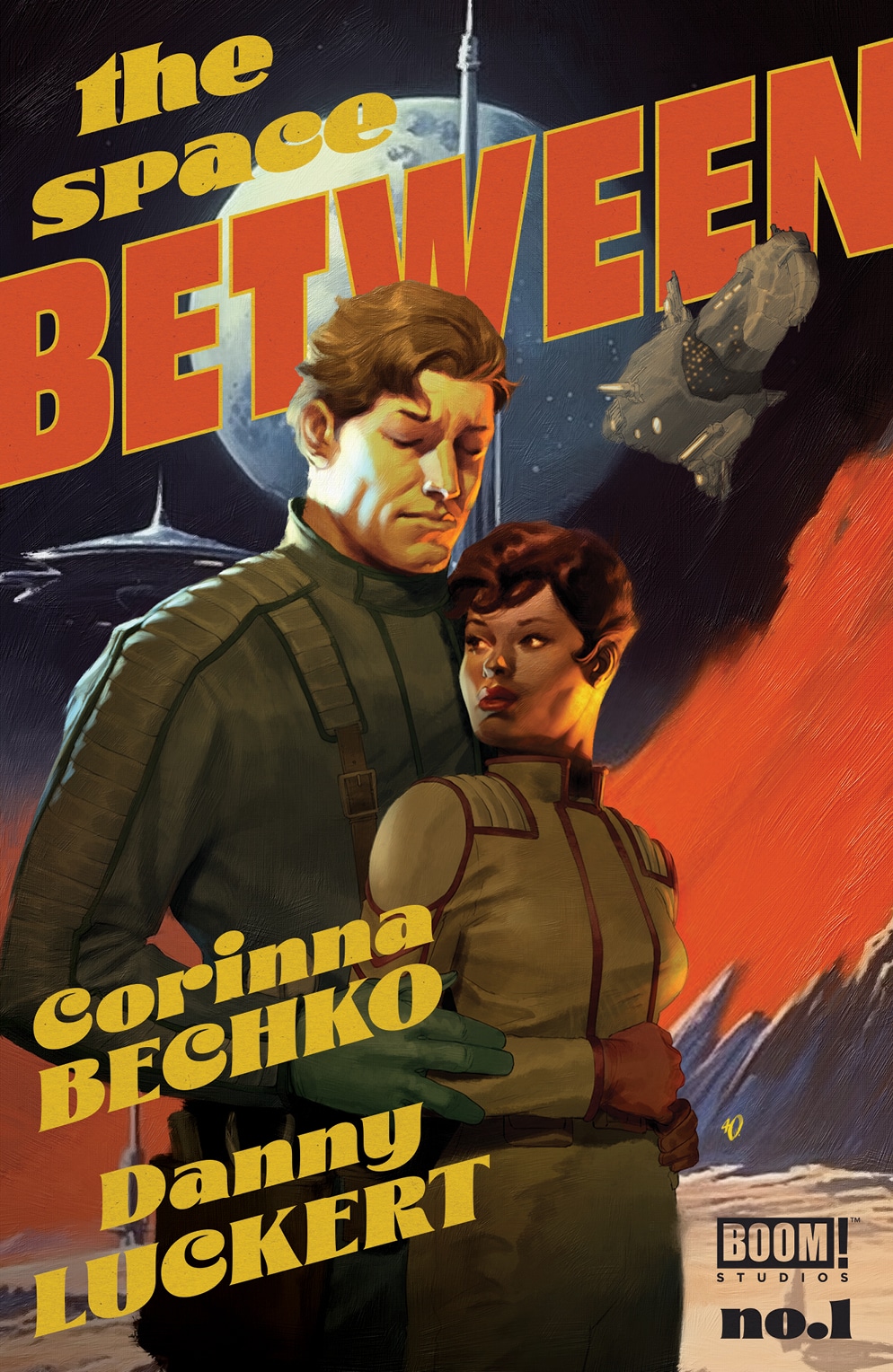
Good science fiction makes readers want to visit the worlds they contain, to explore them first-hand as a kind of traveler. The best science fiction, though, makes readers want to be the protagonists in them. The Expanse comes to mind as a recent example, a story that considers class and intergalactic warfare from various points of view, each an entry point into a larger conflict that’s hard not to put ourselves into. Star Wars does it by leaning into the promise of adventure inherent in the Hero’s Journey, of becoming a Jedi. Corinna Bechko and Danny Luckert’s The Space Between inspires this by making its sci-fi feel urgently timely and consequential, presenting conflicts that can be overcome despite the odds. You should be reading this comic.

The Space Between sees what’s left of humanity living aboard a massive starbound ark called the Dodona, a place that’s deeply segregated between upper tier citizens and pilots and lower tier workers who are prohibited from traveling from their living spaces below up to the top floors of the vessel. In the series’ first issue, a pilot called Revla finds herself on the lower decks by accident following a controversial flight that’s put her career on the line. While in the lower levels she meets Les, a worker from lower caste who helps her navigate the area. Through him, Revla experiences just what the class divide truly means and what kind of injustices it actually furthers and so decides to rebel and fight the system that sustains this division. In an interesting twist, that fight is also the result of a blossoming romance between the two characters, representing a union that transcends class and expectations.

This alone is plot enough for a whole sci-fi series, but that’s only issue #1. Subsequent entries (the series is three issues in as of the time of this writing) sees a new generation of protagonists continue the plight through different mutations of the same problems. Some of these characters are related to those found in previous issues, but new characters are also introduced. In the process, The Space Between transforms into a political space epic with a unique take on romance and social responsibility that never neglects the elements that make for great science fiction.

The Space Between

Bechko and Luckert succeed, in an impressive manner, in never making new issues feel like retreads of previous ones. It isn’t a kind of sci-fi Groundhog Day with a new pair of characters each time taking on the exact same problems. It’s a natural continuation of struggles that keep the class perspective firmly in place to track the evolution of the situation aboard the Dodona. Progress is certainly logged, but so are the changes in strategy from those who seek to cosign on reverting back to the days of segregation.

Luckert adds subtle but important touches per issue to communicate the jump in time and the changes in living conditions brought upon the results of key struggles. It makes Bechko’s characters more believable in the process as part of a social and political ecosystem that’s consistently being put in contentious spots that threaten to undo progress.

The romance aspect of the story is especially refreshing. It’s obvious from the covers to the story’s focus on a pair of protagonists primed for love per issue that an emotional connection can be as strong a unifying force as a political philosophy. Love isn’t on display merely as an excuse to get two characters to meet within a story. Instead, the intention is to show how it can generate a level of empathy that espouses understanding. Bechko and Luckert leave nothing to chance. It’s all carefully orchestrated with a sense of purpose that imbues the story with consequence. It makes everything feel genuinely honest.

The Space Between

The Space Between is the type of science fiction that comes along to remind readers of the power and influence of the genre, of its potential to look beyond trends to find something that sparks different kinds of conversations. It certainly earns a spot among some of the best comics of 2023, if you ask me, and it is a must-read. It possesses an energy that can turn casual readers into lifelong fans of science fiction. It’s that good.

Movie Review: Godzilla Minus One turns the iconic kaiju into the God of Monsters

Godzilla Minus One

From the very first trailer on, it was evident Godzilla Minus One was setting its sights on echoing the roaring debut of the nuclear monster back in 1954. Gojira, directed by Ishirō Honda, was a visceral kaiju allegory for the newly minted atom bomb world, a giant creature feature that turned the titular monster into a reminder of the position humanity put itself in by creating weapons of mass destruction. It looked at the state of things at a macro level, from a pretty frightening vantage point. Minus One goes for a more focused approach, putting soldiers and their PTSD at the forefront for a different look at the consequences of human-led devastation and the towering psychological obstacles it creates for those tasked with carrying out militaristic violence.

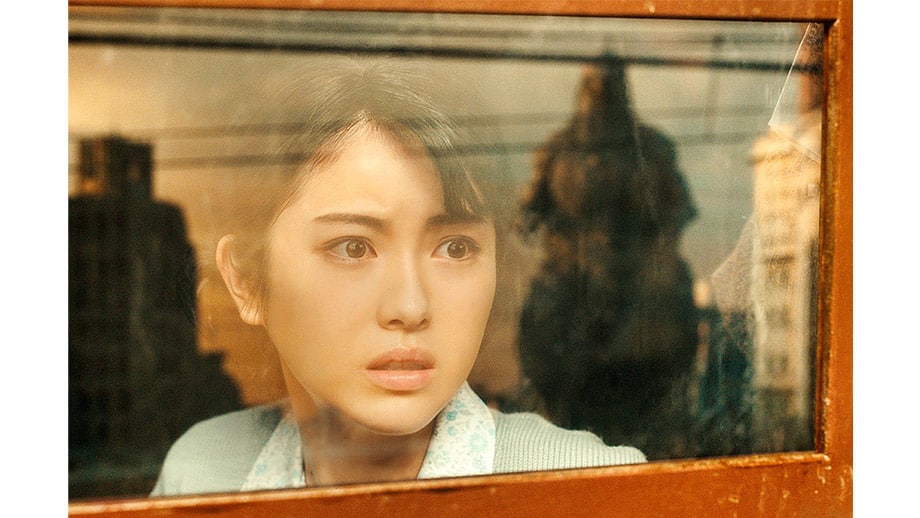
Godzilla Minus One, directed by Takashi Yamazaki, follows a soldier called Koichi (played by Ryunosuke Kamiki) as he comes home from the war with not just the trauma of his failed mission as a kamikaze pilot but also as a survivor of a battle against a young Godzilla. During that encounter, his inability to act in a key moment of the fight led to the deaths of several soldiers, a decision that’ll haunt him for almost the entirety of the film.

Koichi returns to his hometown only to see it buried under rubble, the victim of allied bombing. As he tries to salvage whatever he can to make his home again, he meets a woman called Noriko (played by Minami Hamabe), a woman in a precarious position that’s trying to survive with a baby in hand. He takes both of them in and time passes. Just as things start getting rebuilt, Godzilla is awakened by atomic bomb tests and Japan is reminded once more that wars never truly end. They just assume a different form.

Godzilla Minus One

From the very first Godzilla movie on, audiences have gotten uniquely different iterations of the classic kaiju. He’s gone from King of the Monsters to Japan’s protector to a parody of himself and back again. In Hideaki Anno and Shinji Higushi’s 2016 Shin Godzilla (widely considered as the best Godzilla movie after the 1954 original), for instance, he becomes a force of nature that exposes humanity’s inability to coordinate a unified response to solve a problem. The film mocks the government’s insistence on bureaucracy to problem-solve and how contradictory the efforts end up being. Godzilla represents the consequences of such dysfunction and how destructive it can be.

In Minus One, Godzilla is essentially turned into a god. He’s the ultimate expression of cataclysmic consequence. Director Yamazaki frames every scene he’s in with a sense of finality that absolutely terrifies. Godzilla’s arrival means humanity is about to get judged, harshly. It’s an impressive showcase of the giant monster that makes for one of the most tense-inducing portrayals of it in franchise history. It’s all reflected in his powers this time around. Without spoiling anything, just know you’re in for a few surprises that both make this version of the monster unique while updating certain aspects of it to make sure the metaphors on display hit harder.

The severity of Godzilla’s presence, what it implies, does an excellent job of imbuing the Japanese soldier experience with a sense of duty and hope that isn’t always given the attention it deserves in war movies. Koichi’s character, for instance, wears his PTSD on his sleeves, constantly reminding the audience his war is a constant and that it didn’t end with the armistice that brought the conflict itself to a close. Trauma does not sign off on this process and thus owes it no recognition. The film hits you over the head with this idea, but it’s in service of setting up a different outcome for the soldiers driving the story.

Godzilla Minus One

Koichi’s supporting cast does an incredible job of exploring the range of trauma and disillusionment that ailed soldiers in the postwar period. One character of note is Sosaku Tachibana, played by Munetaka Aoki, a soldier that also survived the first Godzilla attack along with Koichi. His trauma manifests as anger, making his own war one of disappointment in his brother in arms. The way the movie tackles the diversity of trauma, though, is by highlighting the things soldiers have in common rather than the things that separate them.

By turning trauma into a unifying force, Minus One opens the doors for hope and healing to come through as real and attainable things. War movies dealing with the similar themes rarely opt for hope. Minus One does and it makes for a welcome deviation from the norm. It actually makes the Godzilla scenes feel scarier as the possibility of surviving the giant monster raises the stakes considerably. The audience is encouraged to cheer for the story’s heroes more so than in other stories that deal in war.

Naoki Satô pulls all this together with one of the best Godzilla scores to date. It’s surprisingly restrained but possessed by an epic sense of dread and momentousness that captures the god-like terror of the iconic creature. There’s one particular sequence that feels ripped straight out of Stephen Spielberg’s Jaws that ramps up the horror of facing a giant monster at sea by relying on doom-charged sounds that slightly quicken whenever Godzilla gets closer to the boat he’s chasing. Not a single musical cue is wasted in this regard, giving individual action sequences their own identities. Even when the requisite theme music from the original Gojira (composed by Akira Ifukube) kicks in during one sequence, it doesn’t overshadow Satô’s score. In fact, I wanted to see how that particular sequence would’ve played out with Satô’s score accompanying it.

Godzilla Minus One

Godzilla Minus One is a triumph. It earns a spot among the greatest Godzilla movies ever made, right next to the original one and Shin Godzilla. It’s integration of multiple war metaphors along with tense kaiju action lets it stand on its own. What makes it soar, though, is how it manages to turn an already iconic monster into an even more impressive and colossal version of itself. The age of the King of Monsters is over. The age of the God of Monsters has begun.

Demián Rugna’s WHEN EVIL LURKS is a masterful exercise in cruelty

When Evil Lurks

Horror loves grand metaphors about society, be it on the effect capitalism has on people (Dawn of the Dead) or the terrors racism can manifest in different scenarios (Tales from the Hood). Demián Rugna’s When Evil Lurks certainly has its metaphor in place – namely human behavior in times of crisis – but more than having an interest in calling out society, what it really wants is to express its highly justified anger at it. And this movie is angry.

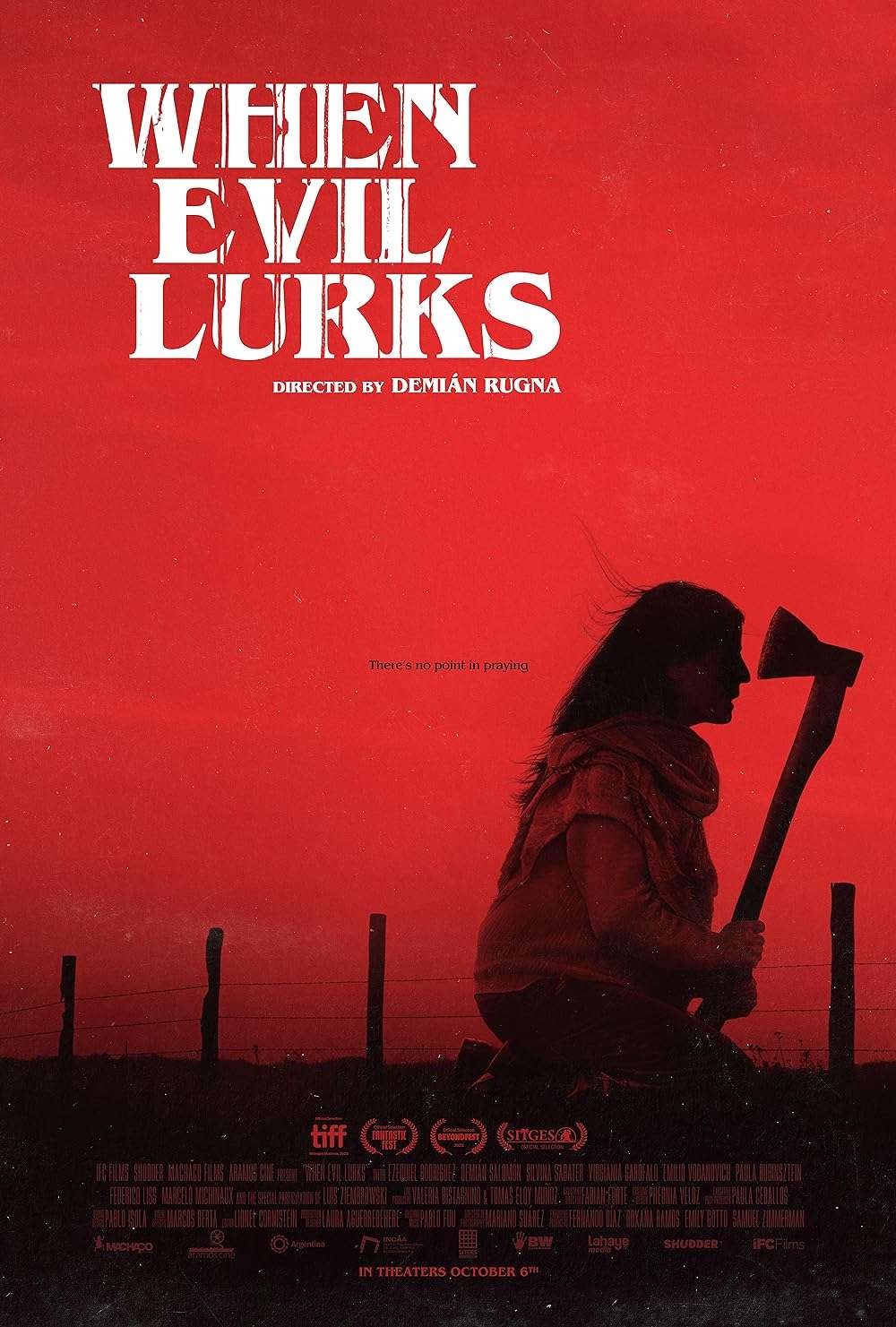
When Evil Lurks (or Cuando Acecha la Maldad, in the original Spanish) imagines a world where demonic possession spreads like a virus. Essentially, humanity is in the throes of a possession pandemic, a very cruel one at that. Cities are hotspots, making smaller rural areas the ideal places for safety. That is, until panic inevitably sets in and people start giving in to it.

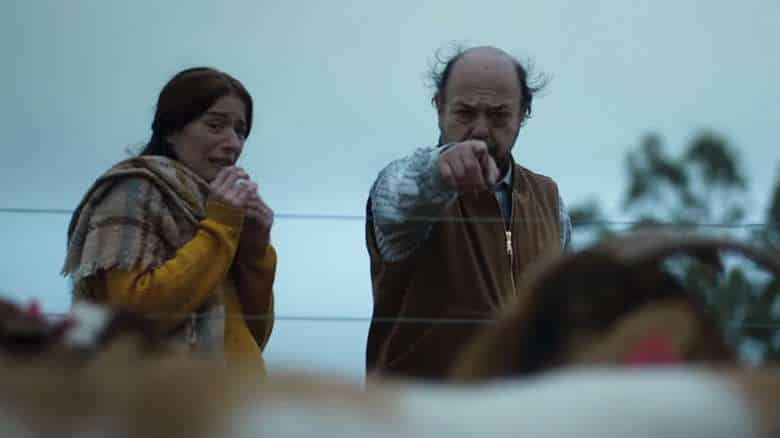
The movie follows Pedro (Ezequiel Rodríguez) and Jaime (Demián Solomón), two brothers who live in an isolated and very quiet part of the countryside. One night they hear gunshots, a sign that things in their corner of the world might not be so disconnected from the outside world. The next day they find a possessed (or embichado in Spanish) and realize the pandemic has reached their home. Panic rears its head almost immediately, and what follows is a blood-soaked journey that leads to death, doom, extreme violence.

What sets this particular pandemic horror story apart is how intently it focuses on human error and how it can lead to all the tragedy that ensues once a full-blown crisis is under way. Pedro and Jaime are scared and unbearably anxious for almost the entirety of the film, and it influences each decision made in their poor attempt to outrun the demonic pandemic.

When Evil Lurks

Pedro and Jaime’s actions put their group in immediate danger from the onset, an interesting comment on how people disregard logic and common sense when met with danger in its earliest stages. Echoes of the COVID-19 pandemic carry through here. The memory of people disregarding social guidelines and hoarding supplies due to fake fears of shortages is fresh enough that it’s hard not to connect the dots while watching the movie. But it goes beyond that. The mistakes Pedro and Jaime make are timeless, things people have been doing since time immemorial.

The performances do an excellent job of conveying this throughout. Interactions are intense and loud, led by frustration rather than careful thought. Ezequiel Rodríguez, especially, channels this with aplomb. His characterization of Pedro weaves good intentions with desperation to show a man that wants to help but does more damage in doing so. Here’s where cruelty sets in.

Rugna approaches death sequences with a visceral sense of violence that is unmatched when compared to what landed on cinemas this year. What makes them hit hard isn’t necessarily their explicitness, but rather how important he makes each character feel to the group that Pedro and Jaime eventually put together. One scene in particular, involving a dog and a small kid, ripped through the silence of the theater with a shock that threw any semblance of safety out the window. No one is safe, and no one dies easy. The violence the victims face help build the more sinister qualities of the pandemic while also reflecting how badly key characters screwed up so that this could happen.

Cruelty, here, is a storytelling tool that accentuates consequence. Shock value is there to weigh characters down with the guilt of having put people in the way of their terrible deaths. Tried to save your son without considering taking him out of his home was the wrong idea in the first place? Expect an embichado to eat his head while casually walking on the road. A tragedy, sure, but an avoidable one. Realizing that brings with it a special kind of pain.

When Evil Lurks

One other point of note is Rugna’s worldbuilding. Not unlike James Mangold’s 2017 Logan, there are no dedicated points of exposition to explain how the story got to this point in the pandemic. You get bits and pieces and are then expected to put them together. Preventing infection, for instance, is a process that’s mostly inferred. Fighting the possessed follows suit, but is given more depth with the introduction of certain tools that carry a lot of story. In a clever twist, though, these arcane-looking tools are there to inspire more questions. They are pieces of a puzzle with strange dimensions the audience is not made privy of. It helps keep the mystery of the pandemic open enough to not just be COVID-specific, but rather more universal regarding humanity’s woeful track record with crisis management.

When Evil Lurks is a dare for the horror genre. It pulls the camera away from the über-intimate focus of newer horror movies (that often overindulge the topic of trauma to get their point across) to get a very good look at panicked social behavior. It’s pandemic horror of the highest order, of the kind that points the finger at people and tells them they’re making it worse. We need more movies like this, hence the dare. Angry horror movies are like getting a bucket of cold water getting dunked on our heads followed by a bucket of hot blood. You’re not supposed to feel comforted. You’re supposed to feel guilty if you’re part of the problem. It’s confrontational horror at its finest, and it’s precisely what When Evil Lurks is.

Apple’s new The Enfield Poltergeist documentary dives into the real story of the infamous UK haunting

As popular as paranormal shows and documentaries are, there’s really only a handful of them that mystify people enough to consider the possibility that ghosts are real. The United States, for instance, will forever have The Amityville Haunting, which produced an entire franchise of movies and books given how aggressively it took over the American psyche when it reached the zeitgeist. England has The Enfield Haunting. Or The Conjuring 2 haunting, as many might know it as.

Apple + dropped a trailer for their new docuseries focusing on the British haunting, titled The Enfield Poltergeist, a project that might garner a lot of attention for its connection with The Conjuring universe. It took place in 1977, when a working-class family in Enfield, London claimed their house was visited upon by angry ghosts that caused kids to levitate and be thrown around by unseen forces. All four episodes drop on Friday, October 17, 2023.

The case is not without its controversy. Much like Amityville, accusations of the haunting being staged for publicity, fame, or financial gain were quick to make the rounds. Skeptics point to the picture “evidence” of the poltergeist as being fabricated, and that it was quite obvious at that. Pictures of family members levitating, for instance, have been subjected to considerable scrutiny as they seem to show girls just launching themselves up into the air or jumping to give off the impression they were being thrown around by ghosts.

This isn’t the only documentary dropping this year tied to the James Wan-developed horror franchise. Netflix is releasing its own, titled The Devil on Trial, the first case in the US to attempt a “demonic possession” defense at a murder trial. It was the basis for the third Conjuring movie, what many consider to be the weakest entry of the three films. The Devil on Trial will also drop on October 17.

enfield

These two docs lay bare the fictionalized aspects behind the films, especially in the case of the Enfield haunting. The Conjuring 2 made it look like The Warrens, the paranormal investigators and exorcists driving the films, were mostly responsible for riding the house of its demonic afflictions despite investigator Maurice Grosse alleging they were only there briefly. Grosse was the original investigator behind the Enfield Haunting, staying on the case for the duration of it while also acting as witness to some of the more extreme phenomena (levitation, changes in voice).

In fact, Apple also revealed the series will draw heavily from Grosse’s research, especially from the recordings he made and the reports he wrote up. Events will be recreated and will aim for fidelity to the sources. All of this to say, this won’t be The Conjuring 2.

The Enfield Haunting does have an interesting cultural record, having been used as the basis and inspiration for other movies and TV series. One notable project that used it as its foundation was the 1992 BBC television movie Ghostwatch, a pseudo-reality horror documentary that aired on Halloween of the same year. It took the form of a live special report on a haunting at a house on the fictional Foxhill Drive area in Northolt, Greater London. The found footage genre owes it a lot, preceding The Blair Witch Project by seven years.

The Enfield Poltergeist is a fascinating case that should yield a compelling watch once it premieres. Myths can certainly be shattered here, especially if the hoax allegations are treated seriously enough (some of which are referenced in both The Conjuring 2 and Ghostwatch). Real or not, there’s potential for deep fear to set in the series. Ultimately, audiences will have enough to be afraid of. Even if the haunting is entirely human.

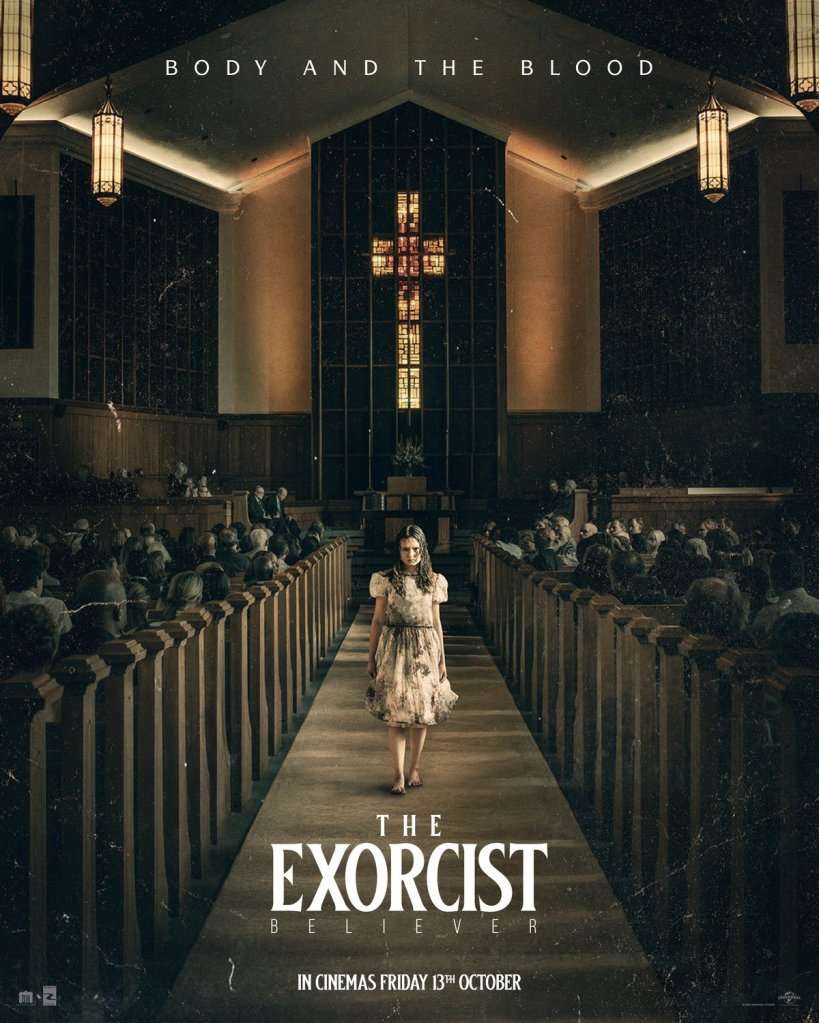
Should we be excited for The Exorcist: Believer?

The Exorcist: Believer

William Friedkin’s The Exorcist is considered by many as the scariest and most accomplished horror film in history. It essentially perfected the possession story while setting the blueprint for future forays into the subgenre.

Building a franchise around such a landmark film, though, proved remarkably difficult. Expectations shot up astronomically given the towering presence of the original. Other than the uneven but compelling Exorcist III (released in 1990 and directed by William Peter Blatty, the writer of the 1971 The Exorcist novel the first movie adapted), and the amazing but short-lived The Exorcist 2016 TV series developed by Jeremy Slater, every other attempt at expanding upon the signature horror of Friedkin’s classic has failed spectacularly.

The question now is, will David Gordon Greens’ new Exorcist movie, subtitled Believer, become a possession that’ll reignite audience fears of demonic activity, or will it be another botched exorcism that’ll fade into obscurity along with Exorcist II: The Heretic (1977) and the the prequel movie Exorcist: The Beginning (2004). Another version of the prequel exists called Dominion: Prequel to the Exorcist which was released in 2005 after The Beginning failed to ignite the box office or win over critics. Yes, Warner Brothers released two versions of the same movie, complete with two mostly different casts and two different directors (Renny Harlin worked on Beginning and Paul Schrader on Dominion).

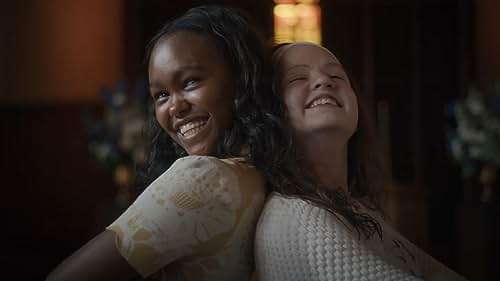
Believer is the first of a planned trilogy that seems to be taking more than a page from Gordon Green’s treatment of the Halloween franchise. The first trailer for the movie established a considerable alteration to the formula concocted before it by showcasing two possessed girls instead of one. This doubling down on the source of horror is an idea that also made its way into the latest Halloween trilogy, to an extent. In the third installment, Halloween Ends, a new character opens the door to the possibility other people can “become” Michael Meyers, thus changing the fabric of the original concept.

The first Believer trailer goes on to show the parents of the possessed girls in a desperate race to try and figure out what’s wrong with their kids. This lands them on the path of someone who’s been through this experience before and who’ll end up helping the parents navigate the possession: Chris MacNeil (Ellen Burstyn), the original survivor parent.

The Chris MacNeil character seems to be cut from the same cloth Laurie Strode was in Gordon Green’s Halloween, Strode being that franchise’s original final girl. She’s a survivor that looks like she’s either been waiting for or has been preemptively preparing for another bout with the same demon that possessed her daughter Regan. Trauma cloaks this character to justify a continuation of the story that ties in to the very first film. From there, we’ll have to see how much is sticks to the Halloween reboot formula and how much it deviates from it.

A few things worry me about this new chapter in the Exorcist franchise, apart from potentially being too similar to the latest Halloween trilogy in structure. First, we’ve gotten a lot of exorcism and demonic possession movies since the first Exorcist. Clichés, genre trappings, and expectations have had ample time to settle in and make themselves known. The first trailer, for instance, shows the possessed girls talking in that overdone multi-voice distortion effect that sounds more like an anonymous caller asking for ransom money than it does a demon.

One of the things that made the first movie’s possession so gut wrenchingly terrifying and memorable was the fact the demon had its own voice, which was masterfully crafted and performed by actress Mercedes McCambridge speaking over Linda Blair’s lines. It created a horror icon and it made things intimate and infinitely more disturbing.

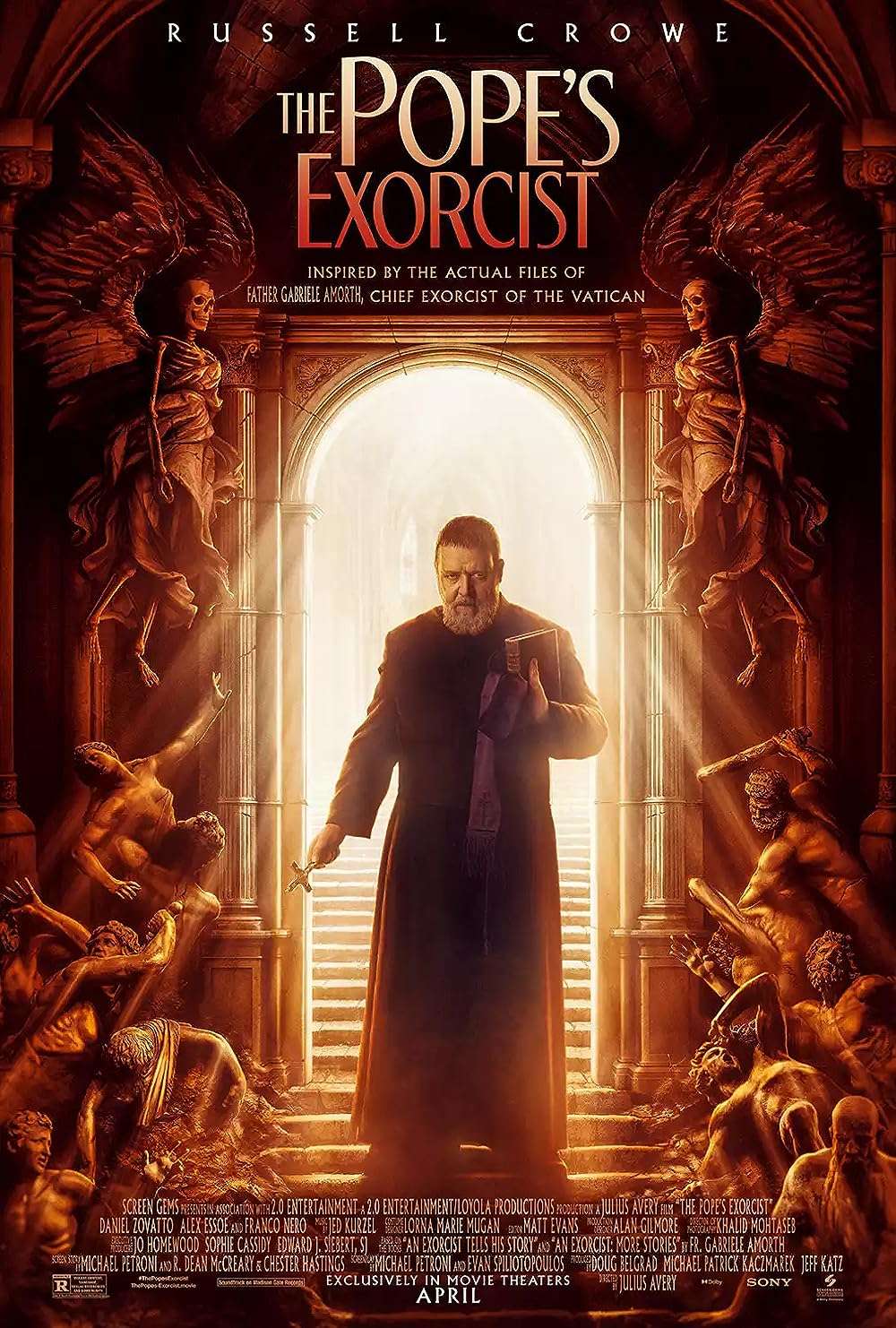
Thus far, the two possessed girls from the Believer trailers come off as more generic, the standard demon kids that spout the usual unholy jargon in the exact voices you’ve come to expect. Fans have gotten a good helping of this already this year alone with The Pope’s Exorcist, though that movie did largely stick to one voice actor for the main demon. In this case it was Ralph Ineson (The VVytch) who took on demon duties. Before The Pope’s Exorcist, though, we had an exorcism episode in FX’s American Horror Story: Asylum, a found footage take on it in The Last Exorcism, an Anthony Hopkins-led movie called The Rite, and the Scott Derickson film The Exorcism of Emily Rose (the better of the bunch).

When Friedkin’s Exorcist came out, no one had seen anything like it. That’s not the case anymore.

My second worry concerns the decision to turn the story into a trilogy. In a sense, The Exorcist already tried this, though not intentionally nor with an eye to create a larger narrative that extended to several movies to get the complete story. Regardless, the result was just not good.

John Boorman’s Exorcist II: The Heretic is considered one of the worst horror sequels in existence, to the point that Friedkin himself once said to have felt disgusted after watching it (a sentiment shared by Blatty, who called it a humiliating experience). It’s a direct sequel, catching up with Regan a few years after her exorcism to find the demon might not have been cast out entirely (diminishing Father Karras’ sacrifice at the end of the first movie).

The Exorcist III, while boasting some great scares and an underlying sense of unease that carries throughout, didn’t exactly stick the landing. It could’ve bene great, but its ending (of which there are different versions of) felt like it belonged to another movie. Its successes, though, are owed to the new mysteries it creates regarding good and evil and spirituality. It’s not a retread of the first movie. Rather, it’s an expansion that explores similar themes through different avenues and perspectives using the more fleshed out characters from Blatty’s novels.

Having this new set of movies already conceptualized as a trilogy might alleviate these problems, but Gordon Green’s previoustrilogy work with Halloween saw a good idea stretched to its limits in all the wrong ways. Michael Meyers became a blunt metaphor for Trump era divisions, characters were killed for shock value rather than carefully plotted story arcs, and the violence authored by The Shape became gratuitous to the point of losing touch with the narrative.

Halloween Kills and Halloween Ends betrayed the storytelling highs of the first one, killing the momentum early into part 2 and never really catching up again. Believer’s chances of hitting the targets it has in its sights become stronger if each movie justifies its existence without coming across as a cash grab that’s only just tangentially connected to push out another horror trilogy. To score a win, it needs avoid the things that ultimately held Halloween back.

So, should we be excited for Exorcist: Believer? Based on the trailers alone, no. There’s always a chance the odds get flipped and we get a great new take on the material. But whatever expectations we might have now should be taken with caution. Don’t get me wrong, I want to see a good trilogy come of this, especially since the triple-feature approach hasn’t gotten the chance it deserves in horror. Unfortunately, the journey to Believer carries a lot of baggage that can weigh it down considerably. More excitement could’ve been afforded to it had it not been an Exorcist movie but a whole new venture into possession horror, one that stands on its own demonic legs. Then again, anything has the capacity to surprise. Breaking the cycle and giving audiences something worth screaming at, or potentially fainting from, will be welcomed with open arms. The road to that, I fear, is looking quite bumpy.

The Exorcist: Believer opens October 6th, 2023 nationwide.

« Older Entries