Author Archives: Alex K Cossa

Those Two Geeks Episode 287: Returning to the JAM Sessions!

Joe, Alex and Matthew Klein hang out and talk about conventions, artwork, deadlines and the nature of ordering comics from a shop. Which isn’t what the were intending to talk about.

Matthew’s book Crashing is available now through IDW Publishing. His webcomic The Rhyme Scheme is available for free here. He can be found on Twitter @matthewklein316 and Instagram @macktheknife1116

You can reach Alex and Joe can be found on X respectively @karcossa and @FirstRonin4 if you feel the need to tell them they’re wrong individually, or by email at ItsThose2Geeks@gmail.com.

If you would like to learn more about Yom Kippur, you can do so here.

Music by AlexGrohl from Pixabay

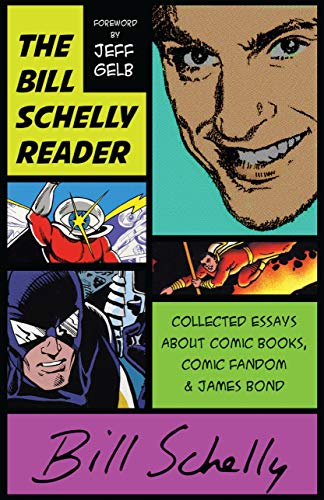
Underrated: The Bill Schelly Reader

This is a column that focuses on something or some things from the comic book sphere of influence that may not get the credit and recognition it deserves. Whether that’s a list of comic book movies, ongoing comics, or a set of stories featuring a certain character. The columns may take the form of a bullet-pointed list, or a slightly longer thinkpiece – there’s really no formula for this other than whether the things being covered are Underrated in some way. This week: The Bill Schelly Reader.


I’ve never been shy about my interest in comic book history, and it was when I was searching for some new books to scratch the itch, I came across The Bill Schelly Reader, a book by Bill Schelly that collects some of his finest prose work on the early history of comics and fandom.

Borrowing the text from the back of the book, because that’ll give you a better synopsis than anything I’ll write:

Bill Schelly has been writing about comics and fandom since 1965. In over 50 years one can do a lot of writing, and The Bill Schelly Reader includes some of the author’s best work on subjects ranging from the golden age of comic fandom to James Bond.

Schelly takes us back to the very beginnings of comic fandom with such articles as:

  • “Batmania”: a short history of the early 1960s fanzine (the first fanzine Bill Schelly ever read) credited for a resurgence of interest in Batman comics during a time of dwindling sales
  • “The First Comicons”: a retrospective on the first conventions organized by comics fans, from the Alley Tally Party to larger events in major cities like New York and Chicago
  • “It Started on Yancy Street”: an issue-by-issue look at the first fanzine devoted entirely to Marvel Comics, and why an unwelcome decision by Marvel led to its demise

In addition, book includes articles about the Silver Age Batman, Hawkman by Joe Kubert, the James Bond books by Ian Fleming, and an interview with the author. With dozens of vintage photos and images!

I’d never knowingly read one of Schelly’s essays before, though that’s mostly because I never got much of an opportunity to read Alter Ego where a lot of his essays were published. Over the course of The Bill Schelly Reader, Schelly dives into the early stages of comic fandom in the 1960’s, exploring the emergence of fanzines and the very first conventions. His essays are deep and incredibly interesting for those of us who want to learn more. A lot of the information that Schelly presents, while by no means the definitive history, paints enough of a picture so that you grasp what those days were like for fans. Remember this was long before any websites or even widely published magazine like Wizard, and so fanzines often had circulation numbers running at less than a thousand issues – and were put together by folks who also had other jobs (not unlike a lot of comics websites, but we don’t need to worry about publishing, printing and distribution of our content).

The essays run an average of ten pages or so each with a lot of additional images that add flavour to the text, and it’s amazing how much info Schelly crams into each one. There’s the odd moment where I found my interest waning, but for the most part the book held my attention from cover to cover (though I’d only read an essay or two a night).

If you’re at all curious about the early days of comic fandom, then I’d highly suggest you take a look at this book. Schelly’s literary work often goes out of print (well, as far as I know from my fifteen minutes of research, anyway), and then inevitably the prices spike. Grab this one if you’re at all interested.


Join us next week when we look at something else that is, for whatever reason, Underrated.

Underrated: MY CAPTAIN AMERICA: A GRANDDAUGHTER’S MEMOIR OF A LEGENDARY COMIC BOOK ARTIST EXPLORES THE WORLD OF JOE SIMON

This is a column that focuses on something or some things from the comic book sphere of influence that may not get the credit and recognition it deserves. Whether that’s a list of comic book movies, ongoing comics, or a set of stories featuring a certain character. The columns may take the form of a bullet pointed list, or a slightly longer thinkpiece – there’s really no formula for this other than whether the things being covered are Underrated in some way. This week: Captain America: A Granddaughter’s Memoir of a Legendary Comic Artist .


MY CAPTAIN AMERICA: A GRANDDAUGHTER'S MEMOIR OF A LEGENDARY COMIC BOOK ARTIST

In the 1990s, Megan Margulies’s Upper West Side neighborhood was filled with strife, and the small one-bedroom apartment she shared with her parents and two younger siblings was hardly a respite. Salvation arrived in the form of Megan’s spirited grandfather, whose midtown studio became a second home. His living room was dominated by the drawing table, notes, and doodles that marked him as Joe Simon the cartoonist. But for Megan, he was always Daddy Joe.

That was all it took for me to want to read My Captain America: A Granddaughter’s Memoir of a Legendary Comic Artist; it checked all the boxes of my interest – comic book history and the chance to learn more about a legend, Joe Simon. I’ll be honest in saying I can count on one hand the number of memoirs I’ve read (aside from graphic novel memoirs, I could probably use two fingers to count), because ultimately memoirs aren’t typically my thing. Megan Margulies book recounting her relationship with her grandfather, however, was a book that I thoroughly enjoyed.

Although Joe Simon, or Daddy Joe, features prominently in the book, My Captain America… is as much Margulies’ story as it is about Joe Simon.

We follow Marqulies story growing up in the upper west side of New York City in a one bedroom apartment, through the expansion of her family and her rebellious teenage years. Through it all, there’s Joe Simon He is the refuge in a tumultuous young life, the island of calm as the author’s life spirals through familial squabbles and the New York of the late 90’s.

This isn’t a historical record of everything Joe Simon did in his storied comic book career and Marqulies never presents it as such, only bringing up moments that are relevant to the events unfolding on the page. By doing this, she is able to give you an insight into who Joe Simon was, and the impact he had one those around him. Her tidbits also have the effect of being told from a very unique perspective; – and yes, there are certainly aspects of the comic legend that many will be learning about for the first time from this memoir.

You will read about the behind the scenes of Simon’s interviews, snippets of his reactions to events within comics, and even hear about his experience watching Captain America: The First Avenger.

For any fan of Captain America, this book is a must read.

Joe Simon passed away at 98 years old in December 2011. Even knowing that date is coming when reading this book, you can’t help but feel heartbroken when Marqulies peels back the layers of time. The grief we feel as readers is only a fraction of what his family felt, and I’m not ashamed to say that my eyes were more than misty reading those pages. Marqulies pulls on every heart string you have, and some you didn’t know about.

What I was expecting to be an exploration of a comic book legend from a perspective that we’ve never seen before quickly became an intimate look at the relationship between a grandfather and his granddaughter that it was an honor to share.


Purchase: BookshopAmazon (Hardcover)KindleAudiobook Audio CD


Join us next week where there will doubtless be another movie, series, comic or comic related thing discussed that is, for whatever reason, Underrated.

Those Two Geeks Episode 286: Terror, Cons, Tangents

Alex and Joe hang out and talk about TerrorCon, test some new (to them) technology and generally shoot the shit.

You can reach Alex and Joe can be found on X respectively @karcossa and @FirstRonin4 if you feel the need to tell them they’re wrong individually, or by email at ItsThose2Geeks@gmail.com.

Music by AlexGrohl from Pixabay

Underrated: Ultimate X-Men

This is a column that focuses on something or some things from the comic book sphere of influence that may not get the credit and recognition it deserves. Whether that’s a list of comic book movies, ongoing comics, or a set of stories featuring a certain character. The columns may take the form of a bullet pointed list, or a slightly longer thinkpiece – there’s really no formula for this other than whether the things being covered are Underrated in some way. This week:  Ultimate X-Men


Ultimate_X-Men_Vol_1_1.jpgUltimate X-Men was a series launched under Marvel’s Ultimate Marvel imprint that aimed to do away with 40 years of so called convoluted continuity into a more modern and updated setting. The second title to launch after Ultimate Spider-Man, Ultimate X-Men was written by Mark Millar and drawn by Adam and Andy Kubert. Millar was largely ignorant of the storied history of the X-Men, and reinvented the characters with the 2000 X-Men  film as his primary reference. Millar has admitted in an interview with Sequential Tart that he knew bugger all about the characters before Joe Queseda and Bill Jemas asked him to pitch for X-Men, expecting them to use the script as toilet paper. Instead, because Millar knew next to nothing about the franchise, they decided that he should be the one to reboot the X-Men for Marvel’s Ultimate line of comics.

Free from the shackles of the past Millar set about crafting a new, and more modern universe for the X-Men to inhabit aimed to bring a return to the mainstream appeal the franchise enjoyed years before.

Launching in 2001, Ultimate X-Men was also part of Marvel’s “dot-comics” format, which was an early translation of print to digital using a slightly animated Flash format. Comic pages would appear on the screen showing a handful of panels at a time, and speech and thought bubbles hovering over the characters. The format would eventually pave the way toward Marvel Unlimited. Although not the first comic on the dot-comics format, it was one of the first that I read that way. Because the dot-comics were free to whomever had an internet connection and the patience to read the comics in their episodic form (if memory serves, five or so pages were uploaded every few days), they were a great way for people like myself to get introduced to a series that I otherwise would not have before.

Ultimate_X-Men_Vol_1 interior.jpg

Although I had previously dabbled in the X-Universe before, I was never a constant reader. Ultimate X-Men drew me into reading an ongoing series featuring Marvel’s merry mutants for the first time. The characters were familiar and yet felt fresh, the situations they were in reflected more of the world around them than the main Marvel universe characters did. Or at least that’s how it felt at the  time. It was here, with a newly discovered love of the characters that I truly became an X-Men fan and not just a Wolverine fan. At the time the irony that the series was being written by a man who knew bugger all about the characters was something I was unaware of, but the benefit of hindsight brings into sharp focus that provided one is a competent writer and has some understanding of the subject, then the essence of characters one is writing about shine through. And Millar, for the most part, had that understanding.

Running from 2001 until 2009 where it was cancelled at the conclusion of the critical and commercial failure of the Ultimatum crossover, Ultimate X-Men enjoyed nearly a decade as the fan favourite X-title. Although it was eventually relaunched as Ultimate Comics X-Men in 2011, the series never enjoyed the success of its pre-Ultimatum days.

Would Ultimate X-Men have worked had it been released today? Although we’ll probably never know, you can look at DC’s New 52 and to a lesser extent the successor to the Ultimate line (Ultimate Comics) to get an idea – although there are obvious faults with either comparison. The New 52 replaced DC’s continuity in its entirety, to much chatter from fans, and the Ultimate Comcs line tried to pick up after the failure of Ultimatum which had driven many fans away already. However you look at it, for nearly ten years Ultimate X-Men, and some of its companions under Marvel’s Ultimate line, were among the pinnacle of superhero comics. The reimagining of the characters, stripping them down to their core and putting them in a different world was a brave choice, but one that I, and thousands like me, fell in love with.

I grew up reading Ultimate X-Men, both as a comics fan and a human, and it hurts me a little to see people ignore it as an unimportant part of Marvel’s past because it’s not chronologically relevant in the X-Men’s story. It’s not, not really, but that doesn’t mean the stories told under the Ultimate X-Men banner remain among some of my most cherished to this day. If, for whatever reason, you haven’t read them then you can find the collected editions easily enough at your favourite online retailer (or, maybe your LCS can get them in for you).

That’s all we have for this week, folks. Come back next time  when there’s something else Underrated to talk about.


Those Two Geeks Episode 285: Batman And Friends Day!

Alex and Joe hang out and talk about Batman Day and constantly wander off topic (what’s new?).

You can reach Alex and Joe can be found on X respectively @karcossa and @FirstRonin4 if you feel the need to tell them they’re wrong individually, or by email at ItsThose2Geeks@gmail.com.

Music by AlexGrohl from Pixabay

Underrated: Superman/Batman: World’s Finest

This is a column that focuses on something or some things from the comic book sphere of influence that may not get the credit and recognition it deserves. Whether that’s a list of comic book movies, ongoing comics, or a set of stories featuring a certain character. The columns may take the form of a bullet pointed list, or a slightly longer thinkpiece – there’s really no formula for this other than whether the things being covered are Underrated in some way. This week:  Superman/Batman: World’s Finest


Fifteen years ago, I picked up this book when I had first moved to Canada and I was looking for something to read that wasn’t Marvel related. Volume one of a series seemed like a good enough place to start, and despite knowing very little about DC’s comics at the time I was more than aware who Batman and Superman was in the general sense from the movies and TV shows that had been released at the time.

The story was also adapted for DVD in 2009 or so under the title Superman/Batman: Public Enemies. Because I’m not talking about the adaption today, I’m referring to the story under the comic book title.

No, today I wanted to revisit a story I hadn’t read in years because my wife picked me up a Batman blind box recently, and this was one of the books within the box. I’d forgotten how much I enjoyed reading it until I flicked through the softcover collection again.

Collecting the first six issues of the series, Superman/Batman: World’s Finest was released in April 2004, and was written by Jeph Loeb with art by Ed McGuinness and colours by Dexter Vines. The story features a then President Lex Luthor, the framing of the man of steel for Metallo’s murder and a fantastic twin narrative device that allows Loeb to use the internal monologues of both Batman and Superman to great effect. It is often the source of my laughter when reading the book, as both men have some diametrically opposed viewpoints on things, and their thoughts in the moment are almost mirrored.

It’s honestly worth reading for that alone.

The story itself is largely free of any major continuity trappings from other series, by which I mean at the time I was able to go into this entirely blind about the state of the DC universe in 2004/2005 and still thoroughly enjoy the story. And my introduction to a cast of new characters like Captain Atom, Black Adam, Major Force and others I had never heard of before.

Although there have been a lot of really good Batman/Superman stories since this came out, the writing of Loeb and the way he has the two leads play off each other makes this collection stand out. If you’re not that keen on reading yet more stories featuring two of DC most popular heroes, then that’s fine. But you’ll be missing out on one of the coolest and most underrated aspects of this collection – I’ve said it before, and I’ll say it happily again – the dueling monologues of Superman and Batman highlight Loeb’s understanding of the two characters and their relationship.

The only downside is that as my introduction to DC comics, this remains one of the finest examples of that relationship I’ve read to this day.

You can find this collection at your local comic shop; it’s still in print so shouldn’t be too hard to find if you’re looking for it. I highly recommend checking it out when you get a chance.


Join us next week when we look at something else that is, for whatever reason, Underrated.

Those Two Geeks Episode 284: Marvellously, Legendarily, Tangentially!

Alex and Joe hang out and talk about Marvel Legends. And, almost, only Marvel Legends.

You can reach Alex and Joe can be found on Twitter respectively @karcossa and @FirstRonin4 if you feel the need to tell them they’re wrong individually, or by email at ItsThose2Geeks@gmail.com.

Music by AlexGrohl from Pixabay

Underrated: The Highest House

This is a column that focuses on something or some things from the comic book sphere of influence that may not get the credit and recognition it deserves. Whether that’s a list of comic book movies, ongoing comics, or a set of stories featuring a certain character. The columns may take the form of a bullet pointed list, or a slightly longer thinkpiece – there’s really no formula for this other than whether the things being covered are Underrated in some way. This week:  The Highest House


I had picked this book up prior to going on vacation to read on the plane at the suggestion of my LCS, but never actually got around to reading the book while I was away. Thankfully, I found I had the time this week and decided to sit down and start reading the book in between devouring Andrej Sapkowski’s The Witcher novels. 

I don’t say this lightly, but The Highest House is one of those books you give to people who don’t like comics, or don’t read comics, to show them what the medium can do. Its impact isn’t only felt in the story, but rather that you don’t need to be aware of decades of tropes and nuances to get the most from the book. This is just a really moving and powerful story about change and overcoming the shit life throws at you in order to rise above and become the best version of yourself.

Written by Mike Carey and illustrated by Peter Gross, the trade paperback set me back $30 Canadian, and is worth each and every penny that I paid for it. Without revealing too much about the story, this won’t be the longest column, but I want you to go in blind – just like I did. 

Because this book is worth it.

I usually end this column with a recommendation to check out the book or series or movie in question, but I genuinely can’t recommend this graphic novel to you highly enough If you don’t grab this with both hands when you see then you’ll miss an Underrated gem.


Join us next week when we look at something else that is, for whatever reason, Underrated.

Those Two Geeks Episode 283: Toys! Toys! Toys!

Alex and Joe hang out and talk about…. well, honestly whatever toy based things come to mind.

You can reach Alex and Joe can be found on Twitter respectively @karcossa and @FirstRonin4 if you feel the need to tell them they’re wrong individually, or by email at ItsThose2Geeks@gmail.com.

Music by AlexGrohl from Pixabay

« Older Entries Recent Entries »