
Early Review: POS
 Swiss comic book publisher and writer Pierre Paquet and artist Jesus Alonso deliver Paquet’s second graphic memoir POS (An abbreviation for “Piece of Shit”) about his early days as a publisher, his friendships, relationships, hangovers, party fouls, and most of all, his relationship with his dog, Sonny. This bond between Pierre and his mixed breed runt of the litter man’s best friend is the emotional anchor point for Paquet’s episodic autobiographical narrative. But memories in real life are non-linear and fragmented, and Alonso’s quick and nasty pen strokes “fill in the gaps”. Paquet leans on his talents to tell a range of stories from a court room drama about Pierre suing one of his artists JD, who took out advances and didn’t finish his comics to a silly anecdote about Pierre and a friend going on their first online date with a tall German girl, whose height is shown by Alonso’s use of three gutters for her body.
The scenes in POS that Pierre spends with Sonny definitely left the biggest mark on me, and the story adds a layer of gravitas and feeling when the pooch is introduced as a problem dog that has had five foster families and is afraid of everyone. I think that Pierre (and Paquet by extension) saw a lot of himself in Sonny, and some of Paquet’s narration towards the end of the graphic novel and the use of a ghostly dog as a kind of framing narrative seem to confirm this. Throughout the comic, Pierre has romances and sexual relationships with different women and despite all the drama and legal stuff, finds success as a publisher, but Sonny is always on his mind. For example, there’s a scene where he’s sitting with Anna, a woman that he probably loves, and she asks what he’s thinking about, and Sonny pops up in his word bubble. Pierre is afraid to be vulnerable and real around her, taking an out of the way flight to see her in Zurich, Switzerland, and making no effort to get back with her. But, then, he starts crying around his new intern when Sonny has one of his many illnesses that always add a spike of drama to the narrative.
However, Paquet and Alonso pepper parts of the narrative of POS with well-realized relationships. In the early going, Pierre’s best friend is David, who I initially thought was going to be the butt of fat jokes and the physical comic relief by Alonso’s art style, but he ends up being a total hedonist. David got a big inheritance from his dead father and spends it on fancy wines, weekend trips to Florence, escorts, strip clubs, and basically being the lead of the Swiss version of Entourage. But, there is a tragic side to David’s pursuit of pleasure, and he ends up passing away early in the book leading to the second or third saddest page in the comic where Pierre thinks about his own father’s passing when he was 11 (The subject of his previous graphic memoir A Glance Backward.). He realizes that the fact that both he and David were fatherless sons helped get them through some tough times even though most of their “good times” ended up with Jesus Alonso doing cinematic dissolves of Pierre’s post-hangover Alka-Seltzer turning into strippers.
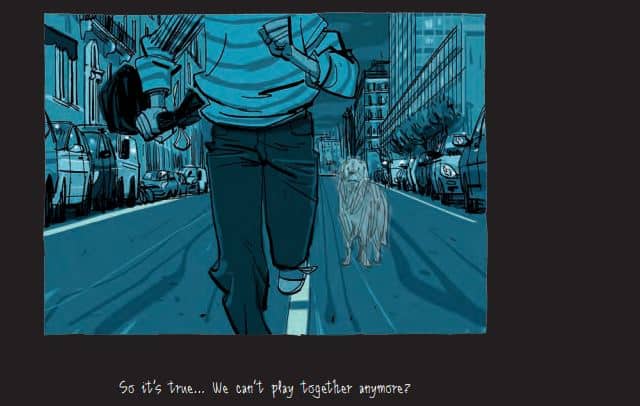
Possibly because Paquet himself is a publisher as a well as a comic book writer, POS is sympathetic and realistic about the plight of a comic book publisher and has many scenes showing that Pierre is very serious about his job and about the comics medium. One of the first pages has him putting his phone away and reading a comic on a tablet for a second before running out with his dying dog’s leash and collar to throw in the water, and he takes a Greyhound bus from New York to Woodstock to meet one of his artist idols, a reclusive, cross dressing cartoonist, who lives in a trailer deep in the woods. Alonso uses thick lines to show the stress that Pierre has trying to get his publishing company off the ground and goes a little stir-crazy when Pierre is in legal conflict with one of his artists, who was ripping him off. This sequence shows that sometimes artists, not companies, are the unscrupulous ones and has some character growth for Pierre, who with the help of an old friend, endures through the trial and is vindicated even though some comics creators won’t work for him. And the margins of POS are filled with the trials of comic conventions, like the famous Angouleme Festival, including after-con drinking, weird sleeping arrangements, and of course, the all encompassing con crud, which allows Alonso to explore the more grotesque side of his color palette.
Pierre Paquet and Jesus Alonso have a gift for finding the funny, tragic, and just plain relatable in the life of comics publisher Pierre over the years in POS. They hold their protagonist responsible for his inability to form meaningful relationships outside while still making him likable and vulnerable and take their time digging into Pierre’s feelings via flashbacks, cartooning tricks, or well-placed caption box instead of moving him from dramatic to humorous situation. POS is naturally paced and has too many feelings for own (It’s the damn dog, guys.), and I really hope that Lion Forge continues to publish artistically brilliant and emotionally authentic graphic memoirs and bande desinee like it.
Story: Pierre Paquet Art: Jesus Alonso Translation: Jeremy Maloul
Story: 9.0 Art: 9.5 Overall: 9.3 Recommendation: Buy
Lion Forge provided Graphic Policy with a FREE copy for review
Discover more from Graphic Policy
Subscribe to get the latest posts sent to your email.
