
Interview: We chat Undertow with Steve Orlando & See the Variant Cover for issue #2
 If you want to break free of the system, Redum Anshargal can offer you a place at his side. With Atlantis now a world superpower, Anshargal and his hostage-protege Ukinnu Alal hunt the Amphibian, a legendary creature that may be the key to an air-breathing life on land. In Undertow #1, writer Steve Orlando and artist Artyom Trakhanov bring pulp monster adventure to comics and debut a new take on Atlantis in this new series.
In Undertow, Atlantis is a world superpower and breathing air is something of a rare phenomena.
Debuting February 19 from Image Comics, Undertow is an interesting and entertaining debut that mixes sci-fi, action, politics and social commentary. Writer Steve Orlando took the time to chat with us about the series.
Today is the final order cut-off for the series, so if the below sounds exciting, and believe me it is, make sure to bump your orders because I’m expecting another Image sell-out!
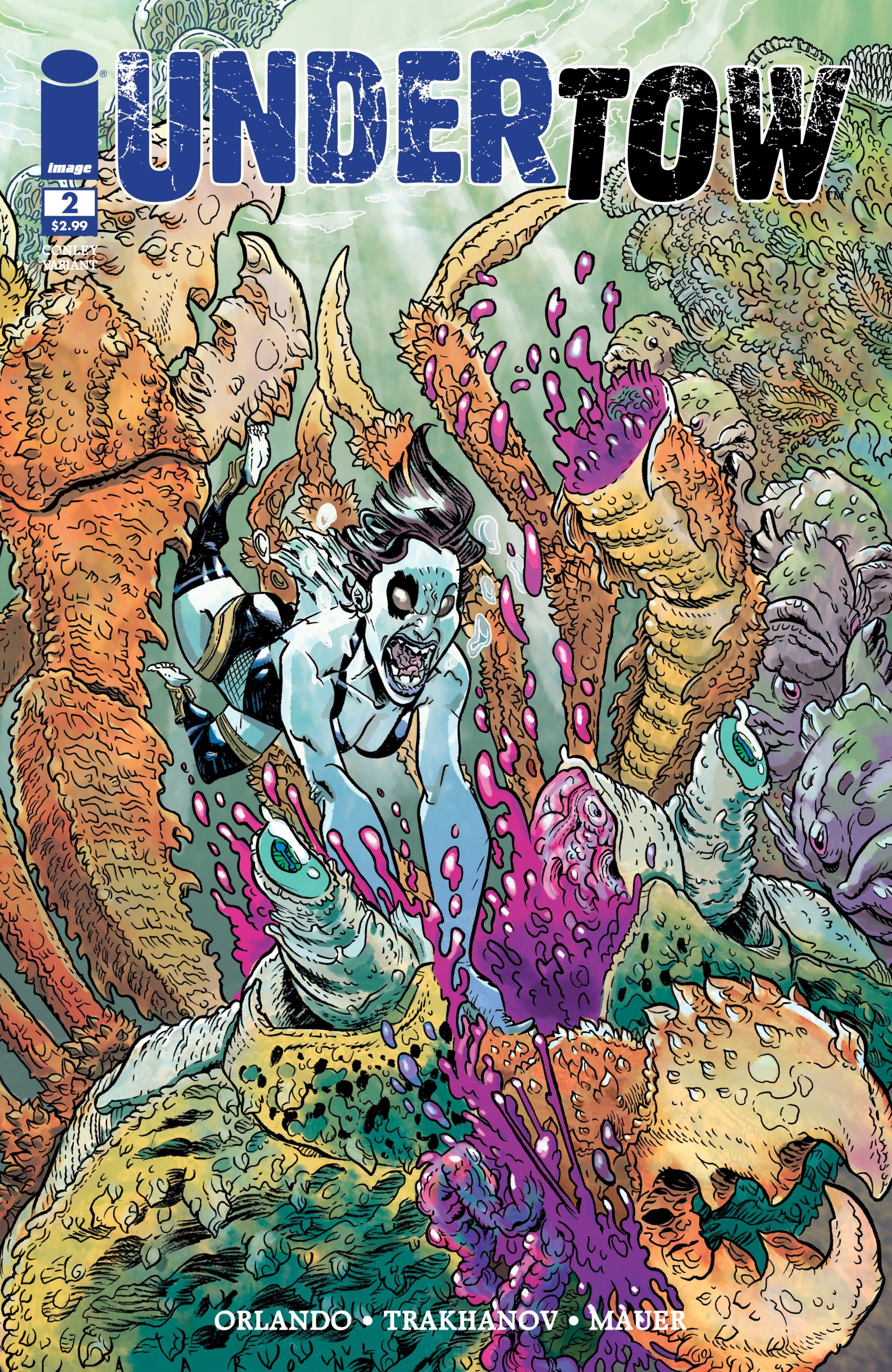
And after the interview you can check out the newly revealed variant cover for issue 2 by Aaron Conley.
Graphic Policy: Where did the idea of Undertow come from?
Steve Orlando: Claymation skeletons! Undertow came out of my love of old-school adventure, Jason and the Argonauts, The 7th Voyage of Sinbad, hell, Clash of the Titans. I’ve never gotten over my love of heroes fighting monsters. And Atlantis is full of monsters. The book started out as a police procedural set in a metropolitan version of Atlantis, but soon it became so much more. I revisited 20,000 Leagues Under the Sea, and saw a lot of the same things in Nemo that today’s freedom fighters and political refugees have. He’s a man betrayed by his nation, maybe even himself and his past. And he’s escaping it by exploring. So all I had to do to get to my monsters was apply that to today, when Atlantis is the world power, the consumerized, the corrupt, the self focused, and humans are savage, knuckle dragging savages that people study for sport. We turn the actual world on its head! The places the readers are sitting when they read the book are barren, unexplored wastelands. The surface is the final frontier, and to escape what lies beneath the waves, Undertow’s leads have to survive it. Its the perfect chance to talk about today, talk about people, and do with with huge monsters and a healthy amount of punching.
GP: There’s many things that stood out about the book, but Atlantis’ grasp of technology versus humans is one of the bigger ones. Why set the comic up the way you did as opposed to creating a completely unfamiliar world?
SO: Is it really so unfamiliar? Hopefully the switch in who’s tech and who’s not will give us a chance to show up what really makes us people. This is a world where nothing looks like we expect. The people are different, and because they use water in their lungs, they have to do different things to accomplish the same results, the same lifestyle. Their entire history is different- they have characters riding seahorses and talking to giant squids as their version of pre-history. But once you look past that, they’ve got the same needs we do. The passions, the lusts that drive them, they’re the same as us. And that’s the interesting question- what makes us who we are? Maybe it’s more than skin and lungs; maybe it’s what we do. So these guys looks different, but it’s unsettling how human they act. And the ones that look like us? They’re not human at all. They’re eating each other.
GP: There’s also a lot of talk about class and what feels like a caste system in the comic. Where did that come from and does that play out more in the comic?
SO: The playout IS the comic! If there’s a caste system, it’s self inflicted, and unspoken. Just like today, we don’t have castes per se. But they just announced that 85 people have the same wealth as the entire poorest half of the world. Just 85 people. The class system in Undertow is the product of greed and media manipulation, the extreme, exaggerated focus on self interest and the cult of the individual. Atlantean citizens are out for themselves and its okay if bad things happen as long as they don’t know about it. This meat grinder of a social system is what churns out the people who decide to leave Atlantis and live with Redum Anshargal on his enormous Society Barge, the Deliverer. There they live outside the system, free, as they pioneer the surface world. But it’s just as dangerous, only the dangers come with talons and teeth instead of bank accounts. But some people on the Deliverer are angrier than others, and it’s only a matter of time until someone is going to want to take that anger back to the city and the nation that created it.
GP: There are also subtle comments about consumerism and the monotony and how planned out and repetitive life can be. Did you go into this thinking of it as commentary about modern society?
SO: Certainly it’s a commentary, but in the tradition of 1984 it’s more of a warning. What happens if we go further in the direction we’re looking now? What if we get lazier and the inertia gets greater? More and more we’re letting algorithms make our decisions for us, all in the name of convenience. But what if that gets hijacked by business interests? They just published an article about using an algorithm to write the perfect blockbuster novel, instead of a person. And we’re okay with that because we believe the directions we’re getting and the answers given to us are impartial. But what if we get too comfortable and complacent? People joke about how international tragedies only matter once a dictator is killing someone other than his own people (Eddie Izzard says so), and what if we were so focused on ourselves that that attitude extended to anyone but our own families. The people of Atlantis have let their guard down in the name of convenience, and with a few similar decisions, we could maybe be there too.
GP: When creating a new comic and world, how much thought goes into the details like how a society might function or things like their class system?
SO: A lot! I’ve been thinking about Undertow for about four years at this point. And I’ve been asking myself every question possible about how a modern, technological life would work, how it would be achieved in an underwater setting. And once Artyom came on board he pushed me even further. There is nothing I can’t show how Atlanteans do now, whether its sacred or profane. Ask me at a convention! You will find out how they go to the bathroom! You will find out how they use their new organs to float or sink when they want to! I am always considering new answers to “how” and “why?” We see that even things like electricity, mundane to us, are weapons of mass destruction. And bioluminescence, something we never needed, is the backbone of lighting technology in a nation so far underwater that light barely ever penetrates.
GP: Did you intend for Undertow to be a commentary about modern society? Or are these types of things just sprinkled in to make a richer world?
SO: Well I think those things are in many ways one in the same. You want a story to have texture and depth, and the more you work to make a world seem layered and real, the more you have to build in ways to connect to the reader. We see mirrors of our own society in Undertow, and those are the connection points that you can hang the crazier Science Fiction ideas on to enrich the narrative. We get hints of modern society that gateway us into the crazy points, the wild gravity energies and the sea locusts with claws that move so fast they boil water.
GP: You’re also the creator behind Virgil which tackles LGBTQ issues. Do you enjoy infusing political commentary or messages with telling an entertaining story?
SO: I think when you’re creating a story, you can use a tried and true genre as a vehicle to talk about important ideas, AND make them more relatable. In Virgil we’re using the Die-Hard like action of saving your loved one to cast a new light on LGBT relationships. With Undertow we use monster hunting and pulp sci-fi to talk a bit about one-party systems and self-centrism. But in both, as it should be, the action and the story come first.
GP: I think comics have a long history of being political in nature; some of the very first ones were commentary on class for example. What is it about the medium that opens itself up for being used in that way?
SO: I think it’s their populist roots. Pop culture is often where the risky messages break. And back when comics started they were mass consumption items (they still are in Japan). The visual aspects make it easier for the readers to dig in to the emotional side of the argument, but what it really comes down to is the readership and the love of pushing boundaries. Early comics readers were on the street, and they had problems, they wanted books they could relate to. Today as the indie market grows, the so called “comics lit” crowd is hungry for pushing social boundaries, and comics are here to deliver. And its not like this is a new idea. Science Fiction has always been there to push boundaries. Don’t forget! Star Trek featured the first interracial kiss on Television, over 50 years ago.
GP: Artist Artyom Trakhanov’s work is fantastic with what looks like fully realized machines and a thought out look to everything. How involved were you in that and really how much detail is put into how all of the devices work?
SO: Artyom is a mad genius generating pure awesome from the heart of Siberia! What I’m saying it, Artyom has had a huge amount to do with the look of the technology in our book. We both love weird, old sci-fi, like Apergy, an energy created in the sci-fi novels of the 1880s. After two years, he has such an amazing sense for the book, and for what I’m going for in a script. I only drop the seed, and then he lets it grow into something unique and cool. And we definitely know how all the machines work, as a byproduct of the inside-out understanding of Atlantis that we decided from the get-go would be key to making the world complete. He decided to turn the Deliverer into almost a metal organism, with rooms like huge cavernous organs. And he created the pop-out, glowing design of the Apergy tech, the vacuum science rooms that run the ship’s power dynamos. Each person in Undertow has a unique story and face, even if they’re in the background. Artyom and I have a name for each one.
GP: What can we expect from you next?
SO: We’re focusing on getting the book out on schedule and awesome! There is of course more brewing in the future, not the least of which is Virgil, which you mentioned. We’re in production on that, doing an exclusive hardcover edition for backers, and trying to jam pack as much 1970s grindhouse infused revenge action into each page as we can. Keep a lookout at www.thesteveorlando.com for updates, or follow me @thesteveorlando, where you’ll also see some previews of projects I can’t announce yet sneak out from time to time.
Check out the variant cover for issue 2 by Aaron Conley below.
Discover more from Graphic Policy
Subscribe to get the latest posts sent to your email.
