Category Archives: Underrated

Underrated: Batman Vs Superman: Dawn Of Justice Ultimate Edition

With the Snyder Cut of Justice League having just been released, I felt it was an ideal time to rerun this older post. This has nothing to do with me not preparing a column in advance. Nope. Not at all.


This is a column that focuses on something or some things from the comic book sphere of influence that may not get the credit and recognition it deserves. Whether that’s a list of comic book movies, ongoing comics, or a set of stories featuring a certain character. The columns may take the form of a bullet pointed list, or a slightly longer thinkpiece – there’s really no formula for this other than whether the things being covered are Underrated in some way. This week: Batman Vs Superman: Dawn Of Justice Ultimate Edition.


Let’s not beat around the bush here: the theatrical cut of Batman Vs Superman: Dawn Of Justice wasn’t the greatest superhero movie of last year and while it wasn’t the worst comic book movie of the year, it was perhaps one of the most disappointing – for me at least. I had expected so much from the movie, because it was fucking Batman and Superman on the big screen together. And… well we got an average movie. There were parts that were great (Ben Affleck and Gal Gadot), and parts that were pretty good (Henry Cavil), and… some less than savoury parts. I left the theatre feeling quite unsure of how I felt; did the good outweigh the bad, or did it balance it out? What didn’t click for me? Could the movie had been better?

Shortly after seeing the movie I found out that there would be an R rated extended cut of the film released for home media, and I wondered whether that would do anything to set the film right.

As it turns out, it did.

Almost every problem I had with the pacing, plot and direction of the movie was made better by the extended cut. I still wasn’t happy that the entire movie had effectively been told in short form in the trailers, but there wasn’t much I could do about that other than not watching the trailer in the first palace. Since that wasn’t an option…

Look, I get that Warner Brothers probably had concerns about audiences sitting for an extended period of time… I mean the near two and a half hour run time of the theatrical cut was the longest movie in recent memory, and understandably Warner’s were concerned about audiences attention spans. It’s not like we’d ever sit patiently during Lord Of The Rings, or binge watch five hours of Daredevil in one sitting. That’s just not who we are. And to think we’d rather have  a great long movie longer than a slightly shorter average one would never cross their minds. 

It’s okay, though.

Whether it’s thanks to the success of Deadpool, or the critical slamming early on, or both, the Extended cut of the movie is a much better story in every way. The plot holes that resulted from the opening sequence are fixed because of the additional footage showing the soldiers using flame throwers to incinerate bodies to mimic Superman’s heat vision, if you wrote the movie off based on the theatrical cut then you’re missing one of the better superhero movies of last year.

Yeah, I said it.

The Extended edition is a better move than Civil War is, but because the real version of the film was never released in theaters, the movie as a whole got quite an unfair reputation – albeit fairly earned based on the expectations people had for this supposed juggernaut of a film, and what was initially delivered. If you’ve only seen the theatrical cut of the movie, then give the Extended edition a shot. The additional scenes add significantly to the overall experience, delivering a much better experience than anything you’d have expected from the theatrical experience.
Underrated: Wolverine: Not Dead Yet

This is a column that focuses on something or some things from the comic book sphere of influence that may not get the credit and recognition it deserves. Whether that’s a list of comic book movies, ongoing comics, or a set of stories featuring a certain character. The columns may take the form of a bullet pointed list, or a slightly longer thinkpiece – there’s really no formula for this other than whether the things being covered are Underrated in some way. This week: Wolverine: Not Dead Yet


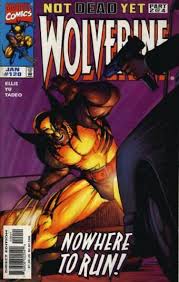
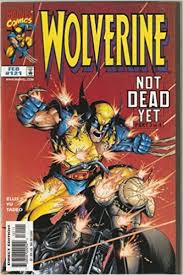
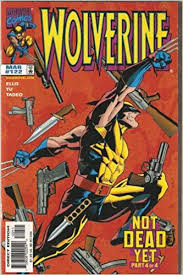
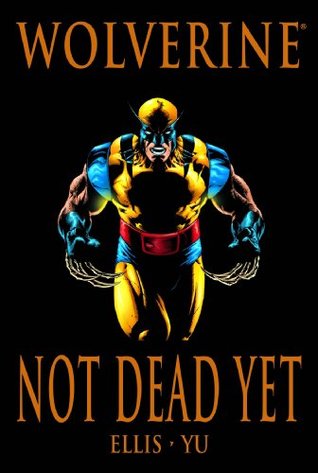
With a new Wolverine series have started last month, I wanted to take a look back at one of the very first Wolverine story arcs I read that wasn’t reprinted from older comics. I didn’t know it at the time, but Not Dead Yet was written by Warren Ellis and drawn by Lenil Francis Yu. When I first read this story, I wasn’t as concerned with knowing who had written it because I didn’t follow creators at the time, only the characters. Only Wolverine and the X-Men.

Originally published in Wolverine v. 2 #119-122 back in the late 90’s, the story was both my first introduction to American comic books and how they were laid out with the advertisements, the page sizes, the recap pages and the preview page with Stan’s Bulletin Box. It really was a transformative experience in how I experienced my comic books at the time as I went from the UK reprint magazines to the real thing. They were unlike anything I could get my hands on at the time; the reprint mags contained three issues, were slightly smaller, and had only minimal personality to them that wasn’t in the original comics. The other comics I was reading at the time were all weekly anthology magazines too – there wasn’t a dedicated 30 odd pages to a single comic and all the little extras that go with it. Looking back on those single issues now, I feel that we’ve lost something along the way as technology has progressed and the need for previews in comics has decreased – but that could just be the nostalgia talking.

This is quite possibly one of my favourite Wolverine stories that I’ve ever read. It’s certainly the one I will always point readers to if given half a chance. The story takes place during the time Wolverine had no adamantium in his body, it is told both in the present and the past by use of flashbacks that serves to emphasize the relationship between the ol’ Canuckle head and a Scottish assassin called McLeish who eventually sets his sights on our favourite mutant. Wolverine is being hunted by one of the best, a man who has planned for years to be able to take down the nearly unkillable Canadian mutant with adamantium bones, but what he doesn’t know is that Wolverine’s bones are no longer coated with the metal, and Logan is suddenly much more vulnerable than he used to be.  I keep coming back to this story every few years, and I have mentioned it several times on my blog, too.  It’s available in trade paperback format, and I highly suggest you pick it up.

I mentioned earlier how I didn’t realize who the creative team was when I read this story more than twenty years ago. In all honestly, it was for another 40 issues of Wolverine when Frank Tieri and Sean Chen started writing the book. So it was years later that I finally realized that Warren Ellis wrote the book, and I remember being somewhat surprised. I’d read and enjoyed a lot of his stuff over the years, but never realised that one of my favourite stories was penned by him.

Wolverine: Not Dead Yet has a timelessness to it that’s only betrayed by the amount of payphones and the style of cars and the odd fashion choice if you’ve a keen eye for those things. This is a tale that focuses less on Wolverine being a superhero and instead takes him back to the shadowy underworld of his past in a much more grounded setting. There’s no spandex in sight, and consequently the story has more of an immediacy to it. This was a time when Wolverine would frequently get his fightin’ togs on when he had a chance, and in Not Dead Yet he doesn’t have that chance.

When it comes to classic Wolverine stories, Not Dead Yet is seldom counted on the list, and one could ask if I would hold it in such high esteem had I not read it at such a formative time in my life. The answer is an easy yes; I read a lot of stories around that time, but none have stayed with me the same way Not Dead Yet has. The story still holds up to this day, and is honestly one of the most common places I’ll start with when going through the back issues of Wolverine in my comic boxes. That‘s why I wanted to focus on this as an Underrated gem this week.


That’s all we have for this week, folks. Come back next time  when there’s something else Underrated to talk about.

Underrated: Scarlet Spider (2012)

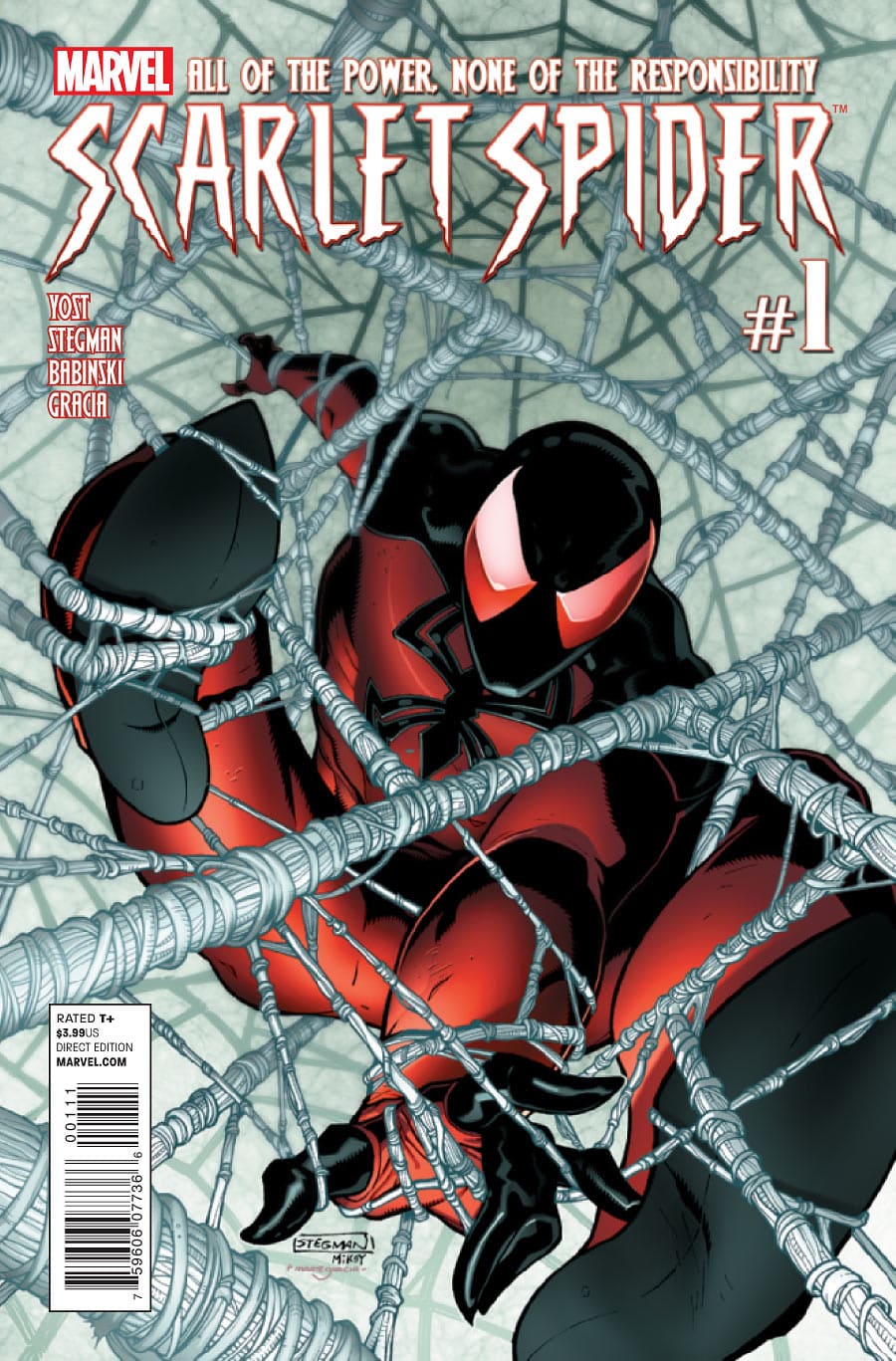
Scarlet Spider has always been one of my favourite Spier-Man sub characters, and even more so when his former enemy (and clone) Kaine took up the mantle. However unwillingly. I recently reread the series, and so, as you can see, wanted to revisit an old column.

The series more than holds up.


This is a column that focuses on something or some things from the comic book sphere of influence that may not get the credit and recognition it deserves. Whether that’s a list of comic book movies, ongoing comics, or a set of stories featuring a certain character. The columns may take the form of a bullet pointed list, or a slightly longer thinkpiece – there’s really no formula for this other than whether the things being covered are Underrated in some way. This week: The 2012 Scarlet Spider run.


Scarlet_Spider_Vol_2_1

I have always enjoyed stories about villains becoming heroes, struggling to atone for or come to terms with their actions; I’m a sucker for a good redemption story, I’ll admit. There’s something about somebody striving to earn forgiveness when surrounded by people who don’t believe in them I’ve always enjoyed.

With 2012’s Scarlet Spider we get almost the exact opposite of that. A man who just wants to disappear surrounded by those who inexplicably believe in him.

I originally added this to my pull list with its first issue way back in 2012, I had assumed that the Scarlet Spider in question was Ben Reilly in a new costume, and not Kaine. I’m sure had I been reading the Spider-Man comics at the time I’d have known better, but I figured this was a good place to jump on board – and I wasn’t wrong in that sense, but I was wrong about who was wearing the costume. So I settled in to enjoy a story about Spider-Man’s clone, and as I hoped I ended up loving the series.

But not for the reasons I expected. Instead of a heroic story featuring Ben Reilly, Scarlet Spider delivered something I wasn’t expecting – and ended up loving more than I thought I would given my initial expectations of who I was going to be reading about.

The story starts with Kaine trying to get to Mexico, having recently been cured of the cellular degeneration he was suffering as a clone (it’s a whole thing that’s explained in multiple stories and other resources), he’s seeking a chance to finally live his life free of the constant agony he used to suffer. But, as with any good story featuring a Spider, things inevitably get in the way of that and Kaine gets stuck in Houston, quickly becoming the city’s own resident super hero. The series was written by Chistopher Yost, who was joined by a variety of hugely talented pencillers, inkers and colourists throughout the series 25 issue run (there were also  couple of specials and tie-in issues that bulk up the issue count if you want the whole story).

The full run remains one of my favourite Spider stories, in part because of the redemptive nature, but also because it’s just really good. But like all series that features a lesser known character it was cancelled because of low sales – though Kaine still pops up as the Scarlet Spider from time to time, and I will always try to grab those issues as and when I can. Scarlet Spider is a brilliant alternate to Spider-Man as we see a hero with, as the tag line so eloquently puts it, “all of the power, and none of the responsibility.” But Kaine is still a Parker, and as he begrudgingly accepts the responsibility of being the Scarlet Spider, we get to see a villain slowly change into (well, almost) a hero. However reluctantly.

This is a fantastic run, easily one of my favourite parts of my collection, but it’s one I don’t see getting the love it deserves – that’s why the book is Underrated.


Join us next week when we look at something else that is, for whatever reason, Underrated.

Underrated: Eternal Warrior: Sword of the Wild

This is a column that focuses on something or some things from the comic book sphere of influence that may not get the credit and recognition it deserves. Whether that’s a list of comic book movies, ongoing comics, or a set of stories featuring a certain character. The columns may take the form of a bullet pointed list, or a slightly longer thinkpiece – there’s really no formula for this other than whether the things being covered are Underrated in some way. This week: Eternal Warrior: Sword of the Wild


It should be no secret to you that I am a huge fan of Valiant comics. I’ve also made no secret of my love for the Eternal Warrior. But a lot of that love stems from Book Of Death and Wrath of the Eternal Warrior, and not his first solo series offered since Valiant’s 2012 relaunch, the eponymously titled Eternal Warrior. I first read that series shortly after Book Of Death and didn’t enjoy it as much as I wanted to, and although I’ve heard mixed opinions on it since, I wanted to give the first four issues in the series another chance (you can find them collected as Sword Of The Wild, hence the full title of this week’s column, and what I’ll be referring to them as going forward).

The back of the trade dressing (apparently) reads;

Soldier. Guardian. Warrior. Legend. Across ten millennia and a thousand battlefields, Gilad Anni-Padda has traversed the darkest, most mysterious corners of history. But the horror and bloodshed of constant warfare has finally taken its toll on the man myth calls the Eternal Warrior…and he has abdicated his duties as the Fist and the Steel of Earth for a quiet life of seclusion. But when a blood vendetta from the distant past suddenly reappears in the modern day, he must decide if he will return to the ways of war…for the child who betrayed him thousands of years ago…

Before rereading Sword of the Wild I realised that I had to look at the book as its own entity, removed from the larger continuity of the Valiant universe as a whole. This realisation came because for me Sword of the Wild doesn’t tie in to the portrayal of the Eternal Warrior we were given in Unity, and subsequently Book Of Death and Wrath of the Eternal Warrior (although the latter two came after Sword of the Wild) nor the general continuity Valiant had built at the time. Once I had taken that mentality with the book,  I sat down, opened the front cover and got started… and was immediately transported to what felt like a reimagination of the 90’s era Eternal Warrior.

I say this because although the book doesn’t lot in as well with the Valiant continuity as other books and series have done, it’s still a really enjoyable read. More so than I initially expected. When you look at this book as a standlone story about an immortal warrior finally having enough of the world’s shit and just wants to live the rest of his long days in peace (or at least a portion of them), and remove any preconcieved notions of how it could or should fit into the other stories featuring Gilad Anni-Padda, then you’ll find that there’s a really compelling four issue arc here.

Just on that maybe lines up better with the pre-relaunch Valiant comics than the Valiant Entertainment era.

I really enjoyed this book – far more than I expected to. So why is it today’s subject? Because I hear very few people talk about this volume with the enthusiasm the character deserves because it doesn’t fit the larger Valiant continuity as well as it could. But as a standalone story? It’s pretty good – that’s why the book is Underrated.


Join us next week when we look at something else that is, for whatever reason, Underrated.

Underrated: Voracious: Appetite For Destruction

This is a column that focuses on something or some things from the comic book sphere of influence that may not get the credit and recognition it deserves. Whether that’s a list of comic book movies, ongoing comics, or a set of stories featuring a certain character. The columns may take the form of a bullet pointed list, or a slightly longer thinkpiece – there’s really no formula for this other than whether the things being covered are Underrated in some way. This week: Voracious: Feeding Time.


Markisan Naso, Jason Muhr and Andrei Tabucaru have a new comic coming out in 2021, By The Horns. Because of the fact that these three have created one of my all time favourite series, I’m going to revisit the three volumes over the next couple of months. You can find the first column on Diners, Dinosaurs & Dives here, and the second on Feeding Time here.

Published by Action Lab, Voracious: Appetite for Destruction is written by Markisan Naso and drawn and lettered by Jason Muhr, with the co-creators being joined by colourist Andrei Tabucaru. The series can usually grab your attention with the shortest of descriptions: “time travelling chef makes dinosaur sandwiches.”

It sounds awesome, right? Well, that’s because it is. But there’s a lot more to the series, including dinosaur cops, giant monsters and a strangely relatable dilemma throughout the series.

The first trade introduced the concept of time travel and dinosaur hunting, the second volume introduced us to dinosaur cops and an entirely new world as we learn that our hero wasn’t time travelling but hopping dimensions. The third brings everything together as we add a giant flying monster into the mix as the story hurtles to a remarkable conclusion.

Again, it sounds like it shouldn’t work as a story progression, but the comic never feels as though it’s out of hand; Markisan Naso has an excellent grasp on pacing and weaving the tale through some genuinely heart warming and wrenching scenes that continuously serve to keep the more science fiction aspects of the story feeling as though they’re perfectly natural occurrences.

Whereas the last trade effectively established the time travelling dimension hopping chef Nate as the villain in the story, Naso never quite lets you dislike the character; his action were and remain entirely sympathetic, and his desire to do the right thing even as he acknowledges his mistakes echoes across the page. Of course, the right thing in this case is stopping a significantly enlarged dinosaur as it rampages through Nate’s hometown of Black Fossil, a small desert town with a single cop who just happens to hold a massive dislike for our hero. Familial ties are a massive part of the entire story, but especially volume three as the shit hits the fan in ever increasing ways you see certain characters’ bonds deepen as they try not to fall apart.

I’ve yet to mention the artwork; Jason Muhr and Andrei Tabucaru step up their game from the last volume, and there are some great silent panels as Naso literally lets the pictures tell a thousand words in conversation and character development. Although the high octane scenes are brilliant, it’s the subtle moments when the art shines brightest; the gradual fading of Gus’ memories, the pastel infused flashbacks and those previously mentioned silent conversations help elevate this volume into must read territory.

Voracious is one of the few series where I own both the floppy issues and the trades as, like I said in the last two columns:

“I put my money where my mouth is because Voracious is a wonderful breath of fresh air in an industry that has been choking on relaunches and rehashes; the five issues that make up Feeding Time are some of the highest scored comics that I have reviewed for Graphic Policy.“

If you’re tired of reading about superheroes fighting each other and you want a story to take you across the emotional spectrum without the use of glowing rings then you need look no further. While the comic is about a time traveling, dinosaur hunting chef, it’s also a powerful look into what makes us who we are and how. It’s a story about mistakes and loss, and most importantly coping with those things.

If you want more Voracious, then you can check out the episode of GP Radio where we talked all about the dinosaur sandwiches with both Markisan Naso and Jason Muhr. The new book, by the same team, will be launching February 28th.


Unless the comics industry ceases to exist this week, Underrated will return next week.

Underrated: Green Valley

Did you read this book yet? Allow us to remind you why you should with a rerun of a column from 2019.


This is a column that focuses on something or some things from the comic book sphere of influence that may not get the credit and recognition it deserves. Whether that’s a list of comic book movies, ongoing comics, or a set of stories featuring a certain character. The columns may take the form of a bullet pointed list, or a slightly longer thinkpiece – there’s really no formula for this other than whether the things being covered are Underrated in some way. This week: Green Valley


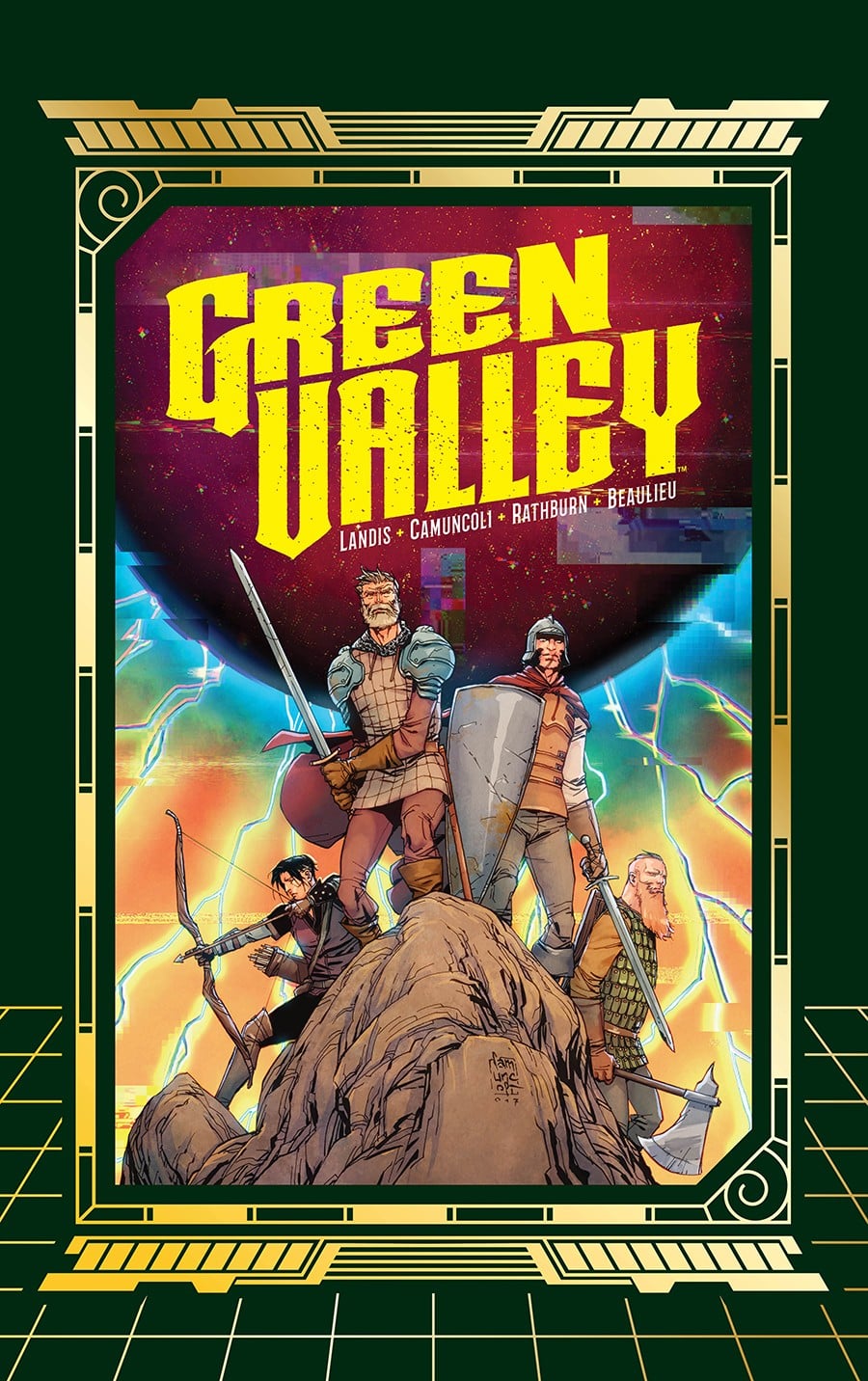
Published by Image, Green Valley was written by Max Landis and features art by Giuseppe Camuncoli, inks by Cliff Rathburn and colours by Jean Francois Beaulieu. The wonderful hardcover collection in my hands collects nine issues and will set you back $29.99 (I paid for this out of my own pocket, and happily so, even though I probably had access to the single issue review copies).

So what’s the story about?

GreenValleyHC.jpg

The knights of Kelodia are the finest in the land, but they’ve never faced a POWER like the one that resides in the Green Valley. Now they’re about to embark on the adventure of a lifetime—to stop a wizard and slay his dragons—but there’s no such thing as magic or dragons…is there? 

You may have noticed by reading this column that I tend to enjoy stories set in and around medieval times, even though I don’t tend to read that many comics set in that era (or at least I didn’t until this year). So when my LCS suggested I pick this up (it was on the counter and the owner told me I’d like it) I did so without question because sometimes I don’t want to read superhero comics.

One of the first things I noticed was that the hardcover itself just feels utterly wonderful in your hands.  The above image is of the hardcover, with the comic art inset slightly into the gold and green cover of the book itself in an effect that really doesn’t translate as well in the image as it does in person, but it does give you a hint about the nature of the story, which aside from the cover and text on the back I entered utterly blindly – and I fell in love.

green valley interior 2.jpg
green valley interior.jpg

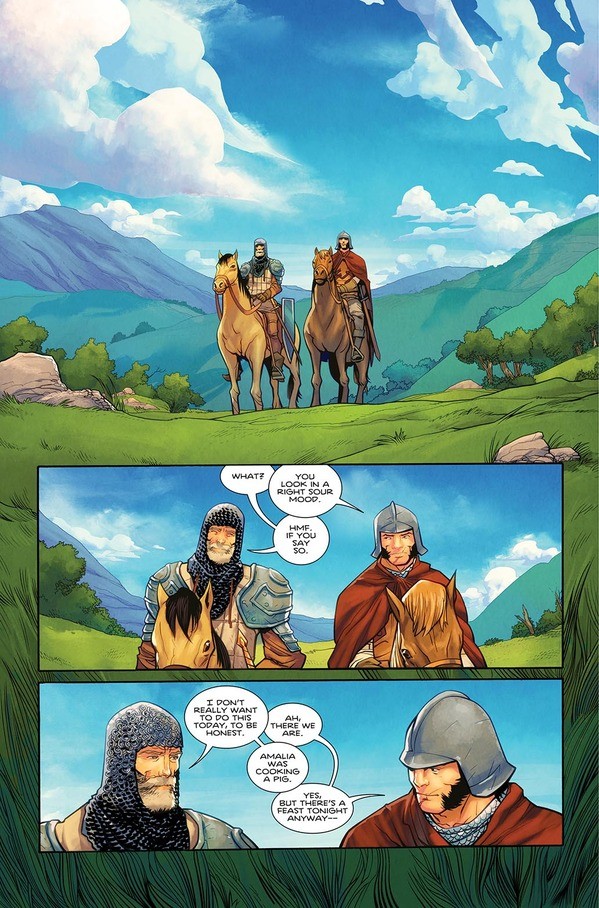
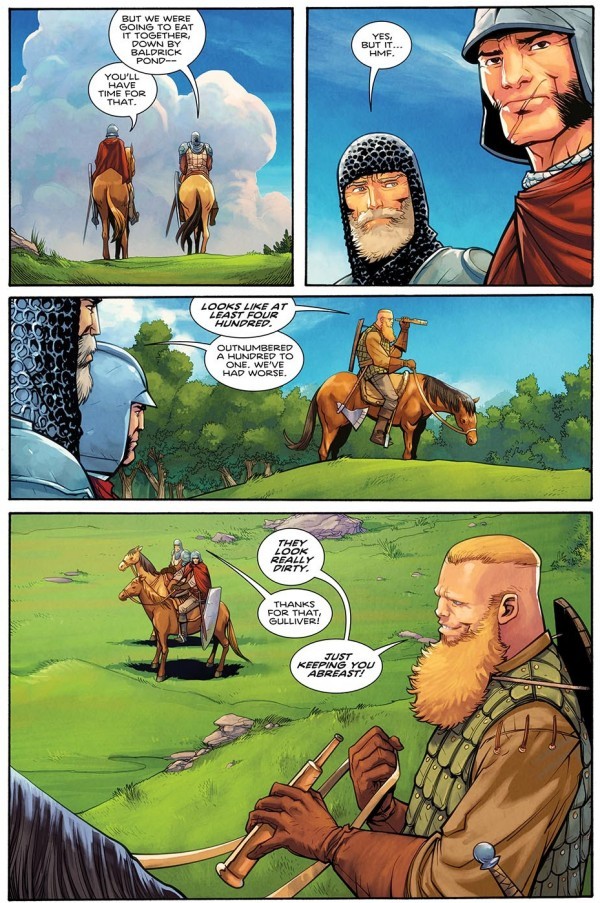
Green Valley is the kind of book that you will want to read in a single sitting – it grabs you right from the start as you’re introduced to the legendary Knights of Kelodia (all four of them) as they face down a barbarian horde in a brilliant sequence that’s full of dry humour, a genuine feeling camaraderie from the knights  and tense knightly masculinity all wrapped up in some beautiful visuals that are some of the nicest pure-comic pages I’ve seen in quite some time. Were I reviewing this here, I’d be giving this at least 9’s across the board and telling you to buy this without question – the story and art genuinely took me by surprise and had me forget that I really should be doing a bunch of other stuff for the hour or so I sat enraptured in this story.

Without spoiling anything, it’s tough to explain why I loved this story, but that won’t stop me from trying. Green Valley is a very intelligently written book, with dialogue that is, at times, so sharp you could loose a finger. There are moments that span the gamut of human emotion for the characters, and will have you laughing out loud and pumping your fist as the story goes on – just as you’ll feel gut-punched at certain other moment. Max Landis has written one hell of a story that deserves a very special place on your shelf.

Now excuse me while I go reread it (no, I’m not saying that for effect – I’m actually going to reread it now).


Unless the comics industry ceases any and all publication look for a future installment of Underrated to cover more comics that aren’t cracking the top 100.

Underrated: The Wrong Earth

This is a column that focuses on something or some things from the comic book sphere of influence that may not get the credit and recognition it deserves. Whether that’s a list of comic book movies, ongoing comics, or a set of stories featuring a certain character. The columns may take the form of a bullet pointed list, or a slightly longer thinkpiece – there’s really no formula for this other than whether the things being covered are Underrated in some way. This week: The Wrong Earth


I initially stumbled over The Wrong Earth because the first issue of the second volume caught my eye. I enjoyed it, a lot, and decided to circle back and order the trade of the first volume.

What’s the book about? Well because I don’t see the need to rewrite the publisher’s blurb for the trade, I’ll paste it below.

“On dark, gritty Earth-Omega, masked vigilante Dragonfly punishes evil maniacs and evades corrupt authorities. On sun-splashed Earth-Alpha, costumed crook-catcher Dragonflyman upholds the letter of the law. Now they’re trapped on each other’s worlds, where even the good guys don’t share their values!”

If the idea of the Silver Age Batman or the Adam West Batman and Frank Miller’s Dark Knight switching places sounds awesome, to you, well, that’s because it is. But it’s also so much more than just that elevator pitch.

Written by Tom Peyer, featuring art by Jamal Igle, with inks and colours provided by Juan Castro and Andy Troy respectively. Rounding out the creative team is letterer Rob Steen, who’s contributions to the comic are often subtle until you catch the sound effects giving you a nostalgic smile. Wrong Earth is the six issue miniseries that launched publisher Ahoy Comics, who some of you may recognise from comics such as Captain Ginger, Second Coming and Penultiman – but we’re not looking at those today. No, this column is about a book that hooked me from the premise, and then surprised me with just how well executed everything was.

A lot of superhero stories that can be seen to take inspiration from others (in the case, Batman), often struggle to tell a compelling story and also stand apart as anything other than a lesser imitation when all is said and done. Wrong Earth leans into the familiarity of the Silver Age with gleeful abandon; Peyer adds a little more realism to the era without sacrificing any of its fun – but he certainly calls out the foolishness of it all as you see the gritty Dragonfly loses his mind at how innocent the world of Earth: Alpha. Conversely, the reader is commiserating with Dragonfly Man as he realizes that Earth: Omega’s world is a living nightmare – and yet you can’t help but laugh as his Silver Age tricks inexplicably work in the modern era. There’s nothing quite like the sense of familiarity as he explains how he escaped a death trap with his cunning, logic, and a little bit of comics magic.

It shouldn’t work, but it does. It REALLY does.

When it comes to The Wrong Earth, I think I’ve found one of my favourite new stories. It is equal parts the charm of the Silver Age and the gritty sensibilities of modern comics, and yet it works in delivering one of the most entertaining stories from start to finish in this volume. In addition, there’s also five back up stories within the trade that enhance and build out the mythology of (the) Dragonfly/man’s world, which are all utterly fantastic.

I’ve only really scratched the surface with this book, because a lot of it you’ll benefit from going in as blind as you can – it’s fun, really fun, and an engrossing read that swooped below far too many radars. Go find this underrated gem at your favourite retailer now.


Unless the comics industry ceases to exist this week, Underrated will return next week.

Underrated: Comic Book Video Games

This is a column that focuses on something or some things from the comic book sphere of influence that may not get the credit and recognition it deserves. Whether that’s a list of comic book movies, ongoing comics, or a set of stories featuring a certain character. The columns may take the form of a bullet pointed list, or a slightly longer thinkpiece – there’s really no formula for this other than whether the things being covered are Underrated in some way. This week: Comic book videogames.


It’s been a long time since I wrote any kind of list for this column, and after finishing up my first playthrough of Spider-Man: Miles Morales yesterday (and my subsequent return to the original PS4 Spider-Man‘s DLC), I wanted to take a trip down memory lane with some games that aren’t as fondly remembered as perhaps they should be amongst the greats like the aforementioned Spider-Man games and Batman: Arkham Asylum/City/Knight. Games that were fun, but may not have been as critically acclaimed or rated as high as others released around the same time; often, super hero games are either overlooked as cheap movie cash-ins (for good reason, honestly), or they’re overlooked in favour of games that have generated more of a buzz. It wasn’t really until the Arkham games cam about that superhero based videogames really gathered any traction; the combat system from that game has inspired countless others over the years – and for good reason.

So, here’s a few gems from yesteryear that are worth circling back to if you’re looking for a bout of nostalgia fueled superhero action.

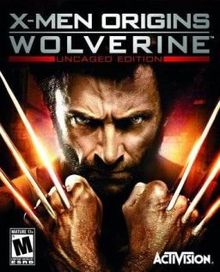
X-Men Origins: Wolverine (PS3/Xbox 360)
A videogame adaptation that was far better than the movie, this game was a blast to play from start to finish. It’s certainly not the best action game around, but it is one of the best superhero movie tie-in games around, and it’s a hell of a lot of fun watching Wolverine getting sliced to pieces and then watching as his healing factor starts to kick back in and rebuild his flesh over his skeleton. Despite it being a very linear game, there’s a hell of a lot to enjoy even today (I’m not holding out hope for a sequel or remake any time soon, but I am very fond of the game even now).

X2: Wolverines Revenge (PS2/Xbox/Gamecube)
If you’re sensing a theme here, it’s probably not accidental. This game was, technically, a tie in to the second X-Men film, but it was also a compelling stealth adventure where the use of Wolverine’s powers were implemented in cel-shaded awesomeness. Fun, though maybe not the greatest game, it’s one that still holds fond memories for me.

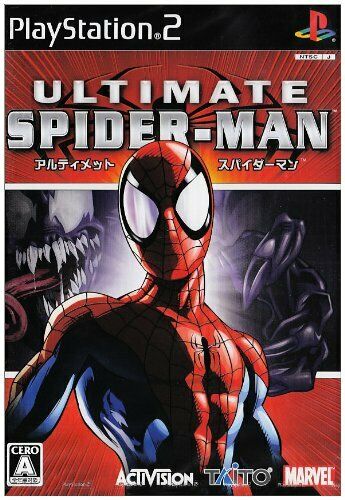
Ultimate Spider-Man (PS2/Xbox/Gamecube)
The second time we got to play as Spider-Man in an open world. Visually, the game holds up fairly well because of the cel-shaded comic style art, though the gameplay may feel a touch dated to those who have become accustomed to the PS4 offerings. The story picks up after the Venom arc from the Ultimate universe’s version of the comics, and so we get to play as both Spider-Man and Venom across Manhattan and Queens (which may have been the last time we saw Queens in the games).

Spawn: In The Demon’s Hand (Dreamcast)
Think Dynasty Warriors meets Spawn. It’s fun, especially with friends, but don’t expect a super deep experience.

Batman Begins (PS2/Xbox/Gamecube)
Look, being completely honest, this isn’t as good as the Arkham games; not even close. But that’s not to say this is a terrible game – it’s just not the best, either. I enjoyed the game, enjoyed the terror mechanics where you’d have to hide from enemies and gradually terrify them into submission (you’ll see this in the Arkham games, but with a much more subtle excitation). Worth a play if you’re curious, but I wouldn’t rush for it.

There’s a lot of 2D games that I didn’t include on the list – games from the Sega Genesis era that were mainly action beat ’em ups – that are all fantastic (though admittedly harder than expected), but what I’d have to say would fall around the same thing: “a solid game that has a lot of vintage nostalgia value, but doesn’t hold up as well as you’d expect – which is the case for a lot of vintage games in many ways. The mechanics of yesteryear take some getting used to, but once you do there’s a lot to love.”


Unless the comics industry ceases to exist this week, Underrated will return next week.

Underrated: Voracious: Feeding Time

This is a column that focuses on something or some things from the comic book sphere of influence that may not get the credit and recognition it deserves. Whether that’s a list of comic book movies, ongoing comics, or a set of stories featuring a certain character. The columns may take the form of a bullet pointed list, or a slightly longer thinkpiece – there’s really no formula for this other than whether the things being covered are Underrated in some way. This week: Voracious: Feeding Time.


Markisan Naso, Jason Muhr and Andrei Tabucaru have a new comic coming out in 2021, By The Horns. Because of the fact that these three have created one of my all time favourite series, I’m going to revisit the three volumes over the next couple of months. You can find the first column on Diners, Dinosaurs & Dives here.

Published by Action Lab, Voracious: Feeding Time is written by Markisan Naso and drawn and lettered by Jason Muhr, with the co-creators being joined by colourist Andrei Tabucaru. The first volume can usually grab your attention with the shortest of descriptions: “time travelling chef makes dinosaur sandwiches.”

It sounds awesome, right? Well, that’s because it is. But it’s also so much more than just that elevator pitch. The second volume is better than the first, but it also takes a left turn when the dinosaur cops Owen and Gus are introduced. You see while Nate may have been travelling back in time to hunt dinosaurs, our assumption was always that they’d be wiped out by an asteroid so no biggie, right? Only Nate hadn’t just been bouncing back in time, but rather into an alternate dimension/timeline where dinosaurs would evolve into intelligent beings.

As you can imagine, hunting the dinosaurs that would eventually evolve is having a disastrous effect on the future of that world as people disappear and are forgotten as their ancestors are turned into burgers and steaks.

It’s a stunning reversal in the story when you realize that Nate, the sympathetic lead of the first volume is also an accidentally diabolical villain in this volume. Or he would be if Naso wasn’t able to continue weaving a tale where you want Gus and Owen to stop the man responsible for Gus’ wife’s disappearance but you also want to make sure that Nate’s business doesn’t go under.

Voracious: Feeding Time has one of my favourite comics within it (issue three) – the entire volume is brilliant, but it certainly peaks around the third issue with the combination of art and writing reaching a height that Voracious hadn’t yet seen. This was the issue when I realized the creative team were destined to write some fantastic comics together. Voracious: Feeding Time is an absolute joy to explore as we witness the series transition from the first volume’s fun to a deep treatise about memory and the importance of cherishing those in your life.

Voracious is one of the few series where I own both the floppy issues and the trades as, like I said in the last column:

“I put my money where my mouth is because Voracious is a wonderful breath of fresh air in an industry that has been choking on relaunches and rehashes; the five issues that make up Feeding Time are some of the highest scored comics that I have reviewed for Graphic Policy.“

If you’re tired of reading about superheroes fighting each other and you want a story to take you across the emotional spectrum without the use of glowing rings then you need look no further. While the comic is about a time traveling, dinosaur hunting chef, it’s also a powerful look into what makes us who we are and how. It’s a story about mistakes and loss, and most importantly coping with those things.

If you want more Voracious, then you can check out the episode of GP Radio where we talked all about the dinosaur sandwiches with both Markisan Naso and Jason Muhr. The new book, by the same team, will be launching February 28th.


Unless the comics industry ceases to exist this week, Underrated will return next week.

Underrated: Die: Fantasy Heartbreaker

This is a column that focuses on something or some things from the comic book sphere of influence that may not get the credit and recognition it deserves. Whether that’s a list of comic book movies, ongoing comics, or a set of stories featuring a certain character. The columns may take the form of a bullet pointed list, or a slightly longer thinkpiece – there’s really no formula for this other than whether the things being covered are Underrated in some way. This week: JDie: Fantasy Heartbreaker.


Believe it or not, I’m not the biggest reader of Kieron Gillen‘s work. The author has some critically acclaimed works that frankly I’ve never gotten around to reading – not because I’m not a fan of his work, but largely because I never make a conscious effort to hunt out the author’s work. More often than not, I end up reading Gillen’s writing as it falls into comics I would naturally gravitate toward; case in point the subject of today’s column.

According to Goodreads Die: Fantasy Heartbreaker is “a pitch-black fantasy where a group of forty-something adults have to deal with the returning, unearthly horror they only just survived as teenage role-players.” Perhaps the easiest way to describe this is as a dark version of Jumanji as six D&D players disappear for two years as they start up a special kind of game. The story takes place almost thirty years later as they’re forced back to the fantasy world as the very characters they played as initially – only this time they have lives they want too return to.

The first volume of Die is heavily influenced by D&D and roleplaying games in general – but if you’re not a fan of that type of entertainment then have no fear because you don’t need to be intimately familiar with the ins and outs of character creation (though as with anything paying homage to something, knowledge of D&D character creation will likely give you a laugh or two when the players go through the same process, but again, it’s by no means essential). The comic is set up in that if you’ve ever played any type of game where you interact with non player characters (videogames, roleplaying games, choose your own adventure type books), and have wondered what happens in the world when you turn off the game, then you’ll find something to enjoy in the premise. That’s to say nothing of Gillen’s writing or Stephanie Hans art as she brings to life the fantasy world in Gillen’s imagination.

It feels odd to highlight the work of the man partly responsible for The Wicked + The Divine, but this is one of those books that I don’t see enough people talking about. Until I picked up the first volume at my comic shop (for all of $10!), I’m fairly sure it had been on the shelf for some time – at the very least I hadn’t heard anybody asking for it in the same way as other works by creators not published by the big two. Die is a dark book, and through this Gillen explores whether we’d truly be heroes in a world of no consequence, whether we would give way to our inhibitions and become the worst versions of ourselves or whether we could rise above.

The more I thought about the book the more I enjoyed the layers Gillen had woven into it; although they were only teenagers when they first entered the game, the six players spent two years in the fantasy world – and three decades later, they’re facing the consequences of actions they took, relationships they forged and the decisions made during those two years. Some of these people are still haunted by their time in the fantasy world, and how that’ll play out across the next two volumes is something I’m super excited to find out.

You should be able to find this at your LCS, or online, easily enough.


In the meantime, Underrated will return to highlight more comic book related stuff  that either gets ignored despite it’s high quality, or maybe isn’t quite as bad as we tend to think it is.

« Older Entries Recent Entries »