Tag Archives: warner bros. discovery

Republican Attorneys General from Iowa and Montana ask the Supreme Court to Intervene in the Antitrust Case Against Paramount

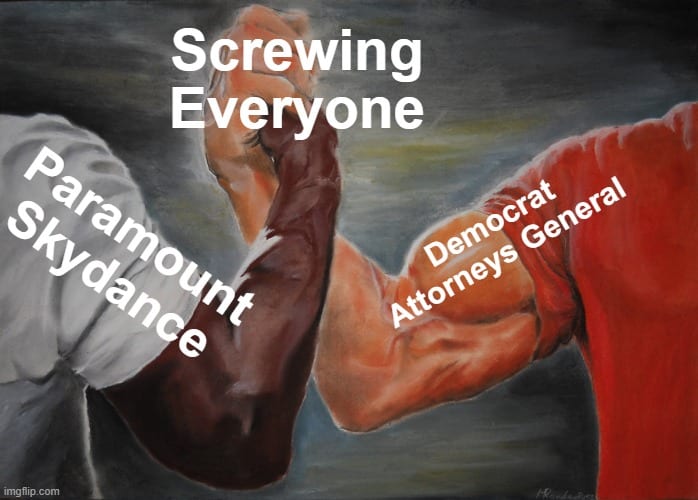
Two attorneys general are stepping in hoping to help Paramount in its takeover of Warner Bros. Discovery. Iowa Attorney General Brenna Bird and Montana Attorney General Austin Knudsen have filed a motion with the Supreme Court naming the dozen states suing Paramount as defendants. They are hoping the Supreme Court will step in and stop the lawsuit by a dozen states against Paramount over its takeover. Those dozen states have raised antitrust concerns.

Plaintiffs, the State of Iowa and State of Montana, respectfully move this Court for leave to file the attached Bill of Complaint to stop a politicized enforcement action that seeks to block the Paramount-Warner Bros. merger.

Twelve states have effectively vetoed a transaction that the other thirty-eight, and the United States, declined to challenge

No other forum can resolve that controversy. Congress made this Court’s jurisdiction over controversies between two or more states exclusive. … This Court is not merely the best forum for this controversy. It is the only one.

How the Supreme Court might act is up in the air. The right-wing court has sided heavily with corporations in decisions but this is an inter-state dispute and while they are the court for issues over boundary and water rights, as examples, it’s not clear if this falls under their jurisdiction.

Iowa and Montana claim they have no other venue to sue the states involved in the antitrust lawsuit. While Iowa and Montana are claiming the dozen states have veto power, the deal isn’t canceled, just delayed, until a court’s decision or Paramount’s agreed upon pause sunset of June 1, 2027.

The two attorneys general claim the lawsuit will have an impact on Iowa and Montana’s economies, “especially the tens of thousands of employees of Paramount and Warner Bros., as well as hundreds of millions who watch their movies, shows, and news through a variety of sources. Iowans and Montanans are being deprived of the benefits of the deal that DOJ and their own state attorneys general approved.”

The antitrust lawsuit does not prevent movies or television shows from being produced, worked on, or released, so the harm is dubious at best. In fact, a report shows the harm the merger would cause if it were to go through with the loss of jobs and more.

The two states go further in their filing:

This case is about the legal limits on politicized antitrust enforcement by a small handful of states seeking to enjoin a $110 billion merger that the United States, most American states, and competition regulators worldwide have cleared. Plaintiff States have the same interest that Defendant States have in well-functioning markets, but believe the merger will help their economies. Because they have the same interest, they should be able to litigate the issue, but can only do so here.

The approval process in the United States is dubious at best, as reports have come out that staff was ready to recommend the merger be challenged, not approved, but were ignored by decision makers higher up in the government. Paramount CEO David Ellison is a friend, and many consider an ally, of President Donald Trump.

The states have requested setting defendant states’ deadline to respond for Sept. 15, 2026, and distributing the case for an Oct. 9 conference.

Paramount is attempting to acquire Warner Bros. Discovery for about $110.8 billion. They have agreed to delay the closing of the deal until as late as June 2027 or whenever the antitrust trial might end as part of the lawsuit after being sued by a dozen states which began in July 2026. That trial is set for March 2, 2027.

You can read the filing from Iowa and Montana below:

Loading Viewer…

Paramount Meeting with Attorneys General Canceled Due to “Lack of Good Faith”

ace attorney canceled

Late last week, news broke that Paramount would have a meeting this Monday with the Attorneys General suing them to stop the acquisition of Warner Bros. Discovery over antitrust concerns. The meeting was ordered by the judge and an attempt at mediation before the trial which begins March 2027. That meeting has now been canceled according to California Attorney General Rob Bonta citing a “lack of good faith” in the settlement talks.

In a statement, Bonta said:

My office had a meeting with Paramount on Friday. Paramount did not maintain the confidentiality of that meeting. Not only did Paramount leak the alleged substance of settlement discussions, but they misrepresented these discussions, demonstrating a lack of good faith.

As soon as Paramount stops playing games and engages sincerely, my office is happy to meet again.

Bonta is leading the dozen attorneys general who have banded together in the lawsuit.

Paramount is attempting to acquire Warner Bros. Discovery for about $110.8 billion. They have agreed to delay the closing of the deal until as late as June 2027 as part of the lawsuit.

Bonta has previously accused Paramount of playing games with their threat to move their company out of California as well as its attempt at a $1.88 billion bond from the dozen states as well as the Writers Guild of America which is also suing.

Paramount and State AGs to Have Settlement Talks Next Week and Gavin Newsom Responds to Threats of Paramount Leaving California

The trial between a dozen state Attorneys General and Paramount over its attempt to acquire Warner Bros. Discovery doesn’t begin until March 2, 2027, but the parties will meet next week to discuss a settlement. After approval from the Trump administration and numerous other countries, a dozen Attorneys General sued Paramount in July in attempt to stop its acquisition of Warner Bros. Discovery for $110.8 billion. Antitrust concerns were raised by the deal which would shrink film and television distributors, have paramount control another major news source in CNN, among other issues.

Representatives from Paramount and the offices of the Attorneys General will meet on Monday to discuss the case. The meeting though is mandated under the mediation procedure, so don’t read too much into it. It’s a common step and has been mandated by Judge Araceli Martinez-Olguin.

California Attorney General Rob Bonta said about the meeting:

As I’ve said before, generally for all of my cases, I prefer to resolve disputes in the boardroom, not the courtroom. As I’ve also said, if the opposing party in litigation wants to meet in good faith to make a sincere effort to resolve the case, we’ll meet. And as I have further said, any potential discussions about the Paramount-Warner Brothers merger will be unproductive absent robust structural remedies on the table that address our concerns.

As it stands today, the proposed Warner Bros./Paramount merger will mean higher costs, less competition, lower wages, job cuts, and fewer movies and TV shows. This merger violates long-standing federal antitrust law, and we are committed to enforcing the law.

Paramount has stated they’re willing to work towards and negotiate a solution without a trial and there has been calls from other parties, some unions and theater chains, for the parties to negotiate a settlement.

Paramount has also threatened to leave California over the lawsuit, a move Bonta sees as an attempt to put pressure on the AGs and get them to settle.

Paramount needs the settlement more than the AGs. If the deal isn’t closed by September 30, a ticking fee begins at about $7 million a day, increasing the cost of the deal. The trial has been set for March 2, 2027 and will last 17 days. The delay through the trial, about 169 days, will cost the company $1.15 billion. Paramount is currently seeking a bond of $1.88 billion from the AGs as well as the Writers Guild of America who is also suing. A decision on that won’t happen until late September

Current California Governor Gavin Newsom has said he is taking Paramount’s threat to leave the state “seriously” and hopes it doesn’t happen.

And I’m of the belief they don’t want that to happen. It’s not, I don’t think, in the company’s long-term interest, but I take it seriously.

I’m concerned about the state, our reputation.

Newsom has also teased there are discussions between parties already happening regarding the antitrust lawsuit. Newsom isn’t running again for Governor due to term limits, and his time in the position will end in January 2027, months before the trial is set to begin.

Newsom is teasing a running for President in 2028. When he does, he’ll need/look for the support of Ari Emanuel, the CEO of WME Group and CEO and executive chairman of TKO Holdings, for that run. Emanuel has become a kingmaker in politics wielding a lot of influence in both parties, though it is rumored Ari’s brother Rahm is also thinking of running for President. Importantly for this, Emanuel is an ally of Paramount CEO David Ellison and has penned an op-ed in support of the deal. Those opposed to the deal would likely have a more difficult time getting his support for their political ambitions.

Los Angeles projected to lose 4,500 local positions and $4.06 billion in business due to Paramount/Warner Bros. Discovery Deal

The Department of Economic Opportunity for Los Angeles and Los Angeles County Film Office has released a report on its projection of the losses for the city if Paramount succeeds in its acquisition of Warner Bros. Discovery.

An initial 60 day report stated “a potential loss of 15,567 corporate roles that overlap across both companies, with 6,099
shared, and 2,495 jobs specifically in Los Angeles County.”

The 120-day final report has been released and highlights risks to numerous groups such as “regulators, workers, investors, and state and local governments” if the merger succeeds.

For Los Angeles County specifically, the final report projects:

  • If the merger goes through, about 4,500 film and TV jobs in Los Angeles County could be lost over the three-year period when the companies combine operations.
  • In total, 10,360 job years could be at risk, including:
    • 2,661 indirect jobs at small businesses that support production — such as prop houses, printers, transportation companies, and other vendors.
    • 3,204 induced jobs that exist because film and TV workers spend money in the local economy — including restaurants, retailers, and service providers.

The economic impact of losing these jobs is significant. At stake:

  • $1.26 billion in wages
  • $2.78 billion in economic value
  • $4.06 billion in total business output
  • $547 million in tax revenue, including $78.6 million in local taxes — most of which (63%) comes from property taxes.

The report raises the concern that job losses would occur through:

  • Slate consolidation (fewer buyers = fewer greenlights) – There would be fewer unscripted/talk shows and related opportunities for Los Angeles-based crews.
  • Talent deals at risk – There’s 895 creators with exclusive deals between the two companies. If there’s less development, work would be lost.
  • Location decisions shifting production away – The new post-merger company would likely shift production away from Los Angeles.
  • Cost of living and Tax Credit Incentives Pressure – LA County and California has a high cost of living and there’s increased competition to court productions through tax credit incentives.

Currently, a dozen attorneys general are fighting the merger between Paramount and Warner Bros. Discovery in an antitrust lawsuit along with a lawsuit by the Writers Guild of America. This report is sure to add fuel to the fire and help the fight to try and prevent the deal to go through.

You can read the full report below.

Loading Viewer…

Paramount $1.88 Billion Bond Request Won’t be Decided until Late September

Just a few days ago, Paramount requested 12 states and the Writers Guild of America post a $1.88 billion bond in their antitrust lawsuits. The lawsuits have halted a $110.8 billion acquisition of Warner Bros. Discovery by Paramount. A federal law protects mergers and acquisition parties from “potential harm” from halting the deal for litigation.

Paramount is trying to get the states and Writers Guild of America to pay for the timer portion of their proposed deal that would increase the cost by about $7 million per day if it doesn’t close before September 30. As of now, that doesn’t look like it’ll happen. Paramount agreed to halt the deal until their lawsuit with a dozen attorneys general is over or June 1, 2027. A trial is set for March 2, 2027 and believed to last 17 days. The delay through the trial, about 169 days, will cost the company about $1.15 billion.

But, a court decision about that bond will cut it close to when that ticking fee begins in the Paramount/WBD deal. Judge Araceli Martinez-Olguin has decided that nothing will be decided in Paramount’s move until September 24. That’s just a week before the the fee would begin and the costs begin to increase.

ABC has filed a First Amendment lawsuit against the FCC’s “Deeply un-American” Censorship

ABC and Disney are taking the fight to the FCC and the Trump Administration for what it calls a “retaliatory campaign against ABC for a single reason: it disapproves of what ABC broadcasts.

Earlier this year, the FCC, and thus the Trump Administration, began to threaten ABC and its parent company Disney over speech that aired on the channel it disagreed with. ABC was directed by the FCC to file early renewals for its licensed TV stations, applying to eight affiliate stations owned by ABC. The FCC, and its chair Brendan Carr, were also investigating Disney for its “DEI practices,” claiming “possible violations of the Communications Act of 1934 and the FCC’s rules, including the agency’s prohibition on unlawful discrimination.”

Unlike other media companies and businesses that have caved to threats from the administration (including pretty obvious settlement bribes to Trump charities), Disney and ABC are fighting back, having filed a lawsuit against the FCC, its chairman Brendan Carr, commissioner Anna Gomez, commissioner Olivia Trusty, and two “John Does” also listed as commissioners of the FCC who have yet to be appointed.

In the filing, ABC and Disney highlight attacks on the channel and its talent’s free speech by President Donald Trump, using his own words and social media posts against him. It also quotes Carr who issued an ultimatum regarding on-air comments by ABC’s late-night host Jimmy Kimmel, “We can do this the easy way or the hard way. These companies can find ways . . . to take action . . . on Kimmel, or there is going to be additional work for the FCC ahead.”

ABC and Disney say they have seen increased pressure from the administration that has culminated in threats of broadcast licenses for the eight stations mentioned above and notes how early the reviews have been demanded, some not even halfway through their current license terms.

ABC also highlights this pressure has impacted programming decisions, deciding to livestream a speech by President Trump but not broadcasting it on television which resulted in President Trump calling for the revocation of the ABC owned stations’ broadcast licenses as well as NBC which also chose to not cover the speech.

Since the Commission cannot lawfully grant renewal this early, ABC and Disney are convinced a decision from the FCC, which is expected soon, will be a negative one.

The consequences of the Administration’s campaign against free speech reach well beyond ABC. If the Administration gets its way, the message to every media company in the country will be unmistakable: tell only the stories the Administration deems favorable, or face the coercive machinery of the federal government. In such a world, the press could in no way be described as free.

The FCC Chairman has left little doubt that this is his goal. He has publicly touted the Administration’s success in extracting speech-related concessions from other media companies, boasting that it has “t[aken] on the fake news media” and is “winning,” cataloguing with evident pride the perceived critical voices that have been taken off the air.

ABC and Disney are asking for the court to:

Declare that Defendants’ order requiring that Plaintiffs file early license renewal applications constitutes retaliatory action in violation of Plaintiffs’ rights under the First Amendment to the U.S. Constitution.

Enter temporary, preliminary, and permanent orders providing that Defendants, their officers, agents, and employees subject to their supervision, direction, and control are enjoined from taking any continuing or further action against Plaintiffs in relation to the early license renewal applications, including issuing a Hearing Designation Order;

Enter temporary, preliminary, and permanent orders, providing that Defendants, their officers, agents, and employees subject to their supervision, direction, and control are enjoined from taking any actions, formal or informal, to coerce or threaten Plaintiffs with sanctions in an effort to alter their exercise of editorial discretion; and

Grant such other and further relief as this Court deems necessary and just.

In their complaint, ABC and Disney lay out how threats from the White House and FCC have impacted their coverage and decisions and is an example as to why the acquisition of Warner Bros. Discovery by Paramount should be stopped. The media company has already shown its willingness to cater to Trump’s complaints and whims.

You can read ABC and Disney’s full filing with detailed history of the attack by President Trump, the White House, and FCC against the companies.

Loading Viewer…

Paramount is seeking a $1.88 Billion Bond from Plaintiffs

Paramount is citing a federal law in asking 12 states and the Writers Guild of America to post a $1.88 billion bond in their antitrust lawsuits. The lawsuits have halted a $110.8 billion acquisition of Warner Bros. Discovery by Paramount. A federal law protects mergers and acquisition parties from “potential harm” from halting the deal for litigation.

Paramount is trying to get the states and Writers Guild of America to pay for the timer portion of their proposed deal that would increase the cost by about $7 million per day if it doesn’t close before September 30. As of now, that doesn’t look like it’ll happen as Paramount has agreed to halt the deal until their lawsuit with a dozen attorneys general is over or June 1, 2027.

A trial is set for March 2, 2027 and believed to last 17 days. The delay through the trial, about 169 days, will cost the company $1.15 billion.

California Attorney General Rob Bonta who is leading the case for the states has said it’s a move by Paramount to get the plaintiffs to back down. Paramount CEO David Ellison has threatened to move Paramount out of California if the states don’t negotiate a settlement.

Paramount and Warner Bros. are two sophisticated companies who willfully decided to include a costly ticking fee [to shareholders] as a provision in their merger contract. They knew this merger would undergo regulatory review; they knew it was not a done deal; and they chose to include it anyway.

What’s more, Paramount itself stipulated to the timing it is now protesting — they agreed to the dates and did not request a bond as a condition of agreeing not to close until after the trial, and potentially as late as June 2027. Now, they’re trying to get a do-over.

Bottom line: Paramount went into this process with eyes wide open. They are lying in a bed of their own making, and once again, trying to blackmail us to get us to back down.

-Office of Attorney General Rob Bonta

Hollywood Teamsters Call out Paramount over the Warner Bros. Discovery Acquisition

While the DGA and IATSE unions kiss Paramount‘s ass and call for a settlement between Paramount and a dozen state attorneys general in their antitrust lawsuit, the Teamster Local 399 is taking another route. Paramount is currently attempting to purchase Warner Bros. Discovery for $110 billion.

Lindsay Dougherty has released a statement to Deadline that it’s time to cut the crap.

At every step of the way, Teamsters have asked for data to show how this merger would be good for our industry, our members and domestic production. Touting worker prosperity, without commitments, while simultaneously threatening their livelihood in the press as a bargaining chip begs the question — what is in this deal for American film and television workers?

The Teamsters had previously called on the Department of Justice to block the merger. Trump’s Department of Justice approved the deal. David and Larry Ellison have been accused of supporting and being friends with Trump which resulted in the acquisition to receive little scrutiny and is reported to have ignored government lawyers who were going to recommend a challenge to the deal.

The deal at $110 billion (currently, more on that later) and heavy debt by Ellison will force the company to make cuts quickly and will likely result in massive layoffs. After the purchase of Fox by Disney, the House of Mouse laid off thousands of workers. Paramount will have to do the same, if not worse, if this deal goes through.

Paramount CEO David Ellison has promised theater owners the combined mega-studio would release 30 films a year, and has assured CNN would have editorial independence. They’ve recently said everything is on the table in hopes to settle the lawsuit from the attorneys general. Paramount’s Chief Legal Officer Makan Delrahim has stated they’re willing to work towards a resolution and there have been rumors that includes selling CNN, though having an oversight board has also been floated. Ellison has threatened to pull the company from California if the antitrust lawsuit continues.

With a trial not set for March 2027, Paramount is scrambling to cut a deal beforehand. Each day beyond September 30, the price of the deal increases $7 million a day. With a promise to put the deal on hold until June 2027 or the conclusion of the trial, the $110 billion deal could increase by about $1.3 billion.

That increasing price is only one factor as to why the deal might be in jeopardy. David Ellison’s father Larry Ellison, the founder of Oracle, has backed a large portion of the deal with about 49% of it being financed by foreign entities. Larry’s wealth is tied heavily into Oracle stock which has been volatile due to questions regarding its investment in data center infrastructure and whose fortune now relies heavily on AI succeeding. With the belief of an AI bubble growing, it’s very likely Ellison’s fortune could tumble quickly and soon. The longer the deal drags out, the more the risk increases for Ellison in the bubble popping and the deal collapsing resulting in a $7 billion payout to Warner Bros. Discovery for the deal ending.

Paramount’s CEO David Ellison Threatens to Exit California Unless the State AG Negotiates Regarding the Warner Bros. Deal

Veruca Salt with a David Ellison name tag

Paramount CEO David Ellison is taking another page out of the Veruca Salt playbook of stomping your feet until you get what you want. Ellison has told executives of Paramount that he will begin the process of exiting California on October 1 unless State Attorney General Rob Bonta negotiates a settlement regarding the antitrust suit regarding the takeover of Warner Bros. Discovery.

Bonta is leading a group of 12 state Attorneys General that have formed like Voltron in an antitrust lawsuit against Paramount in its attempted $110 billion (potentially $111 billion) takeover of Warner Bros. Discovery. Paramount had agreed to pause any business with the takeover until the trial ends or June 2027. The trial has been set to begin on March 2.

Paramount also faces a lawsuit from the Writers Guild of America as well as one filed by shareholders.

Bonta has released a statement regarding the threat:

In a span of weeks, Paramount agreed to halt the merger until a court decision or until June 2027, asked for a November trial, and is now back with another attempt to blackmail the state into letting an illegal deal through. Paramount has lost the plot as it continues to lose in court. It didn’t work the first time — on the eve of our July lawsuit — and it won’t work this time.

If Ellison follows through with his threat, the relocation would begin with the company’s headquarters and followed by studio jobs. The rumor or Ellison and Paramount leaving the state have swirled for some time.

Paramount faces an increased cost to its deal if it’s not closed by September and the trial alone adds about $1.3 billion to the $110 billion price tag. If the deal falls apart altogether, there’s a $7 billion termination fee. Warner Bros. Discovery can walk if the deal isn’t closed by June 4.

Paramount has been attempting to wage a PR campaign in its favor with Ellison rallying his allies to write op-eds supporting the merger. But, Paramount seems to be hurting its cause by trying to play public opinion as opposed to making concessions with the Attorneys General that may lessen their opposition.

With each volley, and the further strain on the Ellison fortune, the chances of this deal collapsing seems to increase with each day.

The UK Competition and Markets Authority and Culture Secretary Approves Paramount’s Acquisition of Warner Bros. Discovery after Guarantees

A government again has laid down choosing not to protect consumers and workers as the UK culture secretary Lisa Nandy as well as the UK’s Competition and Markets Authority have both cleared the deal for Paramount‘s $110 billion+ takeover of Warner Bros. Discovery.

To secure approval from Nandy, Paramount had to agree to some concessions.

  • Paramount’s Channel 5 will continue to operate as a public service broadcaster until the end of 2034. It will also retain editorial independence and remain separate from other news operations like Paramount’s CBS News and Warner Bros. Discovery’s CNN International.

Paramount has come under scrutiny for its takeover of CBS News removing its editorial independence for a more right-wing bent calling into question is history of quality journalism. Paramount owner David Ellison appointed Bari Weiss as the head of the news service as well as a conservative to act as its ombudsman, an “internal advocate for journalistic integrity and transparency.”

  • Paramount has also agreed that its linear and on-demand services in Britain would retain distinct editorial identities for five years, including its children’s TV content.
  • There’s also a guarantee that the deal would not reduce the number of people commissioning content in Britain, and Channel 5 would continue to back UK-originated content covering drama, factual, and entertainment shows.

The deal still faces multiple lawsuits in the United States including one from a dozen state attorneys general as well as the Writers Guild of America. Another case involves shareholders claiming the Ellisons promised “illegal private benefits” to President Trump in exchange for the government approval.

Paramount has received competition clearances in the United States, Australia, Brazil, Canada, China, Kuwait, Montenegro, New Zealand, North Macedonia, Saudi Arabia, Serbia, South Africa, South Korea, Ukraine, and by the European Commission, and the COMESA Competition Commission.

It also has received foreign direct investment clearances in Australia, Belgium, Czechia, Germany, France, Italy, New Zealand, Romania, Spain, and Slovenia. The transaction was also unconditionally approved by European Commission under its Foreign Subsidies Regulation regime and by the Austrian Federal Competition Authority under its media merger control regime.

« Older Entries