Tag Archives: Synch

Review: X-Men #1

X-Men #1

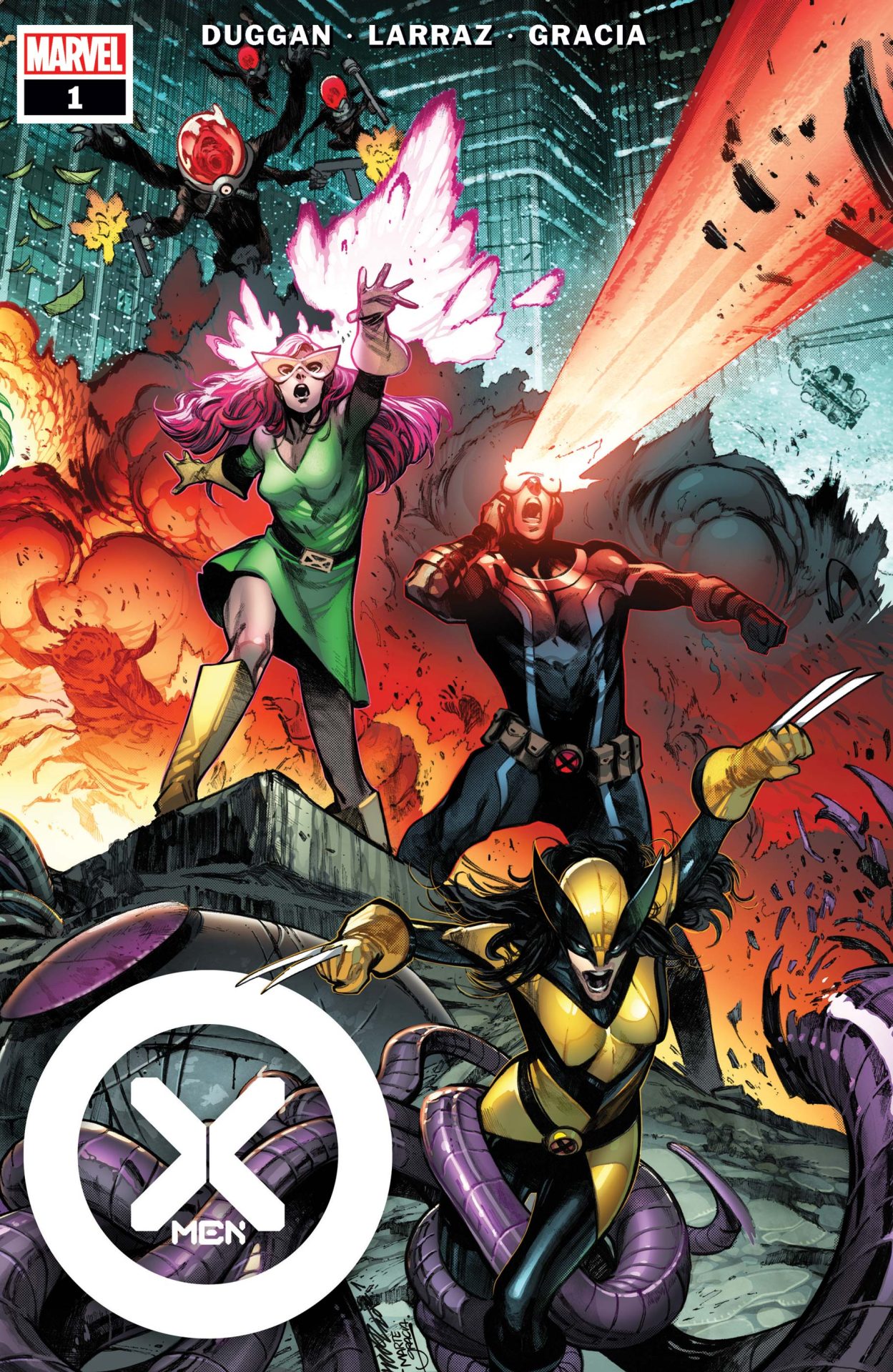
Because it centers around a team of mutant heroes teaming up to beat up a giant villain, X-Men #1 could definitely be described as “meat and potato” superhero comics. But those meat and potatoes happen to be your older relative’s Sunday roast recipe. Plus it’s a damn superhero comic: fights are a staple of the genre, and Gerry Duggan, Pepe Larraz, and Marte Gracia turn in a good one that builds on the strengths of the different members of the Krakoan X-Men team and features visual flourishes like inset panels to show the scale of the monstrosity their fighting as well as different color palettes for different kind of energy discharges (Psychic etc.) This fight also ties into the current throughline of the X-Books that is basically the mutants are flexing their superiority over humanity whether that’s terraforming Mars or building a treehouse in Central Park as their new headquarters. This leads to jealousy and enemies as the main antagonist of X-Men is more like Elon Musk than a cannon fodder robot.

X-Men #1 flows nicely from Duggan and Larraz’s work on Planet-Sized X-Men #1 beginning with yet another large building project, the Treehouse and Seneca Village in Central Park. Seneca Village was home to free Black landowners in the 19th century before it was razed to make Central Park so this move shows Krakoa’s opposition to oppression and reinforces the Civil Rights themes that have been a part of X-Men comics for decades. Or it could just be a symbolic gesture like naming a street after Martin Luther King Jr., but doing nothing to fight systemic racism in a lasting way. With the way the Krakoans have treated folks like the Terra Verdeans, I think it’s the 2nd thing. It’s a drone strike presided over by a Black/South Asian woman, who also has a thing for putting trans women in men’s prisons.

However, for the most part, Gerry Duggan and Pepe Larraz portray the X-Men as classic heroes saving the day and using the abilities in such an efficient way that they did this day-saving before the Avengers, Spider-Man, and Fantastic Four arrive on the scene. (Duggan continues to write great dialogue for Ben Grimm in cameo appearances.) Even the usually arrogant Sunfire fits right in, and his solar fire powers the X-Mech that takes down the villain of the month. But, like a lot of the mutants’ actions during the Krakoa era of the X-Books, there’s something a little off about their actions, and investing billions of dollars in pharmaceutical money in Manhattan real estate is something a corporate baddie would do, not a team of heroes.

This critique of the X-Men comes from Ben Urich, who enjoys the vibe of Seneca Village and the Treehouse, but whose questions about the original death of Jumbo Carnation back in New X-Men are deflected by Cyclops. Cyclops also tells Jean Grey that he’s a little uncomfortable around the press. Urich’s dialogue and short data page article seems to show he has a positive view of the X-Men. However, the abruptness of Cyclops’ movements around him as well as Pepe Larraz using his glasses to hide Urich’s facial expressions show that maybe he doesn’t completely trust his new neighbors. Urich’s appearance in X-Men #1 grounds this new team in New York City almost as much as the Fantastic Four, Avengers, and Spider-Man cameos from afar and coupled with the confidence of the narrative captions as well Jean Grey and Cyclops’ dialogue shows that they’re ready to be the main superhero team in the city that’s the heart of the Marvel Universe.

From this review, you might think that the X-Men are more like X-Force in X-Men #1. This is actually the opposite of how Gerry Duggan and Pepe Larraz portray them in the majority of the comic. Although they’re caught unaware initially by their opponent, they are a smooth, adaptive fighting team. Duggan and Larraz establish Synch as the team’s glue and ideas man even before the battle as he uses Forge’s abilities to tinker around the Treehouse before turning his talents towards the X-Mech. I like how Pepe Larraz doesn’t show the X-Mech in a splash page, but also spends the page before showing the team using their powers in, well, sync to build something to stop the baddie. He can do busy multi-panel pages as well as more wide screen work like Rogue flies into the heat of battle as the X-Men’s tank, and Gracia is there to give each panel a distinct mood like colder colors for the psychically affected bystanders while the X-Men put together a plan. Larraz’s work screams big, damn superhero book, and he has fun with some the science fiction elements towards the end of the book.

On the tin, X-Men #1 is a team of badass mutants saving New York City from a creepy alien being with blockbuster visuals from Pepe Larraz and Marte Gracia, who make the Treehouse as gorgeous and utopian as the team’s opponent is dark and cold. But Gerry Duggan still nudges at the cracks of the Krakoan experiment through remarks by side characters, data pages, and in time-honored genre tradition, the issue’s Big Bad, who is definitely a billionaire I would want to stay stuck in space. It has loads of action and few thought-provoking ideas and is overall just a lot of fun. I mean, in addition to the X-Mech and Cyclops geeking out way too much over the treehouse, there’s space Vegas that use black holes to simulate the “always day” casino feel plus Larraz nails Wolverine aka Laura Kinney’s physicality throughout the issue.

Story: Gerry Duggan Art: Pepe Larraz
Colors: Marte Gracia Letters: Clayton Cowles
Story: 8.0 Art: 8.6 Overall: 8.3 Recommendation: Buy

Marvel Comics provided Graphic Policy with a FREE copy for review


Purchase: comiXologyKindleZeus ComicsTFAW

Review: X-Men #18

X-Men #18

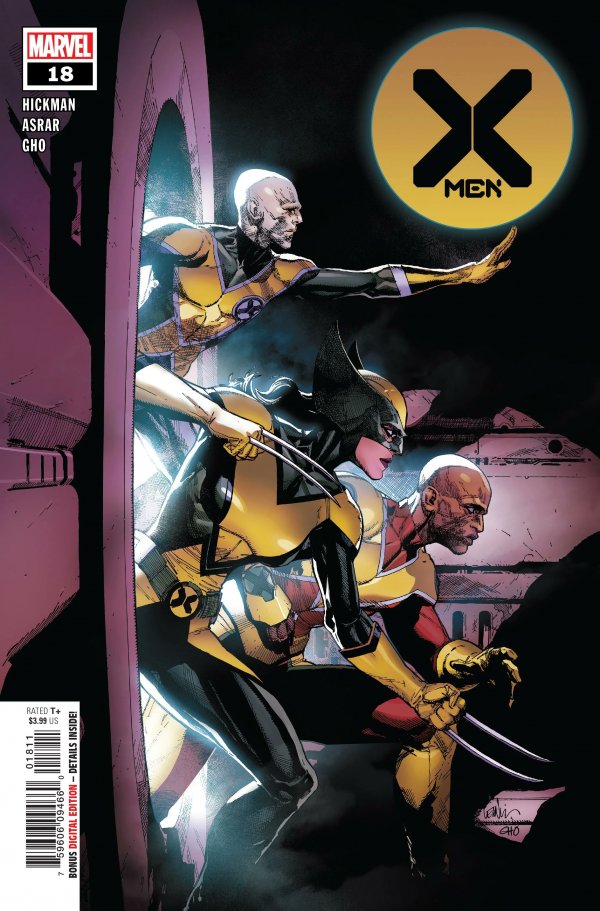
Writer Jonathan Hickman tugs on a long-simmering plot thread in X-Men #18 as he, Mahmud Asrar, and Sunny Gho send the rough and tumble team of Wolverine (Laura Kinney), Darwin, and Synch into the Vault to confront and find information about the Children of the Vault, who appeared way back in X-Men #5 after a lengthy absence from the X-Books. (This is a great explainer about them.) The Children of the Vault are shrouded in mystery, hence, the risky reconnaissance mission in an environment where time doesn’t work traditionally, but they’re humans evolved over a period of 6,000 years in a specialized environment that have given them superhuman abilities. They also see the mutants and Krakoa as a threat so Darwin, Synch, and Wolverine are not in for a good time.

Escape from the Vault” is going to be a rare two-part story in a series that has mostly been loosely connected done-in-ones that give readers a flavor of the Krakoa era. However, with the impending election of an X-Men team and coming of last issue’s space mission, it looks like Jonathan Hickman and Mahmud Asrar are back on a “mutants going on a mission” kick even if it’s not traditionally superheroic.

Basically, the team in X-Men #18 are like the members of the various hapless crews in the Alien franchise, but with special abilities that could get them out of this bind. And speaking of powers, Hickman crafts this team lineup almost perfectly with Wolverine’s healing ability, Darwin’s adaptability, and Synch’s ability to duplicate any mutant power make them have a chance in this hostile environment. Hickman takes a purposeful approach to superhero team building, and you can see this throughline of complementary abilities echo down the X-Books from SWORD and the magic in Excalibur to the training exercises in Vita Ayala and Rod Reis’ New Mutants and even in the Resurrection protocols of The Five. The previous issue was more self-indulgent with 1990s style art and costumes from Brett Booth and star turns from Hickman faves Cannonball and Sunspot, but X-Men #18 is back to the business of setting a tone for the line of comics and showing how Krakoa deals with threats.

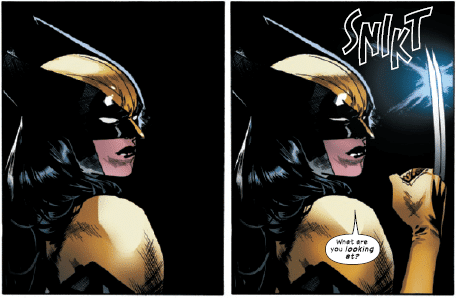
After a foreboding setup and quick introduction to the team, Hickman, Asrar, and Gho dive straight into combat. Wolverine, Darwin, and Synch fight more like the X-Force (Sans guns and pouches.) than the X-Men with Wolverine especially being a ball of rage. Asrar draws her from overhead angles and with plenty of speed lines to show her aggression, and that she isn’t holding back with blood spurting out of Serafina, the only Child of the Vault who gets mentioned by name in this issue. Colorist Sunny Gho accentuates this panel by switching the usual blue background of the Vault to red. Laura is more into action than words, and she demonstrates this in X-Men #18 through her single-handed focus on the mission unlike Darwin and Synch, who are hoping for a quick in and out mission.

Synch acts as the narrator of X-Men #18 providing commentary on the team’s time in the Vault while Jonathan Hickman and Mahmud Asrar show that a seemingly timid character that’s been dead in the comics since 2000 could be one of Krakoa’s deadliest weapon. Synch’s tone is fairly neutral, yet a little freaked out as he reminds readers that even though this comic has a fairly straightforward plot, time isn’t working normally right now, and the team is probably end for some weirdness one they reach the other side, especially after this issue’s, shall we way, nuclear finish. If the middle of X-Men #18 is Aliens, its bookends are Alien: all horror, atmosphere, and tension tinged with science fiction. Because his powers literally make him the ultimate support character, Synch is very passive in the early stages of the fight against the Children of the Vault walking around with a water bubble around his head once he takes a flame to the face.

X-Men #18

However, fire plus water equals boiling, and Synch unveils his grisly potential in a sequence where he reveals that he can duplicate the powers of both mutants and other superpowered beings like the Children of the Vault. It immediately shifts the momentum of both the battle and X-Men #18 with Sunny Gho bringing some vivid oranges in his palette to go with Asrar’s skeleton silhouettes. The A.I. in the Dome was right that the Children of the Vault needed more training, upgrades, and/or evolution to have a chance against the mutants even if total victory doesn’t happen in this issue. However, Synch’s flame on moment pays off a data page earlier in the issue where Dr. Reyes says that his power limits have increased, and that he can “connect” to any kind of superhuman ability.

There is only one other data page in X-Men #18, but Hickman makes them crucial to the plot and arc of the main character. Their placement is also clever with the aforementioned payoff, and more importantly, he puts the text of a letter allowing the team to use deadly force because the Children of the Vault aren’t classified as humans after Wolverine and Synch have done their thing. It’s a great final page of the issue that adds an ethical dimension to the snikts and explosions and shows again that the Krakoans are a little hypocritical and are just like any human nation snuffing out a threat to their sovereignty via various black ops and cutthroat ways, especially since they and the Children of the Vault are a lot alike.

X-Men #18 shows Jonathan Hickman putting his own spin on the typical X-Men “rescue” mission, and the focus on a tight-knit, complementary cast lets Wolverine, Darwin, and Synch’s personalities and abilities shine. Mahmud Asrar and Sunny Gho also get to draw riveting action sequences that showcase this cast of character’s unique powers while working in tandem with Hickman to create an uneasy tone around the team’s actions. By the end of the issue, we know so much about who Wolverine, Darwin, and Synch are, but their opponents are basically explod-y action figures. Hmm…

Story: Jonathan Hickman Art: Mahmud Asrar
Colors: Sunny Gho Letters: Clayton Cowles
Story: 8.0 Art: 8.4 Overall: 8.2 Recommendation: Buy

Marvel Comics provided Graphic Policy with a FREE copy for review


Purchase: comiXologyAmazonKindleZeus ComicsTFAW