Tag Archives: Sakhmet

Review: The Wicked + the Divine #32
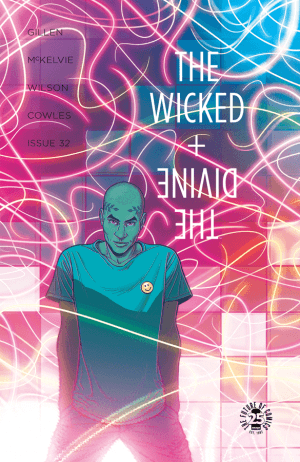
Kieron Gillen, Jamie McKelvie, and Matthew Wilson continue to sometimes literally slice and dice The Wicked + the Divine’s status quo in the last few issues of “Imperial Phase Part 2”, and issue 32 is certainly no exception. The comic manages to pack Dio’s last stand, Woden’s (thankfully premature) moment of Kanye quoting glory, Sakhmet vs. the world, and even Minerva crossing a line. All the while, Persephone plays the punch pulling, sometimes carelessly cruel wild card and gets confronted for this fact by Urdr, who still cares about Laura and even gets to kick it critic style for a little bit. All the gods appear in WicDiv #32, which gives McKelvie and Wilson a veritable playground of styles to throw at the reader with some subtle visual callbacks to big scenes in the series like WicDiv #8’s rave issue, the “superhero” style battles of Rising Action” and at the end of “Faust Act”, and an unexpected character playing the role of Ananke the mercy killer.

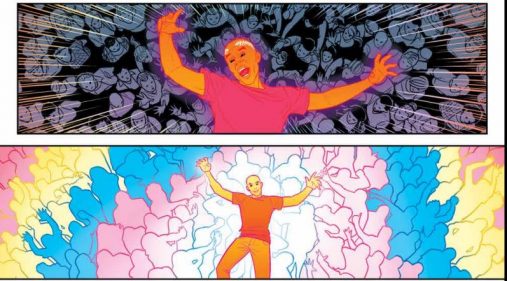
If you’ve read my reviews of WicDiv up to this point, you know that I love both the character of Dionysus, the original Greek god, and forgiving one’s cares on the dance floor. That is why I was glad that Dio got one last rave in WicDiv #32 with symmetrical layouts from McKelvie, heroic sentiment caption boxes from Gillen, and of course, color palettes to end all color palettes from Wilson and his flatter Dee Cunniffe. And it all starts out with an icky lime green color for Woden’s mind control that Dionysus fights back against in the “rave” panels. He takes a beating, but persists because he truly cares about every individual on the dance floor even if it means sacrificing his own life. For the most part, McKelvie draws flexible, silhouette figures before occasionally going for more detail to show how much of a beating Dio has taken after the whole thing where he sat in the dark with Baphomet and then promptly got his hive mind powers stolen. It is definitely sad to see the most decent member of the Pantheon take a curtain call, but Gillen, McKelvie, and Wilson truly collaborate to give him a perfect, empathetic ending with intense colors, blazing speed lines, and the repeated line “One more time” like bass line of “Blue Monday”.

Along with Dio, Woden, and the revenge of the Norns (Matt Wilson makes Urdr’s black and white scheme look very frightening as she charges at Woden and the Valkyries.), Gillen and McKelvie also put the seal on Sakhmet’s storyline beginning with the first page where she and Persephone take the murder of someone considered to be a friend quite casually. But, of course, Persephone is a super secret agent for Baal and Minerva, and the look of betrayal on Sakhmet’s face is quite painful even if she is a killer. Persephone’s flat was a sanctuary for her restless, ravenous soul, and now it is yet another battleground. McKelvie and Wilson go big and bombastic with Persephone, Baal, and Sakhmet’s powers with exploding greens and purples everywhere before toning down the color mix and flailing bodies and going for sheer emotion at the fight’s conclusion. A silent panel is a great way to wrap up these pretty noisy scenes, and the poses and space between the remaining characters nails their attitudes toward and relationships with each other. Also, during the fight, Gillen does some masterful multi-plotting and sets up a possible vine tendriling, crow pecking showdown between Persephone and Morrigan in the “Imperial Phase Part 2” finale with a quiet conversational scene between the fisticuffs.

Urdr is the bridge between Sakhmet/Dionysus last stand storylines along with being the only character who now gives a shit about the Woden machine/MacGuffin plot in WicDiv #32. Gillen and McKelvie show her range, and she slips into a variety of roles, including the ultimate critic, vengeful goddess, extremely disappointed friend, and maybe even grieving lover. Gillen crafts some of his most incisive dialogue, and McKelvie draws some intense as Urdr speaks for a good portion of the WicDiv fanbase when she says that Persephone was better of being Laura. And she can’t help but still be a critic and call Persephone’s shows “middlebrow”. This leads to some hurling of unkind words, an almost fight, and an ambiguous ending. It also reminds readers that Laura wanted to be a goddess during the first two storylines of WicDiv and has done nothing really inspirational with her divine powers. That could change as the colossal story developments and rocking of the proverbial Pantheon boat hints at Persephone totally being more of the Destroyer than an ascended fangirl.

WicDiv #32 is a true companion to the universe shattering, plot demolishing WicDiv #31, but Kieron Gillen either tapers off or adds elements to character arcs to go with Jamie McKelvie and Matthew Wilson’s fireworks or quiet artistic moments. With the deaths of Dionysus and Sakhmet, a lot of rage and serenity has exited the building along with WicDiv‘s respective superego and id, but my excitement for the “Imperial Phase Part 2” conclusion has definitely increased.

Story: Kieron Gillen Art: Jamie McKelvie Colors: Matthew Wilson
Story: 9 Art: 9.8 Overall: 9.4  Recommendation: Buy 

Image Comics provided Graphic Policy with a FREE copy for review
Review: The Wicked + the Divine #31

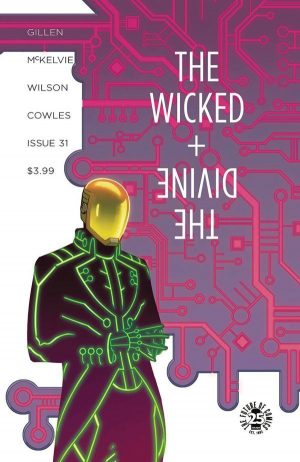
The Wicked + the Divine #31 is the best the series has been in a long time as writer Kieron Gillen, artist Jamie McKelvie, and colorist Matthew Wilson hit a sorrowful groove as “Imperial Phase Part II” draws to a close. This is a memorable issue that will be dissected, oohed and aahed at, sobbed over, and yes, screamed at just like WicDiv #5, #8, #11, #13, and #18, which have been my favorite regular issues of the series to date. With these superlatives out of the way, WicDiv #31 features momentous events, like the Norns, Woden, and Dionysus finally turning on Ananke’s machine to the tune of a glorious Wilson color palette, Persephone coming clean, and some sort of real talk about Dio and Urdr’s feelings for each other. Plus a tragic twist.
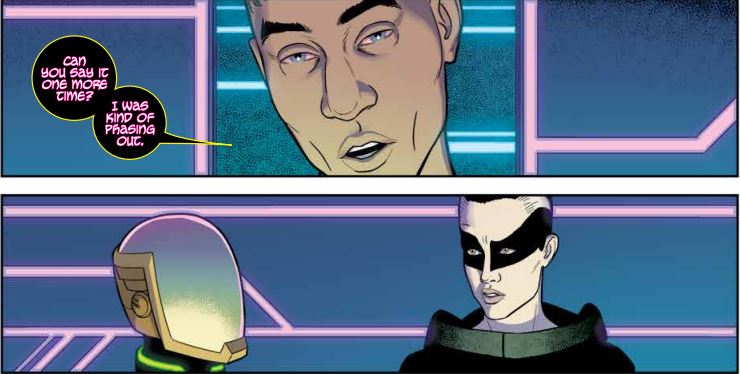
I am really enjoying Gillen, McKelvie, and Wilson’s focus on the character of Dionysus throughout “Imperial Phase Part II”, and WicDiv #31 is no exception. In his first appearance, McKelvie draws lines on Dio’s usual smooth face and gives his eyes a hazy spaced out look, which is to be expected after he spent all of the previous issue sitting in the dark and pleading with Baphomet to leave his abusive relationship with Morrigan. McKelvie depicts Dionysus as a husk of his rave inducing self with basically bad selfie lighting from Wilson, but his wholesome spirit hasn’t faded.

He has a conversation with Urdr, who is a little on edge about the turning on Ananke’s machine thing because Woden is sketchy and Dionysus is tired, plus there’s the whole crush thing. But, even though Urdr and Dionysus don’t directly talk about their feelings for each other, Dio kind of nails how relationships and friendships should work. He basically says that emotions, especially love are important, but they shouldn’t get in the way of caring and supporting a friendship. This is really freaking selfless and par for the course for a man, who admits that his key motivation in life is making other people happy. Dionysus’ smiling face or crowd surfing body should definitely be in the dictionary next to mudita, a kind of happiness that comes from other people’s happiness. However, this ends up being his downfall as Woden uses his abilities in a more toxic way turning a happy party into a hive mind, worship into a cult. But, before everything gets fuzzy, Gillen and McKelvie give us a character defining moment of Urdr looking up and perhaps for the first time, realizing the effect the Pantheon has on other people and admiring those Eisner winning Matthew Wilson colors.

But Woden’s hijacking of Dio’s power isn’t just a simple “Dionysus is a cinnamon roll too good for this world” plot point, it actually takes WicDiv #31 back into the musical realm. Woden and Dionysus’ actions at Valhalla support my theory that, in the end, there are two kinds of dance floors: one filled with light, energy, fantastic music, and camaraderie and another one that is crowded, filled with groping straight men, and plays the Chainsmokers. Dionysus represents the first as evidenced by the immortal WicDiv #8, and Woden represents the second with misogyny, objectification of women, and general fuckboy attitude and spinelessness. Dionysus is about people having a good time and forgetting their troubles for a night and maybe having fond memories of waving their arms and dancing to “Total Eclipse of the Heart” with gods while sitting in their poorly lit cubicles. Woden is all about metaphorically (and probably) getting off the power of the patriarchy to rob women (And people in general in this issue) of their agency. It’s selfishness versus selflessness, and unfortunately, it looks like selfishness has the upper hand in 2017. But Dionysus’ nice little grape Pantheon icon isn’t a skull just yet so there might still be some hope for this beautiful, emotionally honest, and soulful man. I’m probably the naive one in this case.

Dio, Urdr, Woden, Amaterasu, and Sakhmet play the “active” roles in WicDiv #31, but Gillen and McKelvie don’t neglect their heroine, Persephone, who finally kind of does the right thing by telling Baal and the Outsiders that Sakhmet is lurking at one of her favorite haunts: the Egyptian wing of the British Museum. When Sakhmet is out, Persephone starts by lounging in her deliciously foreshadow-y skull and rose pattern leggings with McKelvie nailing her apathy before swinging into a bit of anger when she talks to her ex Baal on the phone. Plotwise, Gillen has her as a wild card, but that’s likely to change after she learns Amaterasu’s fate. Annoying problematicness aside, an Amaterasu gig back in WicDiv #1 was Persephone’s entry to the world of the Pantheon so it should have a major effect on her demeanor going forward. This issue also shows that Persephone has a bit of a conscience and is starting to maybe realize that chaos wasn’t the best decision.

Yes, chaos ends up in death: the death of Amaterasu to be particular as she goes to the British Museum to soothe the sharp teeth and claw toes of Sakhmet with her abilities instead of calling Baal for some muscle like he provided against Luci in the first arc. Amaterasu has a “nice” personality, but is supremely self-absorbed, and her little monologue about the glories of the British Empire’s treasures in the British Museum and family causes her to drop her guard around Sakhmet. It’s also a final nod towards her cultural appropriation as she has turned the Japanese Shinto faith into her own white girl ShinTwo cult, and sad, if poetic that she dies destroying the artifacts that the U.K. took from their old colony of Egypt. McKelvie frames it like a slasher flick with plenty of gore and killer/victim juxtaposition shot although this death feels earned and is also a product of stupid decisions. One thing I love about WicDiv on a macro level is that characters who make not-the-smartest-decisions like going against a bloodthirsty murderer without backup or teaming up with Woden get consequences. It’s like the early seasons of Game of Thrones where behaving nobly, yet stupidly led to death or negative consequences versus the current one starring Jon Snow of House Plot Armor.

WicDiv #31 is a smorgasbord of visual storytelling delights, like Matthew Wilson’s color palette for Dionysus’ (hopefully not) final performance) and Amaterasu’s last foray as a superpower or the weathering on Dio’s face from Jamie McKelvie, and quotable insights about friendships and relationships and even asexuality and aromanticism from Kieron Gillen via Dionysus, but it’s a big downer moment for the series even if Urdr gets her most uplifting panel yet. After the conversations, arguments, and tiptoeing around, this is the plunge after the deep breath. WicDiv #31 is the guns a-blazing after the Mexican standoff or conversations about Bible passages and American hamburgers in Paris.

To not end this review on a glib Pulp Fiction reference, WicDiv #31 (Especially the Amaterasu scenes) pairs nicely with “Rabbit Heart” by Florence + the Machine , which is one of the first tracks on Kieron Gillen’s The Wicked + the Divine playlist. It’ll break your ginger sun goddess loving heart.

Story: Kieron Gillen Art: Jamie McKelvie Colors: Matthew Wilson
Story: 10 Art: 10 Overall: 10  Recommendation: Buy 

Image Comics provided Graphic Policy with a FREE copy for review

Review: The Wicked + the Divine #29

WicDiv29CoverDysfunctional relationships are the bread and butter of The Wicked + The Div ine#29, which kicks off “Imperial Phase Part 2” in cringeworthy fashion with Persephone waking up next to a Luci look-alike. Jamie McKelvie‘s art is sultry, and colorist Matthew Wilson trots out a dusky palette for the underworld goddess, but then writer Kieron Gillen’s dialogue fills in the awkwardness that Persephone feels and the total embarrassment of the moment. It’s also a little tragic and toxic too, which is the tone of WicDiv as a series and much of issue 29, which manages to be relationship driven while driving the arc’s plot ahead in the hunt for Sakhmet.

The most intoxicating thing about WicDiv #29 are the pairings and groupings of Pantheon members that Gillen and McKelvie put on display throughout the issue that evoke various emotions. There’s the cut from Laura fangirling at a Baal gig back in the halcyon days of 2013 (or the first arc of WicDiv) to Baal training Minerva to be a killer. He fits into the Pantheon dad role very well giving everyone (Except Persephone) nicknames and coordinating everyone from Persephone to Woden. Baal seems like more of a general than a pop star, and his regimented training exercises and walk and talk style are the complete opposite of the raw energy of the flashback with its pixelated colors from Matthew Wilson and the easy swagger of his movements drawn by Jamie McKelvie. However, no one can really control Persephone as a London cop remarks after he asks her some questions about Sakhmet’s disappearance.

BaalPersephoneFail

Persephone slinks into her destined Destroyer role throughout WicDiv #29 mostly through lying to everyone and using her abilities to presumably cover up these lies. The big reveal of the issue is that Sakhmet is holed up in Persephone’s flat yet she lies to the police, Baal, and Urdr about the kitten themed murderer’s whereabouts and throws in yet another deception to Urdr when she says she’s going home, but then gets a sad club montage. The reason for sheltering Sakhmet is pretty evident: Persephone loves her. In a conversation with Urdr, she even says that Sakhmet was her girlfriend. In this panel, McKelvie lifts the hard, chthonic goddess facade, and Persephone is Laura again pining over the woman she cares about and happens to make terrible decisions. Love definitely makes you do the wacky, including harboring fugitives, and Gillen gets this out in some of the dialogue where Persephone flat out tells Baal that she can’t fight Sakhmet.

Visually, the scene stealer of WicDiv #29 is Morrigan as Persephone, Urdr, and Dionysus return to the Underground. Because of Baphomet’s affair with Persephone, Dionysus ends up taking point and getting an audience with the goddess, who McKelvie and Wilson imbue with a dark majesty. There is only light in the Underground because Morrigan wills it, and McKelvie and Wilson obscure a lot of the characters’ faces and bodies in this scene. With Persephone taking more of an antagonistic role by helping Sakhmet, Morrigan is the new wild card. She knows that Sakhmet is a threat to everyone, including herself, and says so in her usual, flowery dialogue. However, she isn’t a fan of the Pantheon prying into her abusive relationship with Baphomet, especially Dionysus, who stays in the Underground until he sees Baphomet. Dionysus using his empathy and kind heart more actively has been one of the highlights of both parts of “Imperial Phase” although I fear that Badb may rip the dance floor god to pieces down the road.

morrigan

Toxic relationships are the main theme of WicDiv #29, and “Imperial Phase 2” starting out. At this point, Persephone isn’t a physical Destroyer, but a metaphorical one to her former friendships. Baal can barely look at her and walks away after he’s sent her on a mission to the Underground. She is dealing with Sakhmet’s actions by sleeping with someone who looks like her first “bad girl” crush Luci and lying to everyone. It’s tough to see this bright eyed fangirl become such a trainwreck, and Gillen, McKelvie, and Wilson rub salt in the wound by including that flashback of her at Baal and Sakhmet’s first gig.

With a dollop of dark energy and pinch of sadness in Jamie McKelvie’s art and Matthew Wilson’s colors, WicDiv #29 continues to chronicle Persephone’s development into the Destroyer as Kieron Gillen throws away the seemingly beautiful apple that was the Pantheon’s relationships and exposes its rotten core, black as Morrigan’s wardrobe.

Story: Kieron Gillen Art: Jamie McKelvie Colors: Matthew Wilson
Story: 9 Art: 8.5 Overall: 8.8  Recommendation: Buy 

Image Comics provided Graphic Policy with a FREE copy for review

Review: The Wicked + the Divine #28

To steal a phrase from the great Hunter S. Thompson, The Wicked + the Divine #28 (and the end of the “Imperial Phase” arc) is decadent and depraved. There’s cocaine, an orgy, and even some cannibalism in store as writer Kieron Gillen, artist Jamie McKelvie, and colorist Matthew Wilson show once and for all that the members of the Pantheon are terrible people for the most part. I’ll still vouch for Dionysus and Urdr, but I’m probably being naive. Also, Urdr is kind of an asshole in this issue. The comic is centered around a party once again as Amaterasu thinks she is the actual Shinto goddess Amaterasu even though she is a white girl from England and throws a soiree for her “worshipers”. She goes from a favorite to beyond problematic in just a couple painful pages. Choosing anarchy has taken a real toll on the Pantheon, and after an incident like what happens in this issue, they won’t be much of a match for the Great Darkness.

McKelvie and Wilson’s visual stylings for WicDiv #28 are EDM meets hot lava, especially when Amaterasu gets angry at the always skeptical  Urdr, and her usual kind mannerisms turns orange and rage filled. However, the plot and tone of the issue felt a lot like the end of Brit Pop in 1997 when Oasis was focusing on cocaine and hanging out on 10 Downing Street more than music and releasing nine minute long tracks with multiple key changes that really should have been a four minute pop rock song. Their key rival band Blur was more self-aware releasing tracks like “Death of a Party” and sounding like an American alternative band and later experimenting with hip hop and world music.

Amaterasu, Sakhmet, Woden, and to a certain extent, Persephone, are Oasis in this case and have given up on fighting the Great Darkness or being artists to basically party and use mortals to make themselves feel better instead of inspiring humanity like the Pantheons supposedly did in the past. Like Oasis, they are caught making the same album over and over again and coasting on the fact that they once played a gig to 250,000 people. (Thankfully, Liam Gallagher never ate anyone.) WicDiv #28 is self-indulgence at its peak giving readers a dose of the old sex, drugs, and ultraviolence, and there is going to be one hell of a hangover once “Imperial Phase Part II” kicks off. And this decadence extends to Jamie McKelvie’s clothing choices, especially Sakhmet’s drop dead gorgeous dress, which gets a full establishing panel and sets her up for a major role in the plot of this issue.

The cast of WicDiv has been pretty well-established, but a character, who has been on the margins, ends up kicking off WicDiv #28 with some real emotions. It’s David Blake, who is a scholar of the Pantheon and Recurrences, and is revealed to be Woden’s father. McKelvie draws him as tired, yet angry as he quickly snatches a family picture out of Urdr’s hands complete with a speed line. Gillen’s dialogue for David is full of regrets even as he openly admits being proud of his son, who is at a “finishing school”. With all the battles, motorcycle rides, and non-stop hivemind parties in “Imperial Phase”, it’s nice to have a reminder than the Pantheon members are human beings with parents and families beneath their divine trappings. Also, Woden has an Oedipus complex because the Valkyries remind him of his Asian mother. It’s pathetic, really, but Gillen and McKelvie don’t make a big deal about it and “reveal” it only in a background picture in David’s flat.

WicDiv #28 is so draining that an epilogue featuring an Ananke flashback actually comes as a comfort. She writes about how difficult this particular era is, and in an age of Trump, Brexit, missile strikes on Syria, concentration camps for gay men in Chechnya, and corporate airlines physically dragging paying customers off their flights, this rings true. 2017 is scary and difficult, and Gillen, McKelvie, and Wilson reflect this in WicDiv through the metaphors of youth and divinity.

Everyone is just fucked up in WicDiv #28 as Kieron Gillen, Jamie McKelvie, and Matthew Wilson show the unraveling of relationships as conversation turns to violent threats and actual violence in shades of red and black. These stylish characters have been stripped down to their ugly essences with Sakhmet’s bloodstained mouth representing most of the Pantheon, who have been utterly consumed by fame and power, that they are inspiring absolutely no one and could end up leading to the end of the world.

Story: Kieron Gillen Art: Jamie McKelvie Colors: Matthew Wilson
Story: 9.0 Art: 9.0 Overall: 9.0 Recommendation: Buy 

Image Comics provided Graphic Policy with a FREE copy for review