
Tag Archives: Robotman

Review: Unstoppable Doom Patrol #1
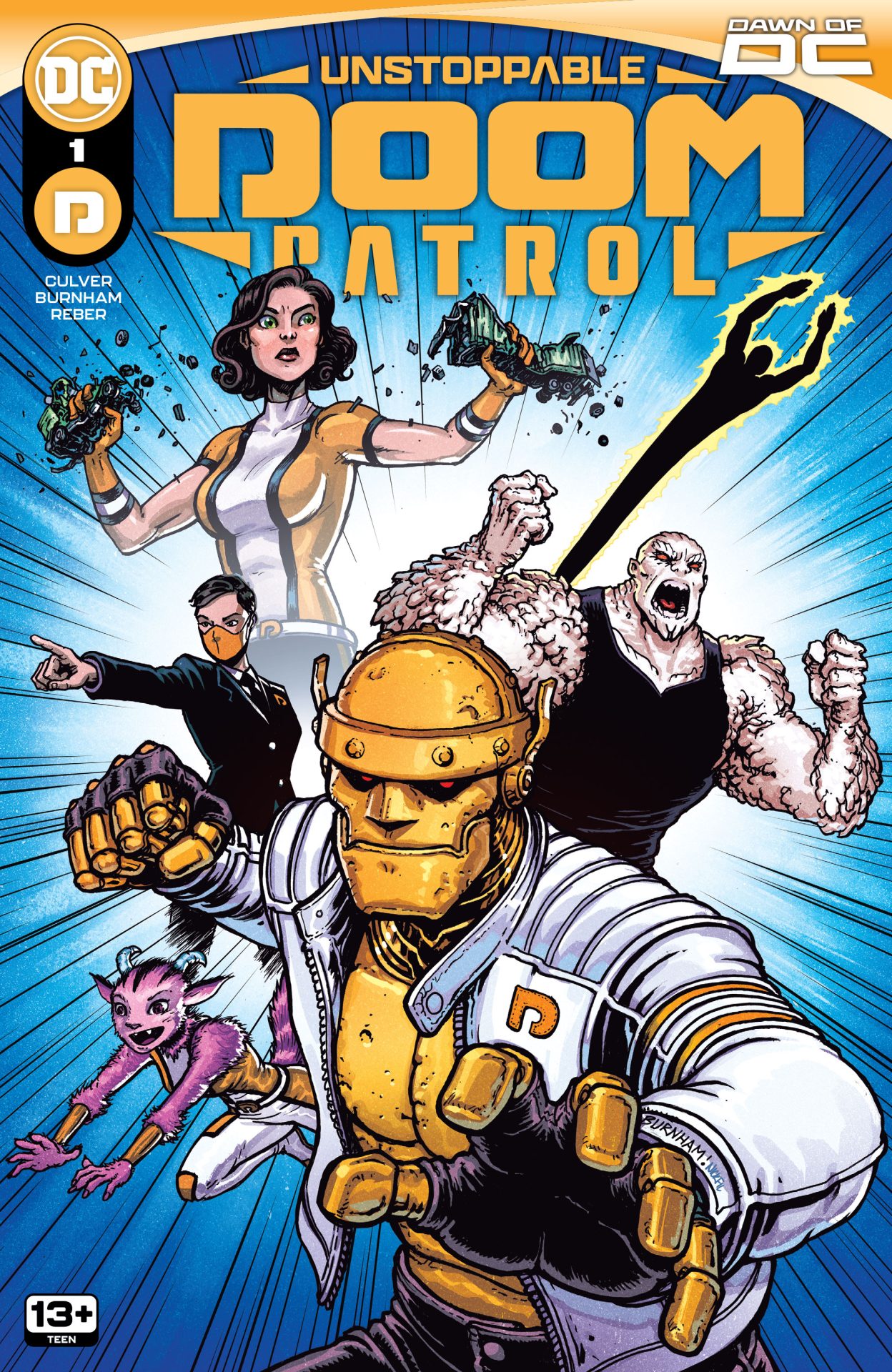
Unstoppable Doom Patrol #1

Unstoppable Doom Patrol #1 is an engaging fusion of meat and potato superheroics and off the wall antics. There is a robot gorilla in this comic. Set in Gotham City, it has one foot firmly in the DC Universe and another in heart on your sleeve surrealism. For example, Crazy Jane is the Chief now. (Don’t ask, just read!) With his experience doing fucked up body horror (Nameless) and globe-trotting superhero team-up’s (Batman Inc.), Chris Burnham definitely was the perfect artistic fit for this new iteration of the Doom Patrol, and he and writer Dennis Culver and colorist Brian Reber lay down a first issue that functions as a done in one adventure, a mission statement for the new miniseries, and sets up some fun plot lines down the road rooted in both the original Silver Age Doom Patrol and Paul Kupperberg’s late 1980s Doom Patrol run (If it had more action and fun and less monologuing.) that paved the way for the classic Grant Morrison run.

Until a passionate Cliff Steele monologue towards the end of the issue, Unstoppable Doom Patrol #1 goes for big and bold in its layouts and approach to storytelling. The first page is Monsieur Mallah and the Brain fighting General Immortus’ incredibly crumbly zombies (Burnham’s art has great and occasionally unsettling textures to it.) in a full splash before a double pager that’s a cool title page and gives you everything you need to know about the current Doom Patrol lineup. Unlike the recap pages at the house Mickey owns, Burnham and Culver dish out this information visually and verbally with a classic team shot of the current lineup and three panels setting up the trip to Gotham that Robotman isn’t looking forward to.

And speaking of classic, Dennis Culver and Chris Burnham have gone with a Doom Patrol cast that is both traditional and breaks new ground. Of course, there’s Cliff Steele, Larry Trainor, Rita Farr, and the Chief (With a twist.) But there’s also Beast Girl, who is a hyperactive riff on Beast Boy’s appearances in the pages of Doom Patrol before finding fame as a Teen Titan, both New and Go. Culver and Burnham use her abilities in a clever way in the big climactic fight sequence, and she’s pure id with some added splashes of color from Reber. Her and Robotman also have a pleasant father/daughter dynamic that I hope gets expanded on in future issues.

However, the most intriguing part of Unstoppable Doom Patrol #1 is one of Jane’s alters becoming a new version of the Chief complete with cloth mask, a keen strategic vibe, and the ability to deconstruct DC Comics’ cash cow at will. Like in previous incarnations of Doom Patrol, the Chief sets the tone for the team and series, but Dennis Culver and Chris Burnham do away with the toxicity and manipulation of Niles Caulder in past comics and replace it with radical honesty and compassion. The Doom Patrol isn’t here to fight monsters, but to save them, and there are factions and folks in the DC Universe that aren’t into this setting up future intrigue in the miniseries. But, for now, it’s cool to see this team kick ass and give heartfelt monologues while simultaneously deconstructing and rebuilding the superhero genre.

Unstoppable Doom Patrol #1 has loads of nods to past Doom Patrol stories, but Culver and Burnham find new wrinkles especially in their take on Jane/The Chief and how the team interacts with more mainline superheroes although I was totally substituting Lazarus Planet with Invasion! in the page where that’s mentioned. All in all, the book features a quirky cast of characters rescuing societal outcasts and saving the day, but in an offbeat way with Burnham flexing his horror muscles in a PG-13 way and still providing a lot of big action and bright colors courtesy of Brian Reber and shows it’s okay to get weird sometimes and express big emotions.

Story: Dennis Culver Art: Chris Burnham 
Colors: Brian Reber Letters: Pat Brosseau
Story: 8.6 Art: 9.0 Overall: 8.8 Recommendation: Buy

DC Comics provided Graphic Policy with a FREE copy for review


Purchase: TFAWZeus ComicscomiXology/Kindle

Review: Doom Patrol #7

DoomPatrol7

Niles Caulder is a terrible, manipulative human being, and writer Gerard Way, artist Mike Allred, and colorist Laura Allred make readers, both new and veteran, aware of that fact in the standalone Doom Patrol #7. The comic might start with Robotman and Negative Man (Larry Trainor) hanging out at the mall and getting away from the general strangeness of the first arc, but this is no slice of life story. Robotman, Negative Man, and new team member Casey Brinke end up following Niles Caulder on a wild goose chase of a mission where they receive “upgrades” without their consent, travel in a cube to a world where bad ideas are jelly, and even transform into werewolves. Just another day in the life of the new look Doom Patrol.

Mike and Laura Allred are the perfect art choice for the adventurous tone of Doom Patrol #7. The one constant is the matching red uniforms that Niles forces Casey, Robotman, and Larry to wear, but their plaid patterned journey to the world of Scantaria provides an opportunity for Laura Allred to go wild with all kinds of reds, brown, and finally a downright disgusting blue when the team fights a monster that decided to ingest all of humanity’s bad ideas in one gulp. For his layouts, Mike Allred sticks mainly to grids and fills them up with all kinds of wobbling, viscous images because everything falls apart when Niles Caulder gets involved. In most of the action scenes, Niles is barking orders and turning the Doom Patrol into putty in his hands, but Allred goes for a iconic, superpower pose towards the end of the issue when Robotman whacks the aforementioned monster with his severed arm. It shows that the Doom Patrol doesn’t need Miles and are find chilling in Dannyland and looking for Casey’s missing cat.

Doom Patrol #7 is a clever book because it deconstructs superhero comics without going the usual  Watchmen, Dark Knight Returns route, having a postapocalyptic setting, or doubling down on the grim dark. It shows that superhero teams don’t have to have a clear leader, go on missions for the hell of it, wear spandex uniforms, or unquestionably follow the old white guy like the Doom Patrol of old. They can wander around the mall and find themselves or look for lost cats named Lotion. They can wear bandages on their faces, clank like a robot, or have a missing leg and still be happy. In the main Doom Patrol, Gerard Way and Nick Derington have taken a fluid, open ended approach to stories and took their time reassembling a “team”, which is the complete opposite of the rigidness that Niles immediately imposes on them. And he’s not a good guy just one on a power trip that tells people what’s good for them instead of asking them like when he gives Robotman a new body that emotions of its own to go with his mind’s emotions. (Being violent is awkward in this case.)

DoomPatrolInterior

Sure, he has kooky gadgets, serums, and vehicles that match the surrealistic tone of the comic, but Niles is entirely self-serving. There is savage irony in a man, who makes so many terrible decisions in this story on the behalf of some kind of greater good, looking for a substance that puts bad ideas that you think are good in your head. And the reason he wants this jelly to rectify one of his personal bad decisions, and the cycle continues like Mike Allred’s drawing of the rapid evolution process the “final boss” of this issue undergoes when he straight up ingests the jelly. Of course, Niles gives Casey and Larry the jelly in granola bar form to fight him off. This rapid sequence of events shows that he is willing to play god at a moment’s notice so the outcome favors him.

Doom Patrol #7 is a statement of this comic’s freedom from ordinary superhero storytelling using Niles Caulder as a metaphor with vibrant wit and an idea a minute plot from Gerard Way and transformative art from Mike Allred and Laura Allred. Old white guys usually don’t know best even if they can regrow limbs in a jiffy or travel between dimensions, and sometimes trying some weird and creative can be more fun than reading the same, “To me *insert old superhero team name here*” over and over again.

Story: Gerard Way Art: Mike Allred with Nick Derington Colors: Laura Allred
Story: 9 Art: 10 Overall: 9.5 Recommendation: Buy

DC Comics/Young Animal provided Graphic Policy with a FREE copy for review

Review: Doom Patrol #1

doompatrol1Writer Gerard Way got the blessing of the great Doom Patrol writer Grant Morrison before beginning his run on the title, and the comic definitely shows the great Scottish writer’s influence. But the comics reads more like Invisibles or Flex Mentallo than JLA with its parallel universes in a gyro, brick throwing hobos, keyboard solos from Doom Patrol founder Niles Caulder, and a singing, former roommate exploding space girl named Terry None. It’s safe to say that Doom Patrol is the strangest experience I’ve had reading a comic in 2016.

Even if Way doesn’t do readers any favors by showing clear transitions between most scenes (Except for the masterful cut from a fly on a gyro to Robotman fighting through a post-apocalyptic wasteland.), he, artist Nick Derington, and colorist Tamra Bonvillain deliver on some eye-catching imagery throughout the comic and also begin to develop some basic themes as well as the protagonist Casey and the evil corporate antagonist. Casey has a “normal” job as a hard-driving EMT, but a weird backstory involving aliens and strange beings that her co-worker Samson comments on while on a lunch break at an arcade. The Space Invaders-esque arcade game could very well be a door into another universe, but Way and Derington don’t give us any clear answers yet.

The experience of Doom Patrol #1 is like being dropped into the middle of someone else’s dream or in the middle of a video game where the controller has buttons set up completely foreign to you and is a genre that you don’t even have the words in your personal lexicon to Like you’re some kid from the far future who has just been handed a Sega Dreamcast controller and are playing something archaic (to you) like Tomb Raider or any sports game. And that metaphor is probably too simplistic. Like Morrison in Invisibles with his protagonist Dane, Way and Derington drop you into this explosive, reality bending universe without giving you the rules to figure it out. Hopefully, a John-a-Dreams type fellow shows up in a few issues to show readers nature of this world, but for now, it’s blind flying.

Doom Patrol is a free fall that ends just before the reader turns into street pizza. And along the way, Derington and Bonvillain warp commonplace visuals into something unusual from double page spreads to panel grids and even a run of the mill explosion. (Things do go boom a lot in this comic making Doom Patrol a natural extension of both Invisibles’ and My Chemical Romance’s unfortunate final (for now) album True Lives of the Fabulous Killljoys‘ penchant for using guns to illustrate philosophical ideas.) The scenes featuring Robotman are especially exemplary doompatrolinterioras Derington uses a different art style and a twelve panel grid to show the intensity of the battle as Bonvillain uses a light brown palette to show the dream-like nature of this fight as Derington zooms out and shows that there’s a whole world stuffed in a gyro in a trash can. Then, there’s a purple explosion from Bonvillain, and this reality enters what seems most like ours. In one bold color, like a Mikey Way bass line, she creates a connection between worlds.

Unlike the (possibly extraterrestrial) Moofgoober Corporation, who are creating a kind of constantly regenerating source of meat and pushing it on the world via franchise tie-ins, subliminal advertising, and just plain giving people what they think they want, Gerard Way, Nick Derington, and Tamra Bonvillain go away from the familiar in Doom Patrol #1 and bombard readers with a flurry of unfamiliar imagery. The final page is nigh incomprehensible even though it does feature a visual refutation of the cliche “People in glass houses shouldn’t throw stones” as the hobo guy can’t stop throwing bricks.

Doom Patrol isn’t nostalgic comfort food for fans of DC Comics, but original almost to a fault and Way, Derington, and Bonvillain use the versatility of the comic book medium to linger or flip through pages and panels to skillfully recreate the falling into an unfamiliar world and decision to press on that artists like Lewis Carroll, Luis Bunuel, Salvador Dali, David Bowie, Grant Morrison, and The Wachowski Sisters or any kind of hallucinogenic drugs have tried to evoke or simulate throughout the years. And Derington’s interplay between the clean lines of his heroine Casey and her new “friend” Terry None and the geometrical corporate toadies creates a feeling of multiple realities without the usual clunky exposition.

Story: Gerard Way Art: Nick Derington Colors: Tamra Bonvillain
Story: 7 Art: 9 Overall: 8 Recommendation: Buy

DC Comics provided Graphic Policy with a FREE copy for review