
Review: Inferno #1
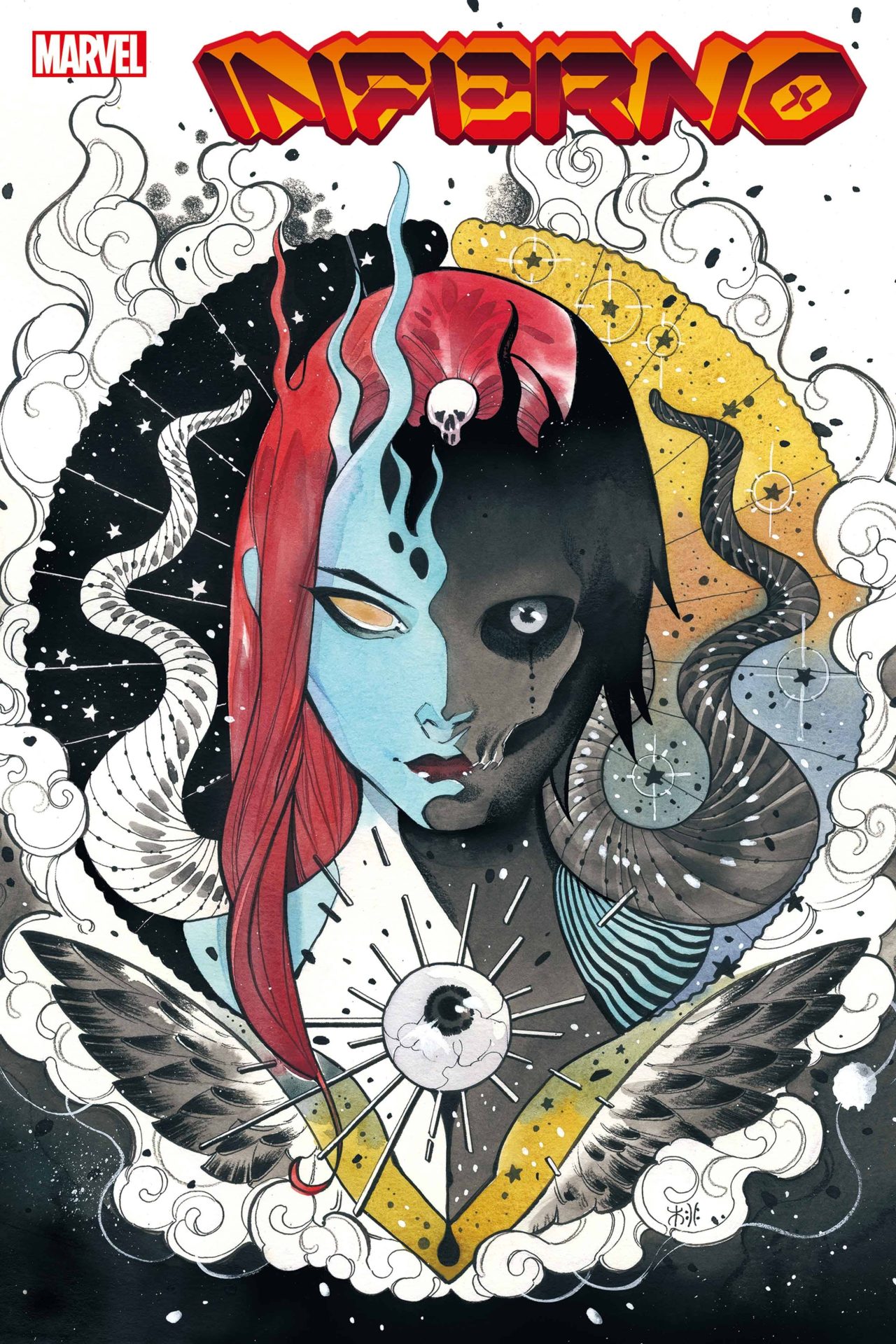
A lot of Inferno #1 is a table-setting tease, but boy, it’s nice to see Moira X back in action and in direct confrontation with the one mutant that can negate her abilities and quash her plans, Destiny. Jonathan Hickman, Valerio Schiti, and David Curiel bring a small semblance of the epic thunder of House of X and Powers of X back in the high stakes arguments between Moira, Professor X, and Magneto as well as a brutal opening battle sequence between X-Force and Orchis. Plus there’s all the underlying elements about Krakoa being on thin ice culminating in a not exactly a shocker of a final sequence, but a statement piece that definitely has me invested in Inferno #2.
For all its flaws, Inferno is a book that is both time-spanning and cloak and dagger, and Schiti is good artist pick to juggle all this. He can use wide open layouts for fight and group scenes and then trim down and go tighter with nine panel grids as Mystique and Destiny confront Moira X and the use of her abilities to try to “cure” mutants once and for all. This storyline is something that has definitely popped up in X-Men stories quite a bit, but Hickman adds a SF wrinkle with the use of multiple timelines and reincarnation abilities. There’s also the failed utopia angle, and the last third of Inferno features plenty of hot people with superpowers acting like academics on a subcommittee with Madripoor substituting for the local watering hole. However, this awkwardness sells the last couple pages even more with Valerio Schiti nailing every Quiet Council member’s reaction to their new member.
Inferno #1’s extended length leads to plenty of Jonathan Hickman self-indulgence, including double data page spreads, a Warlock and Cypher interlude that might be Krakoa’s last happy moment before everything burns, and very long conversations. All the Orchis/Quiet Council maneuvering aside, Inferno is really the story of two couples: Xavier and Magneto, Destiny and Mystique. They are joined together via Moira X and set at cross purposes by her with Destiny seeing Moira’s real threat in her tenth life (The aforementioned cure). On the other hand, Moira sets Xavier and Magneto against Destiny and says she’s a threat to Krakoan stability, which leads them to do some very morally questionable things. This is par for the course in the “Dawn of X”/”Reign of X” era, their characters in general, and definitely backfires as evidenced by the issue’s first image of them crawling out of resurrection pods before a Cerebro-rocking Emma Frost. This page is a shining example of how Inferno #1 is more appetizer than full meal.
The Xavier/Magneto scenes definitely feel like they could be plucked from the better parts of Hickman’s X-Men run and also showcase Schiti’s skill with character acting. David Curiel also ups the intensity of the colors depending on the flow of conversation. Moira X is Krakoa’s ringer, and why they keep attacking Orchis over and over even as this starts to expose the resurrection protocols to their enemies. As anyone who has interacted with X-Men media knows, Sentinels are bad, and mutants are good. But after the double digit failures in taking out Nimrod, Magneto and Xavier start to wonder if a partnership with these machines might be a good idea. Unfortunately, Moira X has seen the future and knows this isn’t a viable path and directs their energies to a pre-cognitive mutant instead. Schiti draws panels of them sabotaging the resurrection process with close-up shots of Mr. Sinister (Or a clone) and Krakoan language vials that scream death of a utopia.
However, Jonathan Hickman and Valerio Schiti keep things ambiguous and basically smash cut to the election of a new Captain Commander and the ending Quiet Council meeting saving the consequences for a future issue. Sneaky, morally ambiguous Xavier and Magneto is a great time though even as they speak about humility and posture about resigning their positions of leadership and letting a new generation take over. It’s unclear how Inferno fits with Trial of Magneto, but these are two mutants that definitely don’t seem to be relinquishing power any time soon, hence, the shady shit with Moira X.
Inferno #1 returns to one of the most interesting plot threads from House of X/Powers of X: Moira MacTaggert being one of the most powerful mutants, who also acts as a kind of meta-commentary on the ideological evolution of the X-Men. (I can take or leave the Orchis stuff.) She has plenty of panel time in this issue, but it’s all set up for future conflicts that will hopefully shake Krakoa at its core and end Hickman’s run on the mutant books in a suitably dramatic fashion. For now, there’s a lot of speeches, posturing, and everyone’s favorite, data pages.
Story: Jonathan Hickman Art: Valerio Schiti
Colors: David Curiel Letters: Joe Sabino
Story: 7.0 Art: 8.0 Overall: 7.5 Recommendation: Read
Marvel Comics provided Graphic Policy with a FREE copy for review
Purchase: comiXology – Kindle – Zeus Comics – TFAW

