
Movie Review: Godzilla Minus One turns the iconic kaiju into the God of Monsters

From the very first trailer on, it was evident Godzilla Minus One was setting its sights on echoing the roaring debut of the nuclear monster back in 1954. Gojira, directed by Ishirō Honda, was a visceral kaiju allegory for the newly minted atom bomb world, a giant creature feature that turned the titular monster into a reminder of the position humanity put itself in by creating weapons of mass destruction. It looked at the state of things at a macro level, from a pretty frightening vantage point. Minus One goes for a more focused approach, putting soldiers and their PTSD at the forefront for a different look at the consequences of human-led devastation and the towering psychological obstacles it creates for those tasked with carrying out militaristic violence.
Godzilla Minus One, directed by Takashi Yamazaki, follows a soldier called Koichi (played by Ryunosuke Kamiki) as he comes home from the war with not just the trauma of his failed mission as a kamikaze pilot but also as a survivor of a battle against a young Godzilla. During that encounter, his inability to act in a key moment of the fight led to the deaths of several soldiers, a decision that’ll haunt him for almost the entirety of the film.
Koichi returns to his hometown only to see it buried under rubble, the victim of allied bombing. As he tries to salvage whatever he can to make his home again, he meets a woman called Noriko (played by Minami Hamabe), a woman in a precarious position that’s trying to survive with a baby in hand. He takes both of them in and time passes. Just as things start getting rebuilt, Godzilla is awakened by atomic bomb tests and Japan is reminded once more that wars never truly end. They just assume a different form.
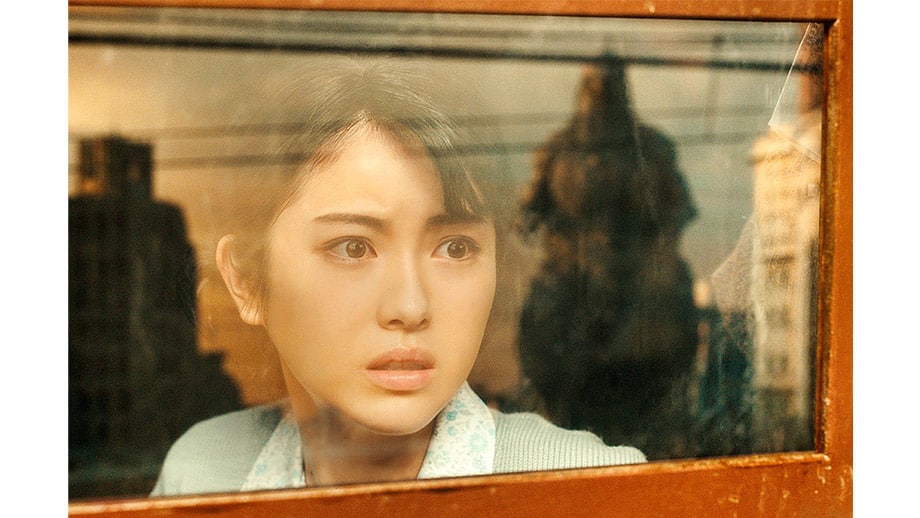
From the very first Godzilla movie on, audiences have gotten uniquely different iterations of the classic kaiju. He’s gone from King of the Monsters to Japan’s protector to a parody of himself and back again. In Hideaki Anno and Shinji Higushi’s 2016 Shin Godzilla (widely considered as the best Godzilla movie after the 1954 original), for instance, he becomes a force of nature that exposes humanity’s inability to coordinate a unified response to solve a problem. The film mocks the government’s insistence on bureaucracy to problem-solve and how contradictory the efforts end up being. Godzilla represents the consequences of such dysfunction and how destructive it can be.
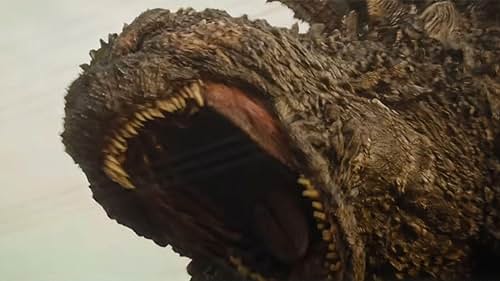
In Minus One, Godzilla is essentially turned into a god. He’s the ultimate expression of cataclysmic consequence. Director Yamazaki frames every scene he’s in with a sense of finality that absolutely terrifies. Godzilla’s arrival means humanity is about to get judged, harshly. It’s an impressive showcase of the giant monster that makes for one of the most tense-inducing portrayals of it in franchise history. It’s all reflected in his powers this time around. Without spoiling anything, just know you’re in for a few surprises that both make this version of the monster unique while updating certain aspects of it to make sure the metaphors on display hit harder.
The severity of Godzilla’s presence, what it implies, does an excellent job of imbuing the Japanese soldier experience with a sense of duty and hope that isn’t always given the attention it deserves in war movies. Koichi’s character, for instance, wears his PTSD on his sleeves, constantly reminding the audience his war is a constant and that it didn’t end with the armistice that brought the conflict itself to a close. Trauma does not sign off on this process and thus owes it no recognition. The film hits you over the head with this idea, but it’s in service of setting up a different outcome for the soldiers driving the story.
Koichi’s supporting cast does an incredible job of exploring the range of trauma and disillusionment that ailed soldiers in the postwar period. One character of note is Sosaku Tachibana, played by Munetaka Aoki, a soldier that also survived the first Godzilla attack along with Koichi. His trauma manifests as anger, making his own war one of disappointment in his brother in arms. The way the movie tackles the diversity of trauma, though, is by highlighting the things soldiers have in common rather than the things that separate them.
By turning trauma into a unifying force, Minus One opens the doors for hope and healing to come through as real and attainable things. War movies dealing with the similar themes rarely opt for hope. Minus One does and it makes for a welcome deviation from the norm. It actually makes the Godzilla scenes feel scarier as the possibility of surviving the giant monster raises the stakes considerably. The audience is encouraged to cheer for the story’s heroes more so than in other stories that deal in war.
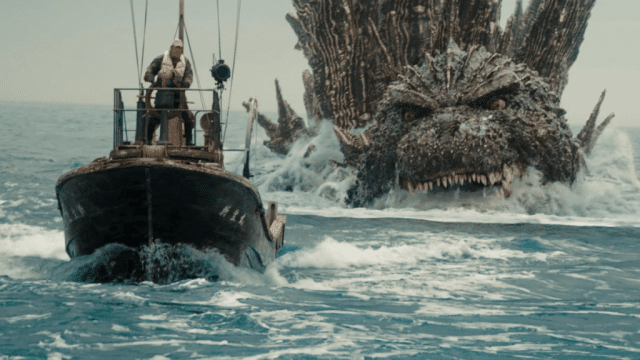
Naoki Satô pulls all this together with one of the best Godzilla scores to date. It’s surprisingly restrained but possessed by an epic sense of dread and momentousness that captures the god-like terror of the iconic creature. There’s one particular sequence that feels ripped straight out of Stephen Spielberg’s Jaws that ramps up the horror of facing a giant monster at sea by relying on doom-charged sounds that slightly quicken whenever Godzilla gets closer to the boat he’s chasing. Not a single musical cue is wasted in this regard, giving individual action sequences their own identities. Even when the requisite theme music from the original Gojira (composed by Akira Ifukube) kicks in during one sequence, it doesn’t overshadow Satô’s score. In fact, I wanted to see how that particular sequence would’ve played out with Satô’s score accompanying it.
Godzilla Minus One is a triumph. It earns a spot among the greatest Godzilla movies ever made, right next to the original one and Shin Godzilla. It’s integration of multiple war metaphors along with tense kaiju action lets it stand on its own. What makes it soar, though, is how it manages to turn an already iconic monster into an even more impressive and colossal version of itself. The age of the King of Monsters is over. The age of the God of Monsters has begun.
 Shin Godzilla opens strong and never loses momentum. As the first Japanese Godzilla film after the franchise went on hiatus in 2004, fan expectations were higher than they’d been since Godzilla: Final Wars twelve years prior. Toho made the wise decision to return with as strong an entry as possible, tapping Hideaki Anno of Neon Genesis Evangelion fame to write the franchise reboot. With Shinji Higuchi co-directing, Anno crafted a Godzilla film unlike any other in the franchise. If you are a longtime Godzilla fan, how well you react to changes in the classic Godzilla formula will determine whether this movie works for you or fails. Speaking as a fan for over 20 years, it worked almost flawlessly.


