 Comics and the prose book go way back. Marvel was starting its golden age and books like the Avengers, Spider-Man, the X-Men, and the Fantastic Four were quickly becoming childhood favorites, and they took advantage of this to write what’s now called in the business a “prose novel” (though anyone should know that that’s rather redundant; no, “prose book” isn’t redundant because a book can be non-prose, like a TPB or graphic novel). Marvel’s first prose novel was 1967’s The Avengers Battle the Earth-Wrecker by Otto Binder, and it was an attempt among other things to show that comic book characters could transcend their images, that they could be literary legends as well. I don’t doubt that it was also a smart marketing ploy to allow parents the satisfaction of knowing their kids were reading books, not comics, while still allowing kids (or adults!) to follow their favorite characters’ sagas. DC did this as well, albeit since some of their characters were older, they were able to build the wagon that then carried the proverbial band, with 1942’s The Adventures of Superman by George Lowther. You can check out more titles on Wikipedia. This paragraph is my way of justifying writing a review of a book on a largely comics-based website, so just go with it…
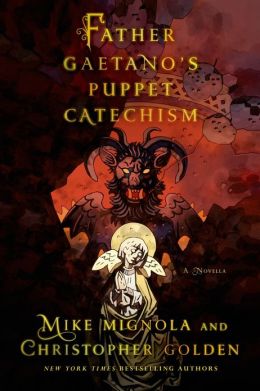
Despite Marvel and DC having founded, pioneered, and created monuments in the comic book prose novel category (though I’m not sure how good the writings of these are), it’s Mike Mignola and Christopher Golden who take home the prize, since they’ve penned two novels to-date and a novella that are spawned from the Gothic atmosphere of the Mignolaverse, aided by Golden’s experience as a novelist, and accompanied with eerie drawing from the mind of Mignola. Now it’s no secret that I’m a Dark Horse fan, since the majority of my reviews are for their stuff, and it should likewise be no secret that I’m a Mignolverse acolyte (hell, I’m planning on writing my Master’s Thesis on the role of the occult and Gothic fascination of American society as it is experienced in modern comics, with special attention Mignola’s books). So when I discovered Father Gaetano’s Puppet Catechism: A Novella, with a promising synopsis on Amazon, I just had to see how he adopted his comic genius to the big page, as it were. What I found in the short novella was entirely worthwhile.
(SPOILERS) The story begins in Sicily during WWII, after Sicily has just witnessed a major battle and the Allies have thrown off the German occupation of the island, making it once again a somewhat insignificant island in the grand scheme of the war. The setting is a rectory in the village of Tringale that’s been turned into an orphanage for those children who lost their parents in the bombing. Already, this is a rather depressed setting rife with emotional possibilities–a key facet of Mignola’s writing. And has anyone else realized that many of his stories are set in wartime? It’s a perfect neo-Gothic setting. A new priest has arrived to take control of the orphanage and local ministry, Father Gaetano. Other protagonists include Sebastiano, a lonely 9-year-old orphan; Sister Teresa, a beautiful but commanding abbess; and Pagliacco, a clown puppet.
Perhaps you can see where this is going given the name of the novella and the cast above? But you’d be only somewhat right. Faith and the ‘parts’ we play in life are the major themes of this book, and Father Gaetano struggles to teach the orphans about free will and the good of God. After all, these kids have lost everything, they’ve seen the worst of human kind, and they’re naturally disenchanted with the religious fold. I know a death in my life caused me to start thinking God wasn’t real; then an anthropology degree led me to the idea that religion is a cultural creation, nothing more (my opinion, the the opinion of this website or anyone else associated herewith). In an effort to capture the children’s imagination and awe them with the word of God, Gaetano uses a puppet theatre left behind by a former caretaker and puppet-master. It is slowly revealed that the puppets might actually be alive; Sebastiano is a key player in all of this, and the development of this plot point is haunting and foreboding.
It becomes obvious to the children, who are visited at night by the puppets, that whatever characters Father Gaetano makes the puppets play during the teaching of the Bible, is the role the puppets take on in their late-hour after-dark lives. The David and Goliath puppets try to kill one another, and the Noah puppet causes a disturbance trying to get the children to help him build an ark. It’s not until Father Gaetano decides to teach the children about good and evil, the double-edged sword of ‘free will,’ and the Fall, that the eerie animation of the puppets takes a turn for the dark. A Lucifer puppet! His creation changes the game, forces realizations that childhood play and the opinions of children are not something to cast off as young, imaginative nonsense. The ending is dark, ominous, and suggestive of the sort of sinister, calculating evil feared by the Church for so long–another of Mignola’s literary watermarks.
Several small, black-and-white Mignola illustrations are included in the book, probably no more than a dozen, and they create a relationship with the text that is not always exactly representative of the actions in the narrative, but more often captures, expresses, and intensifies the tone of Mignola and Golden’s narrative. My only complaint is a petty desire for more, more, more of Mignola’s illustrations!
Hopefully this has your interest, and maybe you’ll have the time to break away from your growing stack of comics to check out Mignola and Golden’s Father Gaetano’s Puppter Catechism, a chilling and instructive novella about the evil we create in our own lives, and that humans are ultimately responsible for their creations, not deities.
Story: Mike Mignola and Christopher Golden Art: Mike Mignola
Story: 9 Art: 8 Overall: 9 Recommendation: Buy and Read

