Tag Archives: cynthia addai-robinson

TV Review: Lord of the Rings – Rings of Power S1E4 “The Great Wave”
The Great Wave

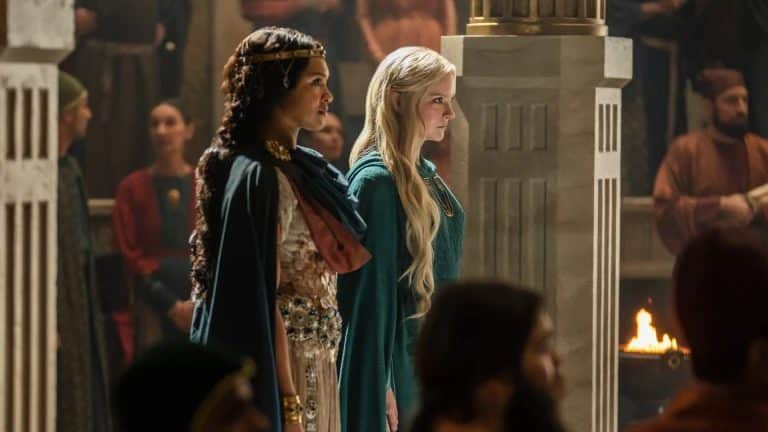
Lord of the Rings: Rings of Power hits the midway point with portents of doom and unexpected alliances in “The Great Wave”. Writers Stephany Folsom, J.D. Payne, and Patrick McKay continue the focus on the kingdom of Numenor beginning with a powerful, opening dream sequence where the queen regent Miriel (Cynthia Addai-Robinson) sees the island destroyed by the titular giant wave while she is blessing babies in the palace. Although she jails Galadriel (Morfydd Clark) for sedition, she is more open to working with the Elves and being faithful to the gods of Middle Earth, the Valar, then she initially let on leading to a surprising conclusion to this episode. As well as spending time in Numenor, “The Great Wave” turns its eye to how the humans of the Southlands are faring and offers a first glimpse at the mysterious Adar (Joseph Mawle) plus a return to Elrond’s (Robert Aramayo) visit to the Dwarves. The episode is chock-full with references that fans of the J.R.R. Tolkien-penned source material will appreciate, but lacks the visual wow factor and emotions of the previous episode as it sets up the back half of the season.

Miriel’s decision to either side with Galadriel and help the humans of the Southlands or continue an isolationist stance is at the center of “The Great Wave”. Galadriel might have great power, but she’s a terrible diplomat and gets a lesson in interpersonal communication from her cellmate Halbrand (Charlie Vickers). The characterization is a little condescending and feels like the writers needed some conflict to spin their wheels until the real reason why Miriel decides to help the Elves comes into play. Clark does get to show off Galadriel’s sheer presence and unyielding presence when she handles a palantir (A magic, seeing stone that can see far-off locations/possible futures) like a champ impressing Miriel, who is revealed to be barely hanging on by a thread because of her sick father Tar-Palantir. As regent, she’s very much an interim head coach, who wants to keep the country/team sailing smoothly and not tear everything down and start a new status quo. It takes an unsettling portent in a moment of visual splendor from director Wayne Che Yip to disrupt this.

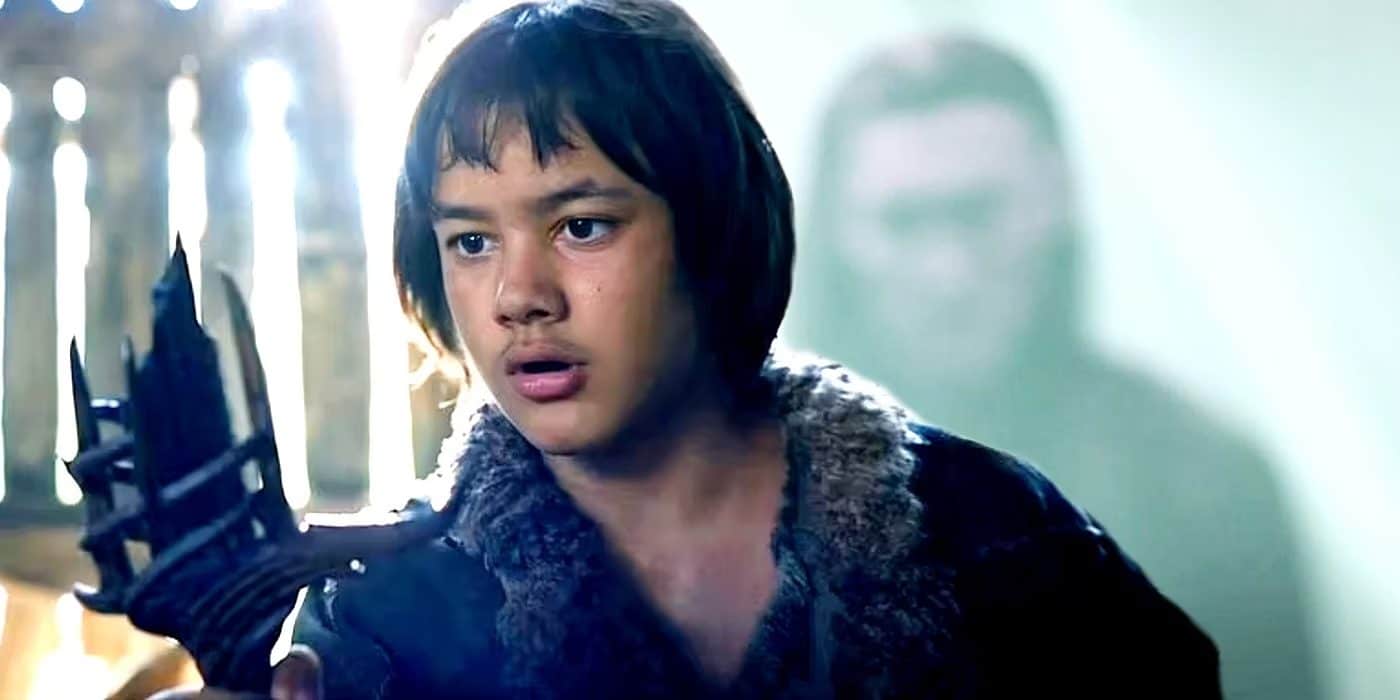
The Southlands’ scenes explore the effects of the supernatural on Middle Earth’s status quo from a different perspective. Building off last week’s fog-obscured character reveal, Folsom, Payne, and McKay stay mystery-shrouded around the character Adar letting makeup and costume design shows that he’s been through some hard time and has an affinity to the Elves, hence, the name. These visual touches cause Arondir to freak out a little bit and have spawned even more fan theories. Mawle plays Adar with unyielding authority offering no terms except surrender to Arondir, who is to run the message to the humans of the Southlands. However, the real supernatural stuff comes from Bronwyn’s (Nazanin Boniadi) son Theo (Tyroe Muhafidin) and his Morgul blade as he and his friend/bad influence Rowan (Ian Blackburn) go to the village to get supplies for the starving Southlanders.
The Great Wave
this kid is so fucking annoying for no reason…

However, I have mixed feelings about the Theo storyline. The inclusion of the blade and the namedropping of Sauron from tavern owner Waldreg (Geoff Morrell nails the creepy old man vibes.) add an air of menace and a connection to what’s going on with Galadriel and Numenor. Theo himself doesn’t get much characterization beyond being a scared, annoying brat, who has the plot armor to get around a legion of Orcs and return to the tower of Ostirith where the people of the Southlands are taking shelter. There’s a point about the seductive nature of power in his hunger to hold onto the blade, but mostly, I think the cool, evil sword is wasted on him. The final chase sequence does add to Brownyn’s mom of the year case as she runs through hails of arrows to find Theo with Arondir (A potential future step-dad?) in tow doing cool slow-mo ducks and dodges and tricks worthy of another heartthrob Silvan Elf (Legolas). I like that the writers and Yip keep showing how vulnerable the Orcs are to light, which could come in handy down the road.

Definitely compared to my reviews of the first three episodes, I’ve been a bit negative of this one, but “The Great Wave” wasn’t in a total wash, and lot of that was thanks to a return to Khazad-Dum. Elrond thinks there’s something secret going on in the mines and doesn’t buy Prince Durin IV’s (Owain Arthur) wife Disa’s (Sophia Omvete) excuses and ends up going on a mini-adventure through Khazad-Dum finally finding out that the dwarves have discovered a new metal named mithril. However, this series of events is more than just an origin story for the metal that corrupted the dwarves and saved Frodo’s life in Fellowship of the Ring, but further develops Prince Durin and Elrond’s friendship that they must balance with duty.

Both Elves and Dwarves think that they’re spying on each other, but Elrond also helps with Prince Durin’s strained relationship with his taciturn, my way or the high way father King Durin III (Peter Mullan) by saying that he wishes that he could have had one last conversation with his father, Earendil. Earendil didn’t actually die, but was placed in the stars by the Valar so Elrond has to basically relive the grief every time he sees the night sky. This anecdote isn’t just fan service for Silmarillion, but adds a dimension of grief to Elrond’s character, especially when he tells Durin IV to just have a conversation with his dad: something he could never have again. However, despite Prince Durin IV giving Elrond mithril as a token of friendship, or Disa’s gorgeous song to save the caved-in miners, there’s a darker edge to wrap up this plot as Durin IV basically comissions Durin III as a spy on the Elves. Duty comes before friendship yet again.

Even though it doesn’t do it in the most entertaining way with time-filling arguments and focuses on one-dimensional characters like Theo, “The Great Wave” gets Rings of Power to its mid-point goal with the Elves and humans of Nuemnor allying to fight evil in the Southlands. Thankfully, it’s not all sunshine and roses with some of the humans of the Southlands being followers of Sauron plus the whole vision of Numenor underwater, its feeble king Tar-Palantir, and Pharazon using the military expedition for political opportunism promising his men that they’ll be giving the Elves orders. However, hopefully, later episodes have more of a personal or emotional connection like the scenes with Durin IV and Elrond aren’t just focused on getting from narrative point A to point B.

Overall Verdict: 7.6

TV Review: Lord of Rings – The Rings of Power S1E3 “Adar”

Adar

The stakes rise in Rings of Power‘s third episode “Adar” that opens with the Silvan Elf Arondir (Ismail Cruz Cordova) and his comrades far from the humans they used to protect or their watch tower, but in the chains of the Orcs that have been living in tunnels underneath the Southlands because the sun burns their skin. They serve a mysterious being called Adar, who may or may not be the Sauron, the Big Bad of the Lord of the Rings trilogy. Arondir’s plotline is a true plunge into darkness and mirrors the show as a whole taking a more tense tone with little bits and bobs of hope, especially in the Harfoots’ plotline with the Stranger (Daniel Weyman) being a little more helpful than he initially let on. However, the big highlight of “Adar” is the introduction of the island kingdom of Numenor that makes Galadriel (Morfydd Clark) and Halbrand (Charlie Vickers) arcs more compelling than floating around the Sundering Sea, introduces a bunch of new characters and political intrigue, and finally gives director Wayne Che Yip a chance to show off the sheer glory of this kingdom that makes its later offshoots, Gondor and Arnor, look like pale reflections with waterfalls, giant statues of former kings, and cool towers and architecture.

Even though it’s nice that Galadriel and Halbrand get picked up by sailor Elendil (Lloyd Owen) instead of floating on a piece of drift wood, Numenor is no picnic and is quite charged political situation. During a walk and talk exposition sequence, Galadriel explains to Halbrand that Numenor was given to the humans who helped the Elves in the war against Morgoth, but their relationship has disappeared. The current ruler of Numenor, Miriel (Cynthia Addai-Robinson) and her advisor Pharazon (Trystan Gravelle) perpetuate a very boot straps-y myth of self-reliance and instantly call out Galadriel’s explanation of Numenor’s origins. Coupled with their xenophobia towards Elves and other humans, the parallels to the current day United States are pretty clear, especially in the individual treatment that Galadriel and Halbrand. Miriel’s xenophobia also comes out when she interacts with Elendil giving him grief because his name means “Elf-friend” and generally treating him like a land mine about to go off.

Because of her reputation and abilities, Galadriel is kept as a political prisoner, but, of course, she uses her Elf parkour abilities to break out and try to escape on a small skiff until Elendil finds her. Even though they’re initially both wary of each other, Elendil breaks the ice by speaking the Elf language Quenya and mentioning a Hall of Lore that becomes incredibly important in the young season’s overarching plot. With the exception of a really weird slow-mo riding sequence, the interactions between Elendil and Galadriel are one of the highlights of the episode and show that maybe there is a chance for Elves and humans to work together against an evil that is still very much present in Middle Earth as evidenced by what’s going on in Arondir’s story.

Adar

However, Galadriel doesn’t occupy all of Elendil’s time in “Adar”. Writers Jason Cahill and Justin Doble explore his family life too, including his relationship with son Isildur (Maxim Baldry) and daughter Earien (Ema Horvath). They introduce Isildur by him staring out into space during the middle of an intense exercise that’s part of his training to join basically the Numenorean navy, but he has the instincts and hero’s heart to save one of his comrades who almost falls overboard and goes out to sea. Later, we learn that joining the navy was Elendil’s idea, and he really wants to sail west to Middle Earth, which is why he was staring over the sea and fanboys over Galadriel. Isildur’s explorer spirit also inspires his sister to join the builder’s guild, and Baldry brings a lot of youthful energy into his performance while establishing that he’s light years from the Isildur, who famously cut the One Ring from Sauron’s finger in the prologue of Fellowship of the Ring. The family interactions already add depth to Elendil’s character, who might be all laconic and no-nonsense about his job as a sailor (and more recently Galadriel’s minder), but also has an air of nobility to him.

Speaking of nobility, Halbrand has his own side-plot and semi-big reveal in “Adar” as he is turned away from working from a blacksmith because he doesn’t have a guild badge, attempts to con a smith out of a badge, and ends up in a back-alley, bare knuckle brawl. Vickers plays Halbrand like a pot put on simmer for most of the episode, but towards the end, Yip finally has him cut loose in a literal bone-breaking street fight that ends up putting him in prison where Galadriel ends up visiting him and regaling him with his true background. He’s a survivor and tries to do heroic things like rescue Elves from drowning because Halbrand is making up for the actions of his ancestor, the king of the Southlands, who cast in his lot with Morgoth. But, despite this reveal, Halbrand remains a slippery figure and the subject of many fan theories. Charlie Vickers brings a roguish charm to the role, especially in the scenes where he’s manipulating Numenoreans from Queen Regent Miriel to the local barflies to try to get what he wants in contrast with Galadriel, who is more straightforward due to her power and reputation.

Adar

Numenor might be the flashier storyline in visuals and running time, but “Adar’s” emotional core finds its emotional core with Arondir and the Harfoots. Wayne Che Yip gives the scenes of Arondir and the Elves in captivity the look of a fever dream that works with the more raw and unhinged character designs for the Orcs, who are incredibly vulnerable to the sun and wear hoods and helmets of bone to protect them. More so than the Peter Jackson films, Rings of Power leans into the fact that the Orcs are a twisted reflection of Elves, who destroy instead of preserving natural life. This comes to a head when the former Watchwarden (Simon Merrells) passionately refuses to cut down a tree for his captors, but tearfully, Arondir agrees to do it so he can scope out a possible escape route.

Ismael Cruz Cordova’s facial expressions are heartbreaking as he prays in Quenya and feels the guilt of taking a life while also having a glimpse at freedom. However, some well-placed arrows and a slobbering and genuinely terrifying take on a warg puts an end to this although Arondir ends up living if only to be brought before Adar as the episode comes to a close. Although both the Watchwarden and Arondir’s partner Medhor (Augustus Prew) end up dying in the several escape attempts this episode, “Adar” redeems them as heroic figures instead of the Silvan Elf equivalent of narrow-minded paper pushers like in the first episode of the series. It also shows the futility of resisting Adar and the Orcs in small groups and the need for a concentrated resistance effort like Galadriel has mentioned to Halbrand and even Gil-Galad and Elrond throughout the series.

Adar

Finally, Yip, Cahill, and Doble continue to explore the quirkiness and tragedy of the Harfoots as the caravan’s leader Sadoc (Lenny Henry) finds out that Nori (Markella Kavanagh) and Poppy (Megan Richards) have been harboring the Stranger while busting them stealing a page of star charts from his book. This leads to the serious consequence of the Brandyfoots being sent to the back of a caravan, which is a virtual death sentence because Nori’s father Largo (Dylan Smith) has a bad injury and can barely lift his cart. Although, tempered with gentle humor and even a bit of innuendo, Sadoc’s big speech to the caravan (Apparently, the hobbits’ ancestors loved public speaking too.) that includes a memorial for all the Harfoots lost on the trail shows how difficult life is for them in Middle Earth.

She doesn’t speak, but Richards’ face is heart-breaking when Sadoc mentions that the entire Proudfellow family passed away, and Poppy can see a similar fate for the Brandyfoots. “Adar” spends a little more time with Nori’s parents Largo and Marigold (Sara Zwangobani), who we find out is Largo’s second wife and really fears for what is going to happen to the family. Smith still brings the great comedic timing and wisecracks, but there’s definitely an air of sadness, especially as he strains and falls behind when the caravan leaves towards the end of the episode. However, this is where the Stranger comes in handy, shows that he can help and not just put out fireflies’ lights, and spawn even more fan theories. The Harfoots’ plotline seems a bit disconnected from what’s going on in Numenor, the Southlands, Khazad-Dum, and Lindon, but they represent kind, good, and definitely eccentric folks, who work together to survive in a (literal) big world that could be shattered if Adar’s evil is allowed to spread.

With its glorious introduction of the very flawed kingdom of Numenor as well as the emotions, tension, and tragedy in the Harfoot and Arondir storylines, “Adar” is easily the best hour of Rings of Power so far this season. The show’s theme of the need to put aside past differences and unite in the face of rising evil starts to emerge, and writers Jason Cahill and Justin Doble really get what makes the different factions of Elves, humans, Orcs, and Harfoots tick adding depth to characters as different as Elendil, Halbrand, Arondir, and Sadoc Burrows.

Overall Verdict: 8.7