
Tag Archives: cinema

Shudder’s CURSED FILMS is a surprisingly noble look at notorious horror cinema
Cursed Films
Shudder

The idea of a cursed film evokes images of satanic creatures standing behind the camera, corrupting what’s captured on celluloid. It’s a kind of subgenre in its own right, a kind of supernatural conspiracy theory hub for fans that do not believe in coincidence when it comes to set fires, mysterious crew deaths, and filming disasters. Shudder’s new Cursed Films docuseries traverses this particular horror terrain, and it does it well, but thankfully not in ways I was expecting.

Cursed Films is a five-part documentary series focusing on five films widely considered to be cursed by horror fans, collectors, and even casual moviegoers, especially those that love to dig into the mythos behind productions marked by tragedy and controversy.

The cursed movies explored in the docuseries are The Exorcist, Poltergeist, The Omen, Twilight Zone: The Movie, and The Crow. As of the time of this writing, only the first three films have been explored in the series.

Those expecting a gratuitous indulgence in the dark stories surrounding these films, and validation of popular beliefs, will not leave entirely satisfied. I say this as a good thing. Cursed Films is, surprisingly (to me, at least), a very serious deconstruction of horror myths, where fact and fiction are separated and then dissected to get at the root of why people like to think cursed movies exist.

The first episode dives straight into perhaps the most controversial movie of the bunch, The Exorcist. My personal favorite horror movie (traditionalist that I am, I guess), William Friedkin’s movie about a girl possessed by a demon has been mired in darkness since day one. People worried that the actual making of the film resulted in the legitimate summoning of Lucifer and his army of possession-hungry demons. Injuries sustained by actors during production and even unexplained set burnings seems to confirm all of this to eager followers of the happenings of The Exorcist’s initial release.
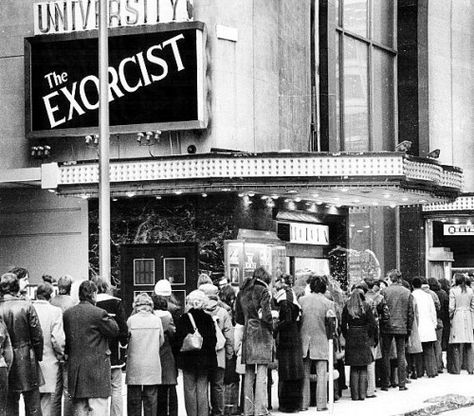
People lined up in droves to see The Exorcist.

To tell you the truth, just writing the name of this movie down gives me chills, irrational though that may be. It’s the only movie that gets scarier with each viewing for me, and yet Cursed Films took me down a different path with it. It dedicated most of its runtime to explaining why people so aggressively associate the devil with the movie and why horror inspires audiences to pursue such dark trains of thought.

The show features psychologists, religious scholars, key production and cast members, and writers all mostly aligned within the idea that the only thing that can curse a movie is its audience. Psychological terms are conjured up to explain why fans gravitate towards curses to explain the mysteries of their favorite movies, all of which have perfectly plausible explanations (for the most part).

The Exorcist episode, for instance, debunks a lot of its myths by looking at the PR campaigns of a desperate movie studio hellbent on turning a profit while also looking at how some of the accidents in the workspace actually happened. It even includes talks on the impact of the work culture the movie’s director created during filming, which is well documented.

Perhaps the most potent and surgically precise look at a cursed film can be seen in the Poltergeist episode. Two deaths and rumors about the macabre nature of certain props have been circulated enough for some people to confirm the tragedies that accompany the franchise are the results of a curse, possibly originating from beyond the grave.
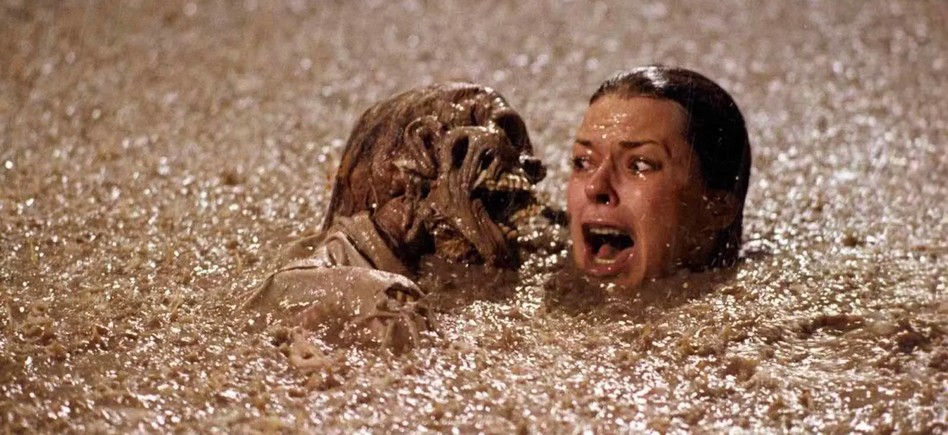
Scene from the movie Poltergeist.

What Cursed Films does with this movie is nothing short of masterful, going from legend to legend in an attempt to dispel the “curse,” which for the series means proving no such thing exists. It looks at the psychological and supernatural value people put into objects and locations seen in popular films and how it translates into a whole tradition of people visiting fictional haunted places as if they’re actually haunted.

I’ve participated in this, although not under the impression the place I visited was really haunted. I once had the chance to drive close to where the Amityville house from the infamous 1979 Amityville Horror movie was located. The fact the movie was loosely based on “true events”—that have since then been disproved—made the opportunity all the more enticing, so I took it. I saw the house. People live there. I saw no ghosts walking around, not a single swarm of flies hovering over its windows, and no blood dripping from its walls. In fact, I saw other houses that looked almost the same neighboring it. So much for a place housing one of the gates of Hell.

I thought about this short trip to Amityville a lot while watching Cursed Films. The show’s deconstruction of what could be termed as magical-horror thinking made me rethink the entire experience. It’s interesting because even though I knew the house wasn’t haunted, I did feel unsettled. The power of the movie, and the story it’s based on, had definitely charged the place with a supernatural sensation that was hard to shake off. In the end though, it was just a house. For the few minutes I was there, the only thing haunting it was a curious horror fan holding up traffic to take in one of horror cinema’s most iconic locations. Watching Cursed Films, one can feel a lot like this, especially if you’re prone to give into urban legends.

Cursed Films aims at reminding people horror fiction is just that, fiction. And it needs that emphasis on fiction. In fact, the docuseries suggests these myths and legends do a disservice to the people behind the scares, the ones who work for a living to get a scream out of people in the movie theaters. It’s a meditation on the power of belief when it comes to the representation of evil in film. It wants us to consider that movies themselves don’t have to be haunted to become superior works of horror fiction. They can achieve that pretty well on their own, without the necessity of being cursed.

Who is the alien in Star Wars?

The universe of Star Wars is a place teeming with life and full of living beings, all of them extraterrestrial.

There are no exceptions. From over here, down on Earth, Luke is as alien as Yoda, just like every other character in the saga, human or not.

star wars 001

But are they aliens to each other?

More to the point, who is the alien among all others?

In a universe such as that, in which many and distinct races share the same galaxy, obey or defy the same set of rules and believe (or not) in a Force which binds them together, the idea of what it means to be an alien gets a little foggy, to say the least.

To make things easier, let’s say that the alien is not the one who comes from outside, but the one who is pushed there and remains there. It’s not about “who got here first?”, as the story of our own worlds and their native people has already made perfectly clear. It’s all about protagonism. Who among all is least important? Who remains under the shadows of all others?

To try and answer that question, I came up with a list of six candidates to the role: the human, the non-human, the sith, the woman, the monster and the droid. I’m always up for an excuse to rewatch all the movies anyway (and you should be too, with The Force Awakens right around the corner).

Which reminds me: this list does not include the expanded universe and all its glorious books, comics, games and merchandising, and relies exclusively on the six feature films.

1st candidate – THE HUMAN

star wars 002

Let’s play it safe and take race into account first. In a universe rife with shapes, sizes and bodies of all kinds, wouldn’t the humans play the role of the intruder, aliens in a world that doesn’t belong to them and reaches far beyond the view they have of themselves?

Not if we’re talking about status (and its doormat the privilege) and who bosses whom around.

The old trilogy shows us the human being in its prime. In Episode IV – A New Hope, there is an all too powerful empire led by a human (Palpatine), single-handedly protected by a human (Vader), reinforced by cloned human beings (the Troopers) and opposed by a human trio (Luke, Leia and Han).

At this point in the story, both the Empire and the Rebels, their one and only opposition, are made up almost exclusively of humans. There are no other races in positions of power. The non-humans are relegated to the role of scum, represented in all its villainy by the drunkards, lowlifes and good-for-nothings at the bar in Mos Eisley.

star wars 003

So the first candidate doesn’t make much sense after all. We could say that humans are actually the opposite of aliens, if their role didn’t change a little further down the saga, as we shall see.

2nd candidate- THE NON-HUMAN

If the humans are on top, then the aliens must be the non-humans, right?

Not necessarily, not all the time and not in every way. In Episode V – The Empire Strikes Back, a non-human takes up the role of Jedi Master (Yoda) and is revealed as more powerful than Luke and his first master, Obi-Wan. In Episode VI – Return of the Jedi, a non-human commands the rebel troops (Admiral Ackbar) and secures the status of meme. In the same movie, an entire race of non-humans (the Ewoks) joins forces with the rebels to thwart the deathly plans of the Empire.

The new trilogy goes even further. In Episode I – The Phantom Menace, the non-humans are at their peak. The main villain is a non-human Sith (Darth Maul), there is a Republic and a Senate composed of many races, a Jedi Council made up mostly of non-humans and a podracing so difficult and intricate that human beings can’t even compete in it (with the exception of Anakin, of course).

In Episode II – The Attack of the Clones, the non-human status goes beyond the exceptional and extends itself to the mundane and ordinary role of the citizen. They’re not only the villains or the heroes of the saga anymore, but also the passersby, the drivers and the honest merchants, people who compose and share the landscape. There is even space for non-human children to show up. Instead of one of each race, the exemplary specimen, the non-humans get to be truly plural and diverse.

3rd candidate – THE SITH

star wars 004

The answer is not in the race. Let’s take a look at ideology then.

If both the humans and non-humans are subject to the same laws, maybe the aliens are the ones trying to break them. The Sith are a persistent threat to the universe of Star Wars, even when part of the Empire. They are, at the same time, the memory of darker times and the obstacles on the path to a new hope. Even when they’re in control, they remain on the fringe of what should be.

But the Sith are not the aliens. They are, as the villains always are, a reflex of the hero and a key component of what moves the story of their world. It’s their willpower that moves the narrative forward, that builds an empire over the ashes of a republic and sets a rebellion in motion. They’re the ones who reduce whole planets to nothing and rouse the last Jedi to the tragedy of their Force.

In a way, the Sith play one of the leading roles. In their effort to destroy everything in their way, they give life to new images and make all the saga fresh.

4th candidate – THE WOMAN

star wars 005

Not race or ideology. Maybe gender?

Among so many creations, clashes and special effects, the women of Star Wars can hardly be heard or seen. Unless she’s asking for help, uttering words in the loop of a gender who cannot defend itself.

In the old trilogy, the woman is restricted to Leia, princess/damsel in distress/holographic image. She rarely fights and barely commands anything. All she does is inspire male ideals of heroism and reward them for their performance.

Things change a little in the new trilogy though. In the role of Padmé, the woman gets to be a warrior and an empress, but she’s still reduced to the one-character representation, a status even the non-humans would have already overcome.

There is one female Jedi, one female warrior, one female leader. And the last two are merely the driving force towards the male tragedy surrounding Darth Vader.

So is the woman the alien? Probably yes. But only because she always is. Not the alien, but an alien, and not only to this universe. The gender issue goes far beyond Star Wars, and the under representation of women is not exclusive to that world. Only a reflex of all others.

5th candidate – THE MONSTER

star wars 006

Besides race, ideology and gender, there’s still the species.

The monster is the one without a race, or laws to protect and recognize the race they should have. They’re a single species under the category of “ugly and dangerous creature”, animals and others beings that exist only as tools or landscape. Like the Rancor, an instrument for torture and death in the dungeons of Jabba the Hutt, or the Sarlacc, a giant gaping mouth in the middle of the desert, more natural disaster and geographical phenomena than living being.

The monster is so far on the fringe that it doesn’t deserve the role of alien. It lacks the strength even to be that. It has no identity, no language and no will. It’s hunger, compliancy and violence reduced to a narrative feature. Less than an alien, the monster is a little more than a film extra.

6th candidate – THE DROID

The droid escapes any classification, be it race, gender or species.

First and foremost, they’re the comic relief. Like Threepio, humiliated and ridiculed since the very first film, or Artoo, which elicits our affection for its constant and surprising efficiency. One looks like a human being and is turned into a joke for its stupidity, the other reminds us of a trash can and relieves our tension in all its false naivety.

The droids are also the librarians of Star Wars. They’re the ones who register the story in all its files, data, holograms and linguistic codes. They function as interpreters, translators, programmers and research tools.

There are also the battle droids, the probe droids, the medical and navigation droids, the cyborgs, the scrapheap. From the very beginning, they serve as talking machinery. Above all, they serve.

And yet the droid is more important to the universe of Star Wars than any other species or race, for they help build the genre itself. It’s the droids who make the sci-fi work in the narrative.

Unlike the monster, which is not even on the fringe, the droid is too deeply inside it. They are the fringe themselves, the super-advanced and high-tech foundation stone of a whole fictional universe. The droid is the image of the format itself in which that universe can be seen.

And for the same reason, the droid is not the alien.

star wars 007

Then who the hell is the alien in Star Wars?

I don’t know. Maybe it has no aliens. Maybe everyone and everything is an alien in flux, with each group – humans, non-humans, Sith/Jedi, women, monsters, droids – taking up and vacating the role at the same time. Maybe the alien is a drifting zone of privilege and exploitation revolving around all characters.

Or maybe the aliens are us, the spectators, forever away from this magical universe, stuck in this non-fictional world of wars under the stars.