
Tag Archives: Bucky Barnes

Review: Captain America #1 Mixes Ripped from the Headlines Relevance with Old School Marvel Action

On 4th of July aka Captain America’s birthday, Ta-Nehisi Coates and Leinil Yu began a new era for Steve Rogers, Bucky Barnes, and Sharon Carter in Captain America #1.  There’s a lot of plates to spin in Coates’ opening storyline from Russia-based vampires interfering in American politics to Cap trying to balance being an inspirational figure while being confronted by a horde of men dressed like Nuke and his relationship with Bucky, Sharon, and the flag on his shield and chest. However, the comic keeps from being overwhelmed by these things by leaning on action with gritty work from Yu, Gerry Alanguilan, and Sunny Gho. The clean art and lantern jaws of Chris Samnee’s run are replaced by pained face, sharp edges, and a muted, shadow filled and it fits a story where Thunderbolt Ross (Who is still a buzzkill). There’s even a well-placed use of a nine panel grid, which I hear is all the rage these days and kudos to Coates and Yu for using for a difficult interpersonal scene between Steve and Sharon and not just a knife fight or something. (Not that there’s anything wrong with knife fights.)

Probably, the boldest decision that Ta-Nehisi Coates makes in Captain America #1 is facing Secret Empire head on and having Steve still fighting to clear his name while also re-casting that whole debacle of an event in the real world light of the election of Donald Trump, Russian tampering of that election, and the increased boldness and acceptance of fascists and white supremacists, who have been here all along. The United States didn’t fight a war against Russia or an army of fascists and lose: they lost at the ballot box and have been losing since 1492, 1607, or 1619 when the first African slaves were transported to Jamestown. Coates and Leinil Yu deal with these real world issues and complicated nature of patriotic iconography through an icon himself: Captain America and explores how problematic he has become in-universe like when Thaddeus Ross benches him for a mission to see who is behind the opening attack of New York City. But somehow guys like Baron Strucker are okay because they helped lead the resistance against HYDRA.
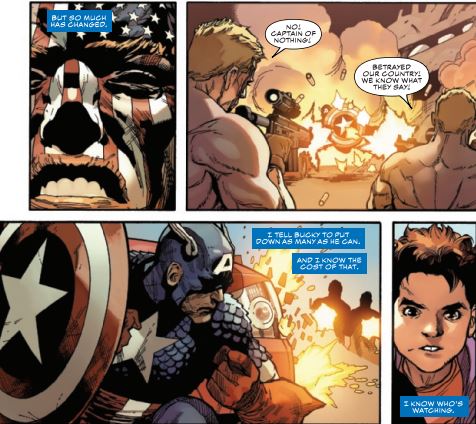
Steve’s struggles with his iconography being co-opted first by HYDRA Cap and then in this issue, by the Nuke wannabes attacking Washington DC, is the emotional heart of Captain America #1. Yu and Gerry Alanguilan give readers plenty of prototypical Captain America shots like throwing his shield into battle, using the shield to protect an injured dad and his son, and then Coates gets to write a great Cap speech. But, then, the narration undermines these moments as Cap wonders what to say to a woman who has lost her daughters and looks around at the collateral damage surrounding the National Mall. And, after the battle, he is immediately undermined by Ross because “appearances matter” and the cloak and dagger spy and assassin skills of Bucky and Sharon are more useful than a guy running around in an American flag costume. A symbol is useful to any resistance, but not a tarnished one, and Yu eschews the heroic poses for middle distance disappointed faces.

But Captain America #1 isn’t all about Steve and his feeble attempts at restoring his legacy. Ta-Nehisi Coates and Leinil Yu using the opening and closing moments of the comics to set up a compelling villain: Selena, a millennia old mutant with “psychic vampire” abilities. She both uses her powers and a mysterious protege, Alexa, to take down HYDRA cells in Russia and to also influence the American government as the head of Faith Based Initiatives in a blink or miss TV screen cameo. In Captain America #1’s cold open, Selena and Alexa prove to be a formidable threat to a group of HYDRA soldiers with plenty of pyrotechnics and snow from Yu, Alanguilan, and Sunny Gho. Coates doesn’t go the secret villain cliche route and immediately introduces the threat while promising to unpack her connection to the U.S. government and finding some way for Steve to confront her in subsequent issues. Having a powerful Russian force interfere with the American government is compelling in light of current events, but that having that threat be a New Mutants villain with vampire-like abilities is a very Marvel way to go about it.

Playing off the classic Captain America quote from Frank Miler and David Mazzucchelli’s Daredevil: Born Again “I’m loyal to nothing except the dream”, Ta-Nehisi Coates and Leinil Yu unpack the role of Cap as an icon and hero in Captain America #1 while kicking off an action conspiracy storyline that is like our current reality, but draped in Marvel Comics lore.  There is a questioning aspect to this story as Steve, Bucky, and Sharon are consumed with doubt and separated by their new roles in this ever shifting new status quo. Also, it’s kind of sad that the weapon that Steve uses to finally take down the Nukes could also incapacitate his best friend.

Captain America #1 is thrilling, thought provoking stuff and hasn’t been this meaty and compelling since Ed Brubaker’s run on the title.

Story: Ta-Nehisi Coates Pencils: Leinil Yu Inks: Gerry Alanguilan
Colors: Sunny Gho Letters: Joe Caramagna 
Story: 9.2 Art: 8.4 Overall: 8.8 Recommendation: Buy

Marvel Comics provided Graphic Policy with a FREE copy for review

Review: Thunderbolts #1

TBOLTS2016001-cov-68f28Spinning out of the Avengers Standoff crossover, Marvel has decided to roll the dice and have a team not affiliated with the Avengers. The Thunderbolts have quite the pedigree as villains doing heroic things (or being part of a corrupt government) with writers like Kurt Busiek, Jeff Parker, and Warren Ellis having runs on the title, but unfortunately writer Jim Zub (Wayward) and artist Jon Malin (Youngblood) can’t live up to their predecessors despite the presence of some former Thunderbolts members like Moonstone and even fan (and Tumblr) favorite Bucky Barnes.

Thunderbolts is presumably an action book, but Malin’s art is nothing to write home about.  It mixes a more anatomically correct Rob Liefeld style (Especially in the way he draws Moonstone, the only adult female on the team.) with a touch of manga in the character of Kobik, a young child who can manipulate reality with the Cosmic Cube and is the wild card on the team. There is also some photorealism for Bucky because it seems like he has to look like Sebastian Stan with Captain America: Civil War coming out this week. Malin’s style with headbands and similar faces makes it hard to differentiate between Fixer and Atlas except for the first is an arrogant, technobabble spouting genius and the other one is not so smart. He spills cereal on himself in a scene that is supposed to be a playful bit of slapstick while Moonstone complains about their hideout not being like good ol’ Thunderbolts Island, but Malin’s art is too stiff to pull this off.

He and Zub do add a bit of pep and humor to Thunderbolts #1 every time Kobik shows up, and her interactions with Bucky are the best part of the comic. Bucky has taken Kobik in tow because she was used by SHIELD to brainwash supervillains in the town of Pleasant Hill during the Avengers Standoff crossover. He was also forced to do things against his will as the Winter Soldier so he has real connection with her and a nice rapport. Kobik calls him “Buckaroo” and asks if she brought him a souvenir from their cold open mission, which is shooting random SHIELD agents.

Bucky hopes to keep her out of action, but it’s hard to keep a lid on someone who can manipulate reality and hasn’t really been changed so Kobik ends up playing an integral part in the endgame of the first issue. And she might have a darker role on the Thunderbolts than the cute, almost omnipotent team’s little sister. The cliffhanger of Thunderbolts #1 is definitely a jarring tonal shift, but it’s better than a generic finding Inhuman cocoons plotline or the pointless drama between Bucky and Moonstone over who will lead the Thunderbolts when Bucky is the one who reassembled the team after they were brainwashed at Pleasant Hill.

Except for the interactions between Bucky and Kobik, Fixer’s supreme arrogance which ends up reading like a parody of Hank Pym and Reed Richards, and occasional fun banter from writer Jim Zub, Thunderbolts #1 is a paint by numbers superhero team book with a smidgen of espionage elements. And it slips from average to borderline bad in Jon Malin’s 1990s Marvel house style art work, which is an awkward fit for Matt Yackey’s garish digital colors.

Story: Jim Zub Art: Jon Malin Colors: Matt Yackey
Story: 6 Art: 4 Overall: 5 Recommendation: Pass

Marvel provided Graphic Policy with a FREE copy for review

Review: Red Skull #1

rs001There are likely those that think that the well of ideas for Secret Wars might already be exhausted, between the new material and the inspiration from previous crossovers or other inspirations.  If thinking only inside of Marvel, then they might be right, but Red Skull #1 proves that there is still some more distance to go in this massive crossover.  Although it draws upon characters from across Battleworld, this series is one which is at home in the heart of the Deadlands, the realm of the crossover title of Marvel Zombies vs. Age of Ultron.  The setup is not like anything from Marvel though, as it is essentially a Secret Wars version of the Suicide Squad.  This group of supervillains only has one job, to travel to the Deadlands and to prove that the Red Skull died after being exiled there.

The team is made up of an unlikely grouping of villains, similar once again to the Suicide Squad comparison – Electro, Moonstone, Magneto, Lady Deathstrike, Jack O’Lantern, and Bucky Barnes, seemingly acting in the Rick Flag role.  They are recruited by Crossbones, a one-time loyal follower of the Red Skull who has given him up for a blind allegiance to Doom.  He leads the team to the brink of danger before stopping to stand guard over the portal from which he expects them all to try to instantly escape.  The remainder of the story comes across as a bit of a juvenile wish list, with zombies, robots and dinosaurs, but the action never lets up in this exciting issue as the team get pretty close to discovering the source of their mission.

This issue proves that there are still some fresh ideas floating around in the somewhat constrained world of Secret Wars.  This has proven to be a winning formula elsewhere, and works well here too.  The combination of characters is broad, but it seems like they fit well together, even if they don’t have much of a chance yet at this point.  With so many other Secret Wars inspired series being born after this crossover, it would be nice to see one inspired by the same concept as presented here.  Many people will look at the title for this series and likely not give it a chance, but for those that do, they will find something pretty fun and probably what will become one of the highlights of the entire crossover.

Story:  Joshua Williamson Art: Luca Pizzari 
Story:  8.9 Art: 8.9  Overall: 8.9  Recommendation: Buy

Catching Up on Reviews, Part 5 — Avengers Academy and Captain America

Avengers Academy #9 (Marvel) – I love the storyline here where Finesse might turn out to be the daughter of the Taskmaster, one of my favorite Marvel anti-heroes these days. Less well-done are the parts of the issue dealing with Tigra expelling Academy members for assaulting the Hood. The art isn’t particularly great, either.

Story: 7 Art: 6.5 Overall: 6.75

Avengers Academy #10 (Marvel) – Sean Chen’s art is a step up from the previous issue and the storyline where Leech comes to give Hazmat a day as a normal kid is great. The best part of the issue is Speedball’s growth as a character and the burying of some of his Stamford demons, which is a long time coming.

Story: 8.5 Art: 7.5 Overall: 8

Avengers Academy #11 (Marvel) – Christos Gage writes a good connection to Avengers past by bringing back Korvac for this story arc. I’m a little annoyed at the flood of Thor movie tie-ins, though this one takes a different route than most. Tom Raney’s art is good, but not spectacular.

Story: 8 Art: 7.5 Overall: 7.75

Avengers Academy #12 (Marvel) – There are moments of very strong writing here. The concept of bringing the future selves of the Academy students back to inhabit their present bodies so they can beat Korvac is an awesome device. The story is also fleshed out by one character showing a glaring weakness and two others showing a surprising vulnerability.

Story: 8.5 Art: 7.5 Overall: 8

Avengers Academy #13 (Marvel) – I guess I get what they were going after with the idea of the “Superhero Prom” for the students, having an issue that focuses more on the characters and the lighter side of their lives instead of action, I’m just not sure how well it works in this case.

Story: 7 Art: 7 Overall: 7

Avengers Academy #14 (Marvel) – I love the way the new incarnation of the Sinister Six is being used and this is another good appearance for them. It’s good to learn more about Dr. Octopus’s character than we have learned in the past, he’s on the verge of being a little over-exposed lately, but certainly not in Deadpool, Spidey or Wolverine territory.

Story: 8 Art: 7 Overall: 7.5

Avengers Academy #14.1 (Marvel) – Ruby is one of the dumbest characters in Marvel history and her presence here detracts from what is otherwise a really good story, focusing on one of the characters who didn’t join the Academy and his tempting offer to the would-be heroes.

Story: 8.5 Art: 7 Overall: 7.75

Avengers Academy #15 (Marvel) – This is Tom Raney’s best art yet and the Fear Itself tie-in works better than most of the others. This story also does a good job of tying in recent themes from the Academy books to Fear Itself, something a lot of the other tie-ins have failed to do.

Story: 8.5 Art: 8 Overall: 8.25

Avengers Academy Giant-Size #1 (Marvel) – Cartoonish art (which isn’t my taste at all) and a retread Arcade storyline with only a few interesting elements makes this issue a waste.

Story: 6.5 Art: 6 Overall: 6.25

Captain America #615.1 (Marvel) – Mitch Breitweiser’s art isn’t my favorite, it seems he has a real problem making people’s faces look realistic (even comic realistic). Other than that, Ed Brubaker’s tale is action-packed and compelling, even if, once again, it relies a bit much on World War II elements in telling the tale of Steve Rogers.

Story: 9 Art: 7 Overall: 8

Captain America #616 (Marvel) – This massive 70th anniversary issue is packed with stories, most of the well-told. The best is probably Brubaker and Mike Deodato’s Winter Soldier gulag tale, the worst is the Mike Benson and Paul Grist Baron Blood/Captain Ameica used to be a vampire story.

Story: 8 Art: 8 Overall: 8

Captain America #617 (Marvel) – The continuation of the story of Bucky being put into a Russian gulag is entertaining and action-packed, but I read it after I knew Bucky’s eventual fate already, so I wonder how effective it is considering that context.

Story: 7.5 Art: 8 Overall: 7.75

Captain America #618 (Marvel) – The different artists used here vary greatly in quality, but the overall ongoing story is still a compelling one that has an impact on the future of Marvel comics, so it’s well worth the read.

Story: 8 Art: 7.5 Overall: 7.75

Captain America #619 (Marvel) – The art from the gulag section is still the best in the issue, and it takes chances and mostly succeeds. The overall storyline comes to what appears to be a satisfying end.

Story: 7.75 Art: 7.75 Overall: 7.75

Captain America #1 (Marvel) – Ah, the good-old Marvel pointless renumbering trick. The worst part about that for this issue is that this really isn’t good enough to be a first issue. It doesn’t break any new ground with the character and simply rehashes things we already know while mixing in a few newly-retconned storylines that don’t let us know anything new about Cap. It is good, I guess, to see Steve Rogers fully as Cap again, but you’d think that for a first issue, they would’ve had more of a point than what this issue has.

Story: 7 Art: 8 Overall: 7.5