
NYU Art Gallery 80WSE Presents Two Exhibitions Featuring Manga and Other Drawings
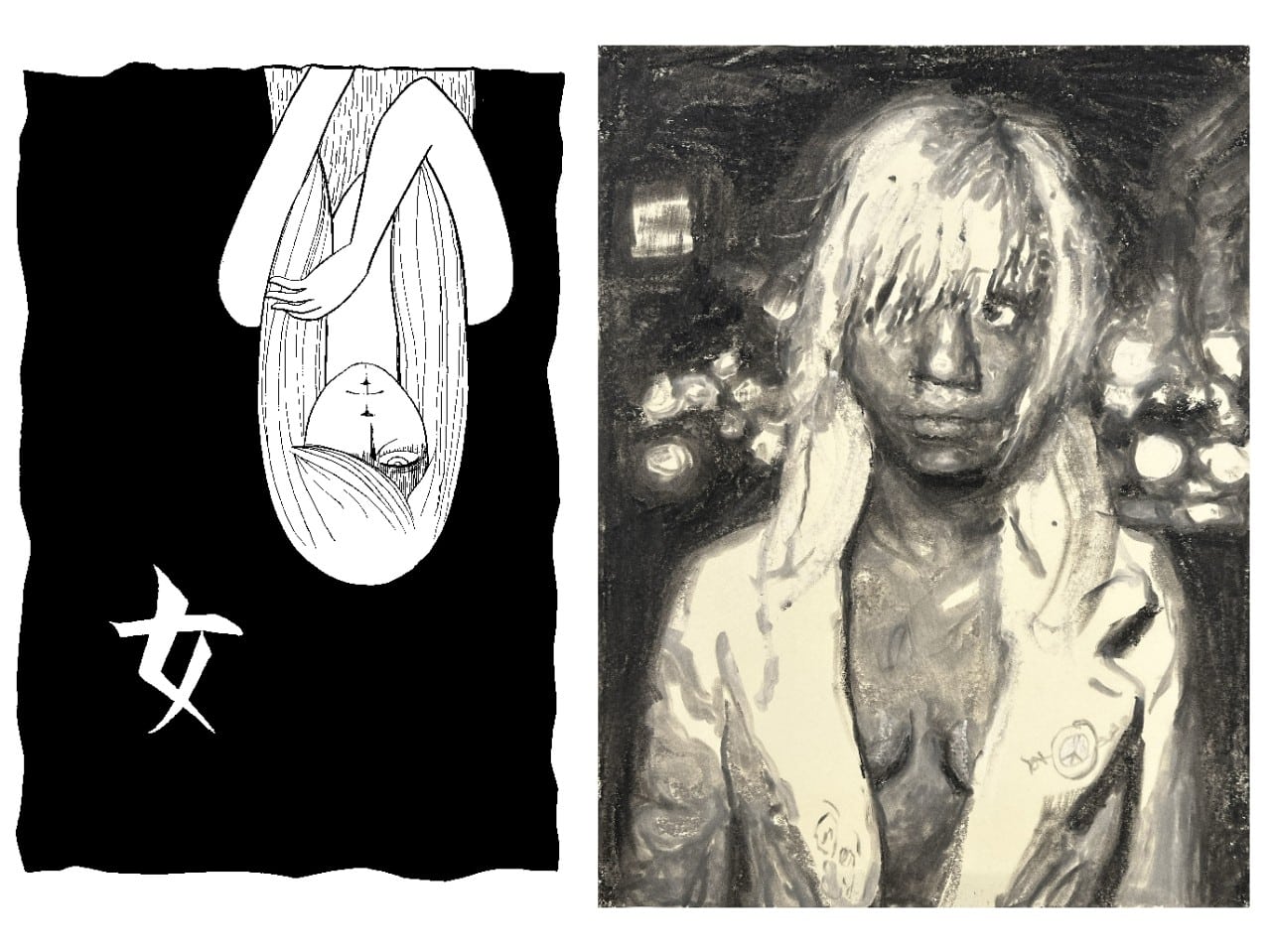
NYU Steinhardt’s art gallery, 80WSE, kicks off two exhibitions that celebrate drawing as an intimate and immediate art form. Beetles, Cats, and Clouds: The Manga of Tsurita Kuniko, Yamada Murasaki, and Kondoh Akino showcases the work of three influential women mangaka, artists who create manga. The exhibition includes manga drawings, sketches, illustrations, animated shorts, and printed books and magazines. Most have never before been publicly displayed, even in Japan.
The exhibition is curated by Ryan Holmberg, a leading art historian, editor, and translator of alternative manga. Beetles, Cats, and Clouds features the art of Tsurita Kuniko, Yamada Murasaki, and Kondo Akino. The exhibition follows the evolution of manga from the 1960s into the 2000s.
Escapements features six artists whose work mediates different worlds. Jesse Chun, Taína Cruz, Hamishi Farah, Mark Lombardi, Adam Putnam, and Mark Van Yetter explore the tensions between heaven and earth, presence and transcendence, and freedom and constraint. The exhibition title refers to the mechanism in a timepiece that releases stored energy as regulated movement. It serves as a metaphor for the illusion of control and stability that springs from raw energy.
The exhibitions open September 10 and continue through January 24, 2026. The gallery takes its name from its location at 80 Washington Square East in Greenwich Village. Gallery hours are Tuesday through Saturday from noon to 6 p.m. The opening reception is September 10 from 6 p.m. to 8 p.m.
Beetles, Cats, and Clouds includes:
Kondoh Akino (b. 1980) debuted in AX magazine in 2000 and lives in New York City. Her comics include surreal stories, romantic comedies, and diaristic pieces. She also works as a fine artist, exhibiting drawings, paintings, and animated videos internationally. She chronicles her life in the city in the ongoing series New York Diaries. An English translation of her 2004 debut, Beetle, is forthcoming.
Tsurita Kuniko (1947–1985) began drawing shōjo manga, a category targeting an audience of adolescent girls and young women, for rental libraries in the mid-1960s. Her stature grew after she joined the alternative magazine, Garo, in 1965. The magazine was known for experimentation and progressive politics, and Tsurita remained its only regular woman contributor until the late 1970s. Her work is collected in The Sky is Blue With a Single Cloud (Drawn & Quarterly, 2020).
Yamada Murasaki (1948–2009) began cartooning in 1968 with COM magazine, and her early work depicted the challenges of growing up as a woman in conservative Japan. She paused her career in 1973, when she married and began having children, but she returned soon after to support herself, gaining attention as the “single mother cartoonist.” Her best-known work includes Sassy Cats (1979–80), Talk To My Back (1981–84), and A Blue Flame (1983–84), which was adapted into the 1986 film, Bed-In.
Escapements features:
Jesse Chun works across moving image, drawing, sculpture, and sound, centering on her concept of “unlanguaging.” Drawing from Korean folk and shamanic traditions, as well as diasporic and familial archives, she has developed a material vocabulary that evokes alternate semiotics and untranslatable temporalities. Her drawings include meticulously hand-cut and drawn asemic scripts on hanji paper, inspired by shamanic talismanic paper-cutting and her grandmother’s Buddhist writing. In HERE 시: concrete poem (no.041924), 2024, drawing becomes a time-based meditation, with thousands of graphite lines, cuts, and shadows conjuring non-linear passages of meaning, mediating spiritual and material worlds.
Taína Cruz’s practice spans painting, sculpture, and video, drawing on pop imagery, online subculture, and personal archives to create a surreal visual language. Blending satire, horror, and seduction, her avatars—elves, goblins, and sirens—bring together contemporary image worlds, art history, and post-colonial narratives, serving as allegories for mythology, selfhood, and transformation. In recent drawings, these figures emerge gradually, their slow formation generating a charged stillness with bodies suspended between tenderness and disappearance, or bracing with a psychic anticipation as if the body senses what the mind has yet to comprehend.
Hamishi Farah uses conceptual and figurative painting to bring together subjects that invoke what he terms the “colonial libido,” including Christian iconography, power systems and visual allegory. Most recently, Farah has turned his attention to explorations of Christian martyrdom, with his latest paintings taking Saint Sebastian as a central subject. These works depict the saint’s arrow-pierced body as an enduring Renaissance motif and an askew symbol of resilience, strength, and transcendence within our contemporary moment.
Mark Lombardi developed a drawing-based practice known for intricate “narrative structures” that map complex networks of power, institutions, and capital rendered in a web of lines and notations. Study for World Finance Corporation 7th Version, 1999, offers a rare glimpse into a study drawing based on his extensive research, using syndicated news and public sources to chart the role of the World Finance Corporation, a global conglomerate tied to drug trafficking and money laundering in the 1970s.
Adam Putnam’s practice spans photography, drawing, sculpture, film, and performance, investigating the boundaries between architecture, nature, the physical body, and the internal self. His imagery frequently returns to motifs such as holes, obelisks, and towers—forms that collapse distinctions between interior and exterior and presence and absence. Visualizations (Escapement Annex), 2025, a series of postcard-sized ink drawings, builds on earlier series that form an archaic diagram of the unconscious. A new drawing from this work will be displayed each day of the exhibition.
Mark van Yetter engages in drawing and painting, realized in pastel and oil on paper and often presented in artist-made frames. His compositions elude simple narratives, inviting contemplative engagement with the depicted subjects and the compressed spaces they inhabit. Embedded in van Yetter’s tableaus, landscapes, and portraits are pointed reflections on society, including culture, power, alienation, and modernity.
Discover more from Graphic Policy
Subscribe to get the latest posts sent to your email.
