
Movie Review: Dr. Seuss’ The Grinch
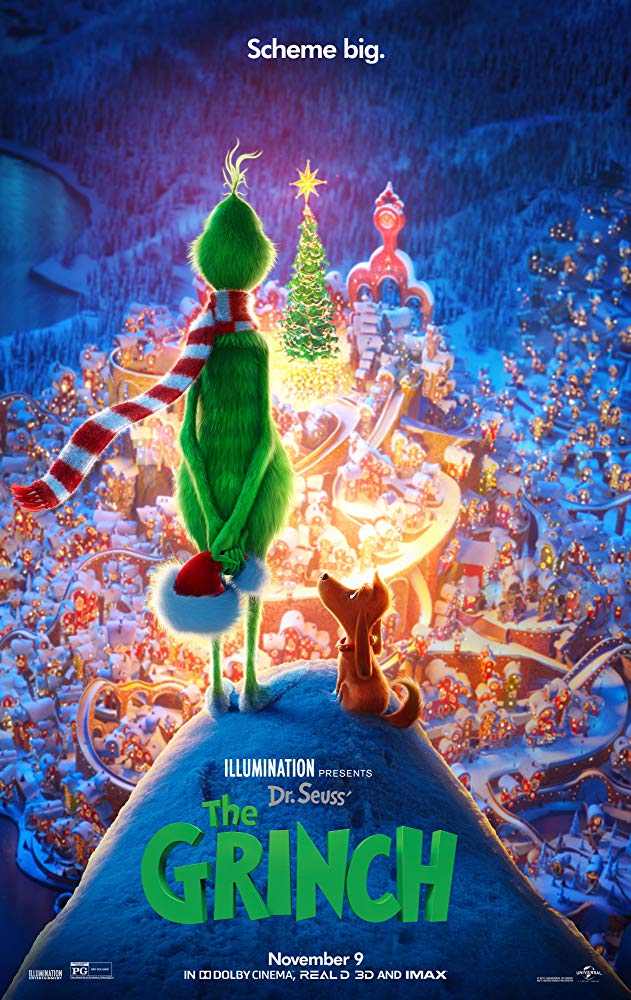 All the Whos down in Whoville liked The Grinch movie a lot,
But the critics on Rotten Tomatoes—they did NOT.
Look, let’s be 100% real here. It’s a foregone conclusion whether or not you will go see Dr. Seuss’ The Grinch sometime in the next few months. Either you have children of a certain age who will enjoy this regardless of its artistic mediocrity, or not. Or you, yourself, are a huge fan of Grinchitude and want to check this out. Or, perhaps, most Grinchily, you want to hate-watch this because your heart is also two sizes two small (A holiday tip of the cap to you, good hatewatchers!)
So, look—it’s not going to be bad. But it’s not great. And the sad thing is? It should be. The original Dr. Seuss’ How the Grinch Stole Christmas book is a concentrated, aged Christmas eggnog made with the finest and most rarefied ingredients, and it should be a holiday explosion of joy and the best of Christmas sentiments. Instead this film is a somewhat middling retelling of a tale that we already know already, going from its scant 64 pages and 1800 or so words (this review is longer than the book itself—buckle up) and stretches it to just under 90 minutes. Even starting with that as the base for your eggnog, if you water it down too much, it’s not going to be delightful and tasty. It’s going to be insipid and weak.
The first most obvious question is why remake a classic? It has already been adapted once as an animated TV show to perfection by Chuck Jones, the genius behind so much of Looney Tunes, and once again in a less successful remake by Ron Howard starring Jim Carrey. I can confidently say that this is one of the top two versions of the Grinch story ever made for film or TV. However, it still misses so many of the important story beats, misses its mark, and begs the question why you shouldn’t just read the book or watch the Chuck Jones version.
Before we go any further, I can hear the grumbling—another cynical middle aged critic. Why should we care what he thinks? I bet he’s the true Grinch and just doesn’t like anything.
Confession time: I love Christmas. I am in the tank for the holiday season. I am not a Grinch, I am more like Santa—in both physique and demeanor. I love every damn thing about Christmas. I love the music, I love the decorations, I love the food, I love the time with friends and family, but most of all I love the movies and TV shows. And if it isn’t clear, I love the book, and I love the Chuck Jones animated version. But they’re not so perfect that I don’t think it can be adapted to a longer film.
This is why this film is so disappointing to me. This new version of The Grinch is only passable rather than a new modern classic. By all accounts, it should be so much better. Let’s deconstruct exactly what is so great about the original Dr. Seuss book and then talk about how this doesn’t quite measure up.
The Grinch was just mediocre– No one quite knows the reason. It could be its head wasn’t screwed on just right.
Illumination Studios’ and its animators who came out of Blue Sky Studios’ previous outings with Dr. Seuss have yielded incredibly good results with both Horton Hears a Who and The Lorax, the latter which may fill up some of your favorite dank meme stashes. So what happened here? Their previous winning formula was to stay true to the heart of those stories, while The Grinch somewhat misses its mark. More on this in a second.
And while Horton and Lorax were headed by the same creative teams who worked on the Despicable Me films, The Grinch is directed by the co-director of The Secret Life of Pets (another serviceable but not classic animated film) and frequent Kevin Smith Askew-niverse producer Scott Mosier. I’d expect some of that dark, quirky humor to creep in here, but it doesn’t. This is fairly by the book, which is what makes it mediocre rather than a masterpiece.
It could be, perhaps, that his shoes were too tight.
Also in the slam dunk category, we have Benedict Cumberbatch as the eponymous Grinch. Cumberbatch could normally read the phonebook and be interesting. So no one can say exactly why film studio executives thought that giving this role to him, making him do an American accent, and then changing his vocal delivery to be incredibly nasal and sniveling rather than the deep baritone that we expect from him (and which could surely compete with the deep resonant tones of Thurl Ravenscroft and Boris Karloff from the Chuck Jones original) was a good idea.
Even with an American accent, Cumberbatch in other roles – such as Dr. Stephen Strange — is authoritative, sometimes scary, and awesome in the literal sense of the word.
Instead, Cumberbatch sounds like he’s doing a Ken Jeong impression. And not the cool Ken Jeong—but Ken Jeong when he’s trying to be annoying Ken Jeong.
Yes, the Grinch sounds like Señor Chang from Community, not the Grinch. Why? You had the voice of Smaug, you had Sherlock, you had Khan (KHAAAAAN!!!!) and you shortchanged this. It’s like having Steph Curry on your team and telling him to just try for lay-ups.
But I think that the most likely reason of all, may have been that its heart was two sizes too small.
This movie just missed the mark. Illumination’s Lorax didn’t stray from its basic message that “unless someone cares a whole awful lot, nothing is going to change– it’s not.” Their Horton didn’t shy away from emphasizing that “a person’s a person no matter how small.” Working from that theme, from that emotional knockout punch, they could take a short children’s book and pad it to movie-length.
So what is the heart of the Grinch story?
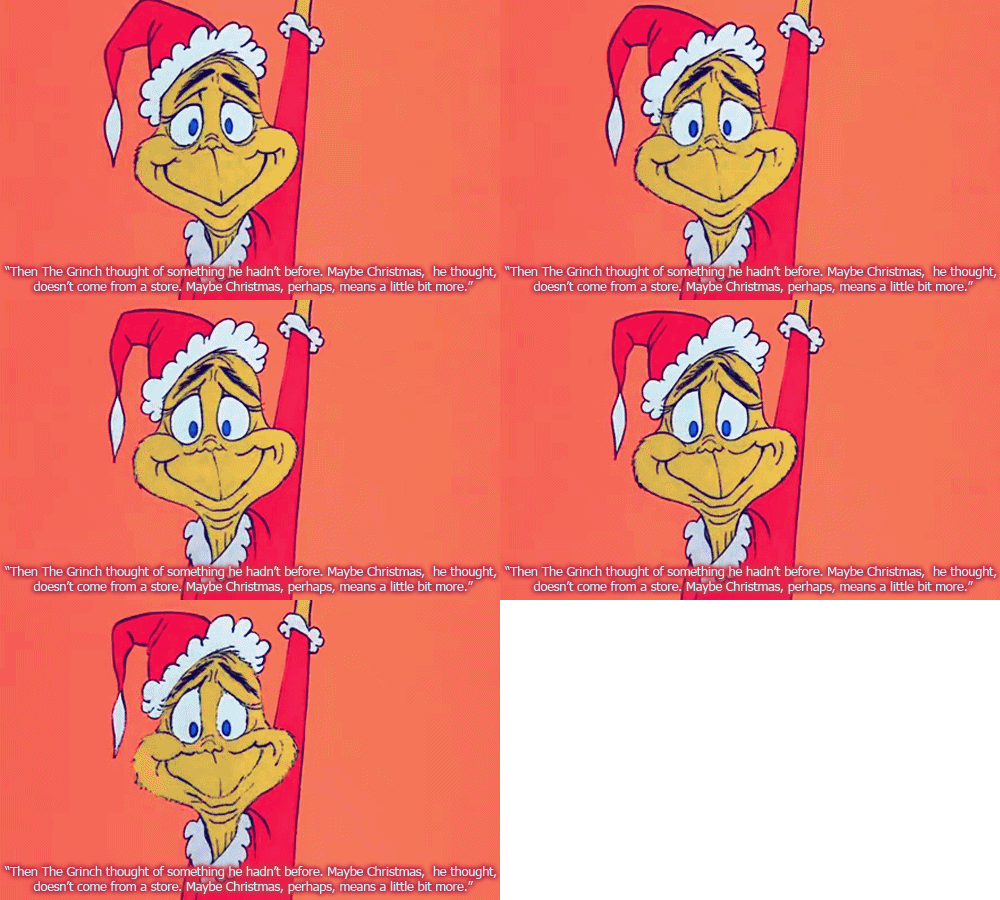
How The Grinch Stole Christmas is the story of its title character. He is the one who we follow, and he is the one who we care about — his heart being two sizes too small, his evil plot that we actually sort of root for and enjoy. Because let’s be honest: the holidays annoy all of us sometimes. And so, his eventual redemption via heart triple-embiggening and superhero turn in which he undoes his dirty deed to return the Whos’ Christmas accouterments is what we root for.
But the essence of that story that will make your heart grow 3 sizes bigger is the Grinch’s realization that he hadn’t stopped Christmas from coming—it came! It came without ribbons, tags, boxes, or bags! The Whos were still merry, even without their Who Hash and Roast Beast.
But in this movie, the story instead becomes about Cindy Lou Who and her overburdened working mother (Maya Rudolph). In the book and Chuck Jones adaptation Little Cindy Lou, who is no more than 2, appears only once up for a drink of water, and that’s it. Here, similar to the mistake made by Ron Howard’s Grinch movie, Little Cindy Lou Who is aged up to somewhere around 10 and given a precocious and cute backstory.
Cindy then becomes the audience’s point-of-view character—the one we are supposed to relate to –rather than the Grinch. This is a cardinal mistake. And in this film, Cindy Lou is far more like one of the three orphans adopted by Gru in Illumination’s Despicable Me movies. She even looks like a cross between Edith and Agnes from Despicable Me rather than one of the Whos that we know from the story book. This wouldn’t stick out so much except that all of the other characters look like the Whos we expect from the book’s illustrations.

With this shift from Grinch to Cindy Lou, the film also shifts its main meaning. No longer do we learn the main moral message against consumerism and for holiday spirit, family, community, and togetherness.
Now we get a message about an overworked single mom who works all day and takes care of her kids at night with no time for herself – already a really terrible Hollywood trope – and her adorable child who wants her to have something special for Christmas.
And the message is that the long-suffering mom doesn’t need anything else special, because Little Cindy Lou Who is the most specialist thing of all. Well that’s a really great message for kids about the central place that most of them play in their parents’ hearts. But screw that—this mom needs a spa day! Or a nanny.
The switch to Cindy Lou also shortchanges The Grinch as a character. In attempting to pad the story, they add a backstory of why The Grinch hates Christmas. It makes the inevitable turn away from his Grinchy self somewhat less meaningful and poignant. See kids, (minor spoiler alert for this movie) it was just that the Grinch was lonely all along and if only he would be invited to be a part of Christmas, then everyone would feel better, including the Grinch himself. NO NO NO NO NO NO NO NO NO NO.
In Defense of Grinches Everywhere
The whole point of the Grinch is he doesn’t necessarily have a reason to hate Christmas. In defense of all of the Christmas Grinches out there, I say to you that there is absolutely nothing wrong with you. It’s not necessarily that you’re lonely. Maybe it’s that you actually can’t stand all of the people you’re supposed to be around during the holidays — like your cloying, annoyingly perky, or racist family members. That’s good.
Maybe you’re just one of those people who really likes Halloween and is into spooky things rather than twinkly lights and Jesus and Santa. We all have Jack Skellingtons and Sallys in our life. And they’re great people.
Maybe it’s just the noise, noise, noise, NOISE! There’s nothing wrong with that.
But the story of the Grinch and his redemption is not in him necessarily learning to love Christmas (and that he’s always loved Christmas, he just didn’t have the right people to share it with). What we have to understand is, with him as out point of view character is. . .
The Grinch has a point. The overt trappings of the holiday season are overwhelming. Some of us love them and it is fuel for our holiday cheer. For many it’s just stress. And for some it’s just annoying. The Grinch thinks he hates Christmas and can stop it by getting rid of its stuff. Instead, he learns it’s actually about togetherness and that as long as we have hands to clasp we welcome Christmas, fahoo fores dahoo dores.
It does a major disservice to the character of The Grinch — and anyone who even occasionally feels like a Grinch at the holidays — that if only someone would invite you to their Christmas party, then you would feel better about it all. Maybe that’s true to a certain extent, and undoubtedly we should look amongst our friends and closest loved ones for those who might feel left out or lonely. But that’s not what is bothering The Grinch’s.
This film goes from being a morality tale about not getting your heart set on the presents and trappings of Christmas and is instead the ersatz message of the importance of family (and found family). But it’s not that this is a bad message—but it’s not The Grinch. It’s like reading The Sneetches and coming away with the message that you should be careful about getting sand everywhere when you visit the beach.
But, this movie is actually kind of good.
Or, How I Learned to Stop Worrying and Love The Grinch.
Ok, it’s not all bad. I’ve complained a LOT, and this movie isn’t deserving of that much scorn. It missed the mark, but not by all that much.
There are, for example, some storylines, side characters, and gags that are amazingly fun. It is beautifully animated and a vibrant and fully realized world. The twon of Whoville is a perfect Christmas Paradise for lovers of the holiday season. However, those Grinches among us will find it certainly overbearing and annoying.
And, of course, what would Christmas be without the music? This film brings in the best of the classic holiday catalog from everything to Nat King Cole singing about chestnuts roasting on an open fire to Run DMC rapping about Chritmas in Hollis. Our town of Whoville even includes overbearing carolers doing a rendition of God Rest Ye Merry Genthlemen that descends into them stalking our Grinch and facing off against him in a West Side Story / Beat It inspired showdown. It’s pretty amusing. However, despite having Pharrell Williams as both narrator and musical supervisor (wait, is Pharell our new Burl Ives?), they never really utilize him incredibly well or incorporate the signature song we all expect very well.
Of course, the best part about a film set in a universe created by Dr. Seuss is you expect all sort of delicious and beautiful contraptions– the Floo-Floobers, Tah-Tinkers, Trum-Tookers, and Who-Wonkers. And we get them, albeit too late in the film, as the Grinch doesn’t deploy his wonderful toys until he’s ready to perform his heist, at which point we are already an hour into the movie.
Even though the heart of this film is somewhat misplaced, it doesn’t make it altogether bad. The Grinch attempts to capture other reindeer before having to settle on his dog Max, introducing us to a particularly fun new reindeer friend named Fred. This provides some of the most fun of the film, and (minor spoiler alert?) ends up coming back in the film’s ending back to the theme of family– especially found family.
Max is the other saving grace of this film. He is a perfect Grinch’s best friend, and every kid will absolutely love Max. Confession: I want Max as a dog. He is a 13/10 best doggo. Would Grinch Again.
This film does have a heart of gold, and a good message. But it is really only going to be received best by children who are less familiar with the book or the classic cartoon. However, if you’re looking for a fun and safe place to stash your kids for 90 minutes, there are worse places to do it in. And despite all of the complaints, the film does one of the most important things possible in a kids movie: not annoy parents. Mission accomplished.
3 out of 5 Christmas Stars
Discover more from Graphic Policy
Subscribe to get the latest posts sent to your email.
