Riot at Xavier’s, a Character Study in juvenile political rebellion
The following article is a revised version of a post originally from my Tumblr blog Alfie talks about comics
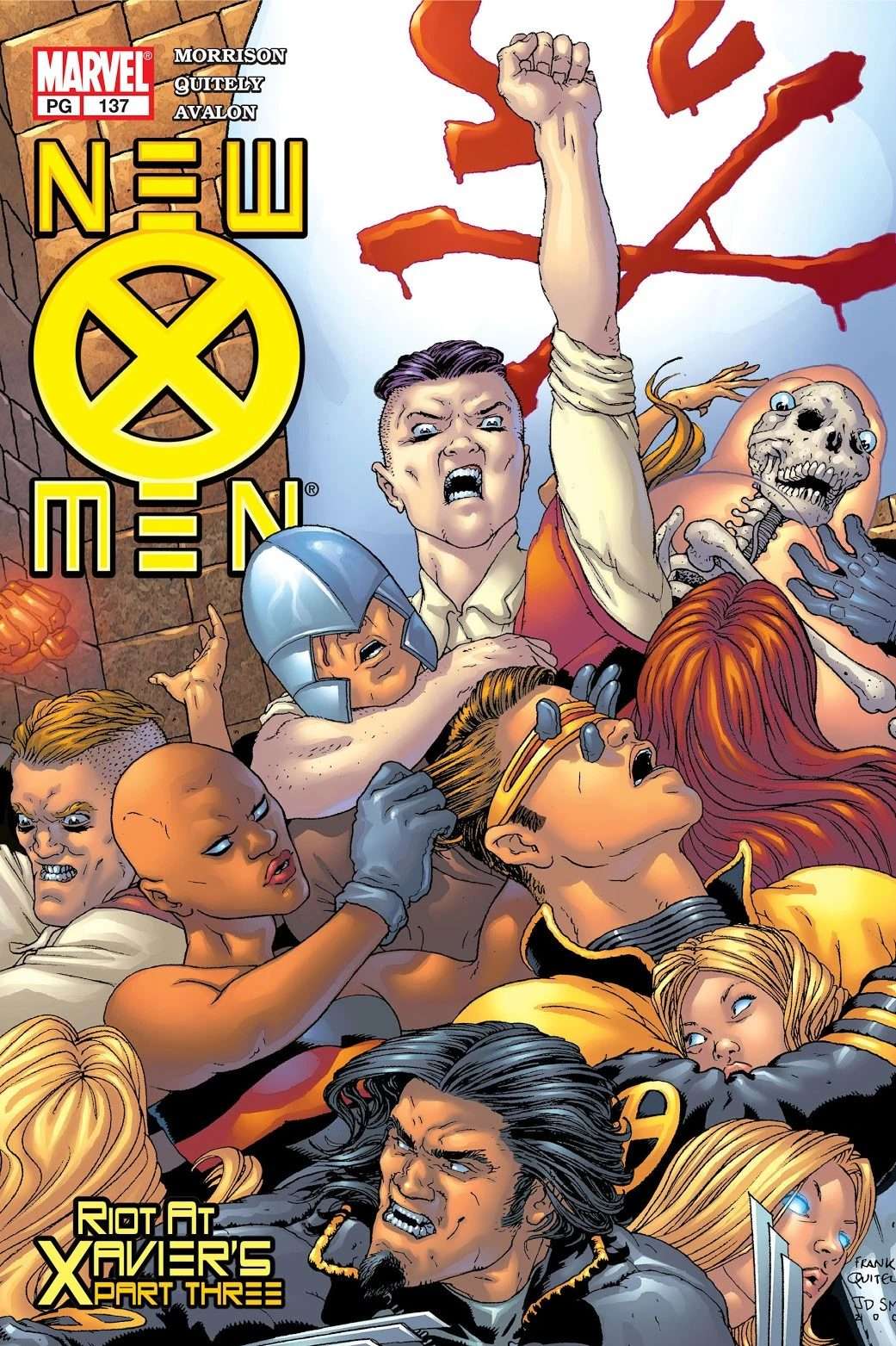
Created by Grant Morrison and Keron Grant, Quentin Quire first appears in New X-Men #134, which then leads into the “Riot at Xavier’s” arc that spans from New X-Men #135 to #137 with an epilogue in issue #138. Quentin, the primary character and antagonist of the arc, is a vehicle for Morrison and co to tell a story about the surface-level politics alienated teenagers sometimes adopt. The kind of person who doesn’t care to meaningfully understand a political ideology but instead dresses in the aesthetics and symbolism of an ideology as a means to performatively rebel against their elders and the world around them.
Many readers have drawn connections to Quentin Quire and the alt-right that would arise about a decade after the publication of Riot at Xavier’s. The alt-right, a primarily online Neo-fascist political movement, came to prominence in the 2010s. It prayed upon young, disenfranchised men as its primary recruiting demographic. In this way it mimics the social critique Morrison makes with Quentin Quire. This has led many readers to draw a direct line between the two. There is a belief that Quentin Quire is an uncanny proto-alt-right character. However I would argue for a different read of the text and the critique it makes.
Quentin is alienated and feels rejected after learning from his parents that he was adopted. This revalation fundamentally shakes his sense of self and throws him into questioning every aspect of his life. He lashes out because he feels disenfranchised. By rejecting Xavier’s dream he is venting his frustrations at the world, it’s an outlet, not a sincere position. Quentin adopts outrage at the death of Jumbo Carnation not out of genuine anger at the grizzly murder, instead he takes the position when it becomes another outlet for him to point out the supposed hypocrisy of his elders and fuel his anger.
Throughout the arc we see Quentin’s acts of rebellion escalate more and more into violent and destructive outbursts. It starts with cruelty to his peers, his actions escalate further when he and his Omega Gang start assaulting random groups of bigoted humans.
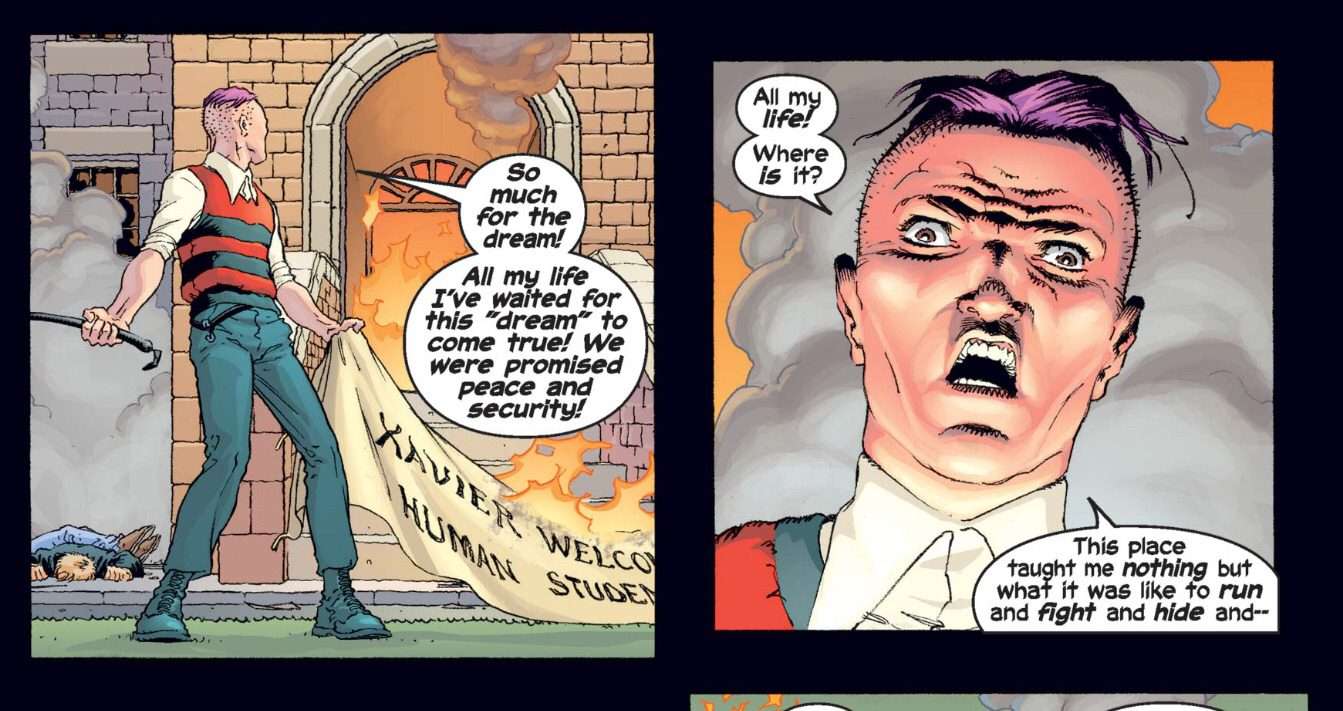
Quentin at the climax of the riot exclaims “So much for the dream! All my life I’ve waited for this “dream” to come true! We were promised peace and security! All my life! Where is it!” Here we see his true motivations laid bare, he feels disowned and abandoned after learning about his adoption. And now he thinks his teachers also have failed him. Quentin Quire has devastating abandonment issues that fuel his actions in Riot at Xavier’s.
As much as the riot itself escalates the Omega Gang lack clear goals or demands for their actions. They are just wildly lashing out because of the drug Kick and juvenile angst. It’s very much like a baby crying out for the attention of the adults.
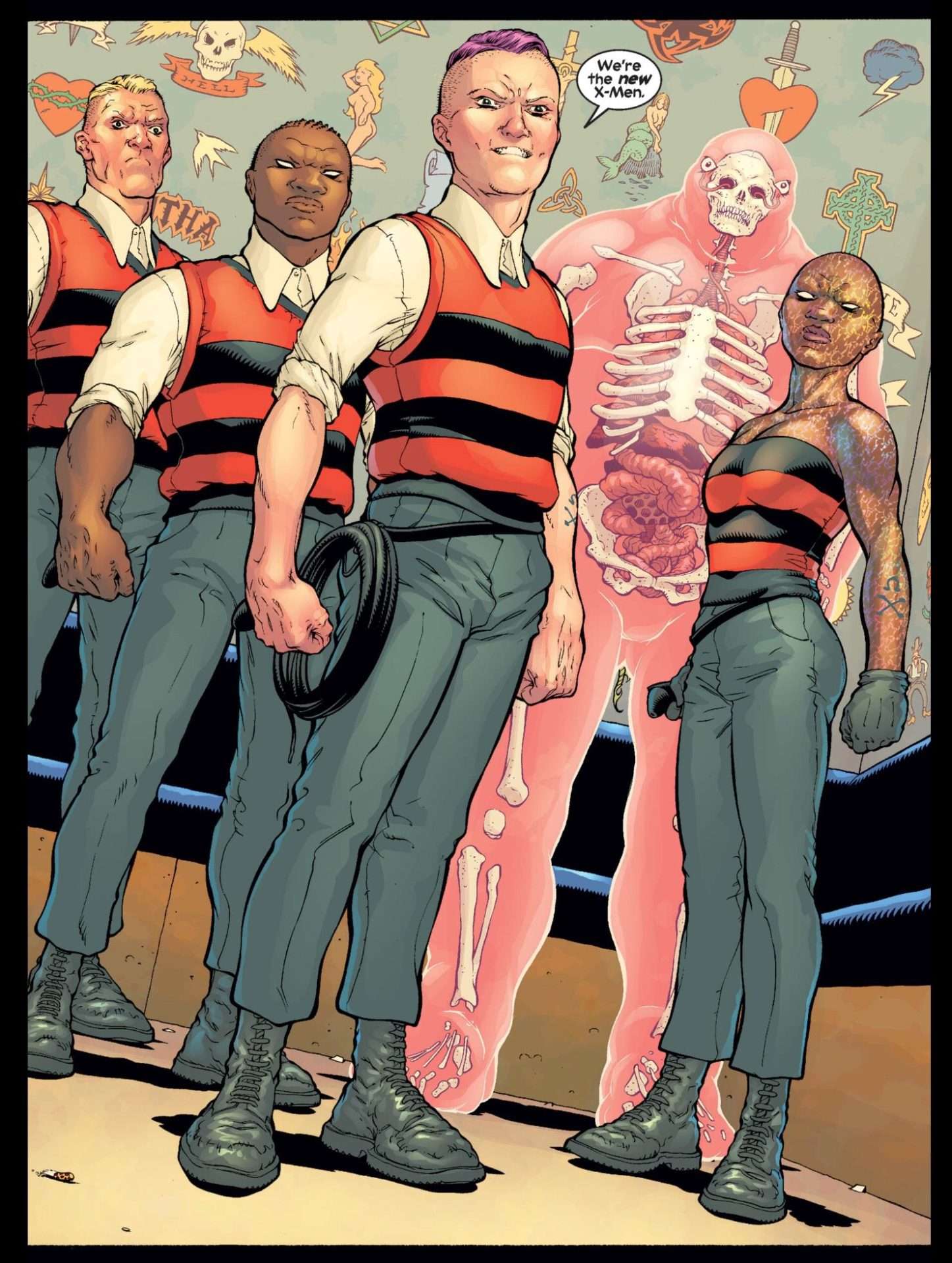
In their sadism, the Omega Gang are blind and uninterested to the real harm done to their fellow Mutants as shown when they attack a U-Men base. Instead of seeing that the U-Men are planning on attacking Xavier’s students, they obsess over sadistically murdering a U-Man. Their riot leads to the death of Dummy of the special class. It’s a display that they are uninterested in actually fighting against anti-Mutant bigotry but more use the concept of humans as a target for Quentin’s violence, their ideology is style over substance. They aren’t interested in politics or understanding the reason for practicing them, they are only interested in the act itself.
Earlier in the arc, we see Quentin wearing a shirt that reads “Magneto was right” which is a parallel to the real-life use of Che Guevara on graphic T-shirts that were popular in the early 00s among students, the comparison Morrison is making is from an inexperienced juvenile ideology dressed up in leftist aesthetics. Much like in the real-life co-option of leftist imagery the adoption of the motto “Magneto was right” doesn’t represent an actual political position but the rebelling against the positions of the professor, the politics are purely stripped out and made into an aesthetic.
With the use of Kick, what was a normal rebellion for a teenager going through turmoil becomes the source of tangible harm, the Omega Gang’s actions don’t do anything to avenge Jumbo’s death. They lash out without caring to understand the violent consequences of their actions. It’s action for the sake of action, a cult of action which is most commonly known as a characteristic of fascism as identified by Umberto Eco in Ur-Fascism. However I think that kind of methodology (or lack thereof) isn’t inherently right-wing in nature, it can be found in unguided, vague, often experienced political organizing from many groups across the political spectrum.
In “Riot at Xavier’s” Grant Morrison tells a story about adolescent angst and political posturing. In most children, this is a healthy if somewhat cringeworthy point in development. In the case of Quentin Quire, this development is derailed by a combination of Kick and his rapidly out-of-control Mutant gift. Quentin’s politics are neither left nor right-wing, they are vapid and void of political substance, if anything it’s dressed up in imagery of the left wing. While Quentin’s path does mimic that of many young men who fell into the alt-right, disenfranchised and angry looking for an outlet I don’t think that means that he needs to represent that subculture. I think that given time the character of Quentin Quire could grow and evolve out of this phase which luckily we are now seeing done masterfully in X-Force by Benjamin Percy, I’m excited to see how this character continues to grow up with his second chance, and hope that readers open themselves up to seeing how he can grow behind his original actions in Riot at Xavier’s
 Spinning out of her fantastic