Category Archives: Background

Just A Reminder Don’t Miss The Boom! Studios 2010 Holiday Party @ Meltdown Comics!

Official Press Release

COME ONE, COME ALL TO THE
BOOM! STUDIOS
2010 HOLIDAY PARTY
@ MELTDOWN COMICS
DECEMBER 13, 2010!

IT’S A PARTY AND EVERYONE’S INVITED!

December 13, 2010 – Los Angeles, CA – Can you believe it’s been a year since our last celebration? Neither can we! But it’s true. It’s time again for the BOOM! Studios holiday party at Meltdown comics, happening Monday, December 13 at 8pm! So won’t you join us? No guests lists, no velvet rope, if you’ve got the gas or the bus fare to make it to Meltdown Comics, you’re invited!

Who: Mix and Mingle with the BOOM! Crew!

When: Monday, December 13th, 8:00pm – till they kick us out!

Where: Meltdown Comics & Collectibles
7522 Sunset Blvd.
Los Angeles, CA, 90046

Why: FREE BEER while supplies last!
About BOOM! Studios
BOOM! Studios (www.boom-studios.com) 2009 “Best Publisher” of the year, generates a wide-ranging catalog of multiple Eisner and Harvey Award-nominated comic books and graphic novels featuring some of the industry’s top talent, including Philip K. Dick’s DO ANDROIDS DREAM OF ELECTRIC SHEEP?, 20th Century Fox’s 28 DAYS LATER and DIE HARD, The Henson Company’s FARSCAPE, and the original Mark Waid series IRREDEEMABLE. This fall sees BOOM! teaming up with the legendary Stan Lee, creator of Marvel Comics’ characters Spider-Man, The Hulk, and The X-Men for a line of original superhero series, the legend’s first new superhero creations in nearly 20 years. BOOM!’s youth imprint, BOOM Kids!, is an undisputed industry leader publishing Disney/Pixar’s THE INCREDIBLES, CARS, and TOY STORY, as well as Disney’s THE MUPPETS, DONALD DUCK, UNCLE SCROOGE and WALT DISNEY’S COMICS AND STORIES. This year, BOOM! Studios celebrates its fifth anniversary.

See Avatar & Iron Man Suits at the Stan Winston Tribute Comic-Con Booth Hosted by Profiles in History

Official Press Release

Profiles in History Hosts
the Stan Winston Tribute Booth

Comic-Con

Profiles in History
Booth #1605

July 22-25, 2010
San Diego Convention Center

111 W. Harbor Dr.
San Diego, CA 92101

For more information, visit:
http://www.comic-con.org/

Profiles in History clients will have a chance to meet Matt Winston. Fans will also be treated to a once-in-a-lifetime display of iconic creations, a multimedia display, exclusive footage and free photo opportunities in honor of the legendary, multiple Academy Award-winning visual effects genius, Stan Winston.

The Stan Winston Family
in conjunction with the Gnomon School of Visual Effects
proudly announces the unveiling of the

Stan Winston School of Character Arts

Stan Winston School of Character Arts Logo

Some of the items on display at Comic-Con will be…

Iron Man Mark III Suit

Iron Man Mark II Suit

Iron Man Mark I Suit

Iron Monger Suit

Events at Comic-Con

The Winston Effect
Saturday, July 24 at 5:30-6:30
Room 7AB

5:30-6:30 The Winston Effect: Creature and VFX luminaries discuss Stan Winston’s impact on the art of Character Creation – past, present and future. Panel will include messages from Jim Cameron and Tim Burton about a thrilling new Stan Winston endeavor. Panelists: John Rosengrant (Stan Winston Lifer and co-owner of Legacy Effects), Shane Mahan (Stan Winston Lifer and co-owner of Legacy Effects), J. Alan Scott (Animatronic Effects Supervisor and co-owner of Legacy Effects), Alec Gillis (Academy Award nominated co-founder of Amalgamated Dynamics, Inc.),Tom Woodruff, Jr. (Academy Award winning co-founder of Amalgamated Dynamics, Inc.), Howard Berger (Academy Award winning co-owner of KNB EFX), Van Ling (VFX Supervisor, problem-solver and troublemaker), Alex Alvarez (Founder and president, the Gnomon School of Visual Effects), and Matt Winston (Actor and co-founder of SWSCA). Followed by a Q&A session. Room 7AB

Captain America Enters the Modern Age

This blog is dedicated to the political relevancy of comic books. Captain America #1From their humble beginnings comic books had a tinge of political allegory reflecting on social class and acting as a refuge for writers that couldn’t find work due to their ethnicity. The political relevancy continued with Senate hearings in the 1950’s discussed here, and eventually entered the modern age of issue advocacy focusing on such issues as civil rights, AIDs, civil liberties, and the War on Terror.
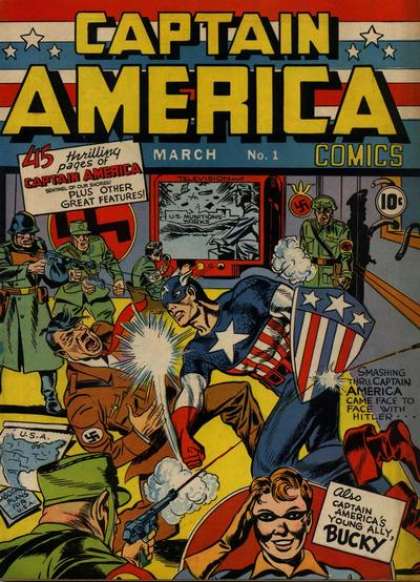
Marvel comic’s Captain America is an icon of the discussion of politics in the comic book medium. Created by Joe Simon and Jack Kirby, Captain America debuted in December 1940, a year before Pearl Harbor advocating the United States’ entry into World War II. The first issue (image above) depicts the hero punching out Hitler in a clear signal of it’s creators encouragement and hope for the United States to enter the war raging on European shores. Joe Simon even said,

The opponents to the war were all quite well organized. We wanted to have our say too.

Throughout the years though this character was a man out his time with his main opponents consisting of remnants of the Nazi’s of World War II. Flash forward through the years and Marvel’s numerous failures to modernize the character. A man out of time, representing the American ideals couldn’t fit in such a gray modern world, or could he?

Captain America Fight TerrorEnter writer Ed Brubaker, who’s run on the series is clearly not just one of the best for the character but can be heralded as one of the best runs of all time. Brubaker’s ability has been to write a character in a post 9/11 world, where terrorism exists and intrigue is everywhere, all on top of a backdrop of politics and social commentary. His vision, in it’s 38th issue this month, weaves a modern day fable reflecting on Al Qaeda’s looming threat, the housing crisis, corporate intrigue, a Presidential election, and the death of an icon. In the interview “The Man Who Killed Captain America” found in Marvel’s Captain America Omnibus, Ed Brubaker is quoted as saying,

I really wanted to ground the book in the real world. Of course, it’s not gonna be Al Qaeda, it’s gonna be Hydra of AIM…”

But, the best way to show the brilliant tale Brubaker has weaved is to lay out the complicated plot of his in process epic. SPOILERS AHEAD

The Red Skull is in control of an object called the Cosmic Cube which can grant it’s owner the power to do anything. Aleksander Lukin, a Russian hardliner wants the Cube to expand his corporation Kronos and make a play for the United States. Lukin gives the order to assassinate the Red Skull and the Cosmic Cube falls into his hands. Now, a deranged person could just wish the world to be what they want but the cube is weak and it’s abilities limited. Lukin instead lures some of the top corporate executives to the Kronos’ headquarters and using the Cube’s power forces them to sign over their companies and become subsidiaries of Kronos (issue #12).

Marvel’s Civil War occurs forcing super heroes to register with the government and leading them to split into two camps on either side of the issue eventually leading to the tragic assassination of Captain America (issue #25). In the comic Captain America defends his position and his leading the resistance to government registration,

Sharon Carter: …And the rule of law is what this country is founded on.

Captain America: No…it was founded on breaking the law. Because the law was wrong.

SC: That’s semantics Steve, you know what I mean…

CA: It’s not semantics, Sharon. It’s the heart of the issue. The Registration Act is another step toward Government control. And, while I love my country, I don’t trust many politicians. Not when they’re having their strings pulled by corporate donors. And not when they’re willing to trade freedom for security.

SC: Now you’re going to quote Ben Franklin at me? Give me a break.

CP: How about Thomas Paine? “Those who expect to reap the blessings of freedom must undergo the fatigue of supporting it.”

Captain America surrenders when he notices the destruction of this battle between heroes and on his way to trial is assassinated on the footsteps of the courthouse. This act was a moment that gained national attention, such as this article from CNN.

Ed Brubaker on the moment,

(I) instinctively thought Captain America is such an icon and the way American icons are killed is that they get assassinated. They don’t die the way they’re supposed to die; they die tragically. That was what I was going for – making sure it played like an American tragedy.

As reported by the Associated Press, one of Captain America’s creators Joe Simon had this to say,

It’s a hell of a time for him to go. We really need him now.

In the modern age of comics no event has directly reflected the state of the world as Brubaker’s iconic political statement of the death of liberty on the steps of that courthouse. But, his brilliant writing proved a comic book series could continue, even without it’s main character.

Lukin’s plan was continuing. His move was to control the United States by destabilizing it and entering the Presidential election with his own backed candidate. Kronos Corporation did it’s part by driving the people to the streets. In issue #34, which came out in January of 2008, a mortgage crisis rocked the Marvel world as much as it has our own real one. In a part of the story playing right out of the headlines of MSNBC, Captain America #38Kronos Corporation foreclosed some homes due in part of a sub-prime lending scandal putting the economy in crisis (ed – who says comics are just for kids?). People took to the streets to protest where a security force owned by Kronos (aka Blackwater) was hired by the Government to keep the peace. We also learn that Lukin has at least one politician in his pocket, Senator Gordon Wright.

The third act of Brubaker’s epic is in it’s infant stages as all of this instability has led to Senator Wright forming the Third Wing party and running for President of the United States.

As you can see by the summary, comics have come a long way over the years. They sport a reality too close to home mixed in with the traditional escapism and fantasy. They reflect our current events, and pose philosophical questions and problems for ourselves to answer. In Brubaker’s epic a new man bears the uniform, shield and name of Captain America, in the comics, and the real world there has never been a greater time when we’ve needed him than now.


Captain America Approach to Foreign Policy

Recently in the American Prospect, Ezra Klein wrote a blog Captain Americapost entitled “A Superman Approach to Foreign Policy” where he describes current American foreign policy in relation to Superman, Captain America, and Jack Bauer. While I understand the point Ezra is making, his understanding of comic book characters comes off as limited, and simplistic ignoring the very rich history both Superman and Captain America have. And “facts” cited are often inaccurate. So first let me set the facts straight:

“Superman and Captain America were superheroes of an odd sort: tremendously powerful beings whose primary struggle was often to follow the self-imposed rules and strictures that lent their power a moral legitimacy.”

Fact: While Superman may be tremendously powerful, Captain America is very much human with extra speed and strength given by the super soldier serum to him. And while I agree both characters follow self-imposed rules, these have lead to questionable power and legitimacy, but more on that later.

“Neither allowed themselves to kill, and both sought to work within the law.”

Well, Captain America has killed, and the fact is Superman is famously attacking a gang on the cover of Action Comics #1, pretty sure that counts as vigilante justice and working outside the law.

“Given their strength, either could have sought world domination, and even if they didn’t, they could have been viewed with deep suspicion and even hatred by those who were convinced that they one day would seek world domination.”

#1 Captain America doesn’t have that type of strength. #2 Superman did try to impose his moral authority on the world in Superman IV: The Quest for Peace by ridding the world of nuclear weapons and the comic Superman for All Seasons. Also in Frank Millar’s brilliant Batman: the Dark Knight Returns, Superman is the arm of a fascist United States government imposing it’s will on the world.

“Indeed, soon enough, both were forming communities of like-minded super beings (The Justice League for Superman, the Avengers for Captain America) and generally operating much like, well, the nation that birthed them.”

Captain America didn’t form the Avengers, case closed on that part of the argument. They were put together by the very Halliburton like, end justifies the means Iron Man.

“If Superman and Captain America were the emblems of the national mood directly after World War II, Bauer expressed the national anxieties uncovered by 9-11.”

Well the issue here is that both Captain America and Superman were created before World War II. They reflected the Great Depression and unease of immigrants and the populace as a whole. Superman is the immigrant. Shipped off like Moses to our world from a dying planet and being adopted by a mid-west couple. Captain America was a great example of ra-ra flag waving. He was created by Joe Simon and Jack Kirby who were repulsed by the growing power of the Nazi’s in the lead up to World War II. His first appearance is in Captain America #1 which debuted in 1940, a year before Pearl Harbor. In this issue he is already knee deep fighting Nazi’s something the United States had yet to do. Much like throughout the years Marvel’s Universe and characters were often ahead of the times when it came to international issues or domestic policy. Captain America was a call to action against oppression and intolerance much like the character Jack Bauer is a reaction to the current political climate. Those early Captain America stories showed rather racist depictions of Germans and later Japanese much like Muslims may be depicted unfairly on the television show 24.

The latest layers of the Captain America mythos is what’s truly amazing and what Ezra clearly misses. In a recent origins series it’s revealed that Steve Rogers was not in fact the first Captain America. In truth the super soldier program that created him had a Tuskegee like past leaving many African American men crippled in their later years. His shining beacon of democracy was tainted by the sins of his creation. As mentioned above Captain America entered World War II far before the United States did in the real world.

But this isn’t the last time that he would be a part of a offensive defense of democracy. In the recent mini-series Secret War Captain America was part of a secret operation to overthrow a democratically elected government who was secretly funding and plotting against a terrorist attack on the United States. But what’s most interesting was his turn as a anti-United States resistance fighter in Civil War. In standing up against a Patriot Act like legislation Captain America leads a band of heroes against government regulation. While standing up for the liberty he represents he in turn becomes an enemy of the state and terrorist.

Captain America is America, both sides of the same coin. He represents the interventionist, the patriotic, the benevolent, the aggressive, the diplomatic, the tainted past, liberty, freedom, democracy, a real reflection upon the nation and it’s people. The question is what Ezra proposes in the end, “Do we want the foreign policy of Jack Bauer and John Yoo, or of Clark Kent and George Marshall?” The fact is we have been living the Captain America Approach to Foreign Policy since our founding.

The Enemy Within

Last week Marvel comics launch it’s 8 month epic series Secret Invasion. Secret Invasion #1The political subtext leading up to this 3 years in the making event goes further than the “Colbert 08” t-shirt snuck into one of the panels in issue number 1.
Secret Invasion is the continuation of a story started 3 years ago involving the invasion of Earth and replacement of some of Marvel’s most powerful heroes by alien shape shifters call Skrulls. This feeling of sleeper cells amongst us was no accident. In an interview with Entertainment Weekly, the series writer Brian Michael Bendis said:

The Skrulls were invented back in the day when Invasion of the Body Snatchers and the Cold War were a big part of the [Marvel] universe. And we’re kind of back in that: The subtext of this story is not knowing if you can trust your friends or family. Years after 9/11, we go on a plane and start scanning the crowd…we can’t help it.

As Bendis describes above the original story of the Skrulls focused on Cold War hysteria, this new story updates it for the post 9/11 era, just replace Skrull for Al-Qaeda and you see where I’m going with this. Following the events of Marvel’s previous event Civil War, covered here, as well as the limited series Secret War, dealing with super power terrorism, Secret Invasion leaves the Earth’s protectors wondering who they can trust. Much like Civil War’s dealing with restrictions on liberty and freedom, Secret Invasion focuses on the paranoia of the unknown. Not knowing if you’re neighbor or friend is really a terrorist preparing to strike. The first issue saw numerous sleeper agents activated resulting in a global orchestrated terrorist strike, and calling into question various actions by some major characters over the past 3 years (ugh, I’m going to have to go back, re-read, and dissect).

The series takes on extra meaning with the recent news of convictions of a Chinese sleeper agent who had been the United States for two decades. An interesting time frame since (spoiler) the final panel of issue 1 reveals many of Marvel’s super heroes returning in their late 70’s/early 80’s uniforms. Weird coincidence, of course they could just be Skrulls as well.

Now this is just the first issue and judging by it, there’ll be tons to dissect over the next 8 months (at least). Bendis will make sure of that.

King and X: Ways and Means

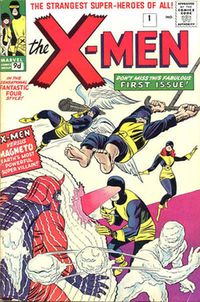
Created in 1963 Marvel Comics’ X-Men has often featured social issues such as the exploration X-Men #1of the civil rights movement through it’s brand of superhumans called mutants. A mutant as defined in the Marvel Universe is the next evolutionary phase of humanity where people are born with a mutation that grants extraordinary powers. These manifest in abilities like flying or telepathy or can deform the persons appearance making them easy to spot and often ostracizing them in society. Over the years laws have been passed and overturned discriminating against mutants and over time general acceptance has been gained as well.

The original conflict in the series presented two sides to a similar coin. Should mutants co-exist with humanity, or should they use their powers to take their “rightful” place as rulers of the planet, enslaving mankind. The two sides are represented by Charles Xavier/Professor X (the leader of the X-Men) and the other side represented by Erik Lehnsherr/Magneto. Some have described Xavier as representing Martin Luther King Jr. or Ghandi while Magneto represents Malcolm X or Meir Kahane. While others have said Xavier represents both King and X while Magneto represents Louis Farrakhan or Nat Turner.

And in this post, on the day Martin Luther King Jr. was assassinated 40 years ago, the exchange below from X-Men: Legacy #209 caught me as appropriate. The two characters are asked whether Xavier or Magneto won their “perennial debate about ways and means”. I leave you with Xavier’s and Magneto’s conversation to ponder:

Magneto: So what do you think Charles? Force majeure versus love and peace and understanding. Which carries the argument?

Xavier: You and me Magnus?

Magneto: Yes, you and me. With the issues oversimplified for the sake of the easy soundbite.

Xavier: I — I think — I think — We cancelled each other out. For a long time. And then — Finally — We became irrelevent. The future walked around us.

Civil War and the Death of Freedom lead to a Secret Invasion

With the release this week of Marvel comic’s Secret Invasion it’s appropriate to look at last year’s overtlyCaptain America's bloody uniform political crossover event Civil War. As described on Marvel’s own website.

“Sparked by the deaths of hundreds of innocents at the hands of the New Warriors, the Super Human Registration Act changed the makeup of America’s super human community.

Torn between perceived freedom and believed safety, the heroes split and Civil War erupted. The ensuing conflict and tenuous resolution still reverberates throughout Marvel’s heroes.”

SPOILERS: The basic story goes while filming their television show the super hero group the New Warriors over estimate their ability to take on a group of villains. In an act of desperation the villain Nitro sets off an explosion devastating to town of Stamford, Connecticut, killing hundreds. A call to end this recklessness is sent out and the “Super Human Registration Act” is quickly rushed through Congress forcing all people with extra ordinary abilities (even if they’re born with them) to register with the federal government, reveal their secret identities, become trained, and in the end a Government sanctioned super human army.

Iron Man took the lead on the side of the Government looking to the Act as a way to prevent another accident like Stamford. Even extending amnesty to murderous villains if they’d join the pro-registration side. Captain America (the embodiment of American ideals) looked at the act as a crushing blow to civil liberties and lead the side of underground resistance. In a great juxtaposition of Iron Man’s “ends justify the means” embracing of murdering villains when the Punisher kills two villains on the anti-registration side, Captain America pummels him, expelling him from the group. A battle between heroes leading to twists, betrayals, and deaths, began over the very definition of freedom.

In the end during a climactic battle between the two sides destroying the town surrounding them, Captain America realizes their battle is leading to another Stamford and orders the anti-registration side to stand down gives up his mantle as Captain America, and in doing so turns himself over to Iron Man and the authorities.

In the final twist Marvel signals the end of liberty as we know it when they have Captain America, brought to trial as his identity of Steve Rogers, gunned down on the steps of the courthouse as he is escorted in cuffs to trial. Writer Mark Millar described Civil War as:

“…a story where a guy wrapped in the American flag is in chains as the people swap freedom for security…”

The Political Undertone: The easiest direct parallel to real life events is the Stamford incident and it’s post reaction directly reflecting 9/11 (which did occur in the Marvel universe) and the legislation rushed through soon after. The “Super Human Registration Act” has it’s real world sister’s in “The Patriot Act” and “Real ID“. Both pieces of legislation were rushed through in a post tragedy hysteria with little regard to their long term abuses and curbing of civil liberties.

When asked about these political similarities, Millar responded:

“The political allegory is only for those that are politically aware. Kids are going to read it and just see a big superhero fight.”

A comic book version of Guantanamo and embedded reporters were even explored. To hold the superheroes (and villains) that the pro-registration forces capture a special prison is built called “42”. Much like Guantanamo it’s goal is to break down and isolate the prisoners. In the offshoot “Civil War: Frontlines” the war is shown from the perspective of reporters covering the events around them. The series’ writer Paul Jenkins told the New York Times:

“Civil War: Front Line” will explore the ramifications of the events in the main series and more. “I have absolute carte blanche to take on the political landscape as it exists in America and all around the world.”

With liberty dead (literally) the 50 State Initiative was put in place to create sanctioned superhero teams in every single U.S. state. And that brings us to this summer’s event and it’s own political spin. Secret Invasion tells the tale of sleeper cells of aliens who have infiltrated the world and plan to attack when activated. This week sees the release of the first issue and in future posts I’ll be talking about the eerie similarity between these alien sleeper cells and the fear of the unknown cells that lay in wait to attack here in the U.S.

Join us this weekend for the first installment….

Recent Entries »