
Tag Archives: time travel

Movie Review: The Long Walk

It takes a delicate touch to cross genres, to marry them and then keep them in harmony to get at something different. Mattie Do’s The Long Walk achieves this in truly impressive ways, finding success in the subtleties of the horror and sci-fi genres she uses for her story rather than in their loudest components. The film—a Laotian production—truly is an achievement, and it does something movies in general should aspire to do more of: broaden the scope of storytelling.

The Long Walk is essentially a ghost story that’s in league with time travel. An old man (played by Yannawoutthi Chanthalungsy) is followed around by a young female ghost (Noutnapha Soydara) that can take him fifty years into the past to when his mother died a slow a very painful death in their house in rural Laos. The old man starts interacting with his younger self (Por Silatsa) with good intentions at heart, but the consequences of meddling in one’s own past turn out to bear a high and strange cost.

It’s a slow burn of a story that gives viewers time to consider the old man’s actions, especially in how well-intentioned he seems to think they are. Given how heavily it focuses on the old man and his younger kid version, the experience is profoundly personal. The audience spends a lot of time with the character at his most intimate and it makes for a study that feels intensely raw but always honest.

It’s important to note that the movie offers no clear answers and offers no real path to judging its main character. As we become aware of what the old man’s intentions are, new questions start claiming their stake in the story, all while making the unique situation the character is in become progressively disturbing.
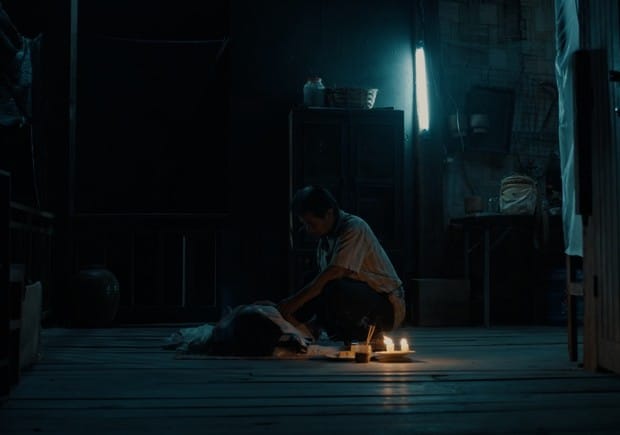
It’s fortunate, then, that the performances are so good. Chanthalungsy and Silatsa never stop being fascinating to watch. They make the most with the pacing of the story by taking their time to methodically develop the emotional arcs that get tangled together throughout the movie.

I appreciated how uncomplicated the whole time travel component was. There are no hard sci-fi concerns here regarding paradoxes or collapsing universes. A change in the past is a change in the present. What it all means, though, is where the game’s at. Mattie Do accentuates this visually with changes to the old man’s house as markers of time manipulation.

The house itself functions like a character in its own right, or an extension of the old man’s spirit and personality. We spend enough time in it to get a good sense of its secrets. Any change to the things in it are important, adding layers of consequence to the old man’s decisions.

There’s definitely more of an interest in the ghost part of the equation rather than the sci-fi one. If anything, the time travelling is more a means to an end, a vehicle for the ghost story to reach alternate destinations within the narrative. One thing that stuck out was the decision to set the story in a not too distant future. It takes an approach to the future much like the one the movie Logan (2017) takes with its focus on small futuristic leaps instead of full macro shifts in society. Technological progress is evident but measured.
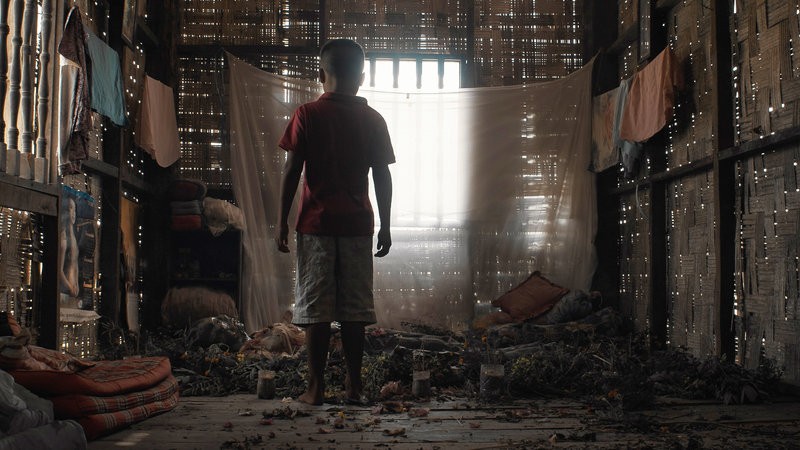
The Long Walk’s Laos is not governed by holograms, lasers, or spaceships. Its sci-fi elements are in the little things, the kind that make a dent in everyday life. Watches, bank accounts, and other functions, for instance, are integrated into human bodies through chips and are displayed on the skin. Solar energy is forced unto the countryside as well, which frames technology as an imposition that threatens established ways of life that might not need the upgrade.

Mattie Do has put a very complex, unique, and important film out into the world. The Long Walk offers a flexible blueprint for new storytelling possibilities and it should be discussed for the things it does with the genres it plays with. If the future holds more movies like this, then horror and sci-fi will be ushered into a whole new age of story.

Review: The Flash #40

theflash040That Convergence is coming is perhaps the most ironic for the Flash of all DC characters.  It was after all Flashpoint, the company wide crossover, that took the old DC into the new 52.  This crossover focused somewhat on Barry Allen and his attempt to stop the effects of the Reverse-Flash on destroying the continuity of the DC Universe, which had left millions dead and Earth without its true heroes.  The move left many series somewhat hanging as the abrupt cutoff forced some stories to be condensed and versions of characters to be erased.  It is now Convergence’s turn to exact this fate on this series, even if its effects are not as drastic.

This issue picks up where the story arc had left off.  Future Barry was on the verge of becoming a homicidal maniac by killing or maiming every villain that he had ever failed to catch, while present Barry was still stuck in the land of the Speed Force.  With the end coming, at least until June, it was time to wrap up this story and to move on, and this was done in this final issue before the break, only perhaps in an overly efficient way.  As with many stories condensed into such time frames, it feels as though the series would have done better with a couple more issues to deal with the heavier issues involved, but here they were disregarded in order to wrap up the plot.  The plot serves as a way to introduce a major villain as well as to reintroduce another, and even yet another that might be back at some point (though might simply be forgotten.)  In the process the two Flashes resolve their dispute in a spectacular way, and there is even some closure for present Barry.

If that seems like a bit much for one issue, its because it kind of is.  The series is not really well done by with this wrap-up, especially as this story arc started off with such an interesting concept, even if that concept was an abandonment of the focus put on science throughout the first three years of this series.  This is a wrap up but it leaves the character a bit too contained, with no stories to directly follow.  Two months of Convergence will dominate and it is likely that the Flash will figure in prominently, but for now this is left on a bit of a mediocre low.

Story: Robert Venditti and Van Jensen Art: Brett Booth
Story: 7.7 Art: 7.7 Overall: 7.7 Recommendation: Read

Review: Ei8ht #1

ei8htTime travel is one of the most common concepts in science fiction, but with the concepts comes its own self-imposed perils.  As the genre most focused on actual science, science fiction brings with it some need to be true to at least some scientific principles, but while time travel is a popular concept, there is nothing really scientific about it.  Generally speaking a real world application of time travel fails almost every potential logical or natural test that it can be put through, thus it remains in the world of purely speculative literature.  That having been said, there are few time travel stories which do not incorporate some aspect of supposed science into it, and in so doing stories about time travel essentially have to make their own rules to prove that what they are proposing is even possible.

In this case, time travel is possible, but there is an unexpected effect of time travel called the meld.  It is evident from the beginning of the book that this is where the main character Joshua is heading, as there is only the past, the present, the future and the meld.  Though little is known  of Joshua’s actual mission nor of his reason for accepting it, the missions would seem to take him straight into the meld, presumably a place where the past, the present and the future are melded together, in a post-apocalyptic land where dinosaurs also roam the Earth.  As an application of time travel making its own rules, this is a fairly interesting one, even if similar concepts have been tried before (for instance at present in the Flash.)  Not relying entirely on its own inspiration though, this time travel tale also seemingly draws some inspiration from Twelve Monkeys in an important enough plot element.

At the very least, this first issue sets up the remainder of the series for some success, as not only is the story interesting by itself, but so too are the character well-written, especially the band of survivors that the time traveler encounters.  Ei8ht still ends up being a refreshing tale of time travel, maybe not as groundbreaking in its version of the concept in its first issue, but still trying out something new while also borrowing from other works in the genre. The new plot device of the meld works well as a microcosm of this series, trying out some new ideas and some old ones, and mixing them together into something interesting.

Story: Mike Johnson  Art: Rafael Albuquerque
Story: 8.3  Art: 8.3 Overall: 8.3 Recommendation: Read

Dark Horse provided Graphic Policy with a free copy for review.

Review: The Flash #38

tf38covAlthough a popular enough character in his own right, the Flash never seems to get the big fireworks when it comes to attention surrounding the character.  There are never big relaunches of the character, bestselling authors are never brought in to give the character better recognition and marketing rarely focuses on the Scarlet Speedster. Some of this is duly earned, as the appeal of the character is just as much there as it is for some of the bigger names at DC, even if the Flash is able to hold down a monthly title quite consistently.  What this means is that many of the stories for the character tend to go unnoticed, with the present story arc being an obvious example.

There are two main stories going on in the story arc, as future Barry Allen has pushed the present Barry Allen into the speed force, expecting him never to return.  This leaves future Barry Allen in the present eager to undo all the mistakes that he knows happened in the future.  This is the more gripping side of the story, as the usual deontological outlook of most heroes is thrown aside as future Barry looks for the greatest good, even if that means a somewhat brutal version of cleaning up his own past.  The other half of the story has been somewhat stagnant, as the Flash that we know has been stuck in the Speed Force, a strange land populated by dinosaurs and robots.  While this has failed to grip as tightly, it picks up a lot of momentum here as it provides some background for the setting before the heroes head out into the thick of it. It ends up being a mix of something like the series Manifest Destiny but being explored by steampunk time travelers.  Although it is only touched on here, it has good potentially to match the other half of the story in the coming issues if handled correctly.

The series continues here to show that it should not be as disregarded as it on the company level, or even by the entire medium.  As the only speedster that can continuously hold down a monthly series, there has always been something special about the Flash, and while the science is often not that hard, there is at least something to it when philosophy is mixed with science.  This series deserves a look by anyone looking for something a little bit outside the box when it comes to their superheroes.

Story: Robert Venditti and Van Jensen Art: Brett Booth
Story: 8.6 Art: 8.6 Overall: 8.6 Recommendation: Buy