Movie Review: Dark Glasses

Dario Argento is considered by many to be one of horror’s great directors, an icon that serves as the face of the giallo subgenre (along with Mario Bava and Lucio Fulci). What pushed the Italian director into that sphere of recognition lies in his ability to produce highly stylized horror sequences involving very intimate and gruesome murders, often at the expense of story and narrative coherence. Seldom has Argento sacrificed an elaborate kill scene, which are more often than not soaked in neon or solid reds and blues, for the sake of logic. And yet, his films carry a distinctive signature that make them unique, that make them Argento.
The director’s new movie, Dark Glasses (now streaming on Shudder), is a surprising departure from the excesses of the genre. It’s more an exercise in restraint than in self-indulgence, something that can’t easily be said about the rest of his films, and it’s one of the reasons why it succeeds so convincingly even as an example of giallo. In a way, Dark Glasses is giallo stripped of its messy storytelling bits, finely tuned to get at the things the subgenre can do well if given the chance.
Dark Glasses follows Diana (played by Ilenia Pastorelli), a highly successful escort that becomes the target of a serial killer that’s preying on sex workers. The reason for the killings is kept a mystery, as is the case in most giallos, but it does lead early on to an intense car chase where the killer slams into Diana’s vehicle and causes a violent crash, resulting in Diana losing her sight. A third car is caught up in the violence, belonging to a Chinese family. A boy is left orphaned as a result, complicating matters further for Diana. The kid, called Chin (Andrea Zhang), later decides to seek out Diana and help her as she navigates her new reality as a blind person, perhaps because he feels a connection to her given their shared experience in loss. This dynamic ends up being one of the film’s greatest strengths.
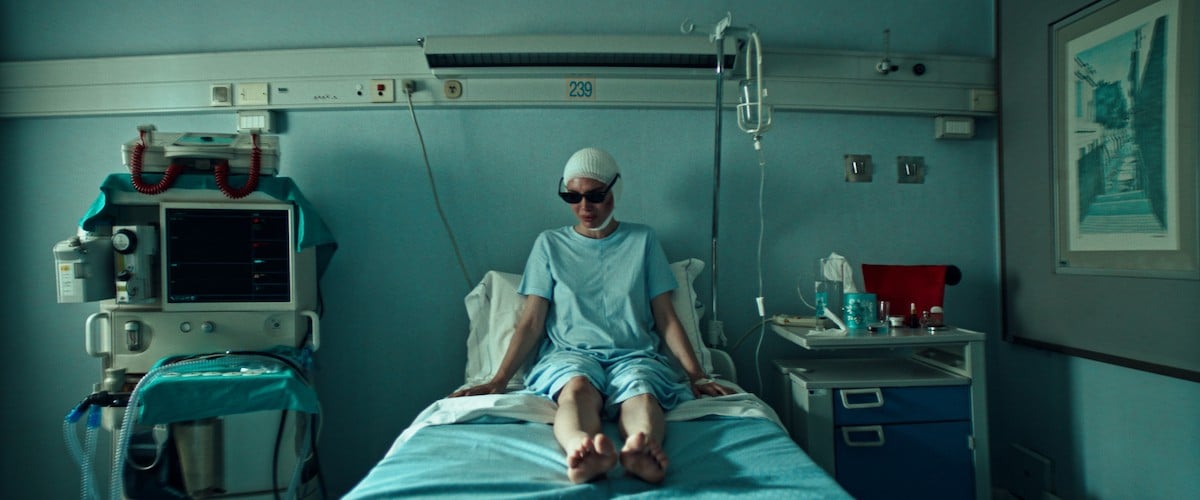
Diana and Chin make for an unusual pairing in a giallo, which leads to them being such a unique set of characters within that context. Their relationship is one of companionship and mutual protection, standing opposed to the usual lonely investigator on the trail of the killer. They very clearly need each other, one due to the loss of a crucial sense and the other due to the loss of his core family unit. This allowed Argento to build his characters, to develop a bond between them and then put it to the test in tense scenarios.
Ilenia Pastorelli’s Diana becomes one of Argento’s strongest and most imposing leading ladies thanks to this welcome focus on character development. Her performance relies heavily on her struggle to accept and understand her new condition and she leans heavily on the character’s frustrations to project that sensation on screen. It’s easy to feel her anger and desperation in the movie’s most intense sequences, especially as she fights against her condition to try and get an advantage over the killer.
Zhang also commits to his role, especially in terms of the range of emotions his character has to go through after the crash. He’s vulnerable in moments when his family is being discussed, especially his future without them, but his resourcefulness as Diana’s guide when trying to the escape the killer shines bright thanks to the all the character work Argento puts in beforehand. It’s a tender and delicate show of friendship that rarely gets the time to grow in these types of movies.

On the traditional giallo violence side of things, Argento goes for a measured touch that prioritizes quicker shots of gore over extended stays on open wounds and severed limbs. Each kill is still elegantly shot in a way that achieves the kind of macabre beauty featured in his other films, but in Dark Glasses he favors teasing the audience with the idea of brutality and cruelty rather than linger on it. Whereas in other films the violence comes off as gratuitous and sensationalized, here it carries weight while also building up the terror the killer carries with him.
Dark Glasses is the kind of Argento I’ve always wished we’d gotten more of. He crafts a memorable female character with Diana, one that avoids falling into the oversexualized and oversimplified characterizations of the past. There’s enough giallo here to please hardcore fans, too, but it’s in the twists and tweaks to the formula that the movie finds a life of its own. Argento should be commended for offering a blueprint for future forays into giallo with Dark Glasses. Goes to show, masters of horror always have a movie in their back pockets that can remind fans why they’ve earned the title.