Die Has a Nuanced Love/Hate Relationship with J.R.R. Tolkien (And Perhaps So Do I)
In advance of Kieron Gillen and Caspar Wjingaard’s upcoming comic The Power Fantasy, we’re revisiting some of Gillen’s previous creator-owned work.
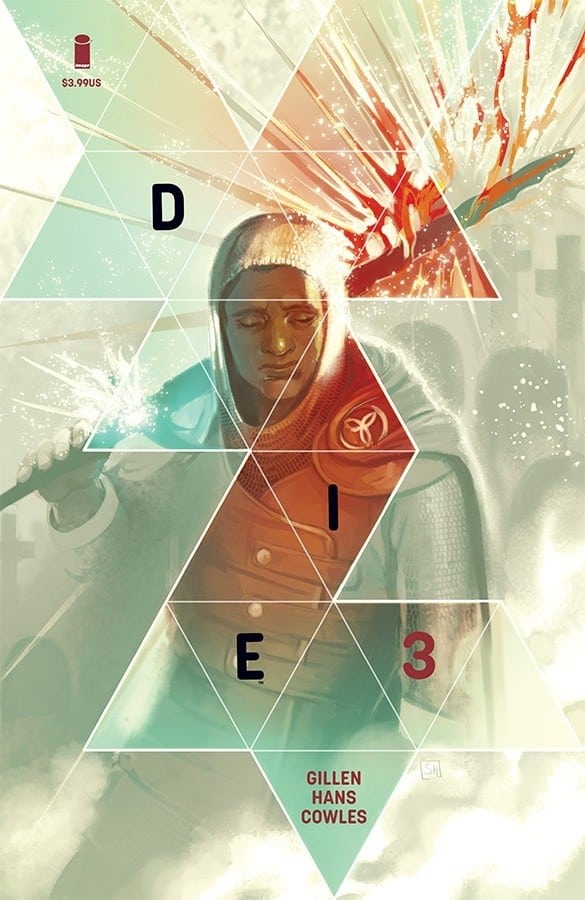
I re-read the first arc of Die “Fantasy Heartbreaker” by Kieron Gillen and Stephanie Hans, and I think a full series binge may be in the cards. I’ve gone on record in the past as saying I didn’t immediately connect with Die like I did with Phonogram, The Wicked + the Divine, or Young Avengers, but I didn’t have that issue this time. I immediately connected with the narrator Dominic/Ash not just because they have a complicated relationship to their gender identity that doesn’t get unpacked until later in the series, but because they understand the hollowness of nostalgia and yet also yearn for it. As also someone who’s moved around a lot and can be bad at keeping in touch with people, I also related to the Die cast members struggling to be an adventuring party decades after their initial “adventure”.
The elevator pitch for Die is that it’s “Goth Jumanji”. Six friends are trapped in a fantasy world while playing a tabletop roleplaying game at the aforementioned Ash’s 16th birthday party, and only five return. 25 years later, Dominic gets a bloody twenty-sided die (D20) that he thinks is from Sol, the missing party member, so he gets his friends Matt, Chuck, Isabelle, and his sister Angela to return to the world of Die (By rolling the D20) and find Sol. What seems like a basic, smash and grab rescue mission turns into an epic fantasy-meets-horror with just a touch of cyberpunk battle/quest between the adventuring party and Sol, who has taken the role of the villainous Grandmaster. Also, to throw a wrench into the story, the characters can’t leave the world of Die until they all agree to end the game and go back home. (This includes Sol.)
Initially, I was going to write about the parallels between how I feel about my gender identity and how Ash feels about theirs in Die. (There was going to be a silly anecdote about how I would always play as the female Elf in the underrated couch co-op, hack and slash RPG Dungeons and Dragons Heroes.) But I think I’d rather write about the series’ (and my) relationship to the works of J.R.R. Tolkien. Gillen and Hans grapple with Tolkien in Die #3 when the adventuring party decides to cross through a war-torn area called “the front” to Glass Town instead of Angria because it’s haunted by the specters of their previous adventures. For example, an Arthurian-type knight who had a crush on Ash turns into a maggot-ridden corpse in front of her with some disgusting visuals from Hans. “The front” is basically a fantasy take on World War I with the combatants being Little England and Eternal Prussia. The Little Englanders look a little bit like characters played by Elijah Wood and Sean Astin in an Academy Award winning film trilogy while Eternal Prussia has dragons that spew poison gas.
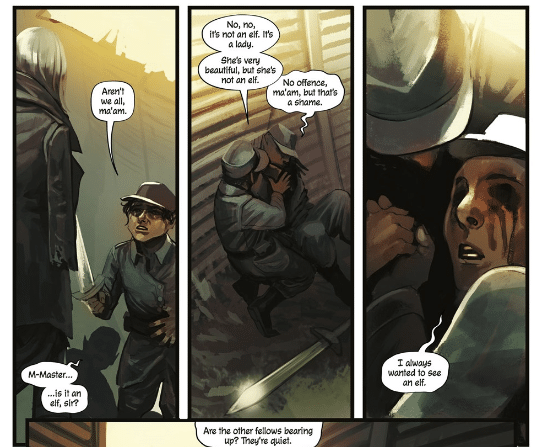
Ash first encounters the Little Englanders in a trench while she is looking for way out after a dragon attack splits the party. Stephanie Hans uses a dark palette, and there’s yet another character whose eyes have bled out, who is deferential to a slightly more alive character. Yes, it’s basically Frodo and Sam dying in World War I trenches. A ring pops up, but it’s one of the Englanders’ wedding band that reminds him of his wife not a world-ending weapon of mass destruction. Through this conversation and a relatable line of dialogue from Ash about liking the hobbit chapters most of all in Lord of the Rings, Gillen unpacks the sad truth that most of us will never go on an epic quest like the Fellowship of the Ring and will probably just be fodder for more powerful people. Hopefully, that’s just in the workplace, but back in 1914, young British men like J.R.R. Tolkien had to go to war for king and country.
There is tension in Ash’s interactions with the Little Englanders because she knows it’s all a Tolkien riff, but gets invested in their stories and feels sadness when they think that the war will end in spring. Sure, there are speaking roles for two women in The Lord of the Rings books and the Orcs are simplistic baddies. Don’t even get me started on the people of Rhun and Haradwaith and Tolkien’s lazy orientalism. (He’s not as bad as his bestie C.S. Lewis though ; The Horse and his Boy is almost unreadable in 2024.) However, these stories still give me hope to endure. If two hobbits can get to Mordor, I can get through this day. Gillen and Hans also explore the emotional resonance of these classic fantasy stories in a sequence where Ash telling the stories of the two Little Englanders makes Matt sad enough that he is able to kill a dragon in three gold and red panels. (Matt is a grief knight and basically can kick all kinds of ass when he’s sad.) It’s words and visuals: the power of comics as a medium in a short burst of an action sequence.
In Die #3, Kieron Gillen and Stephanie Hans peel back the layers of epic quests, good and evil, and now-cliched quotes about deciding what to do with the time that is given us. I love the use of the eagle in the story. In Lord of the Rings, the Great Eagles are an almost spiritual deus ex machina and are unfairly considered a plot hole. However, in Die, the Great Eagles represent hope being lost as they’re shot down by the leaders of the Little Englanders, who immediately send more soldiers to the front as the issue wraps up with a darkly comic nod to the “One does not simply walk into Mordor” meme. It’s also a metaphor for the narrative of Die. This isn’t a 5 issue miniseries ; the cast of former friends must go through many trials before doing their “there’s no place like home” thing.
J.R.R. Tolkien originally wrote The Lord of the Rings as a more kid-friendly sequel to The Hobbit (Aragorn was a original a hobbit ranger called Trotter.), but in the writing process, it became a darker tale possibly influenced by the shadow of authoritarianism sweeping Europe as well as his own experiences in the trenches of World War I. Kieron Gillen and Stephanie Hans follow that tradition in Die crafting a fantasy world that isn’t an escape, but is sour milk nostalgia like playing Skyrim after a bad trip. Escapism feels like guilt when you have “responsibilities” in the “real world”, and that tension pervades Die and makes it a compelling read.
However, killing dragons will always be cool!
