
Review: Uncle Scrooge #30
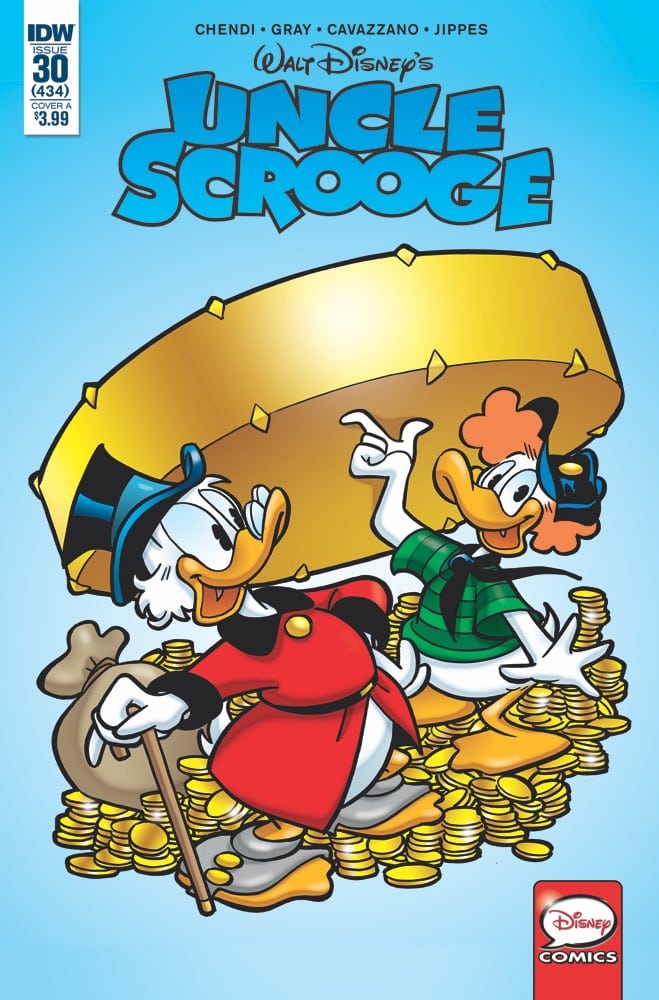 Uncle Scrooge #30 collects two international stories in one book, reprinting one story from 1981 and another from 2011. The book will likely pique interest in those who are jumping on the Duck Tales revival train—myself included—and if you’re just here for classic Duckburg humor then you’re in the right place.
It’s hard for me to recommend purchasing the book, however, as it’s arbitrarily reproduced stories from older books. I can’t help but compare my reading experience to Duck Tales, which may not be fair, but it’s not to be helped, either. The television reboot is original, clever, and seamlessly blends classic Donald Duck comics with the cult-hit 90s cartoon.
In comparison, Uncle Scrooge is the same joke dragged out ad nauseam, which makes the story predictable. Where the new show works hard to give each of the triplets their own personality, and Donald his own meta-twist where his speech is only understandable about 60% of the time, the older stories feel dismissible in comparison. Donald uses complete sentences, Scrooge has no accent, the boys are referred to as clones (with good reason), and Scrooge is so cheap he charges interest on bus fare.
Maybe I’m coming down hard on the book because I hold Duck Tales and Donald Duck so very dear. I don’t like to see them mistreated. But Uncle Scrooge does just that. If the book used the older comics as bookends, like the newer Archie books, I would be much more inclined to return to “Uncle Scrooge” in the future. As it stands now, I think I’ll pass.
Story: Carlo Chendi, Daan Jippes, Jonathan Gray Art: Daan Jippes, Giorgio Cavazzano
Cover Art: Giorgio Cavazzano
Story: 5.0 Art: 8.0 Overall: 6.5 Recommendation: Pass
IDW Publishing provided Graphic Policy with a FREE copy for review
 “Year Three” of the Eleventh Doctor in comics features the two-part arc The Memory Feast, which takes place over issues #3.6 and #3.7 of Doctor Who: The Eleventh Doctor. In the story, Eleven, his human companion Alice Obifune and their, uhm, progeny?, a creature called “the Sapling”. The three find themselves on an impossible ship in deep space, chased by hooded figures through portal after portal of an alternate reality. The Doctor soon determines that the ship is a memory ark for an extinct species called the Xerzes. The species only exists now in the memories stored by the ship. Immediately, he empathizes and encourages his companions to help him eradicate the hooded baddies called the Thrake.

 Welcome to the Vortex Butterflies story line, featuring the Tenth Doctor and his comic-exclusive companions Gabby Gonzalez and Cindy Wu. #3.7 is the second issue in the Vortex Butterflies arc, so I recommend picking up 3.6 before diving in. However, the arc so far is a wonderful entry point into the Doctor Who comics. Doctor Who: The Tenth Doctor #3.7 starts with the Doctor at a space junkyard, picking up a machine that will help him record temporal waves and register “vortex leaks”. He left his companions at a safe house in London, and their travel buddy Noob on the Xenopsychology planet of the Zokadyll. All three stories unfold simultaneously, and their narratives are well-balanced and easy to follow. There are answers to some questions (what do Gabby’s new powers actually DO? What is Noob up to on that giant library planet?) while others are left open-ended, meaning I’m now anxiously awaiting 3.8!
 The book has appeal for both die-hard Whovians, and those new to the series. Most importantly, it adapts the show into the comics format seamlessly. There is plenty of timey-wimey talk, but the elements that matter get a closer examination, making the rest the familiar background noise of our favorite show-off timelord.
 Rachael Smith’s bonus comic at the end of the book took me by surprise. It’s a breath of goofy fresh air at the end of a high stakes adventure-in-progress. I don’t think I stopped smiling from the first panel to the last. Bringing Rose back to Ten’s side in such a realistically teenage way while kicking the comedy up to eleven (no pun intended). I hope this is a tradition we will see continued in future issues.
 *Warning: Spoilers Ahead*

 The first issue of the new series Babyteeth already has me anxious for what comes next. Writer Donny Cates‘ quick-cut storytelling unfolds in a flashback as the narrator, sixteen-year old Sadie Ritter, tells her son the story of his birth. In just a few short pages, more questions are asked than answered in the best possible way. Who is this mystersious child, born on waves of earthquakes and bringing with him the end of the world? And if the world is over, how is Sadie still getting cell service?
 Right on the tail of