This July, Marvel Comics celebrates Disability Pride Month with an all-new saga starring heroes that represent strength and empowerment for the disability community. Written by Marieke Nijkamp and drawn by Andrea Di Vito, the story will be told in special backup stories across four issues: Amazing Spider-Man #32, Uncanny X-Men #31, Fantastic Four #14, and Wolverine #24. Each issue will also feature a Disability Pride Variant Cover by one of several seminal artists: Jamie McKelvie, David Mack, Aaron Kuder, Leinil Francis Yu, and Stephen Segovia.
Intersecting with a range of different disabilities, the iconic characters spotlighted include DAREDEVIL, MISTY KNIGHT, ECHO, HAWKEYE, SILHOUETTE and FINESSE. This formidable group of heroes will come together to save Colleen Wing from a deadly threat in an action-packed story highlighting the power of community and uplifting one another.
AMAZING SPIDER-MAN #32
Featuring a special backup story celebrating Disability Pride Month by MARIEKE NIJKAMP & ANDREA DI VITO Disability Pride Promo Cover by JAMIE MCKELVIE Disability Pride Variant Cover by LEINIL FRANCIS YU On Sale 7/1
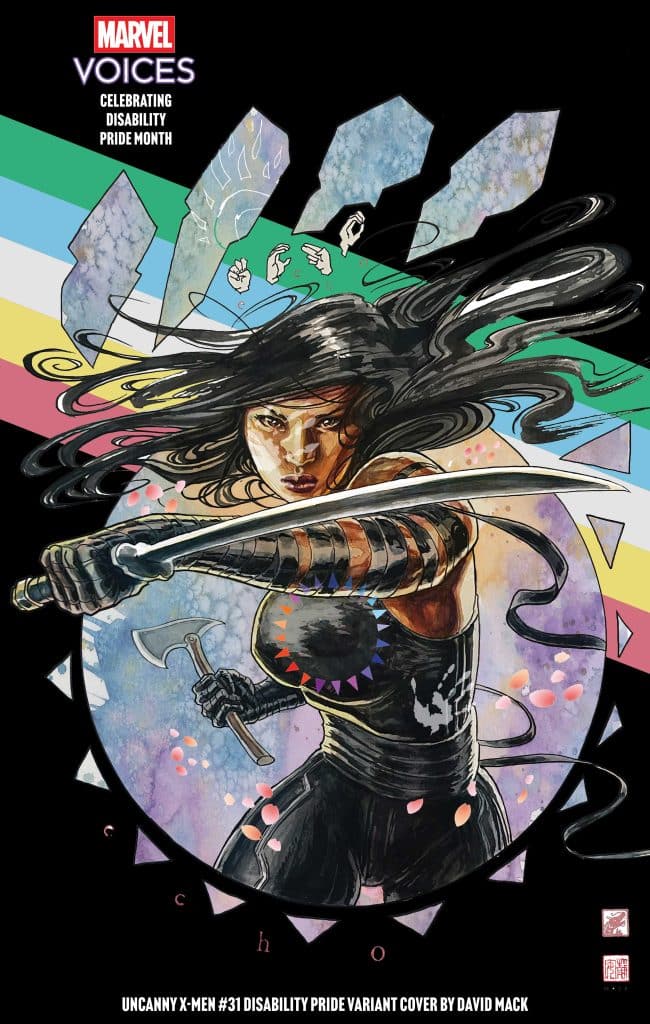
UNCANNY X-MEN #31
Featuring a special backup story celebrating Disability Pride Month by MARIEKE NIJKAMP & ANDREA DI VITO Disability Pride Variant Cover by DAVID MACK On Sale 7/8
FANTASTIC FOUR #14
Featuring a special backup story celebrating Disability Pride Month by MARIEKE NIJKAMP & ANDREA DI VITO Disability Pride Variant Cover by AARON KUDER On Sale 7/15
WOLVERINE #24
Featuring a special backup story celebrating Disability Pride Month by MARIEKE NIJKAMP & ANDREA DI VITO Disability Pride Variant Cover by STEPHEN SEGOVIA On Sale 7/22
Marvel’s Disability Pride Celebration is part of the Marvel’s Voices program, which delivers super-powered storytelling that explores the multitude of unique backgrounds, journeys and identities found in the Marvel Universe.
Check out Jamie McKelvie’s Disability Pride Variant Cover along with David Mack’s Disability Pride Variant Cover and preorder them at your local comic shop today!
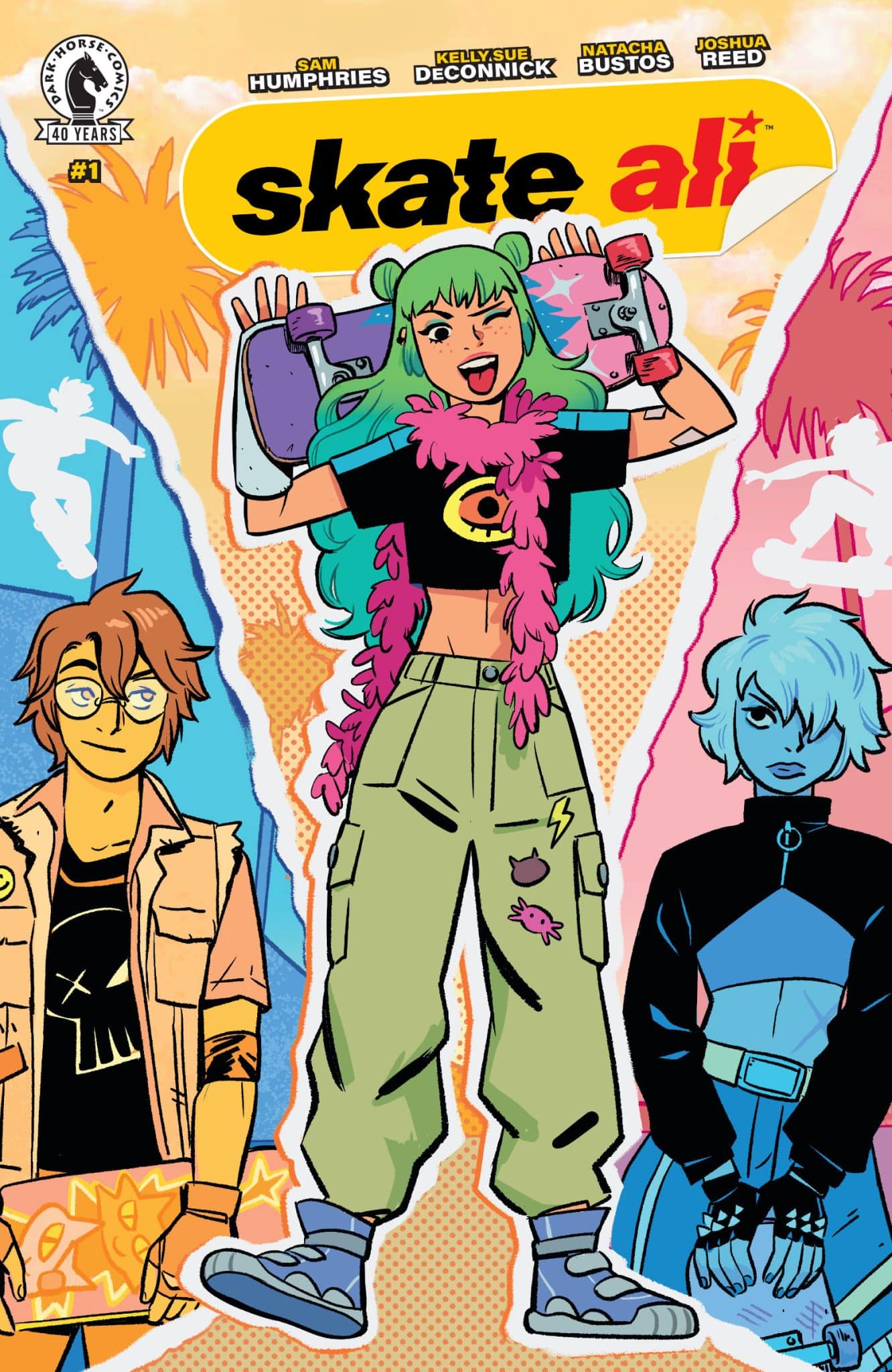
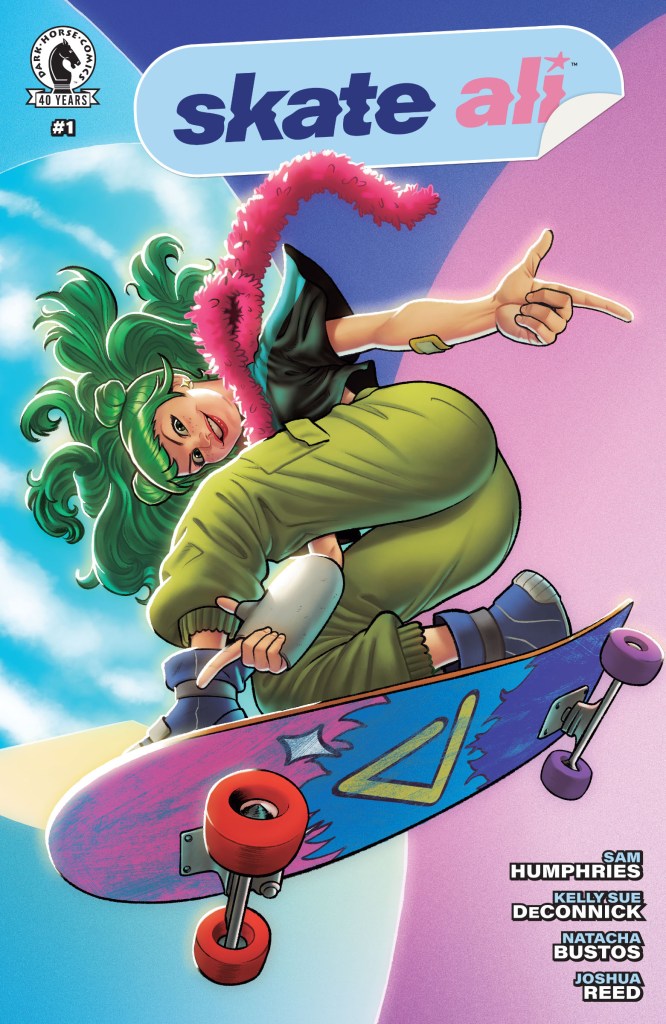
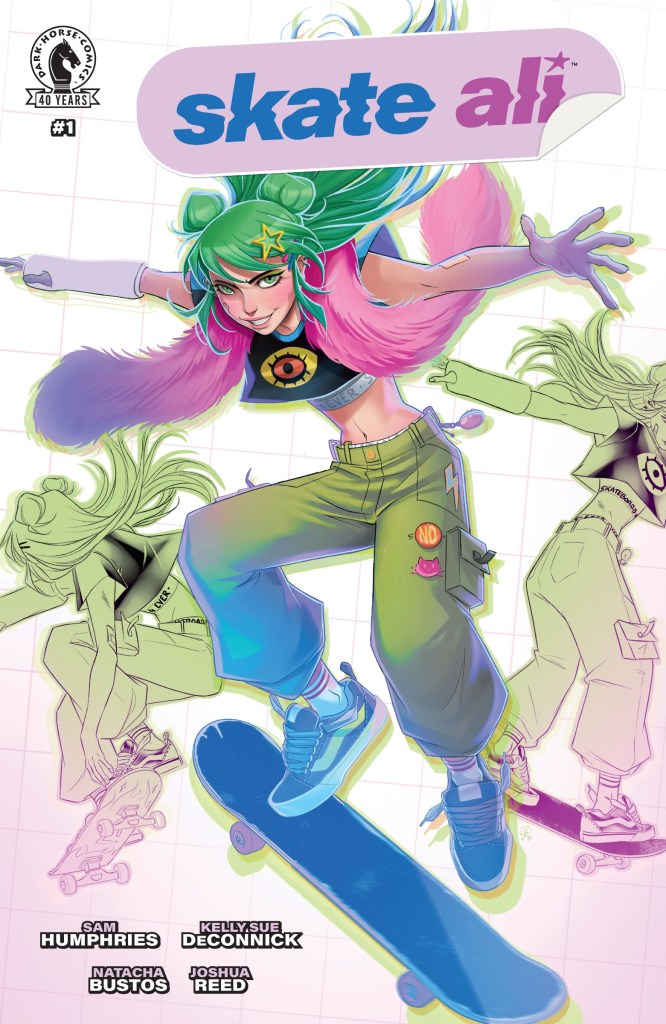
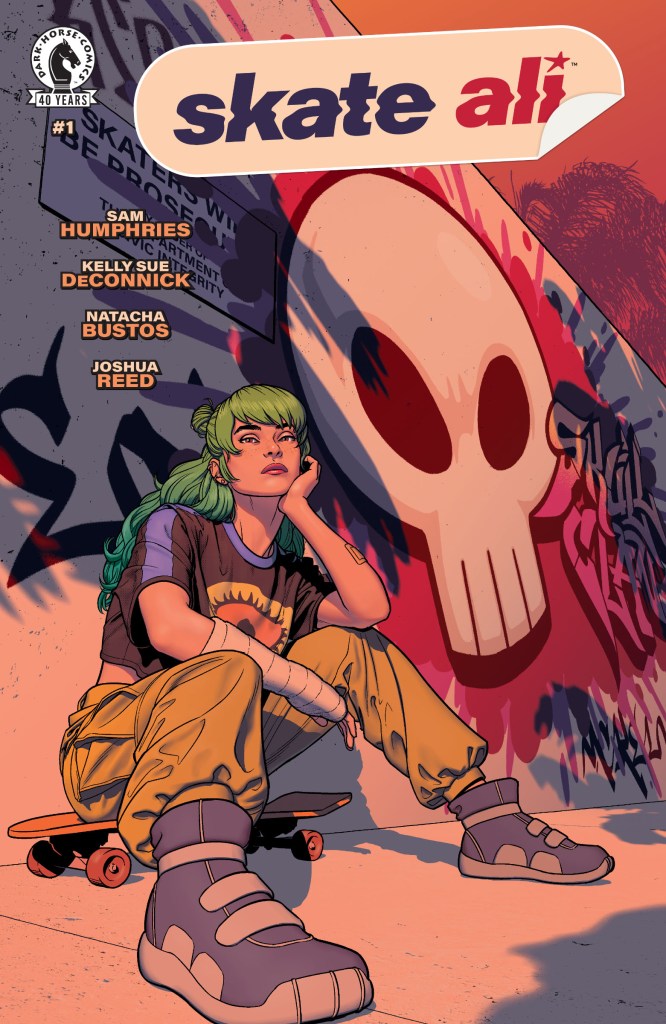
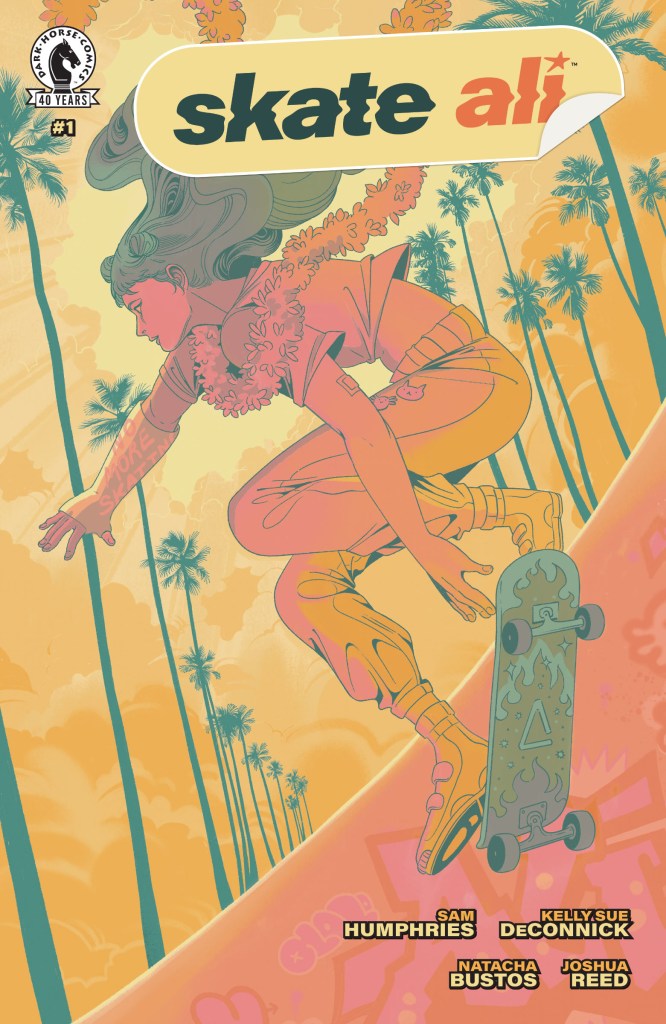
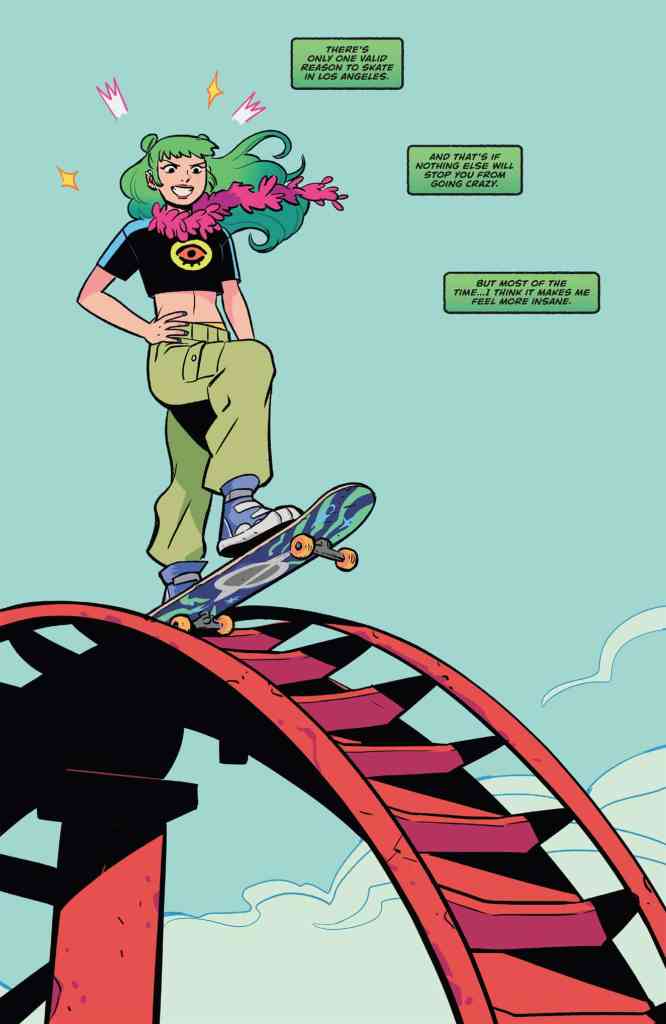
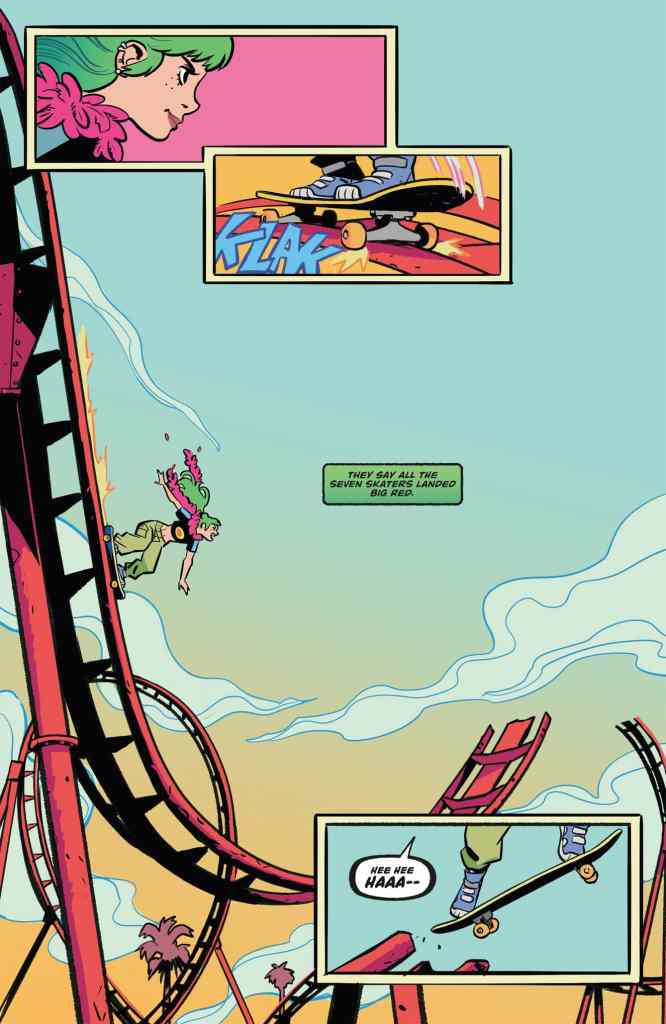
We have the exclusive reveal of Skate Ali,a new five-issue comic series from Kelly Sue DeConnick, Sam Humphries, Natacha Bustos, and Dark Horse Comics! Skate Ali is a high-octane, genre-smashing sci-fi skatepunk saga about friendship, rebellion, and finding yourself when the world wants to knock you down written by DeConnick and Humphries, illustrated by Bustos, and lettered by Josh Reed. Skate Ali #1 will be available in June 2026 and will feature cover art by Bustos, Joe Quinones, Sweeney Boo, Emma Rios, and Jamie McKelvie.
Welcome to near-future Los Angeles—a neon-scorched city where skateboarding has been ruthlessly outlawed. But nothing stops Skate Ali.
By day, she’s just another student dodging detention. By night, she’s a rebel on wheels, an enigmatic loner defying the law on the Los Angeles streets.
But when Ali slams headfirst into the infamous world of underground skateboarding, she comes face to face with a crew of outcast skaters called the LA Skull Clan, and their masked leader, Skull Queen 9. Fueled by a magical force called the Rush, the clan pulls off explosive moves and defiant acts of resistance.
Faced with the opportunity to level up her game, but afraid of actually being perceived by others, Ali must decide: will she play it safe, or kickflip straight into a revolution?
Drop into your local comic shop and pre-order Skate Ali #1 (of 5) before it hits shelves on June 10, 2026 for $4.99.
London, 1900. The capital hums with the energy of the new era, but something darker lurks beneath the surface. A monstrous figure stalks the city’s criminal underworld at night, leaving a trail of bloody corpses in its wake. Rumors about the mysterious killer spread like wildfire. It’s a demon. A phantom. An angel of vengeance.
Nothing can kill it. Nothing can stop it. And once it picks a new target, well, he better have a coffin picked out, because he’s already dead.
Get your copy now! To find a comic shop near you, visit http://www.comicshoplocator.com or call 1-888-comicbook or digitally and online with the links below.
In advance of Kieron Gillen and Caspar Wjingaard’s upcoming comic The Power Fantasy, we’re revisiting some of Gillen’s previous creator-owned work.This article was originally published in January 2021 as part of a series of essays about Phonogram: The Singles Club, but has been edited and re-presented here.
“I used to have a special tape. Used to have my track. My one killer track that would get me flying. You got one of those.”- Buddy in Baby Driver [Aka Phonogram with cars]
“You can’t touch music, but music can touch you.”-Mordecai in Regular Show
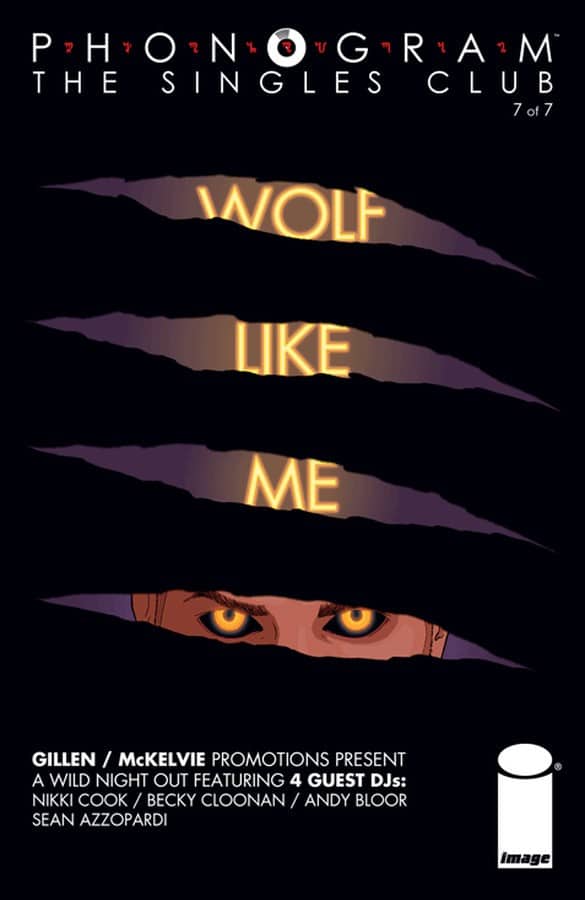
Phonogram: The Singles Club #7 is my go-to single issue for anyone wanting to get into the creative team of Kieron Gillen, Jamie McKelvie, and Matthew Wilson. I’ll also show this book to folks to demonstrate the relationship between sequential art and music and showcase the uniqueness and sheer coolness of comic books as a medium
The premise of The Singles Club #7 is simple, yet brilliant. Up to this point in the series, David Kohl’s hetero-lifemate Kid-with-Knife has been basically Chas from Hellblazer, but he likes Wu-Tang Clan. Sure, he loves music (especially hip hop), but he’s not a phonomancer. However, on the first page of the issue, David Kohl explains what phonomancy is, and Kid realizes that’s something that he and folks do all the time whether you’re walking aimlessly through the city streets, trying to finish a homework assignment, or get that last mile in on the treadmill. Deep down, everyone has that “killer track”, “pump up jam”, or song that gets us moving or feeling inspired and hopeful, and for Kid-with-Knife, that is “Wolf Like Me” by fantastic Brooklyn indie band TV on the Radio. He listens to the song, does parkour in the streets of Bristol, chases away rude men from a couple, ducks in for a kebab and has an amazing indie night with Kohl and Emily Aster. After that, Kid-with-Knife dances some more, forms a connection with, and sleeps with Penny B, who was the POV character in Phonogram: The Singles Club #1. What a night indeed!
Except for the first and final page of the comic, The Singles Club #7 is completely silent so it’s a showcase for Jamie McKelvie’s skill with motion and body language and Matthew Wilson’s color palette. It’s the antithesis of issue six’s black and white zine-inspired story and acts as the praxis to its theory. The art uses werewolf imagery based on “Wolf Like Me’s” lyrics with Wilson using plenty of dark blues, reds, and giving Kid glowing yellow eyes while McKelvie puts a moon in the background in a couple of key early panels before he and Gillen kick the story into parkour mode.
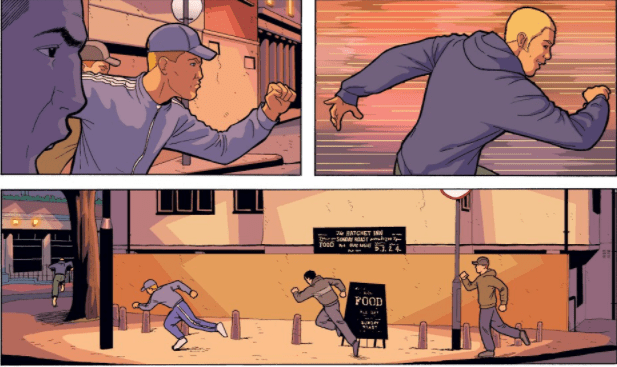
And speaking of parkour, this comic cements McKelvie as a master of showing action in space, especially during the humorous four pages or so where Kid insults a group of tough looking guys and ends up on the run. (He only wanted to get them away from an all-black wearing couple.) He uses The Hatchet Inn (Which is a real place) as a kind of comedic obstacle that Kid and the three guys run around in circles with Kid getting some extra speed lines due to the adrenaline, er, magic of the song. Then, McKelvie goes back to grid mode with the guys looking around a bridge for Kid before breaking it and showing him hanging on one of those height limit signs before making a superhero landing and going into a kebab shop. The power of music plus the heightened nature of McKelvie and Wilson’s storytelling has turned a “running away from a group of guys you probably shouldn’t have pissed off” situation into a chase straight out of one of the better Batman comics. The right track really makes you feel like you’re doing epic things, and that’s the truth. (I totally got pulled over for speeding while listening to Junkie XL’s score for Mad Max: Fury Road.)
Another amazing part of Phonogram: The Singles Club #7’s narrative is the payoff for the foreshadowing that Kieron Gillen slipped in back in issue three when Kohl told Emily Aster that Kid-with-Knife’s high energy came up from being hopped up on a TV on the Radio song. He and McKelvie conclude the issue by showing the indie club night from his perspective featuring intense grids, speech bubbles with symbols and not words, and one beautiful splash page. Kid is so “in the zone” that his perception has become primal. He has transcended boring, old human speech and becomes the werewolf in the song. (See his face as he digs into that kebab.) There are no conversations in The Singles Club #7: just shots, dancing, and bright lights. The use of symbols instead of text in dialogue bubbles is an ingenious way of showing how difficult it is to have conversations at the crowded bar or dance floor area at a club as Kid starts with retelling his pre-club shenanigans, but ends up just ordering a round of shots and dancing with Kohl and Aster. The comic ends up being a montage of fun moments from the previous six issues : all killer and no filler from Gillen McKelvie Wilson.
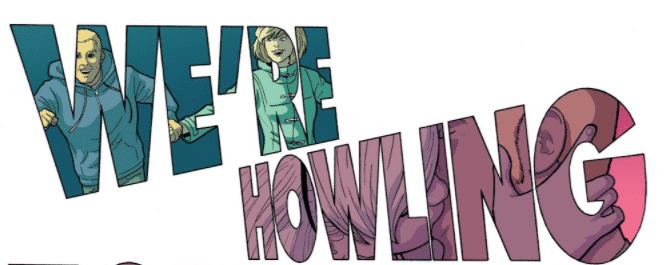
However, the conclusion of The Singles Club #7 and the miniseries as a whole is truly magical as the last bits of “Wolf Like Me” start to fade out, and Kid-with-Knife sees Penny B dancing to “Pull Shapes”. In the first issue, she had ended up dancing on her own and just enjoying her favorite song, but now Kid is in the double-page splash and offers his hand. It’s gorgeous visual choreography from Jamie McKelvie and Matthew Wilson as Penny gets caught up in the music with stars, precise dance moves, and frosted colors. But, then, Kid joins the dance, their energy matches each other in a rhythmic six-panel grid that erupts into them sleeping together. In a clever bit of storytelling, McKelvie syncs the sex scene to the “We’re howling forever” bit at the end of the song and frames it in the letters of the lyrics. It’s passion, chemistry, and great design sense all rolled into one as Kid-with-Knife and Penny B truly become one with this great song.
The main bit of symmetry in Phonogram The Singles Club #7 is definitely the return of Penny B to a prominent role and finally finding someone to dance and have a good time with after her tribulations of the first issue. There’s also symmetry in the larger narrative of Phonogram with both The Singles Club and Rue Britannia concluding with a man and woman in bed together. In Rue Britannia, it’s Beth remembering an old Manic Street Preachers song after she was unable to enjoy music for a while whereas in The Singles Club, it’s Kid-with-Knife and Penny B having a moment of clarity after intimately connecting via the feelings that music gives them. As a phonomancer, Penny is slightly analytical about the moment while Kid (With a sheepish grin on his face) is content to say, “I don’t know. You tell me.” Unlike Kohl, Aster, Lloyd or the other phonomancers we run into in the comic, Kid-with-Knife finds a song he likes and literally runs with it for a full issue with no asides about their subtext (Although, “Wolf Like Me” is definitely about sex.), influences, or any anecdotes from his past about why he is super obsessed with a band.
What I love most about Phonogram The Singles Club other than the masterful silent storytelling from Kieron Gillen, Jamie McKelvie, and Matthew Wilson is that it opens the gates of being a phonomancer to everyone. You don’t have to be a hipster or an indie snob, who makes zines and grimoires. You just have to have the capacity to be moved by music, physically like Kid-with-Knife or mentally like basically every other Phonogram character and the author of this article although I love a good boogie. This song can be in any genre: you just have to deeply connect with it. And that’s really what Phonogram The Singles Club is all about. It’s a saga of connecting or disconnecting with other folks in one night’s time with 2000s pop and indie music as a backdrop. (The kids call it “indie sleaze” now.) So, it’s fitting the book ends with two people finding each other via a song. Beautiful stuff, really!
In advance of Kieron Gillen and Caspar Wjingaard’s upcoming comic The Power Fantasy, we’re revisiting some of Gillen’s previous creator-owned work.
As I’ve written before in features and monthly reviews, Phonogram will always be one of my favorite comics and is responsible for roughly 60% of my music taste. For folks who weren’t reading the book 8-18 years ago, Phonogram is a fantasy comic where music is literally magic. The first miniseries Rue Britanniais about protagonist David Kohl trying to find the missing goddess Britannia aka the personification of Britpop music. The follow up The Singles Club is probably still my favorite Kieron Gillen, Jamie McKelvie, and Matthew Wilson collaboration and tells the story of one evening at a Bristol night club from seven different perspectives. Finally, The Immaterial Girl wraps up the series with its focus on it-girl Emily Aster from the previous two volumes of Phonogram dealing with having two identities in a love letter to MTV-era music and videos. The comic does a wonderful job exploring people’s connection to music, and how it affects their identities using a touch of fantasy. It also functions as an engaging piece of pop music criticism. Seriously, I think “retromancer” every time I get an email from a local music venue about an 80s or emo night.
One underrated thing about the Phonogram comics were its B-sides. These were short comics usually by an artist other than McKelvie that fleshed out supporting characters, commented on a music genre, or told a story about David Kohl’s past or future. Initially, you could only find them in the single issues along with a quite-snarky-at-times glossary of terms and bands that I treated as gospel back in college plus other backmatter like record reviews and a letters page. However, they were collected in the Complete Phonogram hardcover, and you can binge them all at once in all their glory, read them after the issue they first appeared in, or even do a fully chronological read of Phonogram. In addition to fleshing out the themes and characters of the series, the B-sides also act as a showcase of some of the best UK indie comics talent of the 2000s/2010s.
Here are 7 of my favorite B-sides from Phonogram: The Singles Club and The Immaterial Girl in the order of the release date of the comic they originally appeared in.
1. “She Who Bleeds for Your Entertainment”
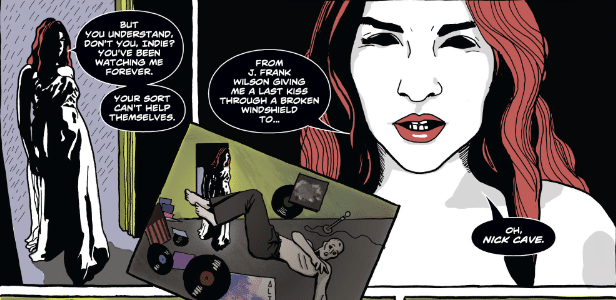
It’s kind of messed up, but Indie Dave is one of the characters I relate to in Phonogram. He’s balding, not great at housekeeping, loves isolation, and is a fan of Joy Division and other artists of early punk/post punk explosion. (You can see Patti Smith, Gang of Four, and Wire posters in his flat in the background of panels in this story.) Gillen could have used him as a cautionary tale in Phonogram, but instead he gets his own arc throughout the B-sides of The Singles Club. This first one, “She Who Bleeds for Your Entertainment”, is an ode to all the women who died in songs from the teenage tragedy tracks of the 1960s to the at-the-time contemporary sad boy tunes of Death Cab for Cutie and Sufjan Stevens. Laurenn McCubbin’s art and colors screams aggressive a la The Morrigan in The Wicked + the Divine as the personification of dead women in songs hurls invectives at him culminating in “emosogynist”. “She Who Bleeds for Your Entertainment” isn’t some kind of moralizing, pop feminist sermon, but a call to consume dark music and its lyrics more mindfully and maybe give some of those female characters agency like Nick Cave did in his tracks with and about PJ Harvey. (They’re my most missed celebrity couple.) There’s room for both Murder Ballads and Boatman’s Call in the world. It’s also a wake up call for Indie Dave to leave his pathetic vinyl-strewn hut and experience real life for once.
2. “Wuthering Heights”
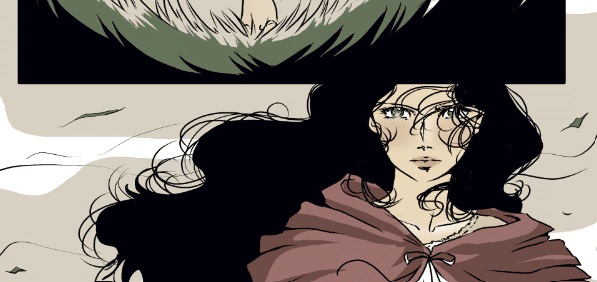
And Indie Dave gets to experience real life almost immediately in the next B-side, “Wuthering Heights”, a beautiful silent comic that is an homage to the Kate Bush song of the same name. Emma Vieceli handles art duties in a style that’s manga meets fantasy landscapes. Unlike the woman in “She Who Bleeds for Your Entertainment”, the female lead of this comic runs, frolics, and dances providing the magical energy for Indie Dave’s journey of self-discovery in the form of a Kate Bush compilation tape. Instead of being cloistered in his room, Indie Dave sets off for the great outdoors with Bush’s ethereal music in his ears and The Dreaming and The Kick Inside in his bag. Indie, artsy music is still his passion and maybe a security blanket, but at least, he’s touching gorgeous Vieceli-colored greensward.
3. “David Kohl: Phonomancer”
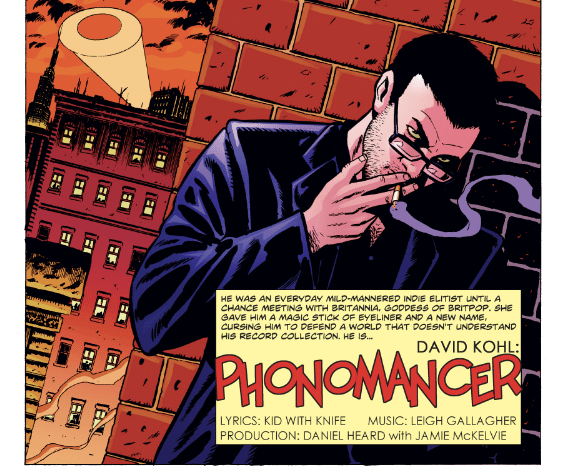
This was one of the first Phonogram B-sides that immediately popped into my mind when I thought about working on this project. “David Kohl: Phonomancer” is a four page parody of Phonogram: Rue Britannia via the Jamie Delano era of Hellblazer. Leigh Gallagher‘s art feels like it should be on newsprint (It’s the wide margin gutters!), and Daniel Heard‘s colors are a dead ringer for Daniel Vozzo’s work on basically every Vertigo/DC Mature Readers title. Kieron Gillen does an amazing job poking fun at the wordiness of old comics/Rue Britannia by having a panel that lays out the main themes of the miniseries with one talking head and blank background. However, the final page is all action and flags, and I definitely detected a little Authority-era Bryan Hitch-meets-Rob Liefeld in the big biceps and guns and Union Jack in the penultimate panel because, of course, action man Kid-with-Knife is the narrator of this yarn. “David Kohl: Phonomancer” is a monument to how clever you have to be to make something seem so dumb.
4. “Your Song”
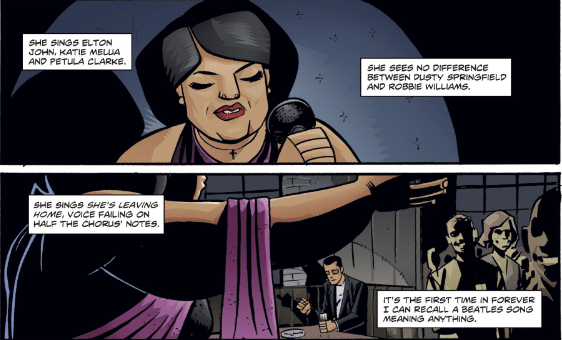
In “Your Song”, Gillen and PJ Holden craft an ode to enjoying your favorite songs while out and about as David Kohl has some drinks at a rural pub while watching a pub singer who’s not very good. However, he ends up being immersed in her performance and realizes that she cares about music as much as him in her own way. Kohl even thinks about cursing a heckler by having her have the same song stuck in her for eternity (A common Phonogram spell.), but realizes that she doesn’t actually care about music so it wouldn’t be a punishment at all. Holden nails the poorly lit interiors and exteriors of the pub while progressively adding lines to Kohl’s face as he warms up to the pub singer, looks at her daughters’ encouragement, and simply finds pleasure in a dance with a stranger. “Your Song” is the perfect sweet and sour B-side beginning with snarky criticism and ending with blissful acceptance as Kohl boogies the night away.
5. “Blurred”
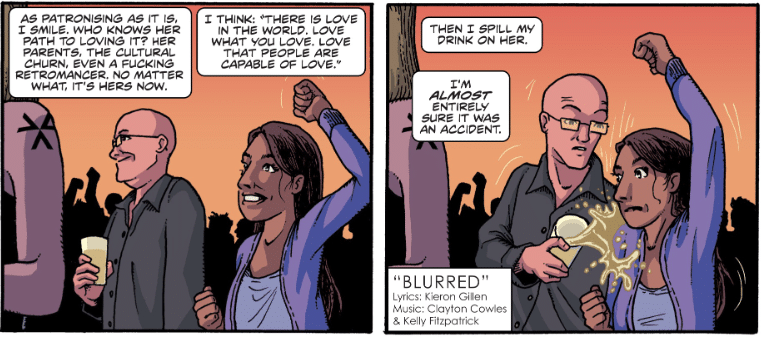
I picked this B-side drawn by Clayton Cowles and colored by Kelly Fitzpatrick as a favorite because I’m totally the girl that David Kohl spills a drink on while comparing a Blur show in 2015 to a Sex Pistols one in 1996. It’s a five panel comic about handing the fandom of a band to another generation. I was a toddler when Parklife came out, and Blur and Oasis battled for the supremacy of Britpop, but you can bet your ass I was on the plane to LA to see them play a warm-up show before Coachella. On the flipside, it’s me at the 7-Eleven chatting with some teenagers/college students/young people (Kohl was right about people under 30 all looking at the same.) about my Paramore shirt when they were toddlers when Riot! came out. It’s cool seeing artists have generations-spanning impact, and gatekeeping that is uncool. I don’t care if they got into Paramore because they opened for Taylor Swift on the Eras tour. I got into them because they said “whore” uncensored on the radio, and Hayley Williams was a ginger from Middle Tennessee like me. Teenagers will probably be listening to The Smiths and “Teenagers” by My Chemical Romance in 2050, mark my words. Gillen and Cowles nail that sentiment while paying homage to the best Brit pop band with a little cheeky Kohl humor on the side.
6. “I Hate Myself”
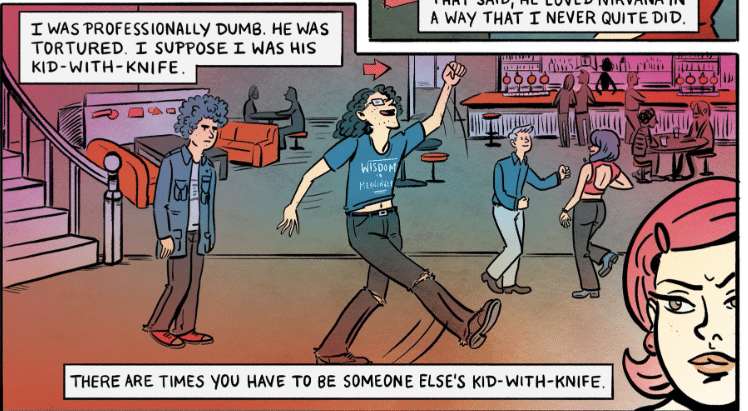
“There are times you have to someone else’s Kid-with-Knife” is a piece of wisdom I think about when I get a little too big for my britches, or the main character syndrome starts to creep up. And I got it from “I Hate Myself”, which was illustrated by Jules Scheele in a lovely, throwback 90s indie comic style combined with a more contemporary approach to color palette. It’s a flashback story of David Kohl in Catholic school with his friend Johnny Panic, who is a huge Nirvana fan, and later confides in Kohl that the band saved his life. In the space of two pages, Gillen and Scheele go through the triumphs, angst (Ecclesiastes quotes on t-shirts!), and dick jokes of adolescence before giving a glimpse of Panic in the future as he dances with shirtless Slovakian men to “Smells like Teen Spirit”. It’s really amusing and cathartic to see a pre-Britannia Kohl fumbling with his identity and following the lead of a more confident, high-energy, and yes, depressed friend illustrating the simple truth that sometimes we’re not always the protagonist.
7. “Modern Love”
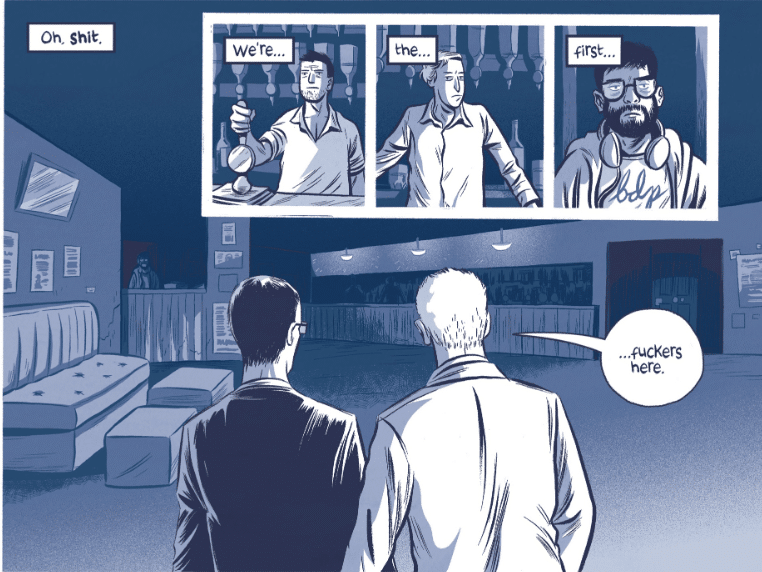
And of course, I had to wrap up this article with the final canonical Phonogram B-side and in-universe story in general, “Modern Love”, which is drawn by Tom Humberstone and is the reason I never turn up early for club nights. (Being “the first fuckers there” is so embarrassing for no discernible reason.) This comic chronicles David Kohl’s bachelor party, which is just him and Kid-with-Knife going to a club, discussing assault weapons, and dancing to The Smiths, Kenickie, and David Bowie aka the songs on Kieron Gillen’s writing playlist. this is funny because the final page of the comic blurs the lines between fiction and autobiography with Gillen pulling a Grant Morrison, facing the audience, and wiping a tear away as he puts this universe to bed. “Modern Love” is a lovely coda to David Kohl’s journey as Humberstone’s pink and blues make memories of club nights rush through his mind, and we get his entire career as a phonomancer in the rush of a page. It’s a beautiful ending to the series and an ode to building friendships, meaning, and creating with the aid of pop bangers like the Bowie track that gives the B-side its name. (I also feel like I lived this comic because I briefly danced with Kieron Gillen to “Modern Love” once upon a time.)
“And every demon wants his pound of flesh.”–Florence + the Machine
“Forgot that inside the icon, there’s still a young girl from Essex.”–Lorde
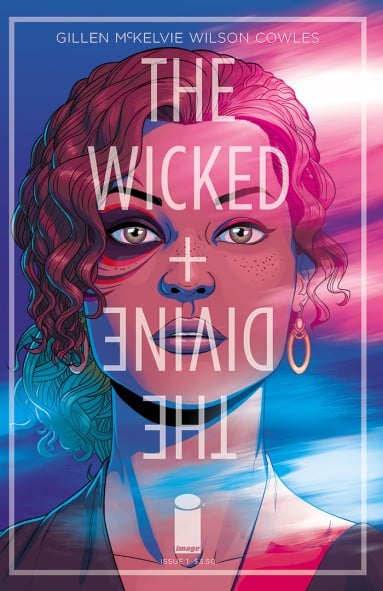
Until I read Kieron Gillen’s newsletter last week, I couldn’t believe that it had been ten years since The Wicked + the Divinewas released and basically changed my life. It, and Gillen and artist Jamie McKelvie’s other collaboration Phonogram, heightened my interest in indie and pop music (Mostly of the British kind because I’m an incorrigible Anglophile.) and transformed me from a Netflix/Marvel comic binging wallflower to a black lipstick wearing, nonbinary Goth degenerate who was closing out bars and dance floors across the South/Midwest/Mid-Atlantic. This might be a bit of an exaggeration because I’m started writing this article at a laidback, very heterosexual brewery while wearing a football top and finished writing it on my bed next to a stack of Amazing Spider-Man comics.
I felt beyond seen in WicDiv‘s cast of characters, especially Laura/Persephone, Inanna, and just a touch of Baphomet. (The whole none more Goth thing.) When the first arcs of the series were released in 2014-2016, I was definitely still a wayward youth working in retail, trying to graduate university (I wrote my undergrad thesis on WicDiv and Paradise Lost when only the single issues were out.), and doing freelance pop culture writing gigs, However, by the time the series wrapped up in 2019, I had found my calling as a librarian andthe trade paperback of “Faust Act” was one of the first books I cataloged. Today, I’m legitimately a pop music librarian, and my life has come a little bit full circle so I can write about the series from a new perspective. “Once again we return!”
Because, plot twist, I never actually reviewed The Wicked + the Divine #1. When the book dropped in June 2014, I was busy studying Jane Austen in Bath, England, sinking too many pints while watching Germany dominate in the World Cup (Today, I’m hoping they do the same at the Euros.) , and soliciting old gay men on OK Cupid for help with my paper on British television over the decades. My first review was for WicDiv #2, and it was already my favorite thing helped by my love for Gillen and McKelvie’s Tumblr-era queer pop superhero masterpiece Young Avengers as well as a positive interaction with Kieron Gillen at my first ever comic convention, C2E2 2013. This passion was also fed by the John Milton seminar course I took at university later that year as well as my first read-through of Grant Morrison’s Invisibles because I read somewhere on the Internet that the intro to WicDiv was an homage to The Invisibles #1 sans bald men and John Lennon. With a few gaps, I reviewed the other 50 issues of the series persevering through moves and career changes to actually stay current with the series. But I never wrote about issue one so here are my (Definitely not long awaited) thoughts on The Wicked + the Divine #1 ten years after its release.
Re-reading The Wicked + the Divine #1 in 2024 makes me realize that it was one of the most prescient pieces of pop fiction in the past decade. Influencers, stan culture, aggressive relationships between fans and journalists (E.g. Paste’s review of the latest Taylor Swift album was released sans byline.), it’s all there in this first issue. Hell, even the rise of nostalgia culture is encoded in the character of Luci, who dresses like David Bowie, got her government name from a Beatles song (Eleanor Rigby), and quotes the Fab Four, Rolling Stones, and Philip Larkin like they were born yesterday. She would definitely fit in with the Tik Tok girlies that dress like they’re a character in Almost Famousor standing in for Patricia Morrison from The Sisters of Mercy, circa 1987.
But, with the exception of Cassandra’s utter roasts of the various Pantheon members (“Kids posturing with a Wikipedia summary’s understanding of myth” is an all-time one liner.), Kieron Gillen and Jamie McKelvie treat fandom as a normal part of growing up in WicDiv #1 beginning with our introduction to Laura where she adjusts her look in the mirror trying to look like her new favorite god, Amaterasu. It’s the first in many aesthetic (and later name) changes for Laura and gives off a cosplay vibe, which makes sense because Young Avengers and later WicDiv was famous for its cosplayers thanks to McKelvie’s fashionable, yet functional approach to character design. The Wicked + the Divine is a coming of age comic, and especially this first issue, hones in on Laura trying to figure out who she is through her relationship to the Pantheon between the flashbacks to 1923, court cases, and exploding heads. She wants to be a Pantheon member, but is far from as she stammers her way through the green room and ends up continuing to spend time with Lucifer and Amaterasu because she witnessed a couple murders not because she made some kind of impression on these radiant beings.
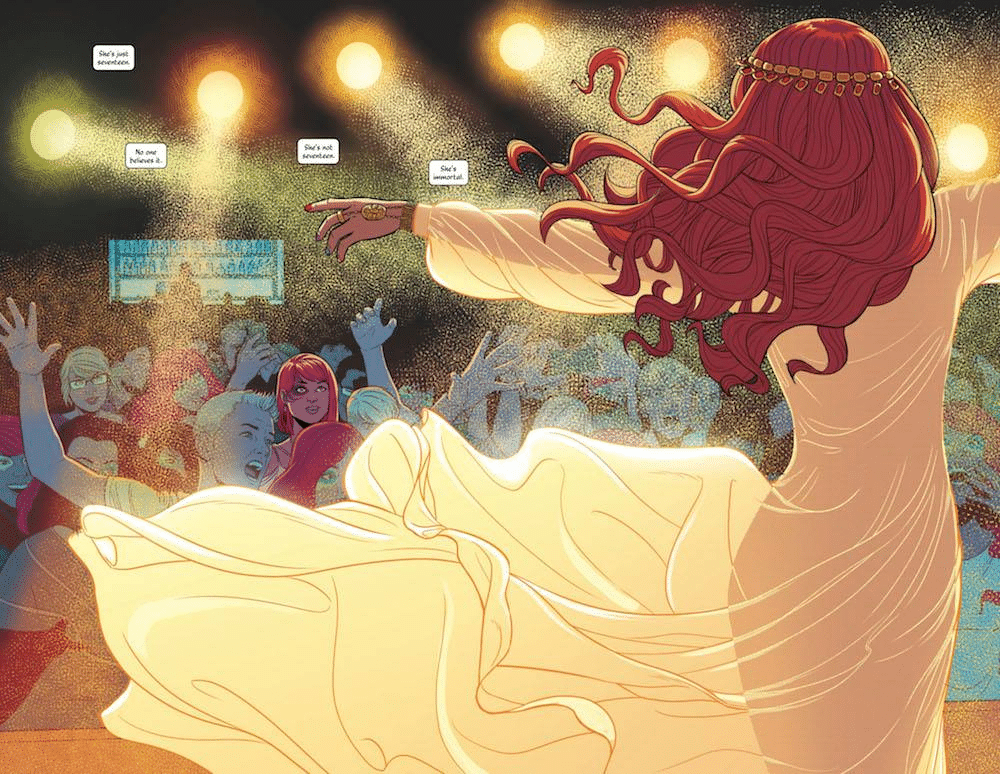
And speaking of radiance, Matthew Wilson’s colors are still as vibrant and awe-inspiring in 2024 as they did in 2014, especially that first splash page of Amaterasu’s gig. Gillen and McKelvie go from the restricted grids of Laura getting ready at her family flat in Brockley before turning the page on a double page spread that nails what it’s like to be wholly enraptured at your favorite artist’s show. The afterglow continues in the following pages as Laura (Through Kieron Gillen’s captions.) processes the performance and tries to connect with Amaterasu before fainting in a white gold flurry. This sequence is a stand-out moment for Wilson in this first issue, but he provides some early bisexual lighting for the Pantheon green room to show that the gender and sexual fluidity of these gods as well as utilizing bright, flat colors accompaniment to Jamie McKelvie’s utter demolition of the human figure when Luci kills the assassins and when the judge mysteriously dies in court.
Moving from the micro to the macro, The Wicked + the Divine follows a pattern that the great comics of the past used, such as The Sandman and Watchmen, which is introduce a rich world with complex characters and universal themes through a simple, accessible plot device. In WicDiv‘s case, it’s the murder mystery. Who killed the judge doesn’t matter in the long run of the series, but it does the job in getting you to pick up WicDiv #2. Gillen and McKelvie introduce the power of the finger click in the opening, absinthe-soaked love child of Sandman and Invisibles flashback and also demonstrate it in present times with inset panels showing Luci kill the fundamentalist Christian gunmen in self-defense. Cassandra’s skepticism aside, the Pantheon members have the ability to kill as well as inspire in an beautiful, abstract way that I’ve witnessed from audience members in the front row at Ethel Cain shows. (I wonder if she’s read WicDiv ; one of her big influences Florence Welch inspired the look for Amaterasu.) The ending of WicDiv #1 and the surprise on Luci’s face creates an air of danger to go with the “necrotically glamorous” (To quote Gerard Way’s blurb on the back of the trade paperback.) tragedy of being a god for two years and then dying, which definitely isn’t a PR line for Amaterasu. I was hooked in 2014 and am still hooked in 2024.
The Wicked + the Divine #1 uses the power of fandom and one’s favorite music and art to explore what it feels like to think that you’re immortal and also about to die, or basically a young adult. Jamie McKelvie and Matthew Wilson’s visuals marry a heightened pop star aesthetic to fundamental, rhythmic storytelling of grids and face and body acting while Kieron Gillen’s caption and dialogues add humor, subtext, and personality to this unforgettable cast of characters. It’s fitting that I’m writing this review while listening to Lorde and Charli XCX’s long-awaited and surprisingly vulnerable collaboration “Girl, so confusing” because I was definitely bumping Pure Heroine, Sucker, and True Romance while writing my first WicDiv reviews in 2014. Sometimes, the things that were great a decade ago are still great plus you have the beauty of hindsight and self-awareness to appreciate them with new eyes and be happy that you’re alive.
Story: Kieron Gillen Art: Jamie McKelvie Colors: Matthew Wilson Letters: Clayton Cowles Story: 9.4 Art: 9.8 Overall: 9.6 Recommendation: Buy
DSTLRY has announced One for Sorrow, a gothic thriller written and drawn by creator Jamie McKelvie. The first issue will launch in comic book stores and digitally on dstlry.co in June 2024.
London, 1900. The capital hums with the energy of the new era, but something darker lurks beneath the surface. A monstrous figure stalks the city’s criminal underworld at night, leaving a trail of bloody corpses in its wake. The only clue that a baffled police force has to work with is the black and white feather left on each corpse, leading the press to dub the killer the Magpie. Is the Magpie killing at random, or is there a pattern that no one else can see? Three individuals, strangers to each other, might together have the answer.
One for Sorrow marks Jamie McKelvie’s first creator-owned project since his work on the GLAAD Media award-winning, Hugo and Eisner-nominated The Wicked + The Divine (with Kieron Gillen) and his first solo creator-owned project in over a decade. His iconic designs of characters such as Captain Marvel, Ms. Marvel, and Loki have moved off the comic page to feature in television and film.
Unlike anything McKelvie has created before, One for Sorrow is an intensely stylish, supernatural suspense thriller. It’s John Wick fired through the lens of Guillermo del Toro, full of kinetic action, bloody revenge, and ghostly mystery.
One for Sorrow #1 features two open-order covers by creator Jamie McKelvie, with 1:10, 1:25, and 1:50 incentive variant covers to be revealed at a later date.
DSTLRY has revealed new covers for the second issues of Gone and Somna. The final order cut-off is December 10 through Lunar and December 11 from Diamond.
In Gone #2, it’s been fifteen years since we last saw ABI—a frightened 13-year-old stowaway on a spaceship bound for distant stars… Now nearly 30, Abi is not only still roaming the galaxy, but is a self-assured—and deeply scarred—veteran of an intergalactic war! Gone is in an action-packed sci-fi adventure where a young heroine has grown into a war-weary spacefarer who still dreams of one elusive goal…. getting home.
Gone #2, by Jock, features covers by Jock, Lee Garbett, Oliver Barrett,Matt Taylor, and Jamie McKelvie.
In Somna #2, set amidst the terrifying backdrop of the witch hunts in a quiet 1600s English village, Somna follows one woman’s erotic escape from the confines of her puritanical world. No one is above suspicion when the relentless Witch Hunter Roland draws his net around someone close to him as this darkly sexual thriller races towards its gripping conclusion!
Somna #2 is by Becky Cloonan and Tula Lotay and featuring covers by Lotay and Cloonan, Emily Carroll, Julian Totino Tedesco, Dani, and Christian Ward.
The ‘90s are back! In celebration of Marvel Studios’ X-Men ’97, a follow-up to the classic nineties X-Men: The Animated Series coming soon to Disney+, Marvel’s hottest artists are showing their love for the decade in Marvel ’97 Variant Covers.
On sale throughout February, these new covers capture the essence of this blockbuster era by depicting your favorite heroes in their iconic ‘90s looks, reuniting ‘90s lineups, and paying homage to memorable ‘90s covers. It’s an stellar journey through the decade that transformed the comic book industry and it’s just the start of a slew of upcoming X-Men ’97 related Marvel Comics announcements!
Check out 20 Marvel ’97 Variant Covers coming in February and stay tuned for more to be revealed.
AVENGERS #10 MARVEL ‘97 VARIANT COVER BY JAMIE MCKELVIE
CAPTAIN AMERICA #6 MARVEL ‘97 VARIANT COVER BY PETE WOODS
DOCTOR STRANGE #12 MARVEL ‘97 VARIANT COVER BY KAREN DARBOE
FANTASTIC FOUR #17 MARVEL ‘97 VARIANT COVER BY RON LIM
SENSATIONAL SHE-HULK #5 MARVEL ‘97 VARIANT COVER BY MATTEO LOLLI
THANOS #3 MARVEL ‘97 VARIANT COVER BY DOALY
VENOM #30 MARVEL ‘97 VARIANT COVER BY MIKE HENDERSON
BLADE #8 MARVEL ‘97 VARIANT COVER BY LEINIL FRANCIS YU
NIGHT THRASHER #1 MARVEL ‘97 VARIANT BY LUCIANO VECCHIO
SCARLET WITCH & QUICKSILVER #1 MARVEL ‘97 VARIANT COVER BY PAULO SIQUEIRA
SPIDER-BOY #4 MARVEL ‘97 VARIANT COVER BY ETHAN YOUNG
THUNDERBOLTS #3 MARVEL ‘97 VARIANT COVER BY SCOTT GODLEWSKI
VENGEANCE OF THE MOON KNIGHT #2 MARVEL ‘97 VARIANT COVER BY GIUSEPPE CAMUNCOLI
CAPTAIN MARVEL #5 MARVEL ‘97 VARIANT COVER BY ANNIE WU
DAREDEVIL #6 MARVEL ‘97 VARIANT COVER BY BEN SU
EDGE OF SPIDER-VERSE #1 MARVEL ‘97 VARIANT COVER BY DAVID NAKAYAMA
GUARDIANS OF THE GALAXY ANNUAL #1 MARVEL ‘97 VARIANT COVER BY PACO MEDINA
INCREDIBLE HULK #9 MARVEL ‘97 VARIANT COVER BY NICK BRADSHAW
SPIDER-WOMAN #4 MARVEL ‘97 VARIANT COVER BY TODD NAUCK
AMAZING SPIDER-MAN #44 MARVEL ‘97 VARIANT COVER BY CARLOS GOMEZ
IMMORTAL THOR #7 MARVEL ‘97 VARIANT COVER BY DAVID BALDEÓN
INVINCIBLE IRON MAN #15 MARVEL ‘97 VARIANT COVER BY PHIL NOTO
PUNISHER #4 MARVEL ‘97 VARIANT COVER BY DAN JURGENS
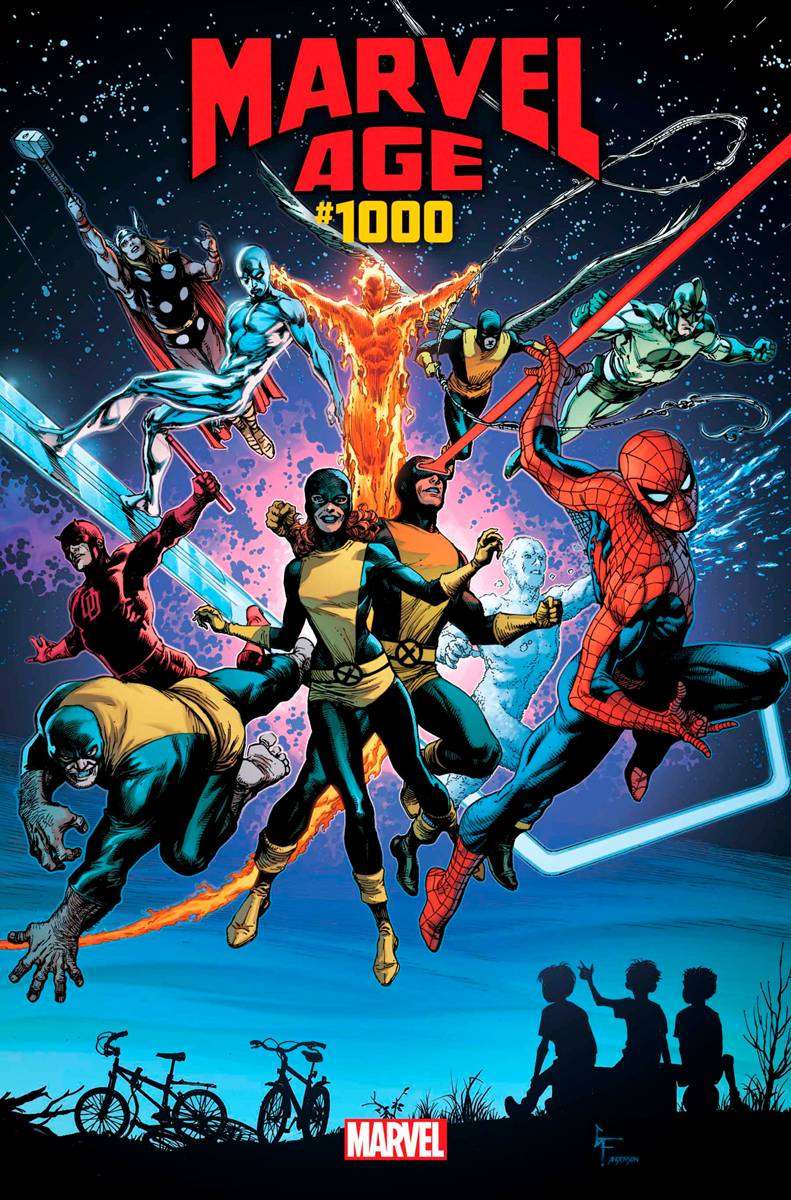
(W) Rainbow Rowell, Jamie McKelvie (A) Various (CA) Gary Frank Rated T+ In Shops: Aug 30, 2023 SRP: $9.99
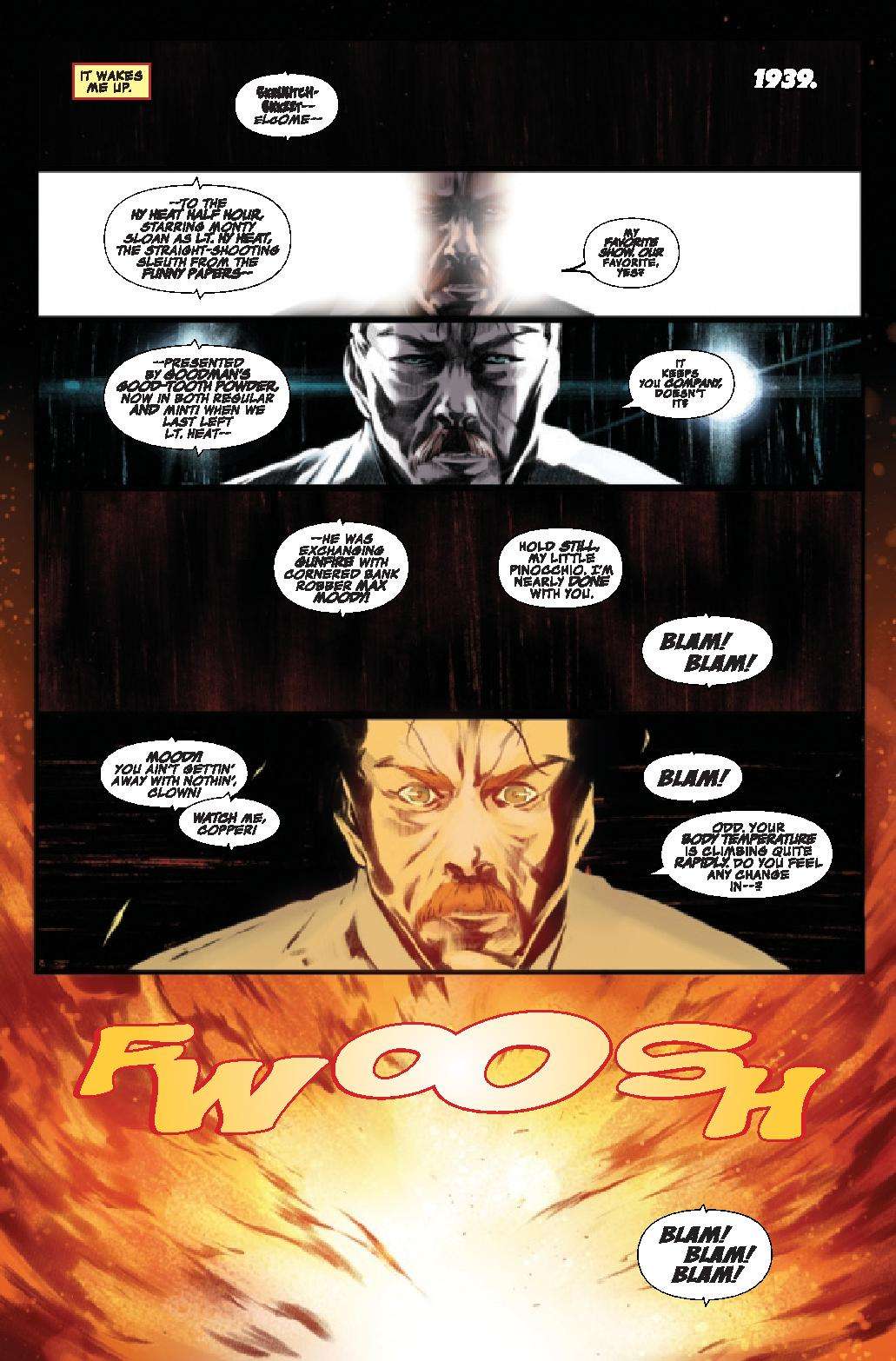
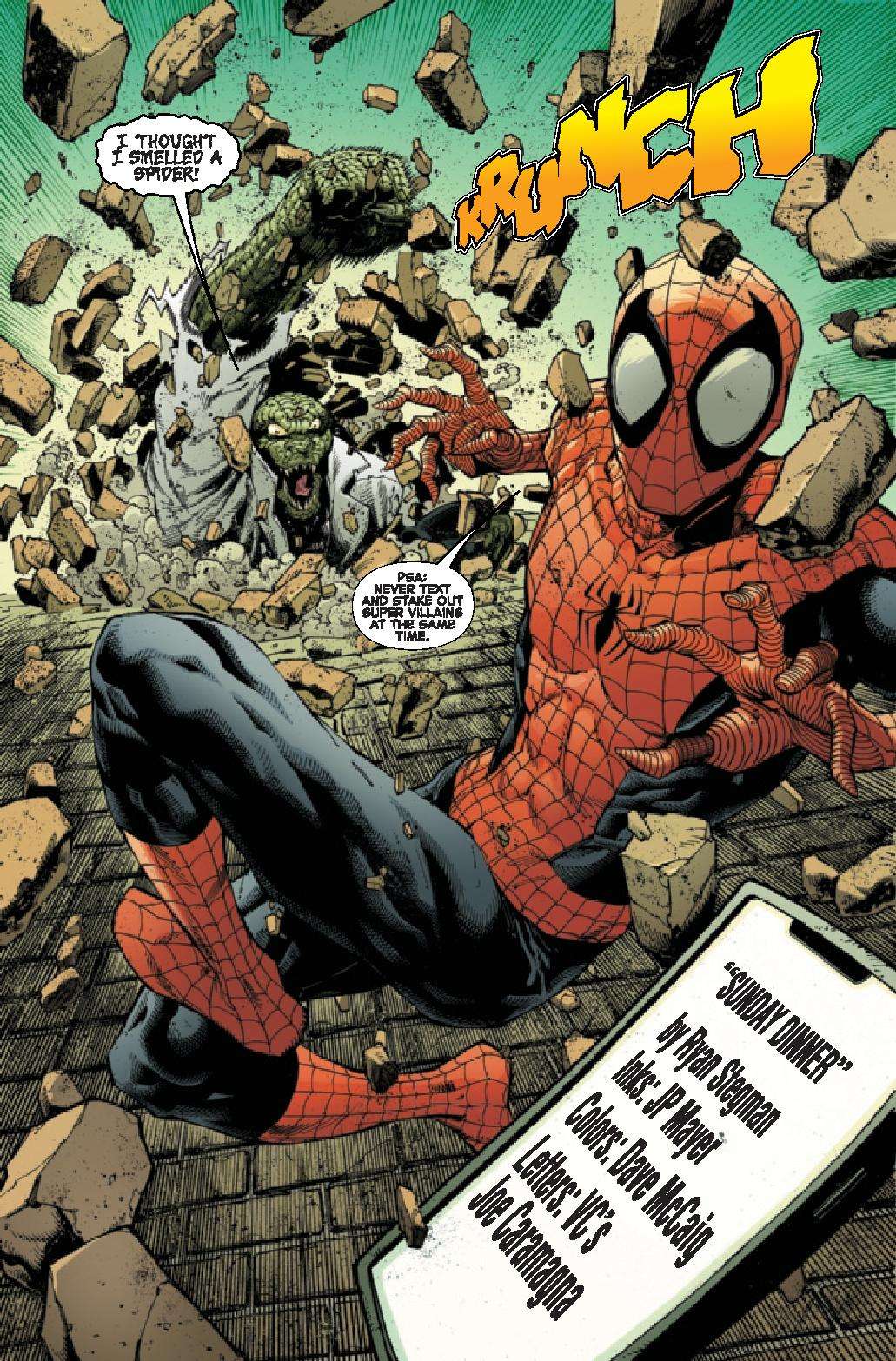
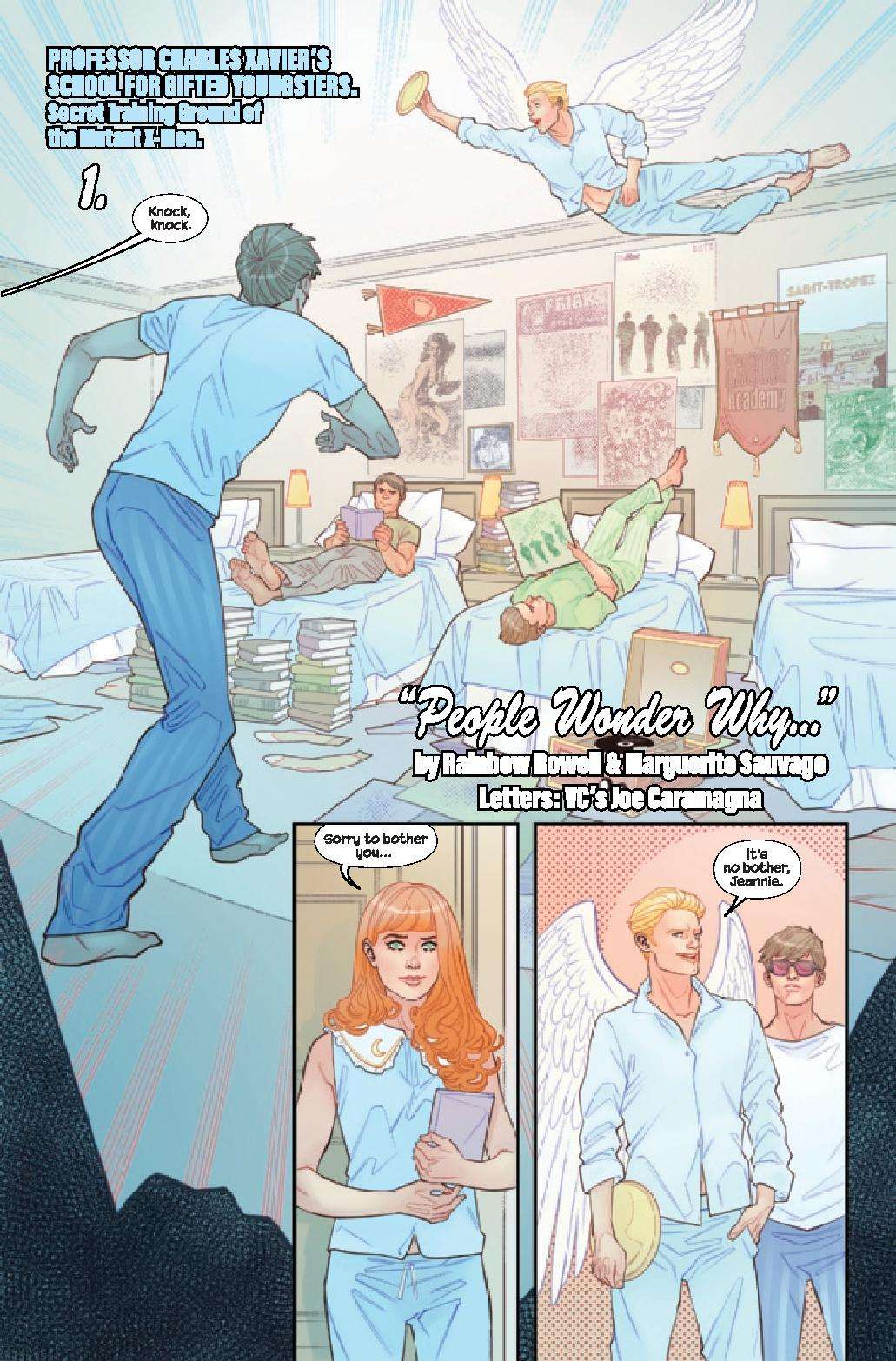
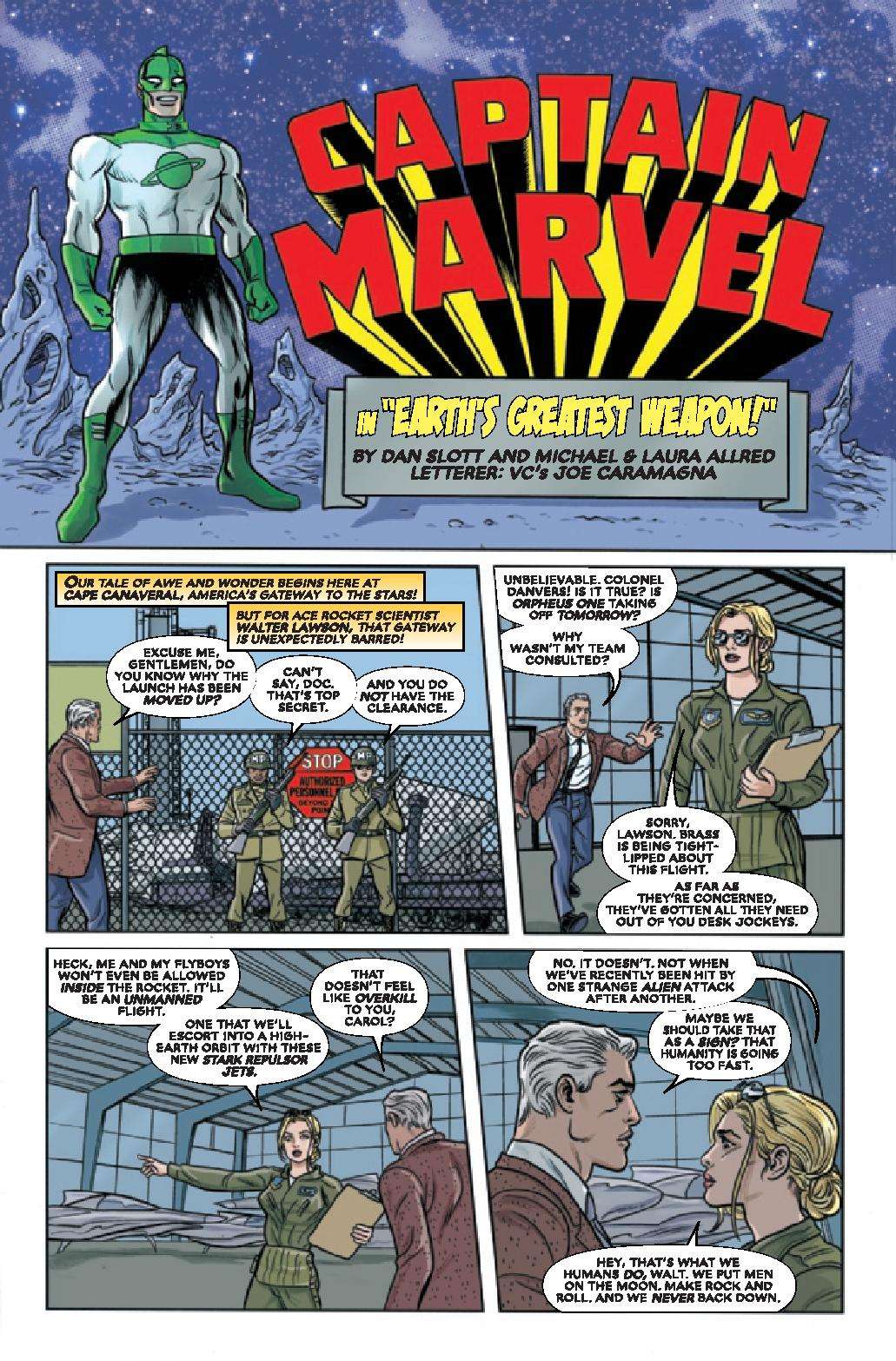
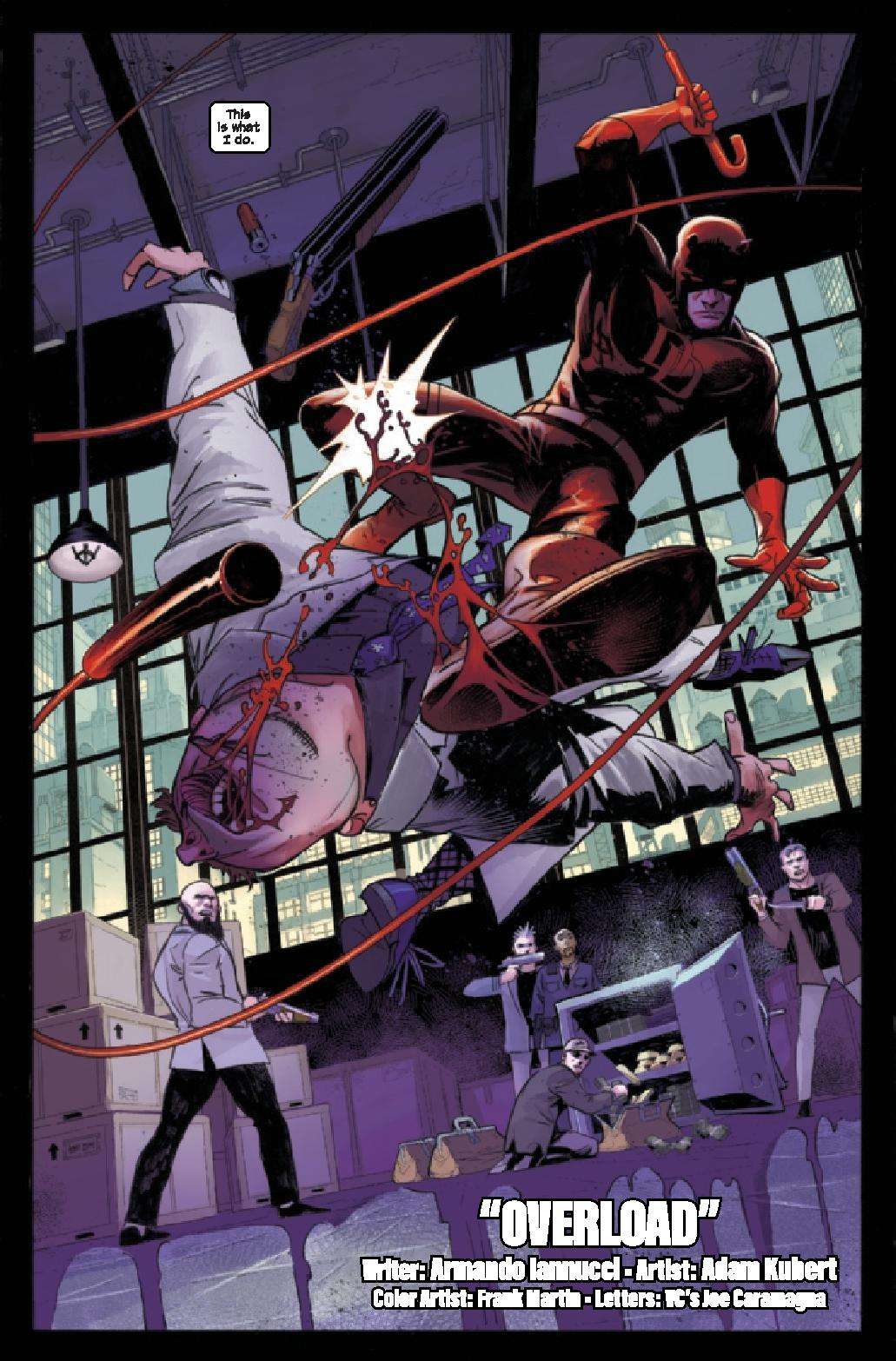
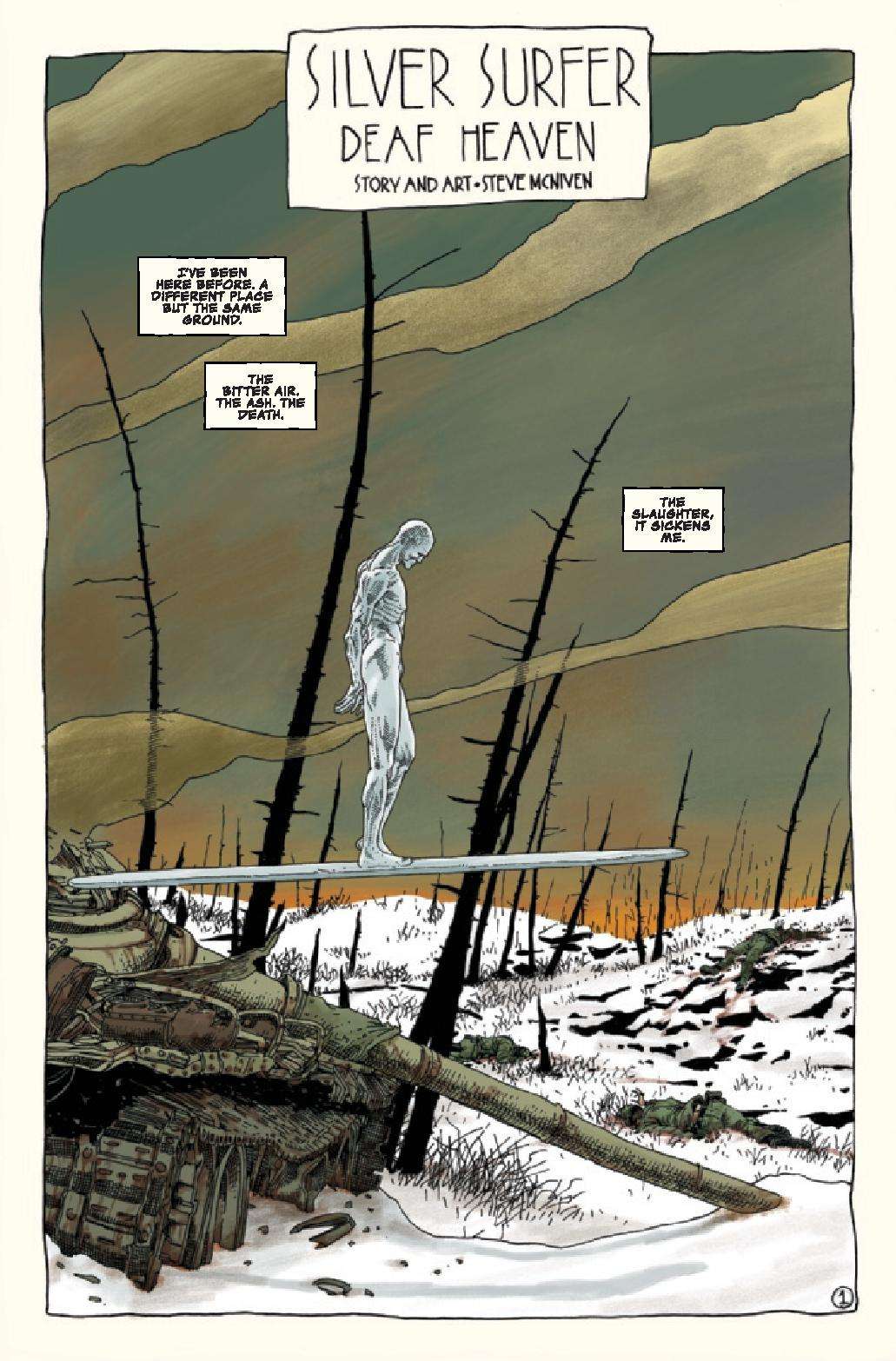
IT’S A CELEBRATION OF THE MARVEL AGE OF COMICS – AND YOU ARE INVITED! This massive commemorative issue includes contributions from some of the most storied creators in Marvel history, as well as a few surprises, as the classic days of Marvel are explored in depth! J. Michael Straczynski and Kaare Andrews create the Marvel Universe in a backyard! Dan Slott and Michael Allred depict a crucial turning point for Captain Marvel! Rainbow Rowell and Jamie McKelvie explore the blossoming relationship between Cyclops and Jean Grey! The original Human Torch finds his purpose thanks to Mark Waid and Alessandro Cappuccio! The Silver Surfer confronts Mephisto under the guidance of Steve McNiven! And more, more, more! Plus: The ultimate Marvel Value Stamp, #1000! Who or what will it feature?